
Why cell phones (batteries) discharge quickly in a cold environment?
Grade 5
Presentation
Hypothesis
Research
Parts of a battery
1. Anode: The negative terminal of the battery Usually made of zinc gel 2. Cathode: The positive terminal of the battery Usually made of manganese dioxide 3. Current Collector: Carries electrons between the anode and cathode 4. Metal Washer: A flat metal disk that is part of the current collector 5. Separator: Prevents direct contact between the anode and cathode Permits the flow of ions during chemical reactions 6. Steel Can: The outer casing of the battery Acts as the negative terminal 7. Label: Displays information about the battery and the brand 8. Steel-Plated Negative Cover: Covers the negative end of the battery & made of steel 9. Steel-Plated Positive Cover: Covers the positive end of the battery & made of steel 10. Seal: A barrier to contain the electrolyte and seal the battery 11. Metal Spur & Brass Rivet Fasteners holding components together
Types of batteries
Alkaline Batteries: Flashlights, remote controls, toys, clocks Lithium-ion Batteries: Smartphones, laptops, digital cameras, electric vehicles Nickel-Metal Hydride (NiMH) Batteries: Cordless phones, digital cameras, handheld gaming devices Lead-Acid Batteries: Automobiles, uninterruptible power supply (UPS) systems Zinc-Carbon Batteries: Remote controls, basic flashlights, small electronic toys Nickel-Cadmium (NiCd) Batteries: Older cordless phones, power tools Lithium Polymer (LiPo) Batteries: RC vehicles, drones, portable electronic gadgets Silver Oxide Batteries: Watches, hearing aids, calculators Zinc-Air Batteries: Hearing aids, some medical implants
Rechargeable vs. Disposable Batteries:
Rechargeable Batteries: Better for the environment and usually more $$$ Disposable Batteries: Easier to make and usually less $$$$
Fun Facts
1# Did you know??? Batteries can act a bit like us when it's very cold outside. Imagine you're in a cold Alberta winter. It's hard for you to move quickly, right? Well, my research discovered that batteries may feel the same way in the cold. When it gets chilly, the chemical reactions inside the battery can slow way down.
2# Did you know??? Did you ever feel super hot on a really sunny day? Well, batteries can feel the heat too! When it's super hot outside, the chemicals inside the battery get all jumpy and excited. It's like they're having a party! My research discovered that too much heat isn't great for batteries - like when we get tired after playing.
Variables
Dependent Variable: Measured Voltage
Independent Variable: Time
Controlled Variable: Temperature
Procedure
This is the procedure I followed during my expirement:
Experimental Procedure: Experiment #1 – Room Temperature 1. Place the two AA batteries in the battery holder. Couple the battery holder to wires with alligator clips. Nest one plastic baggie inside another to insure that the bags are leak-proof. Put the battery pack into the interior plastic baggie with the wires coming out the top of the bag. Close the bag with elastic bands. 2. Couple the other end of the wires to the fan (or other battery powered device). 3. Turn the fan on and set a timer. 4. Check to see that the fan is still on at least every 10-15 minutes. 5. Note the time when the batteries run out and the fan stops. Experiment #2 – Freezing (0°C) 1. Repeat step #1 as outlined above. 2. Fill the cooler with ice. Put the plastic bag containing the battery pack into the ice. 3. Repeat step #2 as outlined above. 4. Affter waiting 15 minutes for the temperatures of the batteries to equilibrate with the ice performs steps #3 - #5. Experiment #3 (-78°C) 1. Repeat step #1 as outlined in Experiment #1 above 2. Wearing gloves, fill the ice bucket with ice. If necessary, break the dry ice into pieces with a hammer. Put the plastic bag containing the battery pack into the dry ice. 3. Repeat step #2 as outlined above in Experiment #1. 4. After waiting 15 minutes for the temperatures of the batteries to equilibrate with the dry ice, perform steps #3 - #5 in Experiment #1.
Materials: Small battery-powered fan powered by two AA alkaline batteries in a detachable battery pack. Other small battery-powered devices may be used as long as the batteries are housed separately from the device. Two AA alkaline batteries (any brand)* Cooler Dry ice Regular ice Zip-lock plastic bags Jumper cable with alligator clips Cell phone to use as a timer
Observations
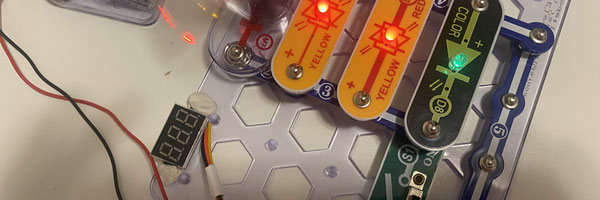
The fan and LED lights stopped working sooner when the batteries were in the coldest temperature. The voltage value dropped faster with the batteries in the dry ice compared to the normal ice or room temperature.
Analysis
I collected the data in a spreadsheet and created a graph comparing battery voltage drop over time. It showed that the voltage dropped faster at colder temperatures than at warmer temperatures.
More Future Testing!
Test batteries in warmer and hotter temperatures. Repeat the experiment with other types of batteries like Lithium-Ion or Lead-Acid batteries. Repeat experiment with re- chargeable batteries and see if they can re-charge after being very cold. Repeat the experiment with larger batteries. Repeat the experiment with larger circuit loads. Repeat the experiment and measure current too.
Conclusion
Alkaline batteries do not work well in very cold temperatures. Alkaline batteries discharge faster in colder temperatures. Alkaline batteries work ok in slightly cold temperatures. Alkaline batteries work better in room temperatures.
Application
REAL WORLD IMPORTANCE
Batteries need to be charged before entering cold temperature zones. Try to keep batteries warm in cold temperatures. More people are buying electric cars like Teslas and they need batteries that work (if the batteries discharge the car won’t start or work) People use cell phones and radios to call for help and need these to work especially when they are in the mountains and cold areas. Flashlights used outside need to work for long times.
Sources Of Error
Sources of error can be:
Inaccurate volt meter.
Consistency in new battery power / charge.
Temperature changes when the ice melts.
Citations
References for resarch: Books Schlesinger, Henry. The Battery: How Portable Power Sparked a Technological Revolution. Smithsonian (2010) Websites Education.com: Experimental Procedure https://www.education.com/science-fair/article/effect-temperature-battery-life/ Energizer.com: Batteries 101 – How Batteries Work http://www.energizer.com/learning-center/Pages/how-batteries-work.aspx How Stuff Works: How Batteries Work http://www.howstuffworks.com/battery.htm About.chemistry.com: Factors that Affect the Chemical Reaction Rate Reaction Kinetics http://chemistry.about.com/od/stoichiometry/a/reactionrate.htm
Acknowledgement
I acknowledge the support of Ms. Stark and my Dad (Mr. Pilecki) in assisting and guiding me.