
The Impacts of Storage on Vitamin C Levels in Oranges
Brielle Hamilton, Mofoluwasewa Adekanmbi
STEM Innovation Academy High School
Grade 11
Presentation
No video provided
Hypothesis
Oranges stored in cold and dark places (such as the fridge/freezer) will preserve more vitamin C compared to warm environments (like the counter) because low temperatures tend to slow down or interrupt natural processes, thereby preventing the natural release of vitamin C over time.
Research
Background Research
University of Canterbury – Determination of vitamin C Concentration by Titration
- This article details how to determine the vitamin C concentration of a solution using titration in steps similar to ours.
Allrecipes – How to store oranges and keep them fresh longer
- According to this article\, oranges last for about a week on the counter\, which informed our decision to make the testing period a week long and keep them unwashed. We had concerns that an orange placed in the freezer may expand upon being frozen and explode\, so we are pending a mini-experiment with a household orange to test if this is the case.
Chosen storage methods: Counter, fridge, freezer, and closed cabinet
NOTE: The aforementioned orange did NOT explode!
The Role of Vitamin C in Human Health
Importance of Vitamin C:
- Antioxidant: helps to prevent damage to cells
- Needed to create collagen
- Collagen: a strong but flexible protein, which is in skin, bones, cartilage and is needed to help wounds heal
- Improves iron absorption
- Helps immune system work
- MAY help lower your risk for some cancers
- In severe cases too little vitamin C causes scurvy
- Scurvy Symptoms:
- Weakened connective tissues
- Petechiae (red dots on skin)
- Joint pain
- Poor wound healing
- Hyperkeratosis (thickening of the skin)
- Corkscrew hairs
- Death
- Scurvy Symptoms:
Titration Background Information
In a titration, stoichiometry is used to determine the amount of a certain reactant. Reactions occur in a ratio known as the molar ratio. In quantitative reactions, the molar ratio is used to determine the amount of moles of a reactant to determine the amount of another chemical agent. The quantity of reactant A necessary to complete a reaction with reactant B correlates with the number of moles of reactant A necessary for this reaction. Both reactants have their volume known, but the concentration of reactant B is unknown. Then, using the balanced reaction to derive the molar ratio, calculate the amount of moles of reactant B and, using the volume, the concentration. For this to work, the moment when the reaction is complete (no reactant B left) must be known. By adding an indicator that will either indicate a change in pH or began reacting with reactant A after reactant B is gone creating a compound with a visible colour this moment can be identified.
In our experiment, we used soluble starch as an indicator and iodine as a titrant (reactant A). The iodine began to react with the starch after all the vitamin C was consumed creating a compound that was purplish-blue and looked green in orange juice. Sadly, we were not able to know the concentration of iodine, so we were unable to calculate the concentration of the vitamin C. However, the amount of iodine used would correlate to the amount of vitamin C so we could still compare the differences.
Variables
Manipulated Variable: Storage method
Responding Variable: Amount of titrant needed to change the colour (correlates to the amount of vitamin C)
Control Variables: Concentration of iodine, amount of orange juice used, amount of indicator (starch solution), colour following titration, amount of time oranges were stored for, amount of oranges per storage technique
Procedure
Four storage methods: in freezer, on counter, in dark cabinet, in fridge
- Get two oranges stored with the same method
- Juice both oranges together, straining and mixing the juice.
- Gather orange juice in a clean 25ml graduated cylinder.
- Move orange juice into clean Erlenmeyer flask
- Fill the burette with iodine solution (?M)
- Clamp the burette to the burette stand
- Let the iodine solution through the (twisty thing) to clean it out
- Add 0.5mL the titrant to the orange juice whiles gently swirling the flask
- Add 3 drops of the starch solution to the orange juice
- Continue to add titrant until the colour of the juice changes to a murky greenish colour
- Record volume of iodine used in spread sheet
- Dispose and clean the Erlenmeyer flask
- Repeat steps 3-12 for the 2 other titrations
- Repeat whole experiment for each storage method
Observations
Qualitative
- Dark: Added iodine before on other titrations = brown / added dark titration 1 = green for a short moment
- Titration 1 for freezer = white bubbles / froth oozing out when squeezing orange
- Juice squirting out sides when orange squeezed for freezer orange / skin is permeable
- Titration 1 for freezer = after adding iodine the mixing a little, added starch and drop point turned blue for short moment
- Titration 1 for freezer = less pulp / structurally weak
- DID NOT DRY / CLEAN FLASK AFTER EVERY TRIAL FOR SAKE OF TIME
- Titration 2 for freezer = after adding iodine the mixing a little, added starch and drop point turned blue for short moment
- Beaker rinsed out after every titration trial
- Granulated cylinder rinsed out after every storage trial
Quantitative
Counter
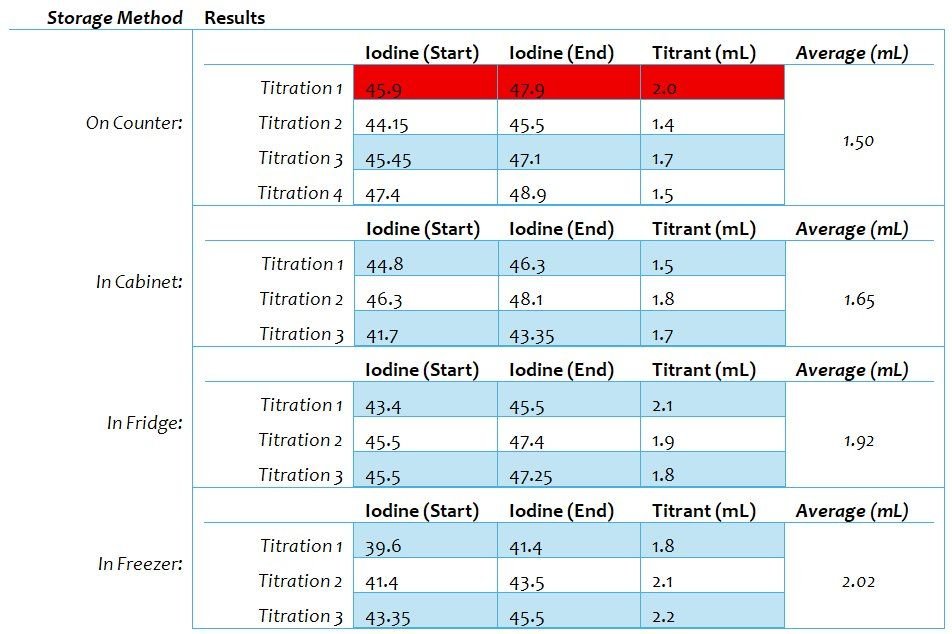
| Iodine (Start) | Iodine (End) | Titrant (mL) | Average (mL) | |
|---|---|---|---|---|
| Titration 1 | 45.9 | 47.9 | 2.0 | 1.50 |
| Titration 2 | 44.15 | 45.5 | 1.4 | |
| Titration 3 | 45.45 | 47.1 | 1.7 | |
| Titration 4 | 47.4 | 48.9 | 1.5 |
Cabinet
| Iodine (Start) | Iodine (End) | Titrant (mL) | Average (mL) | |
|---|---|---|---|---|
| Titration 1 | 44.8 | 46.3 | 1.5 | |
| Titration 2 | 46.3 | 48.1 | 1.8 | 1.65 |
| Titration 3 | 41.7 | 43.35 | 1.7 |
Fridge
| Iodine (Start) | Iodine (End) | Titrant (mL) | Average (mL) | |
|---|---|---|---|---|
| Titration 1 | 43.4 | 45.5 | 2.1 | |
| Titration 2 | 45.5 | 47.4 | 1.9 | 1.92 |
| Titration 3 | 45.5 | 47.25 | 1.8 |
Freezer
| Iodine (Start) | Iodine (End) | Titrant (mL) | Average (mL) | |
|---|---|---|---|---|
| Titration 1 | 39.6 | 41.4 | 1.8 | 2.02 |
| Titration 2 | 41.4 | 43.5 | 2.1 | |
| Titration 3 | 43.35 | 45.5 | 2.2 |
Analysis
Instability of Vitamin C
Vitamin C is a particularly unstable nutrient. It degrades in the presence of oxygen, light, high temperatures, and higher pH into dehydroascorbic acid. The dehydroascorbic acid further irreversibly reacts with water creating a different compound. The behavior of vitamin C is unpredictable as the effects of certain antioxidants may either increase or decrease the speed at which the vitamin C degrades. Some studies have even shown that some compounds may increase the speed of the conversion of dehydroascorbic acid to ascorbic acid, effectively stabilizing the amount of vitamin c. Oranges are a complex mix of compounds that have unknown effects on the degradation of vitamin C. This means that the actual reaction that occurs during the degradation of vitamin C within an orange is unclear. Since we cannot be certain about the reaction that is occurring and why, the EXACT reasons that removing light and lowering the temperature slow degradation of vitamin C cannot be fully explained. We can, however, claim that the removal of light and lowering of temperature will slow down any reaction. This means that ANY reactions that either increase or decrease the amount of vitamin C will be slowed down, effectively stabilizing the amount of vitamin C within the orange.
Conclusion
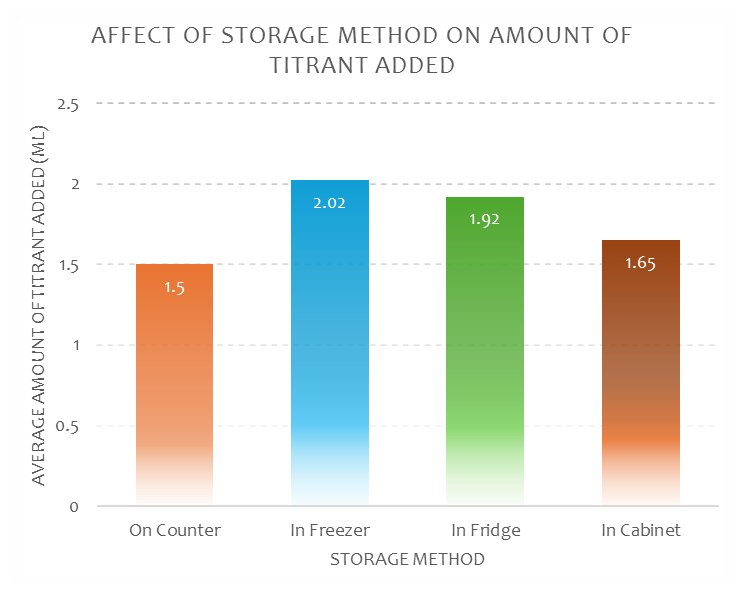
In our results, the oranges that required the greatest amount of titrant were the ones that were frozen, meaning they had the highest vitamin C content. The oranges with the least amount of titrant were the ones stored on the counter, so they had the lowest vitamin C content. The oranges with the second highest amount of titrant/vitamin C were the ones stored in the fridge, followed by the oranges stored in the cabinet.
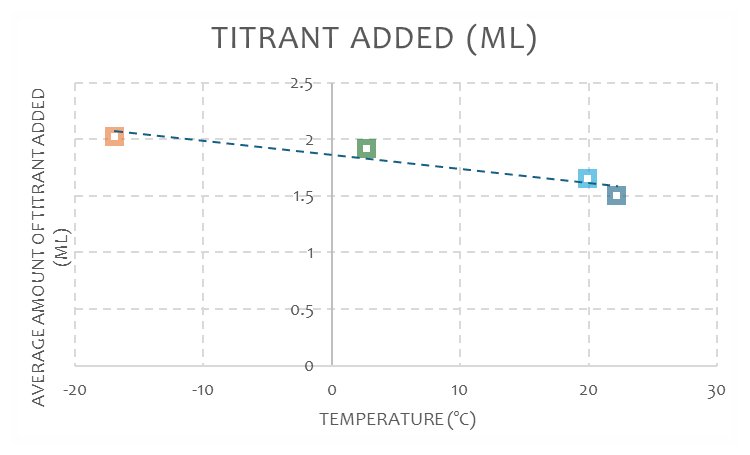
Our hypothesis of the oranges being stored in colder, darker places has been proved correct – on the counter, the oranges received natural sunlight, making it the warmest and brightest environment. These factors – temperature and light – apparently had an impact on the vitamin C concentration in each orange. The most effective storage method in preserving vitamin C in oranges was the freezer. Our experiment concludes that storing your oranges in the fridge not only maintains their taste but also their nutrients levels.
Application
In researching more effective ways to store our food, we take meaningful steps in the issue of world hunger. Learning better methods for preserving the nutrients in food will aid society in combatting malnutrition. Balancing longer lasting food with higher nutritional content means that less food will be able to go a long way. Researching oranges is only the first step toward further innovation in the food industry; down the line, our findings may play a role in developing more sustainable strategies for food storage.
On a smaller scale, our research is applicable in a low-risk context as well. Many people may not know that storing their fruit on the counter not only causes it to ripen and spoil faster but also degrades the amount of nutrition within it. Temperature and lighting conditions have a direct impact on the nutritional content of vitamin C in oranges. Applying this straightforward knowledge in how we do something as simple as storing groceries may also contribute to a more sustainable food future.
Sources Of Error
Sources of Error
- The data from the first titration for counter-stored oranges is an outlier
- Amount of starch solution added sometimes changed due to human error
- Concentration of iodine solution was unknown
- Although there was supposed to be a control orange, our control orange was compromised and was no longer a valid control. Could not get a new orange for control for the sake of time
- In transporting the oranges from their testing environments to the lab, changes in temperature/light during the journey may have altered the results
- We did the experiment during the winter so there naturally less light for the orange stored on the counter
Areas For Improvement:
- Obtaining iodine that we knew the concentration of would have allowed us to calculate the exact concentration of vitamin C in each orange, giving us more accurate results than only comparing the amount of titrant used
- Storing the oranges in the lab—rather than keeping the oranges at home and then transporting them to the lab—would have limited unwanted variables and made the data more accurate
- Having a control would have provided a frame of reference for the rest of the results
Citations
"Determination of Vitamin C Concentration by Titration." University of Canterbury. canterbury.ac.nz/content/dam/uoc-main-site/documents/pdfs/d-other/Determination-of-Vitamin-C-Concentration-by-Titration.pdf. Accessed 21. Jan 2026.
Williams, Corey. "How to Store Oranges to Keep Them Fresh For Longer." All Recipes, 3 Jan. 2022, www.allrecipes.com/article/how-to-store-oranges/.
"Vitamin C - Consumer." NIH Office of Dietary Supplements, 22 Mar. 2021, ods.od.nih.gov/factsheets/VitaminC-Consumer/.
"Vitamin C - Health Professionals." NIH Office of Dietary Supplements, 31 Jul. 2025, https://ods.od.nih.gov/factsheets/VitaminC-HealthProfessional/.
Becker, Bryan R., et al. "Transpiration and Respiration of Fruits and Vegetables." b.web.umkc.edu/beckerb/publications/chapters/trans_resp.pdf. Accessed 21. Jan 2026.
Lall, Ashley. "How Does the Nutritional Value of Fruits and Vegetables Change Over Time?" Lose It, 14 Aug. 2025, www.loseit.com/articles/how-do-fruits-and-vegetables-lose-their-nutrients-after-picking/. Yin, Xin et al. "Chemical Stability of Ascorbic Acid Integrated Into Commercial Products: A Review on Bioactivity and Delivery Technology." PubMed Central, 13 Jan. 2022, pmc.ncbi.nlm.nih.gov/articles/PMC8773188/#notes3.
Acknowledgement
We would like to acknowledge:
Ms. O'Keefe, who was our teacher for Science Fair and a great support.
Ms. Hernandez, the lab technician at STEMIA High School, for providing materials and guidance.
Temi Agunbiade, a fellow student who helped us during our experiment and ensured we finished on time.
Brielle's parents, Mr. Hamilton and Ms. Furtado, who paid for the oranges.