
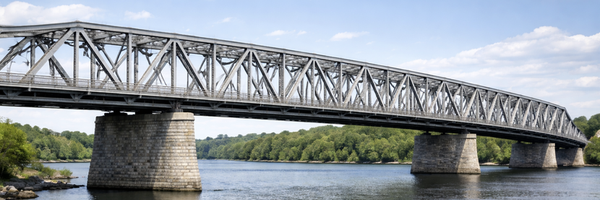
Which Bridge Structure Can Handle The Most Weight
Mohammad Farhan
Glamorgan School
Grade 7
Presentation
No video provided
Hypothesis
If different bridge structures are built using the same materials and size, then the beam bridge will be the strongest because its straight design looks more solid and stable than the others.
Research
For this project, I researched different bridge structures using Science Buddies. I learned that beam bridges are simple but bend easily underweight, arch bridges are stronger because they push force into the supports, and truss bridges are the strongest because their triangular shapes distribute weight evenly. This research helped me understand why some bridge designs can hold more weight than others.
Variables
Variables
- Independent Variable (what you change): The type of bridge (beam, arch, or truss).
-
Dependent Variable (what you measure): The maximum weight the bridge can hold before bending or breaking.
- Controlled Variables (what you keep the same):
- Number of popsicle sticks used
- Type of glue
- Bridge length and width
- Drying time
- Placement of weight
Procedure
- Build three bridges using popsicle sticks: a beam bridge, an arch bridge, and a truss bridge.
- Use the same number of popsicle sticks and the same type of glue for each bridge.
- Allow all bridges to dry for the same amount of time.
- Place the first bridge across two equal stacks of books.
- Add weights to the bridge one at a time.
- Stop adding weight when the bridge bends badly.
- Record the total weight the bridge held.
- Repeat the test three times for each bridge.
- Calculate the average weight held by each bridge and record on a piece of paper.
Observations
- The beam bridge started bending in the middle as soon as a small amount of weight was added and bent quickly.
- The arch bridge stayed stable longer, but the ends began to spread slightly before it failed.
- The truss bridge held the most weight and showed very little bending.
Analysis
The experiment showed that each bridge type performed differently under weight. The beam bridge bent quickly and held the least weight because its straight design does not distribute force well. The arch bridge held more weight because it transferred the force outward to the supports, but it still failed sooner than the truss bridge. The truss bridge was the strongest, holding the most weight.
Conclusion
In this experiment, the truss bridge was the strongest bridge structure because it held the most weight before breaking. This does not support my hypothesis as it said that using a straight beam structure helps distribute weight evenly and reduces bending. The beam bridge bent easily under pressure, and the arch bridge was strong but did not hold as much weight as the truss bridge. Overall, the results proved that truss bridges are the strongest when built using the same materials.
Application
This project helps us understand why certain bridge designs are stronger than others. Engineers use this knowledge when building real bridges for roads, railways, and pedestrian walkways. Knowing that truss bridges are strong and efficient can help save materials and keep people safe. This experiment also shows how triangles and other shapes can be used in construction to support weight, which can be applied to buildings, towers, and other structures.
Sources Of Error
Some possible sources of error in this experiment include:
- Popsicle sticks may not have been perfectly straight, affecting bridge strength.
- Glue might not have dried evenly, causing weak spots.
- Weight may not have been added exactly in the center of the bridge every time.
- Differences in how tightly sticks were glued or layered could change results.
- Human error in counting or measuring the weights.
Citations
- Science Buddies. Bridge Design and Engineering Basics. Retrieved from https://www.sciencebuddies.org
- Science Kids. Building Strong Bridges. Retrieved from https://www.sciencekids.co.nz/projects/strongbridges.html
- Engineering for Kids. Types of Bridges. Retrieved from https://www.engineeringforkids.com
Acknowledgement
I would like to thank my teacher for guidance and support throughout this project. I also thank my family for helping me gather materials and test the bridges. Lastly, I used Science Buddies as a resource to learn about different bridge structures and how they work.