
Why FTL Travel is (Likely) Impossible under Modern Physics
Miles Anderson
Master's College
Grade 11
Presentation
No video provided
Problem
Since the inception of man, we have looked to search the stars. However, the vast distance between solar systems makes it nigh impossible. Physicists and engineers work hand-in-hand to create technology to assist us in traversing the great expanse of space. The pinnacle of which, being the ability to accelerate past the speed of light. While no FTL technologies have been created, there are multiple, theoretical modes of transportation that would allow an individual to travel between two points faster than a photon.
However, under our modern understanding of relativistic physics and chronology, many of these physical models remain impossible because of the universal speed limit, causal restrictions and negative energy-densities. This paper will address the Alcubierre Metric, and Einstein-Rosen bridge as two such FTL methods and systematically demonstrate the issues present in them.
Method
Analysis of Fundamental Restrictions & Effects
- The Universal Speed Limit
- Time Dilation
Theoretical FTL Systems
-
Alcubierre Warp Drive - Based on Miguel Alcubierre’s Work
-
A deconstruction of the Alcubierre Metric and its application in theoretical traversal techniques, as well as the issues surrounding radiation buildup and release
-
Wormholes - Based on the Einstein-Rosen Bridge
-
The evolution of the Einstein-Rosen Bridge and its potential use, as well as its inherent need for exotic matter to prevent the formation of singularities.
General Causal Issues
- Minkowski Diagrams
- A Theoretical Scenario
Negative Energy Density
- Exotic Matter
- Quantum Fluctuation
Research
Universal Speed Limit
The primary restriction when exploring faster-than-light travel, is any object's inability to reach such speeds. In order to accelerate an object past a velocity of 299 792 458 m/s, an infinite amount of energy is required. Under the relativistic kinetic energy formula, K_rel = ((γ − 1)mc^2), a complex number of joules is necessary for such a speed. γ, also known as the Lorentz Factor, is a dimensionless quantity that calculates how much time, length and relativistic mass change an object experiences while moving at high speeds (Singh, 2023). Within the K_rel formula, the Lorentz Function accounts for the increase in an object's relativistic mass as it approaches the speed of light. Inputting a velocity that is greater than c into γ, the resulting equation includes a negative square root, thereby resulting in an imaginary number. Thus, an object requires a complex number of joules to accelerate past the speed of light, making it physically impossible. Now, it is important to establish that the spacetime continuum is not subject to such laws.
Time Dilation
The other fundamental concept that must be cemented to understand this paper is the concept of time dilation.
This phenomena results in an object’s perceived time slowing down, from the perspective of an external observer, as its velocity approaches c. This is denoted by: t = t_0/γ, with t being the object’s time, and t0 being the time at an external inertial reference frame.
Alcubierre Warp Drive
The Alcubierre Warp Drive is a theoretical FTL system based upon Miguel Alcubierre’s Alcubierre Metric (Alcubierre, 1994). It relies on the idea that, by expanding the volume of spacetime behind an object, and contracting it in front, the pressure differential can ‘slingshot’ both the object and the space surrounding it forwards at immense speeds. This proverbial slingshot accelerates the space surrounding an object, as opposed to the object itself, thus circumventing the K_rel paradox. This is accomplished through the Alcubierre Metric: “𝑑𝑠^2 = −𝑐^2𝑑𝑡^2 + [𝑑𝑥 − 𝑣_s(𝑡)𝑓(𝑟_s)𝑑𝑡]^2 + 𝑑𝑦^2 + 𝑑𝑧^2” (Alcubierre, 1994). This formula can be broken down into multiple variables:
-
ds^2 represents the space time interval between two events, or the invariant distance between two events. It can reside in three states:
-
A positive value → Spacelike
- A negative value → Timelike
-
A value of zero → Lightlike
-
t, x, y and z represent the 4 dimensions of spacetime (3 spatial dimensions and 1 time dimension)
- v_s(t) models the coordinate velocity of the warp bubble along an x-axis. Because this is representative of an area of spacetime, this velocity can exceed the speed of light.
- y and z are set to 0 so that the warping of spacetime is only measured in 1 axis (for simplicity sake)
- 𝑓(𝑟_s) is a modulation function that satisfies front compression and back contraction of spacetime
- Fig 1.

- This equation models the shape of the distortion bubble in the numerator, and the unaffected region in the denominator
- The hyperbolic tangents present in the function create a two-dimensional top hat shape that models the topology of the bubble
- This function can be broken down into multiple parts:
- rs defines the distance from the space craft in which the distortion bubble starts
- R defines the bubble’s size
- σ is inversely proportional to the wall thickness of the distortion bubble
- Fig 1.
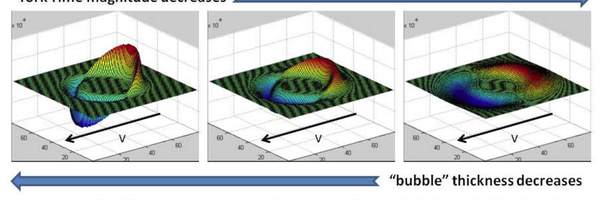
When the Alcubierre Metric is satisfied with selected values for all of these variables, a distortion bubble is created. Fig. 2  Within this diagram, the left-most graph is representative of the lowest σ value, creating a substantially larger warped area in front and behind the bubble, with the right-most graph representing the highest σ value, with no warping around the bubble. The amount of E_k required to warp such an area is similarly inversely proportional to the σ value.
Application & Issues
Miguel Alcubierre proposes that, within the realm of space travel, a traditional propulsion device be used in transit away from earth (or any spacecraft’s starting destination), and subsequently a distortion bubble could be activated to allow for FTL travel. This specific order of events is provided to stop any nearby planets from being incinerated in a gamma-radiation supernova.
This phenomenon is the result of particle accumulation. For an observer inside the bubble, the front wall of the distortion bubble acts as a white-hole horizon while the back functions as a black-hole horizon. Particles from the Interstellar Medium (ISM) - the matter that comprises space between star systems, comprising 70% hydrogen and 28% helium (Ferrière, 2001) - enter the front of the bubble and cannot escape while the drive is active. The number of particles N hitting the front wall over a distance D scales as: Fig. 3 (Where A is the cross-sectional area of the bubble)

Now, when the warp field is deactivated, i.e. vs → 0, the shaping function f(r_s) collapses, and according to the thermodynamic law of the conservation of energy, the accumulated energy must be released. Now, because the accumulated ISM was travelling at v > c, the particles maintain the highest possible mass-weight ratio possible. This results in a high-energy pulse being released upon both initial acceleration and final deceleration, incinerating everything in a surrounding radius. (McMonigal et al., 2006)
The issue that arises from this, aside from the utter annihilation of surrounding life and inorganic matter, is the safety of the spacecraft’s crew. As previously established, because of the extreme spacetime curvature, the bubble functionally acts as an event horizon. As such, it is subject to Hawking Radiation - the thermal radiation emitted passively by black-holes. The temperature of this thermal radiation is directly proportional to the speed of the bubble. Thus, when the ship’s v > c, the radiation's thermal energy nears extremely high levels. One model of such a scenario places the potential thermal radiation at 10^30K, roughly 1,000,000,000,000,000,000,000,000 times hotter than the core of Sol. (Broeck, 1999) At this temperature, the atoms of both the ship and passengers would immediately undergo quark-gluon ionization and be reduced to plasma.
Wormholes
A wormhole is a theoretical topological feature of spacetime that functions as a bridge between two disparate points in space and time. Unlike the Alcubierre drive, which relies on a localized pressure differential to propel a craft through a distorted bubble, a wormhole effectively folds the fabric of spacetime to create a direct connection, or shortcut, between distant coordinates.
The most famous and effective proposal of such an object is that of the Einstein-Rosen Bridge. Originally, this theorem acted to test if the atomistic theory of energy and matter could make use of gravitational field and vector potential variables in calculations. Einstein and Rosen’s original paper begins with a formula for a spherically symmetric mass distribution, used to determine the spacetime curvature of a single, un-rotating, un-charged, In application, this allowed the to predict and prove the existence of black-holes without needing to visually identify them. Fig. 4
 They then proceed to remove the region containing the curvature singularity, resulting in the final equation of: Fig. 5

This resulting equation is a mathematical representation of two, asymptotically flat sheets connected by a Schwarzschild wormhole with a throat, creating an unstable, untraversable, wormhole. (F. Long, 2015) Fig. 6

Application & Issues
The primary issue with the Einstein-Rosen Bridge is the length of the bridge constructed between the two points is mathematically infinite. This was later solved by Morris and Thorne through the incorporation of exotic matter - matter with a negative energy density - to both increase the wormholes stability and provide a two-way traversable tunnel. However, this reliance on exotic matter comes with its own challenges.
Exotic Matter - Negative Energy Density
Both the Alcubierre Drive and Morris-Thorne Wormholes rely on exotic matter. This is the generalized name for theoretical matter that defies conventional laws of physics. In relation to FTL systems, this exotic matter takes the form of matter with a negative energy density.
There can be a localized, negative energy density when:
- Two multi-particle states have the same number of electrons and positions, or
- One state has one more electron-positron pair than the other
The energy itself is a constant positive density, as well as an oscillating positive-negative propagation. However, the local energy density of the superpositions are positive in some reference frames, and negative in others. Because the superposition is always positive, if the particle is being viewed outside of the superposition, its local energy density is negative. (Yu and Shu, 2003)
However, the overall averaged energy density maintains a positive charge even though it oscillates between positive and negative states. This means that it cannot be utilized for FTL travel methods. What it does indicate however, is that, within the realm of quantum physics, negative energy density can exist, meaning we may one day find a way to produce usable exotic matter.
Causal Issues
When examining FTL devices and their validity under our current understanding of physics, one must take a more general look at the issues possibly present. The broadest of which being causal issues. Suffice it to say, FTL travel as a concept cannot exist if it breaks the fundamental order of cause and effect.
A Minkowski diagram is one such way to visualize the order of events in comparison to an inertial reference frame, according to general relativity. The method is simple: one draws a two-dimensional graph with one space axis (on the horizontal plane) and one time axis (on the vertical plane). The point in which both axes meet is the current position and time of the inertial reference frame. An inertial reference frame can be best described as the time and location of the observer by which the conclusion of the order of events will be drawn.
From that point, a straight line can be drawn 45° from the horizontal in both directions, titled c, this is the speed of light. The area above this line is known as timelike region - the spacetime that the observer could experience at slower-than-light (STL) speeds - and the area below the line is known as the spacelike region - the area the observer cannot interact with unless traveling at FTL speeds. Fig. 7
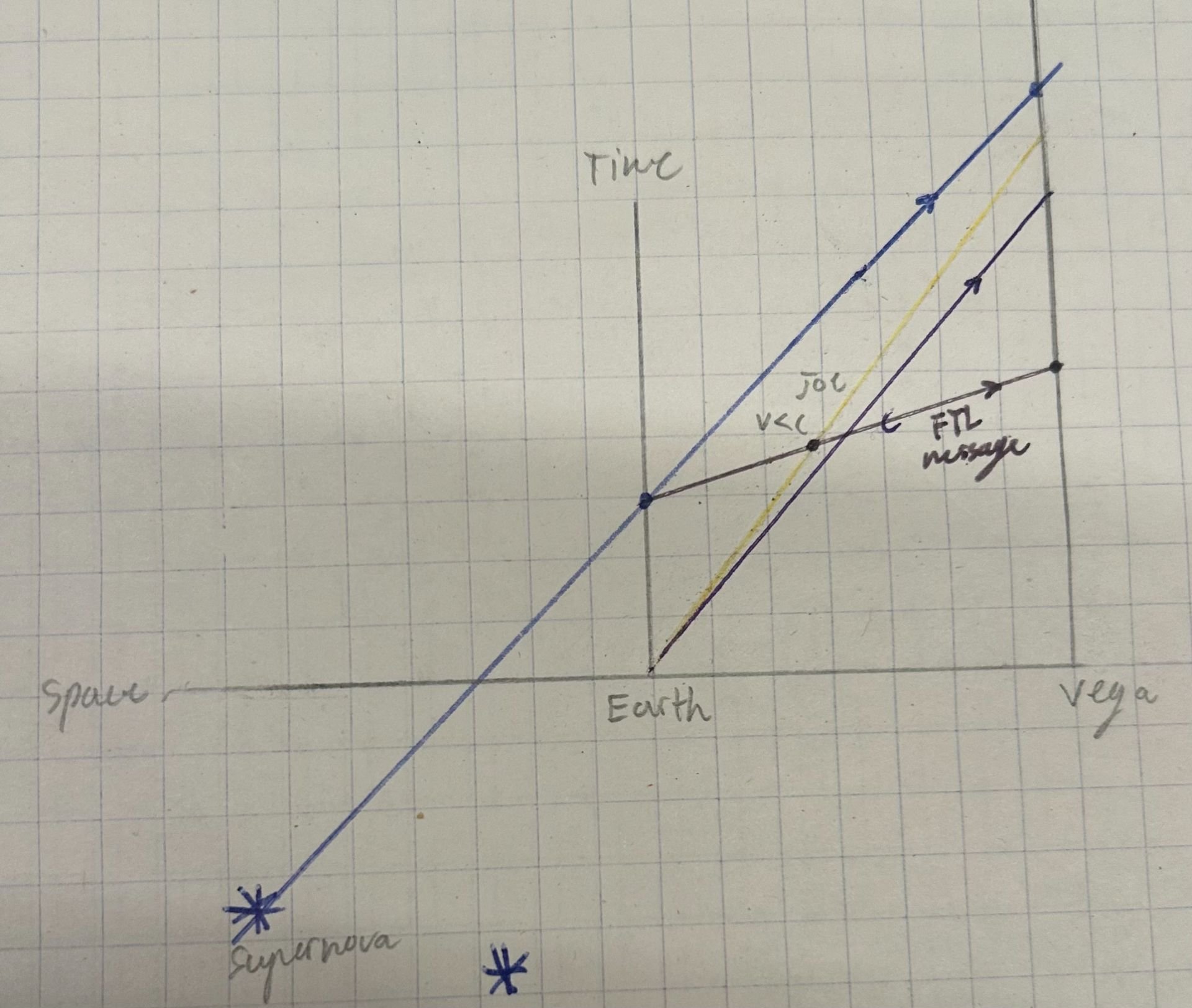
Now, consider an individual, let’s name him Joe for posterity’s sake, attempting to travel from Earth to the stellar body Vega, the largest star in the Lyra constellation, using a non-descript FTL system. To represent Vega, a vertical line is drawn on the space axis, representing the star’s constant position in space at any point in time (for this scenario, Vega is assumed to be stationary in space in comparison to the inertial reference frame, while in reality it is accelerating away from Earth). Now, because Joe’s velocity is greater than the speed of light, the 45° line drawn previously, his angle relative to the horizontal is less than c’s angle. Thus, if he informed the aliens on Vega of his departure using a lightbeam, he would arrive prior to said message. Fig. 8 (insert image here of 1 FTL traveller and a c line going to Vega).
Fg. 8
 In order to determine the order of events, we need to use constant-time lines. They are lines drawn parallel to the c line that demonstrate at what point in time the initial observer would see events occur. Fig. 9
 At this point, if we analyze the order of events they are as follows:
- Joe sends a message and leaves Earth
- Joe arrives at Vega
- Joe’s message arrives at Vega
In this scenario, causal order is maintained, as cause (the sending of the message) occurs before effect (the receiving of the message).
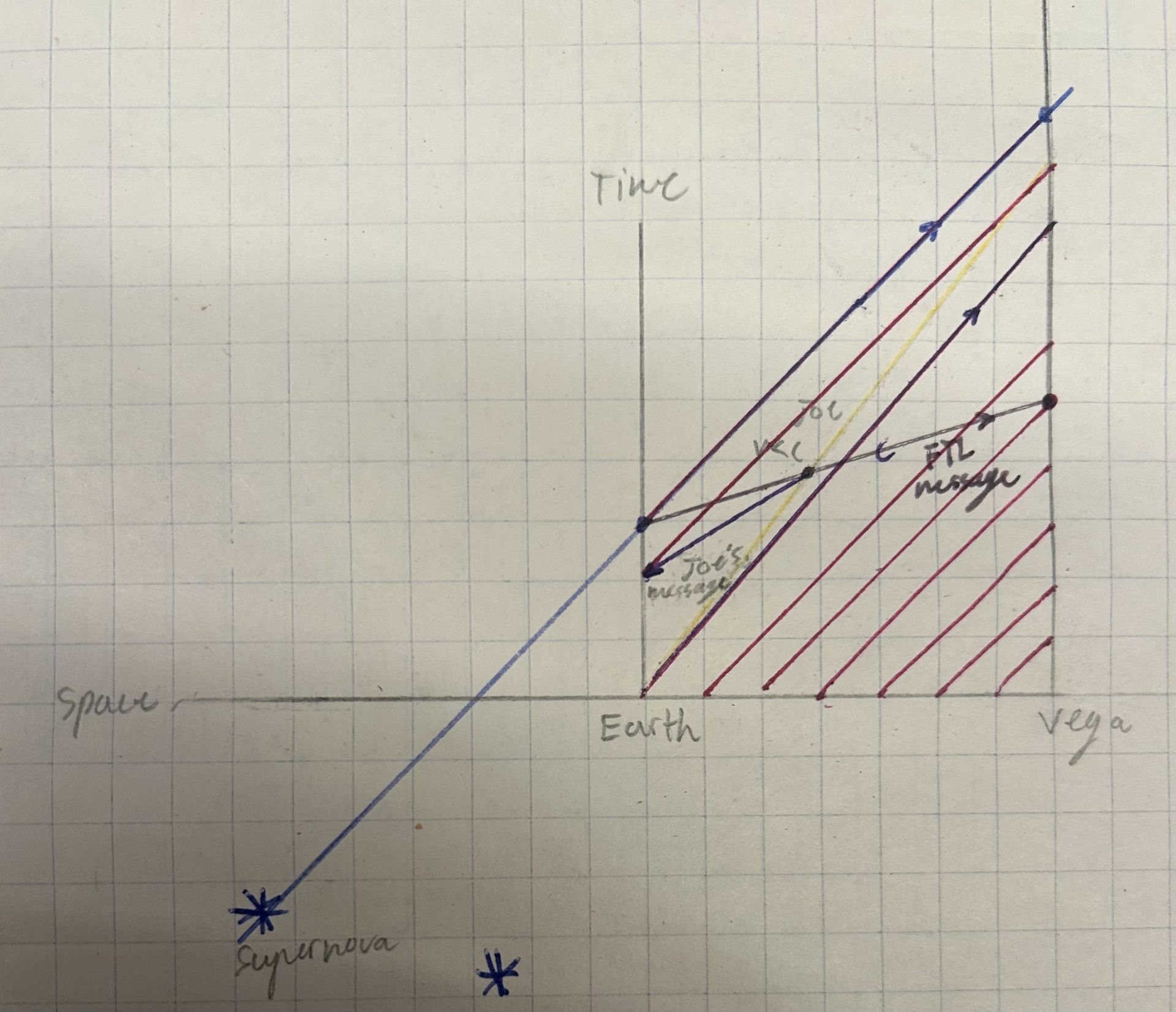
In another scenario, following Joe’s meet and greet with the aliens, an astronomer on Earth views a supernova from the James Webb Telescope and rushes to inform the aliens on Vega of his discovery through his FTL communicator. This can again be represented through a line with a smaller angle than that of the light beam. Simultaneously, Joe has almost run out of FTL fuel, and so he and his crew are traveling back to Earth slower than the speed of light (STL). His velocity is represented by a line with an angle greater than that of c’s angle.
Fig. 10
Using his last bit of exotic matter, Joe sends one last FTL message back to Earth informing them that their message has arrived on Vega.
To the confusion of Earth’s scientists though, they haven’t sent that message yet. Joe has unknowingly circumvented the causal order of events. Let’s analyze this order:
- Joe intercepts Earth’s message and FTL communicates back that it has arrived
- Earth receives the message about their message
- Earth sees the supernova
- Earth sends an FTL message to Vega about the supernova
Fig. 12
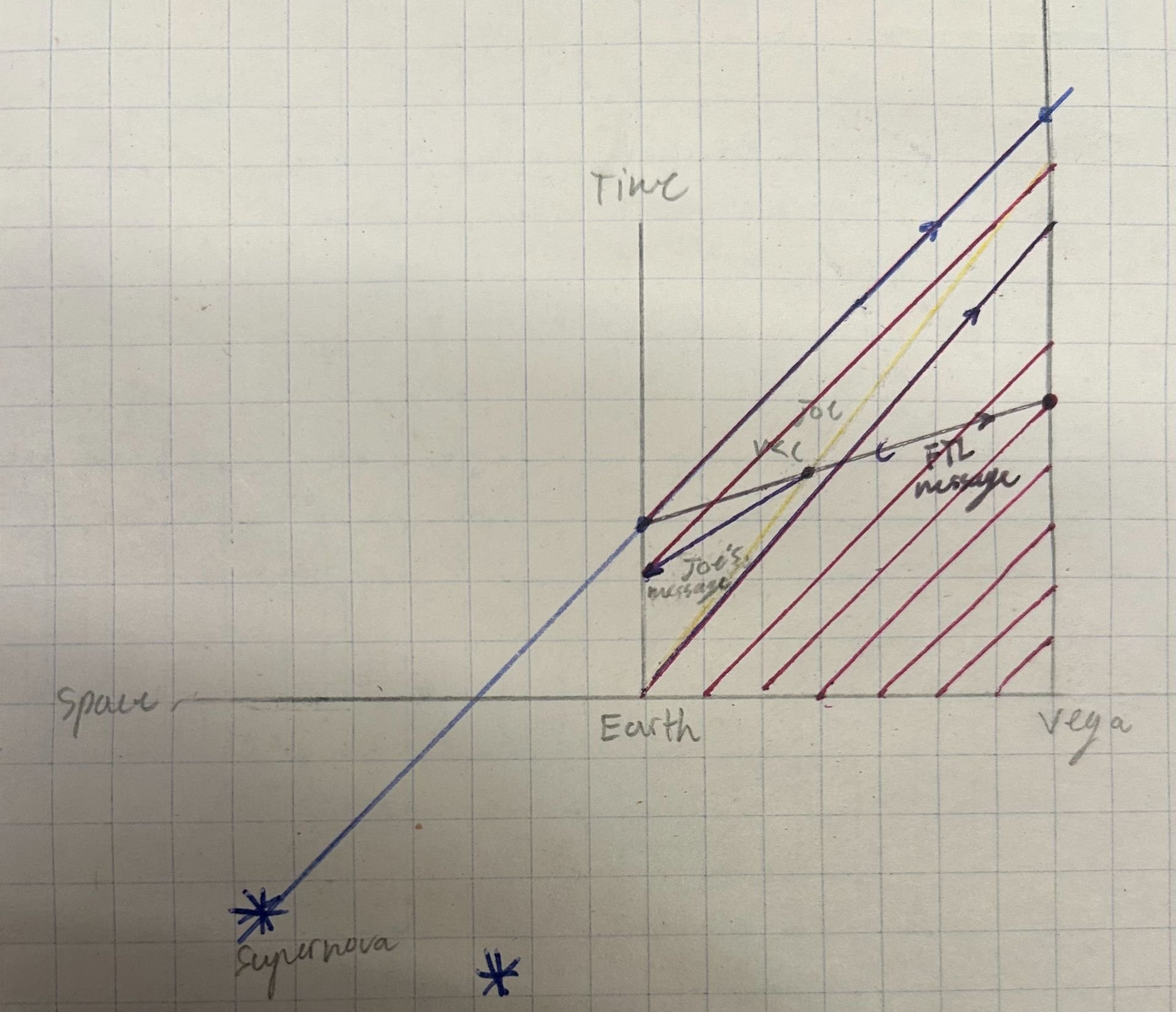
As seen in the above diagram, Joe’s FTL message appears to move backwards in the time axis. This is the result of scissoring. This effect occurs under special relativity because, as previously established, the speed of light is a constant value, and in a Minkowski chart, it is the quotient of the space and time axis (v = d / Δt). Thus, any time an object is moving comparative to the inertial reference frame (the point of origin), their axes are compressed to accommodate for the inherent speed of the observer. This results in scissoring; the FTL message contains a negative velocity in the time axis, causing a disruption in the order of events. This leads to paradoxes that compromise the causal order of events, collapsing our model universe.
Data
Fig. 1
Fig. 2
Fig. 3
Fig. 4
Fig. 5
Fig. 6
Fig. 7
Fig. 8**Fig. 9****
Fig. 10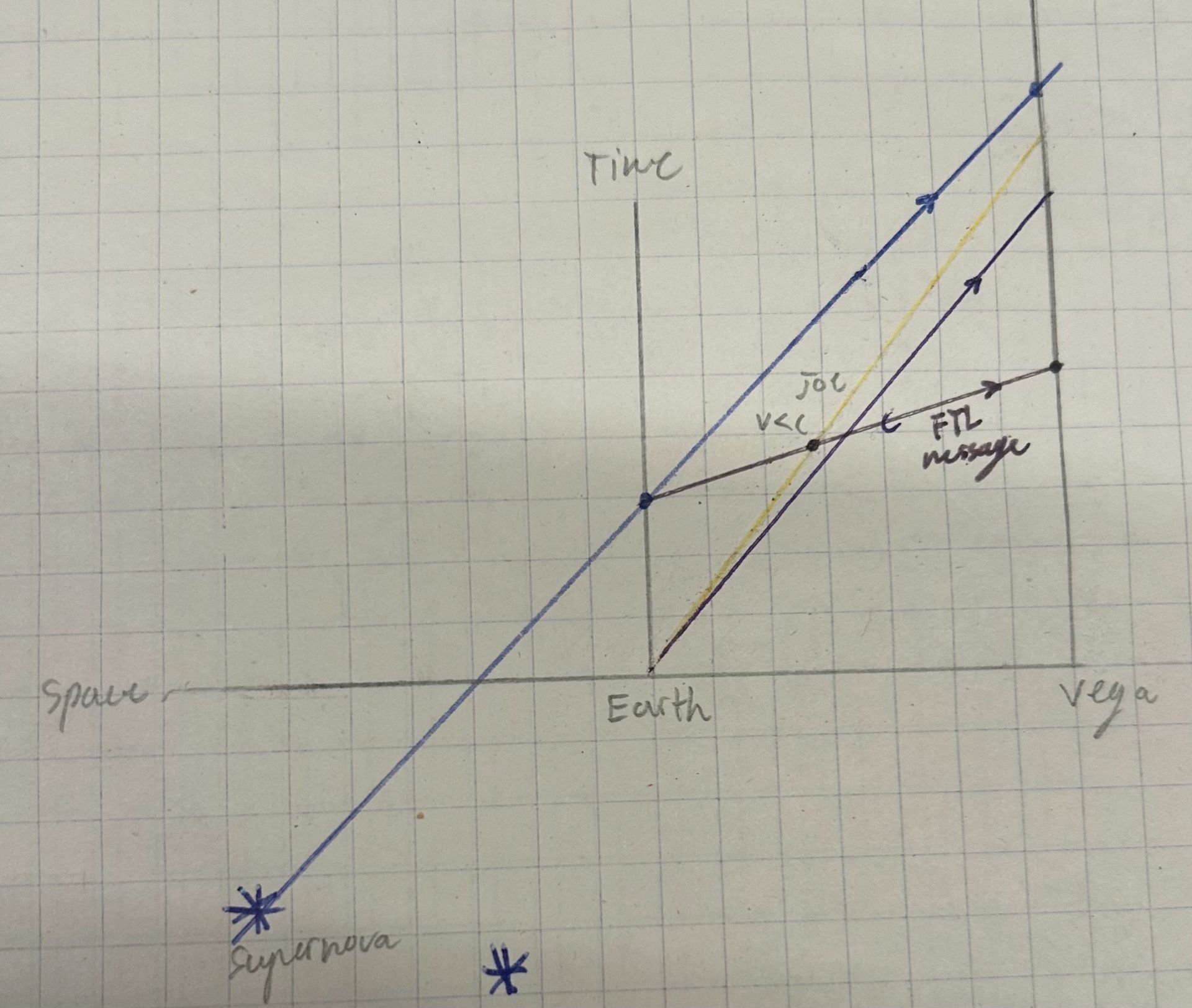 Fig. 11
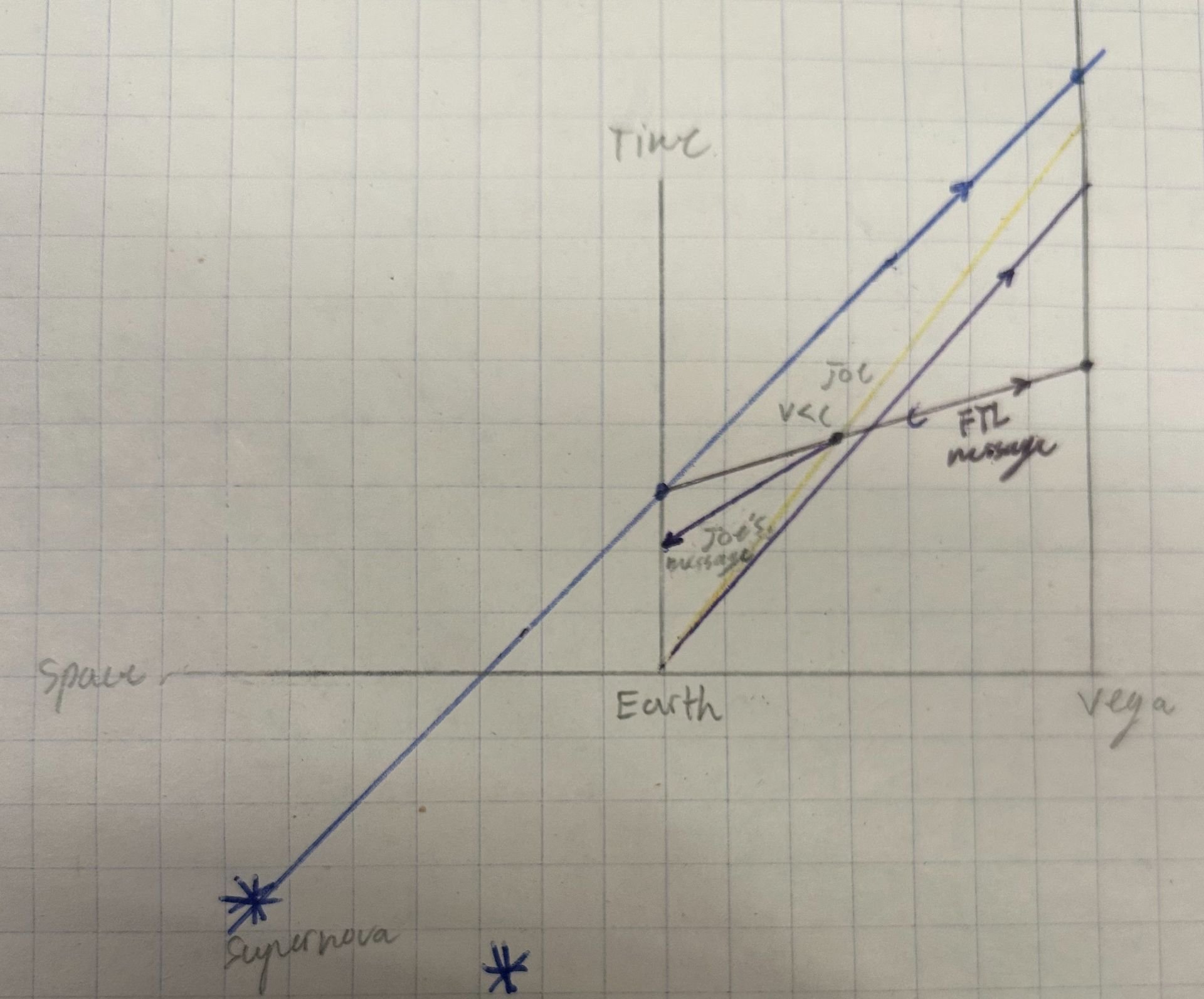 Fig. 12
Conclusion
Before concluding, it is important to establish that our current understanding of physics is inherently limited to phenomena that we can physically measure. It is not, as many believe, the language of the cosmos, but rather our limited interpretation of the effects we see. Thus, theorems like FTL systems that use abnormal values are bound to stress our established conclusions.
There are two conclusions that can be drawn from my research:
-
FTL travel is impossible because it breaks the principle laws of physics, and relies on speculative solutions to rectify.
- This solution is inherently disheartening for the realm of theoretical physics, as the primary goal of such a field is to expand our understanding of what is currently possible. Given our current evidence and logical analysis, the impossibility of FTL travel remains the most likely answer. However, with the ongoing evolution of quantum mechanics and the pursuit of a unified field theory, this barrier could be re-evaluated within the coming decades.
-
Our understanding of the function of time is fundamentally incorrect
- Our contemporary understanding of spacetime is inherently linear, permitting only forward motion through time. Yet, it remains possible that time follows a cyclical pattern or other unfathomable structures. If our traditional ordering of events is flawed, we cannot categorically rule out FTL methods solely on the basis of causality. Nevertheless, FTL remains an immense engineering challenge, as the requirement for negative energy densities remains a problem currently beyond rectification.
Citations
Works Cited
Alcubierre, Miguel. “The Warp Drive: Hyper-Fast Travel within General Relativity.” Classical and Quantum Gravity, vol. 11, no. 5, 1 May 1994, pp. L73–L77, arxiv.org/pdf/gr-qc/0009013.pdf, https://doi.org/10.1088/0264-9381/11/5/001. Broeck, Chris Van Den. “A `Warp Drive’ with More Reasonable Total Energy Requirements.” Classical and Quantum Gravity, vol. 16, no. 12, 10 Nov. 1999, pp. 3973–3979, https://doi.org/10.1088/0264-9381/16/12/314. Einstein, A., and N. Rosen. “The Particle Problem in the General Theory of Relativity.” Physical Review, vol. 48, no. 1, 1 July 1935, pp. 73–77, https://doi.org/10.1103/physrev.48.73. F. Long, Kevin . “The Einstein-Rosen Bridge.” I4is.org, 11 Jan. 2015, i4is.org/einstein-rosen-bridge/#gsc.tab=0. Ferrière, Katia M. “The Interstellar Environment of Our Galaxy.” Reviews of Modern Physics, vol. 73, no. 4, 5 Dec. 2001, pp. 1031–1066, https://doi.org/10.1103/revmodphys.73.1031. Accessed 14 Apr. 2022. McMonigal, Brendan, et al. “Alcubierre Warp Drive: On the Matter of Matter.” Physical Review D, vol. 85, no. 6, 20 Mar. 2012, arxiv.org/pdf/1202.5708v1.pdf, https://doi.org/10.1103/physrevd.85.064024. Accessed 27 Mar. 2020. Morris, Michael S., and Kip S. Thorne. “Wormholes in Spacetime and Their Use for Interstellar Travel: A Tool for Teaching General Relativity.” American Journal of Physics, vol. 56, no. 5, May 1988, pp. 395–412, www.cmp.caltech.edu/refael/league/thorne-morris.pdf, https://doi.org/10.1119/1.15620. Singh, Girijesh. “Lorentz Factor Formula.” Pw.live, Physics Wallah, 4 Oct. 2023, www.pw.live/school-prep/exams/lorentz-factor-formula. Tillman, Nola Taylor, and Alisa Harvey. “What Is Wormhole Theory?” Space.com, Space, 21 Oct. 2017, www.space.com/20881-wormholes.html. University of Mississippi. “Time Dilation.” Www.phy.olemiss.edu, 2024, www.phy.olemiss.edu/HEP/QuarkNet/time.html. Yu, Hongwei, and Weixing Shu. “Quantum States with Negative Energy Density in the Dirac Field and Quantum Inequalities.” Physics Letters B, vol. 570, no. 1, 2003, pp. 123–128, www.sciencedirect.com/science/article/pii/S0370269303010475, https://doi.org/10.1016/j.physletb.2003.07.026.
Images: Figs. 1, 3, 7-12 Original Figs. 4-6 Wikipedia Creative Commons Lisence
Acknowledgement
I would like to acknowledge my teacher, Mrs. Calvert, as well as my fellow peer Shreya Kaushik for helping organizing the Science Fair club at Master's College.