

The Influence of Social Settings: How May That Impact Moral Authenticity?
Mahnaz Saifiddin
Zakia Abdul Sattar
Grade 9
Presentation
No video provided
Hypothesis
Project Hypothesis
If presented with the same complex moral questions, individuals will then present more moral authenticity in secluded, non-judgemental one-on-one settings rather than in close peer settings because of the shift in social judgements and increased comfort levels.
Project Statement
The youth. The people who determine our future society. Yet, with the amount of research done on the behaviours, minds, and actions of the youth, many are still complaining that they don't feel understood by the adults. But could it be this way because the judgments youth make are inauthentic, hard to understand, easily influenced, and constantly changeable? Is the way we create our decisions unreliable because of how easily influenced we are? How could we ever create a healthy society when all it's based on is inauthenticity and constant changes in influence?
Being authentic means to understand and stay grounded in your values, regardless of external pressures and expectations telling you otherwise. But in our society, it seems like we have a lack of authenticity because of how quickly people are influenced to think, act, speak, or appear differently. Therefore, the youth are afraid to be themselves. External pressures get to them, changing what may have even been their strongest opinion. This unreliability of what is "cool" or "in" is damaging to individuality, which I happen to see a lack of discussion about.
My project aims not to resolve the constant change of influences, but to see where it is rooted. Even if it is somewhere as simple as amongst your peers. I want to understand how easy it is for the opinions of the youth to shift because of these external pressures, and then to understand how this will impact the years ahead of us, since, after all, the youth are our future. I want to understand the people who may be confident in their morals, and who may not be. The people who aren't as confident in their answers are the people who are more likely to be influenced by external pressures, as they don't have a clear ground. How often may this occur? How often will people show a lack of confidence in things they should understand? How many youths are influenced to change their morals based on external pressures? How often is true authenticity shown in a group of youth? Those are the questions I want to understand.
Research
Research
Through various research experiments, it was found that teenagers were to lie the most, though those in the pre-adult stage were to be the best at it. These people may had several reasons to lie, but what was noticed most commonly was the urge to look good, gain through it, or to avoid punishment. An average participant more commonly told two lies a day, but for teens or adolescents, this increased to 2.8 lies per day. The underdevelopment of the adolescent brain could have been a leading factor as to why adolescents felt the urge to lie. Because, as other data results showed, the amount of lies an adolescent told was higher as the participant got older.
Though it is only human nature. Lying in children may be seen as a step toward growth in cognitive development, as said by psychologists. And as children grow, they start to create lies based on the environment they are surrounded by. Environmental reasons may include the adults they look up to. But it is mainly taught that lying can protect self-preservation. Therefore, the youth are typically more drawn to lying to protect themselves from damage or punishment.
And as the years pass, social lives become a priority. Hence, the youth may lie about simple things, such as interests, to fit into social circles. The youth aim to receive approval from those around them, which is a strong indicator of deep self-esteem issues.
But to assume that people would be lying in one-on-one surveys and then turn around with the influence of others is bold and nearly impossible to prove. Yes, it may be a possibility, but not a certain or strong one. When answering moral questions like these, people tend to use their judgment more than their lying abilities. And that may leave the question: what are judgments, and how do we make them?
Judgements are the evaluating part of our minds; whether we create judgements on views, appearance, or positions, we unconsciously make them all the time. The interactions and relationships we develop with one another can be judged through similarities or differences between them and us. The perceptions we create of others make it difficult to adapt to the collective expectations and perceptions. And typically, judgments can be negative, as we only see the cover and don't bother to look into the depths of things. This can take a negative toll on self-esteem, either with ourselves or others.
Our judgements acts as a definitive outline of who we may be as people in society; it can also reveal more of our character than the ones we choose to judge. Different types of judgments we may project onto others can include creating judgments based on mental health differences, which signals them out as strange and someone to steer away from. Other judgments can be toward ourselves, where we evaluate ourselves based on whatever we do. This is a strong reason for low self-esteem, especially for those who are vulnerable to insecurity. Judgement can and is a form of discrimination, either against ourselves or others.
Yet, our judgements are more than the harm we may put out against others. It is the part of our brain that creates rational and logical choices. Judgements are the majority, if not all, of the critical thinking skills that allow us to think things through and to evaluate information fairly. Judgements can also be open-minded when in argument or disagreement. Whether our judgements our strong or not, it is what determines our character strength as individuals in a society. People in a society who are able to make good judgments are often seen as reliable and trustworthy for their grounded and reasonable decisions. Lying in our judgments can interfere with the reliability of our judgments and will most likely result in damage, such as corruption or injustice.
Kohlberg is an American psychologist who was the one that developed the theory of moral development. He explains through his theory that there are six steps divided amongst three age groups that explain the thought and judgment processes of these age groups. The earlier stages are stages that focus more on authority, while the later stages focus more on social order.
The first stage of Kohlberg's theory is the preconventional stage, from three to seven years old. This stage includes the first step, the Avoiding Punishment step and the second step, the Self-Interest step. The avoiding punishment stage is the process of determining whether whatever is done will cause punishment or not. And since people in this stage want to avoid punishment, they make moral decisions surrounding obedience. The self-interest step is the stage where we create moral judgments based on whether it would benefit us or not. It's more of a "How will I benefit?" rather than "How could this help others?" thought process.
The second stage is amongst the conventionals, eight-year-olds to thirteen-year-olds. The third step is the Good Boy Attitude, and the fourth step is the Law and Order Mentality. The conventionals tend to make moral decisions with these steps unconsciously in mind. Step three, good boy attitude, is the stage that conventionals wonder, "What will people think of me if I do this?" People may want to stay behind with the crowd to appear as the "good person". The law-and-order mentality focuses on obeying the rules and doing as they are told. Its the desire to uphold the social construct and system.
The last stage is the third stage amongst the post-conventional that includes people of adulthood. The fifth step is the Social Contract, and the sixth step is the Principle. The social contract step is the step where they break out of the mentality of obeying every law and look at the laws as flexible. Again, instead of following every rule to the letter, rules may now be adjusted to be okay if it serves the right purpose. The principal step is where people now make moral judgements based on universal and ethical principles. It is the stage where people want to serve justice and fairness while making judgments.
In this specific experiment, I would have to depend on the law-and-order mentality and the social contract steps to evaluate where moral judgments may have been developed from. Since my group is amongst fourteen to fifteen-year-old kids, these are kids who are newly breaking out of stage two to then reach the mentality of stage three judgment-making mentalities. It can be interesting to see how this may play out in data results.
When it comes to decision-making between men and women, they tend to have different approaches to evaluating situations and finding solutions.
Women who are under stress typically only need self-contemplation to create strong decisions for themselves. They are just as good decision-makers as men, and if anything, are better at making decisions because of the way they look at the positives and negatives of a situation before finalizing a choice.
Men can make faster decisions, but they are less analyzed and thought through. These decisions are typically driven by the reactions to surrounding circumstances.
Women's leadership skills have been praised over the years for their ability to pay more attention while avoiding conflict within solutions, though it is still highly overlooked in comparison to the way men lead.
It is also interesting to see the comparison between men and women when the discussion is about deception. Research shows that men lie more often, showing higher rates of deception. Men typically outperform women in the number of lies they tell and how often they are able to get away with it. And studies show that these abilities may be rooted in narcissistic personality traits usually exhibited amongst men.
Though both genders have equal ability when it comes to detecting lies amongst the other gender. It could be concluded that the nature of deception may not affect the way others are able to detect a lie.
This research is not a key idea of my project, but rather to understand the differences in thought processes when I am interviewing each and every individual.
And I am aware that the goal of this project isn't to detect lies, but the possibility of detecting deception is always on the table.
Peer pressure is the thing I need to look for the most when I conduct my online-survey section. But peer pressures can be so much all at once, so what really is peer pressure?
Peer pressure can be the friends of an individual who share the same experiences and interests, which may cause one another to make decisions and influence one another through choices or behaviours. Typically, peers are of the same age as the individual, but it isn't always. And usually, peer pressures tend to be positive.
As we grow older, we develop an independence that causes us to rely more on peers. Because the more time spent away from home, the more time you spend with your peers. And sometimes, these peers can be seen as our family. It is a comforting feeling to face challenges with peers as a sense of moral support, though, primarily, adults speak down on it.
The positives of peer pressures may include developing new friendships, finding positive examples to rely on, having a source of feedback and advice, socializing with others, getting support and encouragement from others, and gaining new experiences.
But it is also typical to compare and evaluate yourself when put up against your peers, as people surround themselves with the people they want to be like. This causes the desire to fit in, and to therefore become influenced by peers far more easily compared to someone who may not want to be like their friends.
Peer pressure becomes a problem when it starts to force you to do things you aren't ready for. This is the side of peer pressure adults are afraid of, since it may introduce children to drugs, sex, and other harmful activities that can put someone into danger.
And it's especially hard to identify what peer pressure is and what it may not be. Peer pressure doesn't have to be spoken into words. It can be silent signals and social cues. It's hard to resist the temptation to stop yourself from doing what others are, whether it is a harmful activity or not. The pressure of not being the odd one out is what gets us, and why people fall for it. People may see that going along with peers prevents uncomfortable situations, and people usually look for social cues to understand what is acceptable and what isn't.
Yes, peer pressure is natural. But peer pressure can also occur most commonly with people who have low confidence, are new to a group, people who are followers, people who are unsure about themselves, and people who have never been peer pressured before.
Teenagers are most sensitive to peer pressures because their brains are actively undergoing changes that crank up the sensitivity of the reward system. They are highly attuned to social situations in this stage. And because the reward system in the brain is the system that makes us feel pleasure, if peer pressure gives us the pleasure of feeling good, youth will want to lean on that good feeling.
Teenagers are newly learning how to navigate the world, which is why the influence of others is the way they socialize and create a sense of self-identity. Studies show that the reward system and risk-taking-tendencies change when peers are around.
Some teenagers are also sensitive to feeling included and/or excluded in situations. Therefore, they take the bait of peer pressure to fulfill the desire of being included.
This is why in this certain stage of life, the quality of our friendships is far more important than the quantity of them. The higher quality friends someone has can lead to a higher life quality satisfaction and improved mental health.
Variables
Variables
As a quick recap, this project is a series of surveys with complex questions that question the morals of an individual. The first test is a one-on-one survey in a secluded area. The pressure and tension may be high because of isolation and how close the participant may be to me. If it is someone who isn't close to me, they may feel the pressure to uphold an image of someone "good". The second survey is the same questions, but this time, online and in a group full of peers and others who took the same survey. Although comfort is now present, the external pressures of the peers and people around them may influence their answers, testing whether people's morals were authentic enough to be influenced by those around them.
Independent Variable: The location where the test is taken Because the independent variable means the part of the project that is changed, in this case, the only thing that is being changed is the setting in which the survey is being taken. But more specifically, the location affects the way external pressures play into action. When placed in a one-on-one setting, no external pressures affecting the way a person may answer. On the other hand, the room with a group of people may change the way someone answers because of the new external pressures set into place. In order to find whether people show authenticity in their morals, I need to shift the pressures of being in one setting to another, where one setting is a no-judgement, say-what-you-will setting, while the other has constant influences that may change the way one thinks. Furthermore, the settings are the only thing that needs (and will be) changed in this experiment.
Dependent Variable: The shift in answers; whether authenticity in answers is carried throughout both tests, regardless of the differences in settings and circumstances As the dependent variable is the result of the independent variable, finding a shift in answers based on the location change is what my dependent variable is. The change in locations is the opening for new influences and external pressures. And as presumed, these new pressures and second-hand opinions should show a change in answers, also determining whether people's morals were ever authentic to begin with.
Controlled Variable(s): The age of participants (14-15), the questions, the way questions are asked/received, the participants, and the mood of the test These are all aspects of my project that must stay the same in order to maintain accurate and precise data. Showing any change or shift in any of these variables immediately creates inaccurate data to record. For example, if I were to ask the questions in a different way to every participant, that would affect the mood of the test. It may increase or decrease the comfort level one may feel while taking the survey, which impacts the way they answer.
Procedure
Experiment Procedure
When experimenting with multiple parts to it, it is important to follow a certain procedure in order to keep the experiment organized and concise.
- Create your moral-related multiple-choice and open-book questions for both social and one-on-one surveys Creating your questions is a crucial step to setting up the foundation of your data results. This is also a part that must be finalized before planning locations and times for testing is a consideration. To get accurate data results, these questions must be complex to increase the temptation of being influenced by others around them. If it were a question as simple as "What is your favourite colour?", it would not be a compelling question that one may need to change to "fit in". But when creating complex moral questions, it is important not to skid too far from the line. Getting approval that the questions you will ask are appropriate is a necessity for the sake of ethics and the comfort of participants.
- Start planning the location and times for the one-on-one surveys Once questions are all approved and finalized, you will then start to plan how you are going to conduct the first test of the surveys: the one-on-one surveys. We need to start with the one-on-one surveys to gather initial answers from participants who aren't facing the external pressures that may affect their first-thought morals. We need these raw initial opinions to compare them later, as it creates higher accuracy when collecting the final data results. But now, create a clear foundation of when and where you will choose to survey people. Make sure that this is isolated and something that aligns with your schedule. Be prepared to review this with your teacher.
- Confirm this plan with a teacher You are pulling students from this teacher's class, which may impact the learning of the student if it is not thoroughly discussed and confirmed with the teacher beforehand. Review your initial plan with the teacher to make adjustments if needed. If you receive the green light from your teacher, feel free to move on to the next step.
- Create consent forms for students to read and sign with their parents But you cannot start pulling students right away once receiving approval from a teacher. You need parental consent to allow these students to participate. Once you have received approval from your teacher for a set time and location of testing, create these consent forms for parents to review and approve. The more detailed the consent form, the better. Set a deadline for these forms to be turned in, and ensure that the deadline is at least a day before testing begins.
- Grab the first person to interview one-on-one At this point, all consent forms should be in. That is your approval to start interviewing at the times and locations you planned before. Grab your first student and begin. I preferred to start alphabetically, then to go down the list, but it can be personal preference on which order you decide to interview participants. During these interviews, have papers prepared to record the answers of these participants. Organize these papers per student for future reference. Also, during interviews, please ensure that you review what they signed up for and treat everyone the same.
- Repeat the interview process with the rest of the students who signed up The process of the interview with the first participant should be the same for everyone else. Do not alter anything about your questions or interview process for data accuracy. Also, ensure that these are people who only signed up to participate, not those who may want to, but didn't give parental consent.
- Have students who you were unable to survey that day take it another time Chances are, you'll have students who signed up to participate but did not show up on the day of testing. If this happens, further plan more dates and times to continue testing until everyone has been interviewed. I had initially planned 3 days for interviews, but it then turned into 5 or 6 because of how long it took. Do not underestimate or stress about incomplete surveys, as more time can be put into them through planning and the teacher's consent.
- Collect and analyze data Make sure that all data is properly and safely stored on paper. To make this easier in the long run, this may be the time when you analyze the collected data to then assume how many people may show inauthenticity through the second round of testing. I did this by collecting body language detected throughout one-on-one interviews. Through that data, I can then predict how many people may change their initial answers.
- Once over, create the same survey, but online instead You are now heading toward the group setting testing. For this, instead of assigning paper, as it is messy, create the same survey online for it to be shared with the students. When data is collected, an online survey is easier to manage and look through individual student answers. Please ensure that this survey has the same questions as those you already asked. In this case, it would be the same five open-book and five multiple-choice questions initially asked.
- Plan and find a location and time to gather all students who participated to retake the survey together. You're planning similarly to how you planned for the one-on-one surveys, but this time, it is for all the same participants to retake the test altogether. Ideally, plan for this to take place during a long free-time period. Depending on how long one-on-one surveys took, that may be the ideal time you need for the participants as a group to finish the survey. Make sure you also have a way to get all these students together, as this may be difficult when planning for students in different classes and schedules.
- Confirm with the teachers Again, make sure to confirm this plan with the teacher(s) of these students for further adjustment and approval. These teachers can be crucial figures in organizing and setting your plan into action. You may also need teacher supervision when making these students take the survey together in case of emergencies or misbehaviour.
- Survey all of these students again, now all together in the same room Now, the students will be given the same test, but online, with external pressures. You may see how people debate with one another, which is where the external pressures are created. The debate and interaction amongst students to then see how many people had a shift in answers is crucial to prove how these external pressures show inauthenticity amongst initial answers.
- Have students who were not there take it in a group at a different time And again, the possibility of students not showing up for the group testing is there, and if anything, higher than before. Students should not be informed of this final testing, so there is nothing you can do to convince them to show up. Therefore, gather all of these absent students when they finally show up and configure a time where you can pull them all together to take the online test. Please ensure that all of these absent students take the test at least under the influence of one person, as this is the main idea of this shift in setting through the same method of testing.
- Collect and analyze data This is the final stage where you analyze the change in answers from the first testing to the second. Compare how many people had a change in answer and how many didn't. From there, you can determine if your predictions were correct and what this may show.
Observations
Observations
To understand the way my analysis of data may turn out, things such as actions or body language were observed to grasp the general idea of what participants may have been feeling.
Observations noticed in one-on-one surveys: Amongst all participants, certain body languages were shown that could either convey confidence or a lack of it. Determining whether an action showed signs of confidence or not was determined by not only my interaction with the participant, but also by comparing the attributes of someone with self-doubt to find sameness or similarity. Types of body language that were recorded include:
| Confidence: | Inbetween: | Non-confidence: |
|---|---|---|
|
|
|
Through this data, I was able to deduce potential results when thoroughly analyzing data. Some things that were deducted through this data included:
- Attributes of non-confidence were found and seen the most when surveying people. Also meaning that when surveying people, it was more common to interview someone who lacked confidence in their answers.
- Some people projected signs that were unclear whether they felt confident or not throughout the survey. Though this was less commonly found.
- People who struggled to show confidence in their answers have a higher chance of influence affecting it, since they already feel uncertain about what they believe.
- There is potential that people who are either uncertain or not (though people who are certain would do this more likely) would continue to stand their ground the second time around, with further research or understanding. Or, their perspective may change with more understanding and research done.
This observation was collected through the data of everyone. But to be certain about my observations to ensure proper predictions can be made, I went through each participant individually to collect the exact number(s) of participants who conveyed or didn't convey confidence when taking the survey.
| People who showed confidence: | People who didn't show confidence: |
|---|---|
| 1 | 1 |
| 2 | 2 |
| 3 | 3 |
| 4 | 4 |
| 5 | 5 |
| 6 | 6 |
| 7 | 7 |
| 8 | 8 |
| 9 | 9 |
| 10 | 10 |
| 11 | |
| 12 | |
| 13 | |
| 14 | |
| 15 | |
| 16 | |
| 17 | |
| 18 |
Collecting this data individually, I was able to deduce and accurately predict my analysis to a greater extent. The observations here told me:
- Out of the collective, participants tended to show confidence 34% of the time. The other 65% of the time, participants showed a lack of confidence when being surveyed.
- This may further predict that when analyzing the data results, the majority will change their answers because of being more vulnerable to outside pressures.
But some other important things to note are:
- People whom I surveyed who did not have a preexisting relationship with me may have felt more tension or pressure to answer performatively.
- This may play out the second time around, where they may not feel the pressure of a "stranger" asking them these questions, therefore, why more answers may change.
- But the possibility that being secluded while being asked these questions may have been comforting.
- That may show through the people who were consistent with their answers.
- Meaning that data results may go either way.
Observations noticed in the online-survey: Less can be observed through this section of the experiment since I recorded observations strictly as the collective group. Therefore, it is harder to predict what the analysis may show. But as this section of the experiment conveyed, it was interesting to see how everyone interacted with each other.
Once the survey was introduced to the participants, almost immediately, students gathered into groups with their friends to take the survey. Though some students decided to take it on their own. The energy in the room was far more comfortable as people were warming up to their friends. And as the survey went on, there were people amongst each other who argued about the questions and what they believed.
There were also instances where people forgot what the questions meant, regardless of the one-on-one surveys being held less than a week ago, building up to that moment. I figured that if people were forgetful of what they had said less than a week ago, it might make them more vulnerable to changes in answers.
But then again, this wasn't the case for everyone. Some people went strictly based on what they had said in the one-on-one surveys, as seen through conversations with others.
And amongst the insane amount of debate going on, the most commonly overheard debates had been with specific questions per group. The most overheard debate amongst the girls had been the question of whether they would save the baby or the mother in a life-or-death scenario. On the other hand, the boys tended to debate the most about whether it is right or not to save a first-degree murderer from death.
My Prediction
I assume that through these observations, I will see a good amount of answers change the second time around. Because people lacked confidence when answering, they are vulnerable to outside pressures, therefore affecting the authenticity shown by them.
We may see the opposite, where many participants stand their ground, but when put in the spotlight by their friends, it could also be very unlikely that a situation like that occurs.
Analysis
Analysis
One-on-one survey analysis:
The results of the first survey were surprising based on how many people had similar answers to one another.
Question 9 is there twice because I made separate graphs for what people chose to increase and decrease.
And what you will be seeing below is not the entirety of the question(s) told to the participants. They were asked more detailed and specific questions that resulted in these answers:
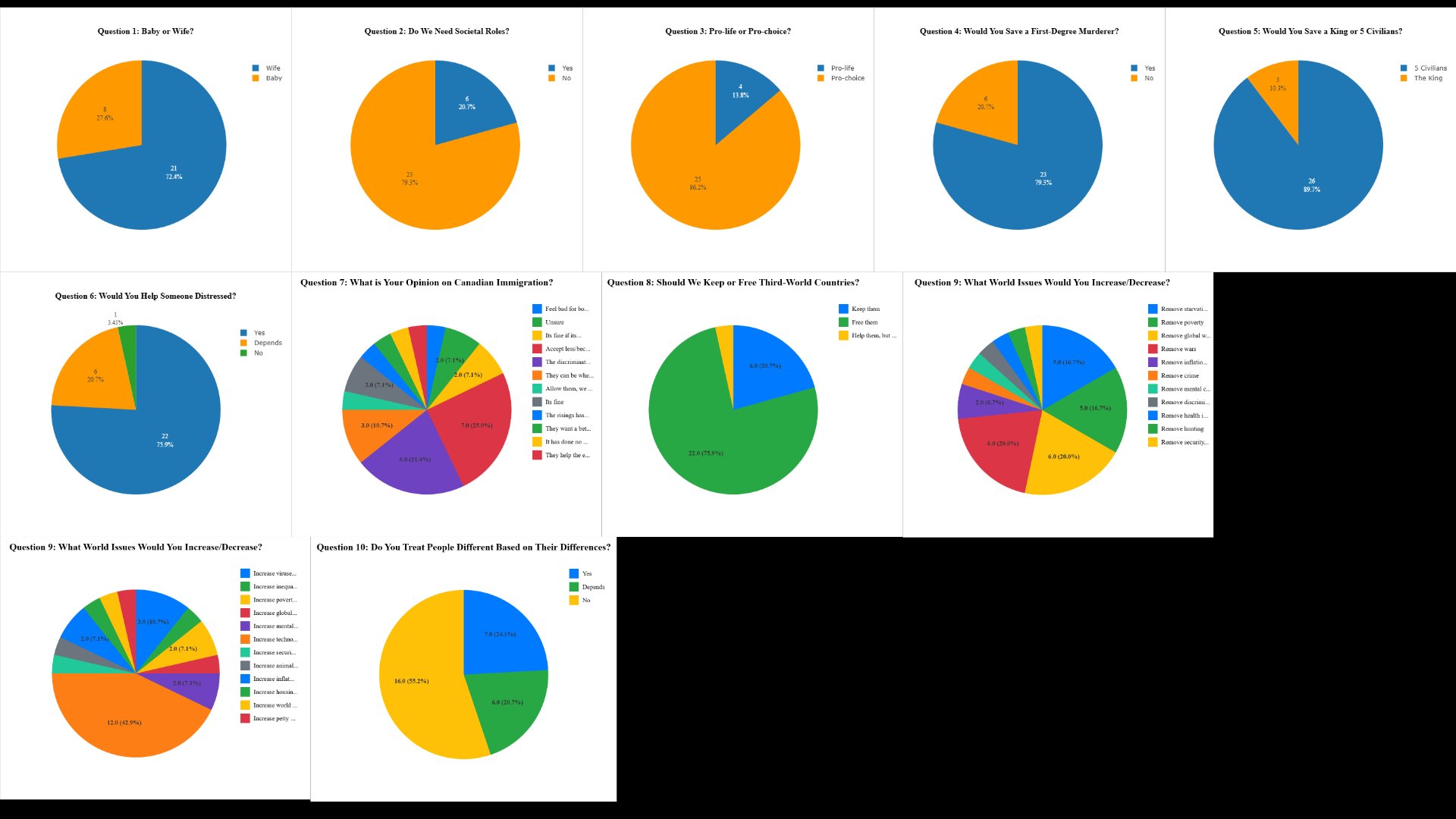 A trend that you can see through all of these graphs is that the majority tended to side with one answer, even when there were answers of all sorts. There is an easily noticeable majority answer within all of these responses.
Participants agreed the most on question 5 when they were asked who they would save between a royal king and 5 middle-class civilians. Twenty-six people (89.7%) voted for the middle-class civilians, while the last three (10.3%) voted for the king. A close runner-up was in question 3 when being asked if they were pro-choice or pro-life. Twenty-five people (86.2%) voted for pro-choice, while the remaining four responded with pro-life (13.8%).
The most separated people were with their answers when they were asked about Canadian immigration and what they would choose to increase out of all of the global issues. Each question had twelve different answers recorded, while a close runner-up was when students were asked what they would choose to decrease out of all of the global issues. That had eleven different answers. But out of the question about immigration and increasing, students agreed the most with one another on the question of increasing a global issue. The highest answer, increasing technology issues, had 42.9% of people agreeing, while the highest answer regarding immigration was about accepting fewer immigrants or implementing a stricter system. That had an agreement of 25% of participants.
What is also interesting to see here is that through all of the answers, most often, the majority answer would reflect in the way participants used their judgments to come to the conclusion.
A lot of the reasoning given to back up their answers seemed to critically think about the impact it may have on not just themselves, but on others, too. For example, when seeing how the majority responded with pro-choice, the main reasons I heard were about what it may do to the woman, how it is her choice, and how that baby may have been produced unethically, which is dangerous and harmful for everyone involved. Another example can be seen through choosing the five middle-class civilians to survive, as this portrays an understanding that the status of someone's life is not definitive to who they are as a person and how they contribute to society. I had plenty of people explaining to me that the five middle-class people may be people who aren't as important as a king, but still may be people like scientists and doctors. They also took into account that these people had family and friends who would be deeply impacted. The "special" life of one was never equal to the lives of five.
This is also interesting to look at through a different perspective. Using the same examples, people who responded with pro-life often looked at the newly developing life of the baby and wanted to give that baby an opportunity at life, which it may never have if it died. They mainly saw it as the woman already having experience in life, so they wanted to allow another to have that chance too. But other times, they also felt as if the woman might want that for her child. Or when people decided to save the king instead of the middle-class civilians, they looked at the impact of the king and what they have done for the people they were serving. They understood that being a king held great responsibility for the lives of many people and thought that it was best that they continue to live to continue to serve and help their kingdom's people.
This aligns with the social contract mentality that young adults seem to possess the most. These responses may not align with the rules that society has set out for us over the years, but they align with the most benefit others can get through it. They look at the different perspectives of the situation and determine what answer is more ethical to maintain the most peace and harmony amongst all people involved.
And though these were not common answers, there were other instances where people made judgments based on what benefited them, not taking much account of what it may do to the others around them. This can be portrayed through the answer "Yes" when being asked whether they believed that societal roles needed to be in place or not to run a society.
The people who said they believed we needed societal roles to run a society often looked at it in a way that maintains order and organization amongst all people in a society. It assigns roles and rules for people to follow to avoid overstepping and maintain orderly fashions.
This can be looked at through a law-and-order judgment-making mentality, since these people are looking at strictly following the rules of society to make things "easier" and orderly. They clearly portray the desire to uphold the social construct of society, which is fine in plenty of situations.
But what these people seem not follow when determining what they believe is the social contract mentality, which is a mentality that is okay with bending the rules for the benefit of others. And this can be harmful because they don't seem to see the way going by this law-and-order mentality restricts the lives and opportunities of others.
When looking at this question through a law-and-order perspective, they believed it is best to organize people based on their strengths, so that they can then contribute only the best to our society. When providing the example of the ideology of women staying in the kitchen and men going out to work, participants didn't believe that exact ideology, but found others that organize roles to specific groups of people based on their genetic strengths.
But when looking at this question through a social contract perspective, people believed that regardless of the societal roles made in the past for specific groups of people, they believed that anyone should have the opportunity to be whoever they want to be. Therefore, allowing people, regardless of strengths or weaknesses, to choose what they may want to contribute to society, as it is their free will. This perspective can be seen as more freeing and open to all people, as it creates equal opportunities for everyone to experience.
Online survey analysis:
The results of the second survey surprised me the most, because when you take a look at this, then compare it to the first time around, you will see how people were inconsistent and inauthentic when responding the second time around.
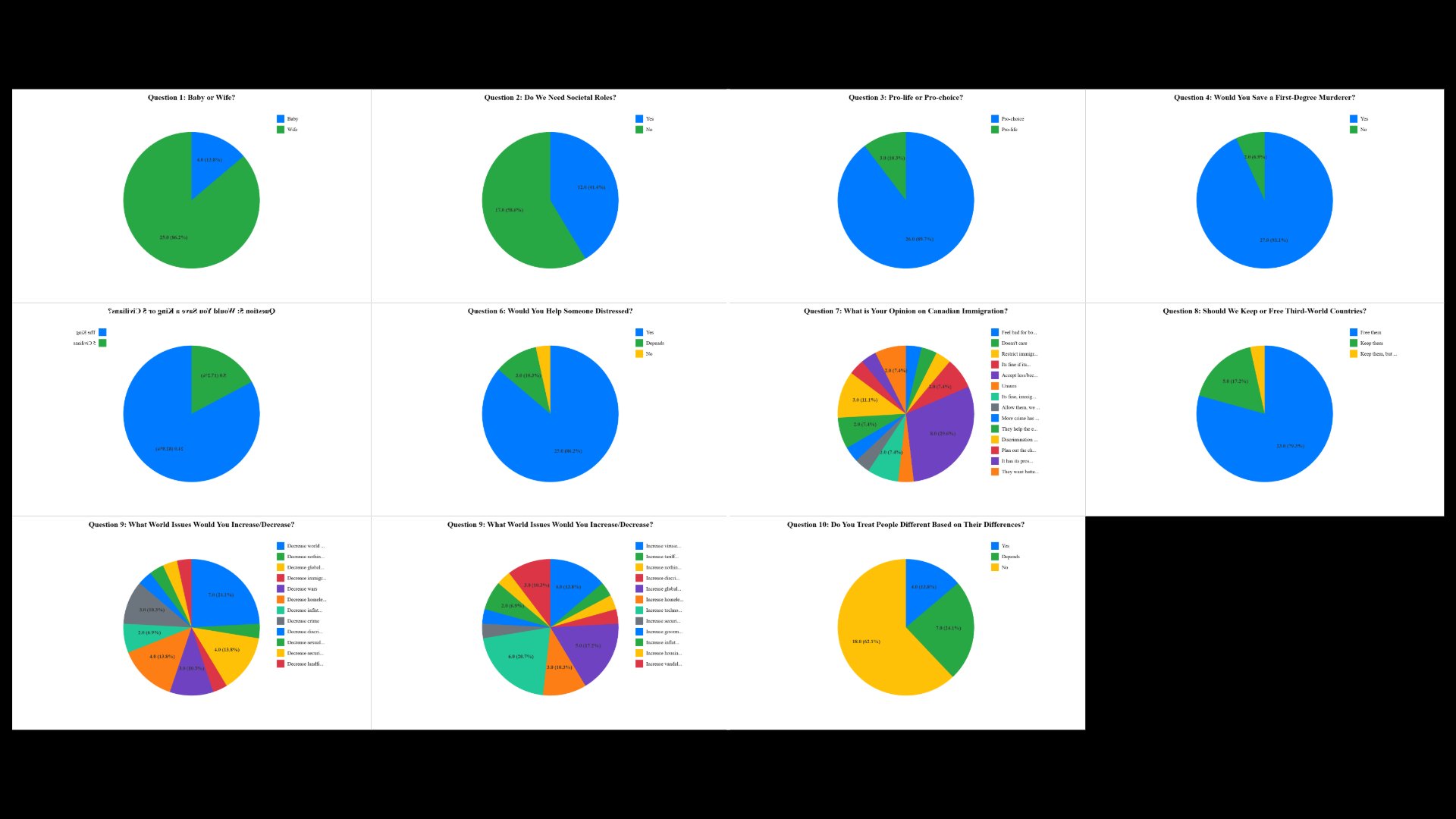 When comparing these responses to the initial responses, it feels far more divided. Especially seen through questions eight and nine, we can see how there are far more responses that even replaced some of the initial responses with new ones. Majorities are still easily noticeable, but have decreased in amounts, so they aren't as significantly bigger anymore.
Question eight was one of the only questions that changed by a single number difference. Question eight initially had twenty-two people (75.9%) saying they'd free the third-world countries, six people (20.7%) saying they'd keep them, and one person (3.3%) who would help them, but keep them. Now, twenty-three people (79.3%) are saying that they would free third-world countries, five people (17.2%) want to keep them, and one person (3.3%) is still keeping them, but helping them. Though going through individual answers, five people had changed their answer here. It just so happens that these five people changed answers that caused a singular person difference in the newer data.
Question four was the only other question, apart from question eight, to have only one person change their answer. And this was the only question that had only one person actually change their answer; everyone else kept their same answer. The first time around, four people (13.8%) were pro-life, while the other twenty-five (86.2) were pro-choice. Now, one person had gone from pro-life to pro-choice because three people (10.3%) answered pro-life, while twenty-six (89.7%) answered pro-choice.
People now agreed the most when asked whether they would save a convicted first-degree murderer from a life-threatening situation. This is different from the first time around, since the majority agreed most on the question about the royal king and five middle-class civilians. Twenty-seven people (93.1%) agreed to save the murderer, while the two others (6.9%) said that they wouldn't save the murderer. But, this is a higher mean agreement between the participants, since the highest percentage here was 93%, while last time, it was 89%.
People were, again, split up the most when answering question seven. But instead of twelve different answers recorded, there are now fourteen. Question nine is now the runner-up for being the most split up, with both parts of it having twelve different answers recorded. Knowing what we know then and now, it is evident that when put into a room to discuss the topics of global issues and immigration, people have plenty of different stands from one another that may make it difficult to discuss.
But the change I found the most interesting was the difference between the first and second times when being asked about whether people believed societal roles should be in place to run a society. No is still the majority answer, but now, answers are nearly split down the middle rather than one dominating the other by extreme measures. Based on what was analyzed about what people answered about this question earlier, it can be deduced that many people may still be in their law-and-order mentality while still newly developing into the social contract mentality.
But what is most important to discuss when looking at these new data graphs is the insane shift in answers. And yes, this was mentioned, but what would this actually tell us?
Well, looking at our graphs, there is not a single comparison that is the same both times. Yes, there are close calls, but never the same.
So, seeing this shift in answers, I took the time to look through everyone's individual answers to see how many participants out of the twenty-nine had the same answers the entire time.
Understanding my predictions before, knowing how a lack of confidence many participants projected when being surveyed the first time around may result in the majority changing their answers the second time around, can show the lack of authenticity that participants reflected in their answers.
Because again, being authentic means to act upon your beliefs regardless of the external pressures around you.
The extreme change in collective data results was alarming, but going through individual answers was the explanation for why things had changed so drastically: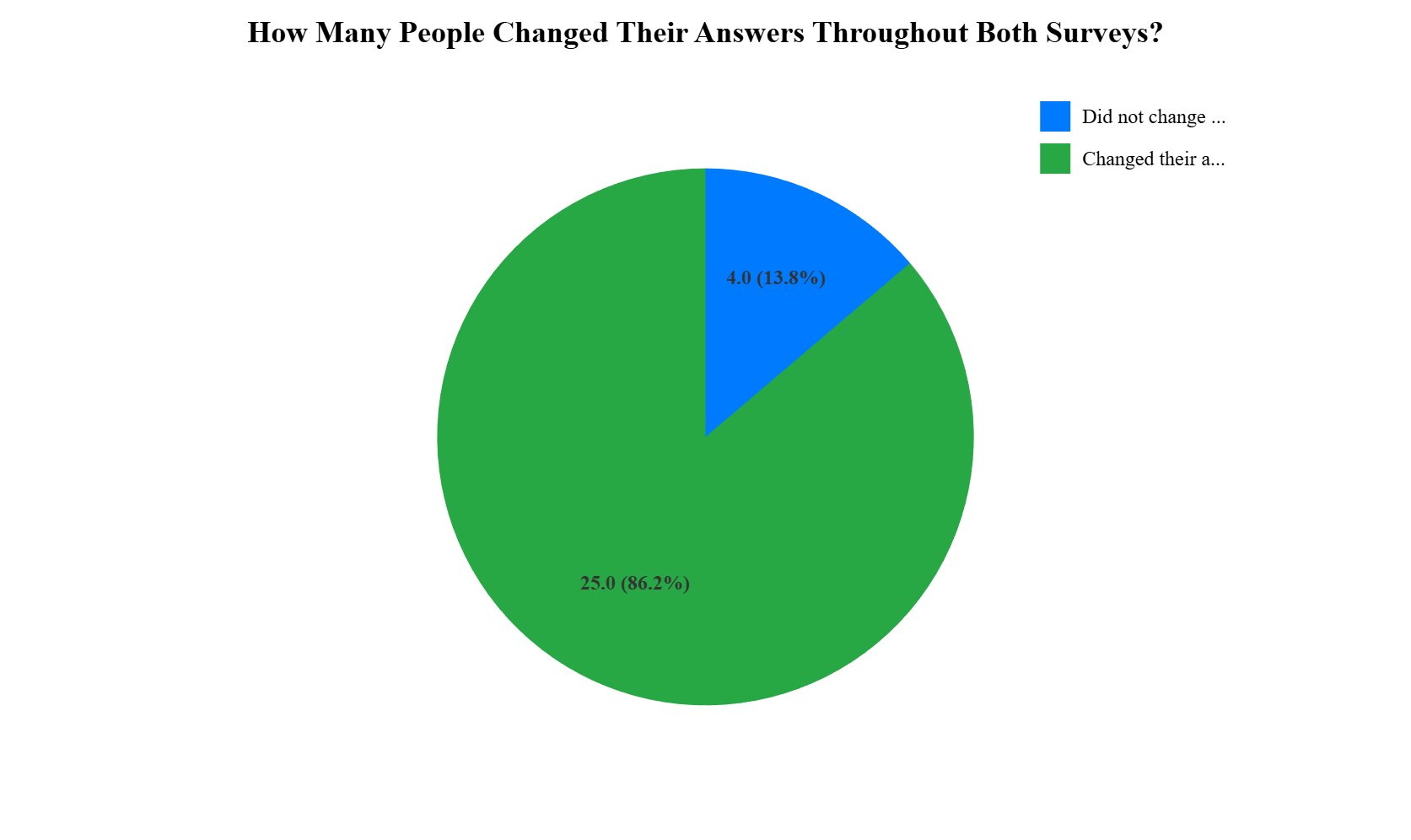 Out of the twenty-nine participants, only four (13.8%) had shown authenticity when being tested multiple times. The other twenty-five participants (86.2%) had changed their answer at least once. And out of these twenty-five, there had been people who changed their answers to their questions six times. Meaning that these people would only ever have four remaining answers that were the same as their original survey.
And yes, there is a possibility that one of the reasons why people changed their answer is that they forgot what they had said the first time around. But if you think about that reasoning, it would further explain why they are inauthentic when sharing their moral judgments.
Moral judgements are judgements that reflect our core values and beliefs. If their beliefs aren't strong enough to remember and uphold for a survey taken place not even a full week later, it isn't moral authenticity.
External pressures had affected participants' responses, as also seen through the way their explanations had shifted during the online survey.
Some people in their online survey explanations had admitted that arguments and debates with their peers had affected their change in judgments. But others who had not specifically admitted to being influenced by their peers showed evidence of external pressures affecting their choice in judgments through similar answers to their peers or opinions that contradicted their initial answer by far measures that couldn't be thought of without other influences, further research done, or an extreme change of thought.
If my predictions from earlier were right, it should've been 34% of people out of the twenty-nine participants who should've stayed consistent during both testings. Specifically meaning, at least nine people should've been authentic the whole time. This group of teenagers portrayed authenticity below the already very low expectations set for them.
A reason why my prediction may have been wrong could be that an outer image may not be accurate to what someone is feeling inside. The people who projected confidence may have been nervous inside, causing them to appear one way, but to answer in another way that doesn't reflect their true moral judgments.
But to summarize the main point, four people in similar developing judgment processes were able to show true moral authenticity compared to the other twenty-nine, who failed to uphold their answers all the way through. This showed a decrease of 86.2% authentic moral judgements made when being asked about real-world issues when peers are around.
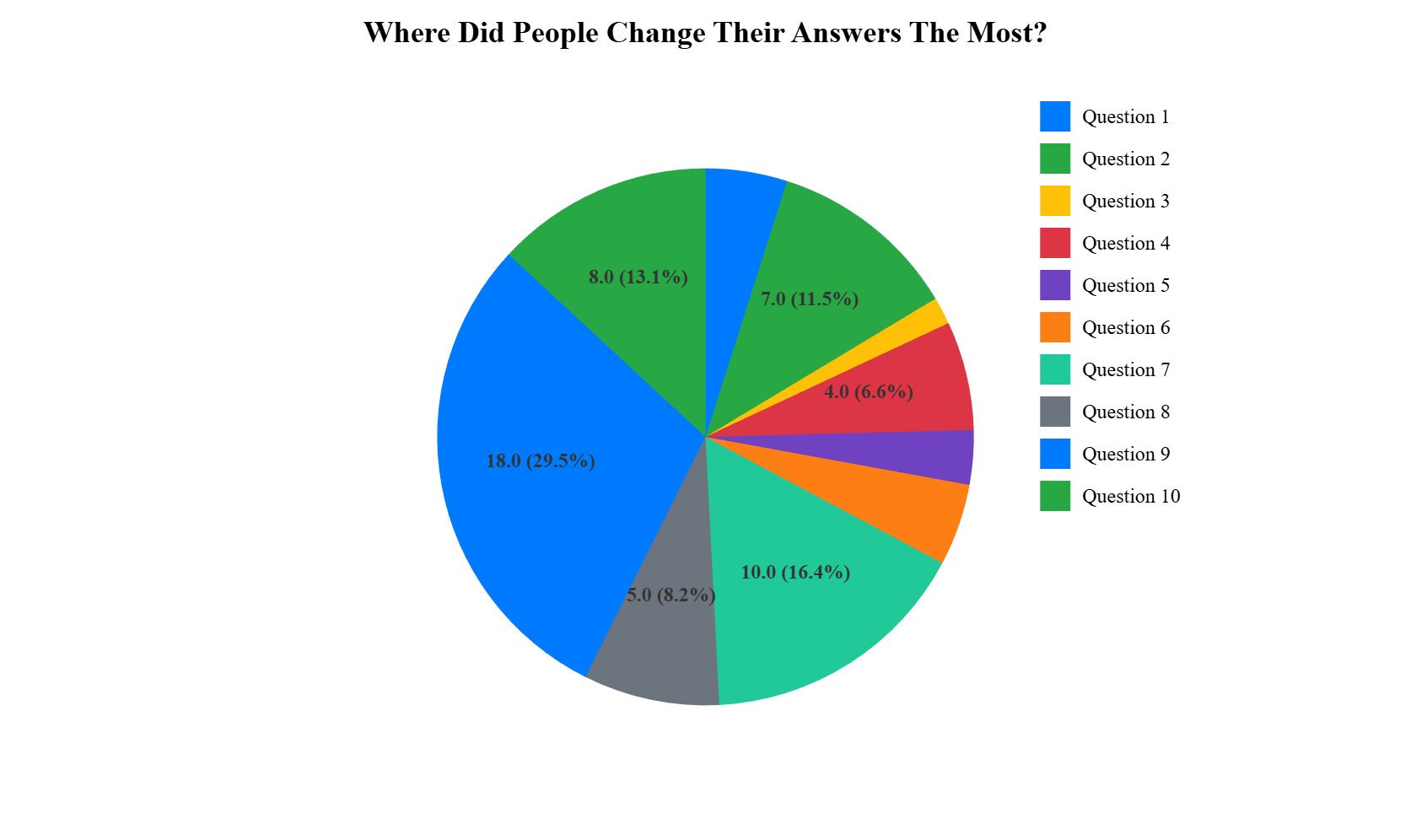 Out of all of the questions, people changed their answers the most on question 9. This could be because it was an open-book question that was overall the most difficult to answer, as shown by how people reacted when told the question in one-on-one surveys. The question with the least number of people who changed their answer was the third question, in which only one person changed their answer. Everyone else continued to stand on the same ground with that question.
But looking at the patterns here, you can see how people changed their answers the most throughout the second half of the survey. The second half of the survey was strictly open-answer questions, while the first half was strictly multiple choice. The versatility of open-answer questions enables student responses, which was most likely the reason why data was messier toward the end, but also where people would typically change their answers the most because of the unlimited answers they can pick from.
People are less likely to change their answers when provided with multiple-choice questions because of how straightforward they can be. Though this isn't accurately represented through question two, where a change in answer was seen seven times.
Conclusion
My Conclusion
With the group of participants I used for this experiment, who are 14-15 years old, I happened to conclude many things about their thought processes when making moral judgements.
Depending on the person, throughout the explanations given to me, I was able to notice how some were in the law-and-order step, while others were developing their social contract mentality. This group of teenagers were able to grasp the idea(s) of difficult topics and discussions and use their critical thinking to find ethical solutions that they believed were best based on their moral judgements. Though we may have to be aware of stubbornness and the lack of understanding of perspective when telling teenagers to make moral judgments. As seen through some other responses, there were instances where they weren't able to grasp the ideas of other perspectives and how their judgments may affect them. I noticed that sometimes what should have been taken into consideration wasn't taken into consideration when making moral judgments, so when placed into future situations where they must make an ethical and promising decision, the lack of perspective may create decisions for the worse.
And though teenagers are completely capable of making good moral judgements, as seen plenty of times throughout this experiment, they cannot uphold their moral beliefs when facing external pressures. This experiment showed a lack of moral authenticity in teenagers' judgments, in which they must learn how to stand firm on their beliefs. When people can be easily influenced, as seen through this experiment, it automatically makes the person easier to control, which can be for the better or for the worse. The youth are newly discovering themselves and their identity at this age, which may be a reason why they aren't able to uphold moral authenticity. The pressure of wanting to fit in and to appear cool to their peers was weighing them down as they took the online survey, which made them highly vulnerable to sudden changes of thoughts. It wasn't surprising that some teenagers lacked authenticity when answering, as peer pressure is powerful. But if peer pressure is too powerful to the point where the youth cannot form critical thinking judgments without feeling the need to change it to "fit in", action must be taken to teach the youth to be less judgmental of others and their opinions.
The moral authenticity within teenagers wasn't strong to begin with, because again, they are just learning how to navigate themselves in a society where all of the "in trend" things are constantly changing. The constant change in trends in society constantly affects what the youth believes is cool or not. And most times, when a youth isn't confident in what they believe in, the constant change in trends will pour down on them hard, regardless of how much they may have liked themselves before forcing themselves to conform to newer trends.
Something also important to note when going over this project is how, even though the teenagers might have been nervous to talk about their morale in a secluded one-on-one setting, noticing the answers of about everyone, they were able to express what they were truly thinking and were not as worried when asking themselves, "Did I look like an idiot saying that?". It was a vulnerable setting for many, as clearly shown through body language, but it was authentic, themselves, and real. Teenagers seem to think and develop truer thoughts when secluded rather than put on the spot by everyone.
Therefore, my hypothesis was correct. When I originally stated that people were more likely to show authenticity when alone rather than faced with external pressures, it was proven when the percentage came back that moral authenticity decreased by over 80% when participants were placed in a room with the same questions as before, but now with the stress of peer pressures dawning over them.
Application
Real-World Application
The lack of moral authenticity may be seen everywhere, because when Solomon Asch held an experiment asking participants to complete a simple, straightforward task, the majority of them failed to do so, not because they were incapable, but because the peers around them had said something different, causing them to follow the crowd instead of authentically standing on their own thoughts and actions.
This experiment accurately plays into our society, as this result was also seen through the majority of the participants in this experiment.
The evidence from this experiment and Asch's simple psychology experiment is telling me a few things about the real world:
- When people are placed into situations where they must make a critical decision, it is best to confront them about it in a way in which external pressures cannot affect their chain of thought. People are more vulnerable and honest when confronted in a space in which they feel safer; therefore, we should seclude people when we need them to make important decisions.
- The impact of peer pressures is alarmingly high, especially for the teenage mind. Yes, peer pressure can be positive, but as of recently, the exposure to social media, where the constant exposure to trends and peer pressures is affecting the developing minds of the youth. Many kids who are exposed to social media are unable to create their own moral values and beliefs without needing the approval of others. Activities such as picking an outfit for the day have become a "what are we doing?" and not a "what am I doing?". This unhealthy mindset is holding society back from independent development, which is just as important as developing with others around you.
- If the issue of not being able to think on your own without needing the approval of others is never addressed, it's going to play into the lack of individuality amongst one another. People online see a trending opinion, praise it as it has always been theirs, then forget it when it suddenly isn't "cool" to think that way anymore. It isn't authentic. And nowadays, it's hard to get true, authentic opinions from people when they are lacking independence and the ability to form opinions on their own.
- This lack of authenticity in moral judgment making is affecting not only the relationships around us, but also important topics, like politics, which is made up of a collection of moral judgments. Parties that should be recognized for the good they can do aren't recognized because they aren't trendy enough to acknowledge. Global issues that must be addressed are left behind because it isn't cool to bring attention to them. And when it is, it is turned into a joke amongst the media. And again, once it is determined "cool", that's when people will care. We are hurting our society's development through the lack of ability to form authentic thoughts for ourselves. Because if we had that ability to independently create that for ourselves, perhaps we would've solved at least some global issues right now.
- The only issue with that last statement is that people are also extremely judgmental about opinions that aren't theirs. They will publicly shame an opinion that they may not agree with because it isn't following the crowd. If someone does have the guts to share their opinion that is different than the one everyone is thinking, it is seen as embarrassing or shameful. It then shuts other people down when they want to share different perspectives out of fear of not fitting in and failing the crowd. Before developing our moral authenticity, we must address the issues with judgment. Because even if we had the most authentic moral judgment as a society, it would all restart, as the pressures of wanting to fit in with other opinions would push back hard.
If I Were to do This Project Again...
Though I am very satisfied with how this project turned out, there are a couple of things that, if I were to do this project again, I would change:
I think that because the idea of this project is to look for the way moral judgements are made and how external pressures affect them, it would be interesting to see how people of different ages would be vulnerable or not to the external pressures they face. Whether it is with a group that is younger and may not understand the concepts of trends and needing to figure themselves out, or if it's with people older in age who have already been through the stage of trying to figure themselves out. I would predict that the older you get, the less you'd be affected by external pressures, but I wouldn't know until I tried it.
I also wish I were able to do a deeper analysis of my data by including how responses varied depending on gender. That was the original idea, but as I got deeper into my project, I realized that with my circumstances, I wasn't able to make it work. Though if I had the opportunity to do it again, it may be cool to centre it around the maturity gaps between girls and boys and how that affects the way they make moral judgements and how vulnerable they may be to external pressures.
Having a section where I were able to put one of the questions to the test would've been extremely interesting to host and record. I feel as if this data will only ever feel complete to me with a test of action morale, which is why if I were to do this project again, I would want to include some sort of test that involves the actions of participants to prove that the moral judgements they claim to believe and stand by can also be brought to life through real-world situations.
I also think that if I did this project again, I would center the questions around the same topics, but make it strictly multiple-choice. Though open-answer questions are telling, for organizational purposes, I feel as if it is easier to record and manage multiple-choice questions.
Sources Of Error
Sources Of Errors In My Project
When interviewing people, the surveys took longer than expected:
- Going into the interviews, I estimated that each survey would take ten minutes per student, occupying about three school days. But my estimate was wrong, as it would take about twenty minutes per participant. As a result, interviews took five to six days instead. This was a setback, as it limited the time I had to work on the other parts of my project.
Getting people to participate was difficult:
- Even when people were presented with rewards to participate, it was a struggle to convince them to participate. Out of the 62 kids we had in the grade 9 population, only 31 people signed up. I was hoping for a bigger number of participants to ensure my data was strong and reliable. Reasons for the lack of participation could have been shown through other forms; teachers have noticed that a lack of parent involvement is preventing these kids from engaging in activities like these. But what I figured was that the main issue is the age group this experiment tested on. Grade 9 is a time when students do not care about activities unless they are passionate or they are directly rewards them. And even then, sometimes students still don't care. This is different compared to the younger grades, as they are more compliant and engaging to work with. When even showing the smallest reward to the younger grades, they were the first to jump up and do anything for it. Attempting to create engagement in a non-compliant group was an extreme setback.
Not being able to control whether people showed up or not:
- Whether people showed up on the days of surveys was out of my control, which made it difficult to manage from time to time. The absence of people when conducting one-on-one surveys hadn't been a massive deal because it only ever affected the time and order in which I surveyed people. But when people were absent during the online survey, that is when it became a bigger problem. The whole purpose of the second test was to create external pressures to test the authenticity of answers. When students were absent, they weren't apart from this grouping, therefore making them have to test them another time. And when I would test them the other time(s), it wasn't in the same big group as before because we didn't have the availability and time to conduct another group testing for a small number of students. Therefore, I had to isolate them more than I wanted them to be. I still had them with other people, but the interactions were minimal, not resulting in the way I wanted them to. This also could've affected the data results because now they had fewer external pressures affecting their mindset and answers.
People refusing to take it seriously:
- When using participants in an experiment like this, it is ideal that they stay on track and are compliant with what they are told to do. But that wasn't the case for everybody. I had plenty of wonderful participants who were on task and were easy to work with. But on the other hand, some people would rush through surveys, hardly give the bare minimum, and not complete the task at all. When people would act like this, it would tamper with the accuracy of their answers, which is what I directly get my data from. People who would goof off are less likely to share what they may actually believe, so if they were to change their answers the second time around, it's harder to tell whether it is because of outside influences or if they realized what the question is actually asking them. Not to mention, how it is frustrating and difficult to work with these people because they don't do things if they don't think it is meaningful or rewarding.
The location of the one-on-one survey(s):
- When I would survey people, I would be placed in the photocopier room. It was a nice and isolated space, which was ideal. But the main issue was that teachers had access to the room at all times and would often barge in mid-survey to photocopy something. This was a distraction not only to me, but to the participants, too. It may have also been uncomfortable for the participants to have an adult suddenly barge in on answers they may not want others to know they had said.
Some people who participated in the one-on-one surveys didn't participate in the online survey:
- In the initial surveys, I had a total of 31 kids with whom I had a one-on-one survey. But the second time around, I was only able to survey 29 people. I wasn't able to get to the 2 other students because one of them left the country for a vacation, and the other was missing both times I conducted the online survey testings (the first for everyone, the second for the people who were missing). This directly affects my data because I cannot include their first responses anymore without it affecting my data analysis as a whole. I had tried to get their responses in the best way I could, and I also thought of ways to manage to include their data results. But no matter what I came up with, there was always a flaw that risked the accuracy of the data I would receive back. So I unfortunately had to cut them from the experiment data as a whole.
Citations
Citations for Research References
These APA citations were generated using https://www.mybib.com/tools/apa-citation-generator and were not created by me.
Health, A. A. (2015, September 25). At what age are you most likely to lie? Health Enews. https://www.ahchealthenews.com/2015/09/25/at-what-age-are-you-most-likely-to-lie/
The. (2025, October 13). Park Slope Therapy. Park Slope Therapy. https://www.pstherapyny.com/blog/the-psychology-behind-lying-and-the-lies-we-tell
Male vs female in decision-making: who is better? (2022, January 8). Www.lpcentre.com. https://www.lpcentre.com/articles/male-vs-female-in-decision-making-who-is-better
Lying Statistics & Facts. (2024). Mastermindbehavior.com. https://www.mastermindbehavior.com/post/lying-statistics-facts
United Nations. (2024). Global Issues. United Nations. https://www.un.org/en/global-issues
VIA. (2020). Judgement | Character Strength | VIA Institute. Viacharacter.org. https://www.viacharacter.org/character-strengths/judgment-critical-thinking
The impact of judgement. (2015, November 27). Time to Change. https://www.time-to-change.org.uk/about-us/our-campaigns/challenging-stigma-young-people/impact-judgement
Positive Psychology Coaching: Judgement as a Character Strength. (2023, February 18). Access CBT. https://accesscbt.co.uk/positive-psychology-coaching-judgement-as-a-character-strength/
Cherry, K. (2025). Kohlberg’s theory of moral development. Verywell Mind. https://www.verywellmind.com/kohlbergs-theory-of-moral-development-2795071
Koblin, J. (2021, January 22). Kohlberg’s 6 stages of moral development. Sprouts. https://sproutsschools.com/kohlbergs-6-stages-of-moral-development/
News in Health. (2021, September). The Power of Peers (H. Wein , Ed.). NIH News in Health; National Institutes of Health. https://newsinhealth.nih.gov/2021/09/power-peers
KidsHealth Behavioral Health Experts. (2015). Peer Pressure (for Teens). KidsHealth. https://kidshealth.org/en/teens/peer-pressure.html
Key Insights from Asch’s Conformity Experiments: A Deep Dive • Psychology Town. (2024, August 17). Psychology Town. https://psychology.town/social/asch-conformity-experiments-key-insights/ Pie Chart Calculator – Free Pie Chart Maker Online. (2025, June 20). Pie Chart Calculator - Create Clear, Custom Pie Charts Instantly. https://piechartcalculator.com/#review-section
Acknowledgement
Acknowledgements
I just want to take a moment to appreciate everyone who helped me with this project. None of this would have been possible without any of these people. And for that, I have so much to thank them for. No matter how big or small the impact they left on my project, they still left an impact. That is what I appreciate the most from these people.
Mrs. Van Den Eynden, my teacher: Also known as my unofficial coordinator. She guided me through the hard and the easy. She was the one to help me set all of this in place. No other teacher would've cared for this as much as she does. She has been the Calgary Youth Science Fair school coordinator for years now, but this is the first year our school couldn't register to participate. I didn't want to take that defeat, and she knew that. She then helped me sign up for an individual project. The existence of this project lies in her hands; I have so much to thank her for that. We've gone through endless meetings of satisfaction and frustration, but not once has she ever given up on me. Thank you.
My mom, my actual coordinator: Though she may not understand why I am so crazy over this, she still put in all her effort to make this work for me. Originally, we had a vacation planned the same week of the science fair. I was stressed because I wanted to do this more than anything, but she demanded I go on this trip. We were left in a huge mix-up of what to do and how to make it work. We discussed it about a million times and still seemed to struggle to find a solution. But my mom, as wonderful as she is, found tickets for cheaper for completely different days that won't interfere with this project. Though I do believe she only got the other tickets for the sake of the cost, she has no idea what that change meant to me. I can enjoy time with her and my family while also being able to pursue this fair. Thank you.
Ms. Lee, my homeroom teacher: She was kind and understanding throughout this whole project, whether it was when I needed her help or whenever I needed to take kids from her class. She may not have been as directly involved with this project as my other teacher is, but she still was extremely important to this project, as none of this would've worked without her cooperation, which she was so kind to give. She was also one of the few who really checked up on me when the pressures of this project came crashing down on me. She sent me the kindest email, reassuring me through my tough times. And I do have to admit, I did cry to it. Thank you.
Mr. Macleod, my substitute teacher: The kids who stole from me took advantage of the fact that we had a substitute to steal the candy from the teacher's desk. In no way am I ever going to blame him for that, though. It was nowhere near his fault. And out of the kindness of his heart, he noticed that the candy was missing and then replaced it with his own money. This small gesture meant the world to me, as I was already panicked and upset about everything. He managed to help bring a little light to the situation, which saved me time, energy, and money. I wish I could've paid him back because I feel bad that he had to spend his own money on this. But his gesture was the sweetest. I nearly cried when trying to thank him for it. Thank you.
Everyone who participated: I will admit, I had my frustrations when trying to manage some participants. But at the end of the day, they were still present and supported me without realizing it. I couldn't have done this project without their participation, for which I will always appreciate them for. Thank you, even if they may have been a pain.
My friends, Khalidah, Rylon, and Blake: These were some of the few people I tested my survey questions on to see whether what I was handing out was a good way to collect answers. They were compliant and fun to work with, as they helped me understand and estimate how the surveys may have gone with the people who signed up. But not only did they help me predict what may happen when testing people, but they were also the people I could rely on to let out all of my real frustrations and anger without feeling like I'd be judged. Though they didn't understand me, they were there to just listen. I really needed it to even help in the slightest to keep my mind off things. Thank you.
My brother, Mehran: My brother was actually the first person I tested my survey questions on to get some sort of confirmation that they were usable. Though he is my brother, so I knew he'd be authentic to me, he was able to show me how others may perceive the questions; thoughtful and difficult. His confirmation was the only reason why I went to my friends. If it worked so well on him, I figured it would work splendidly on my friends. He even asked me, "Are these questions AI?" Which, no, it is not. But it was an ego booster. If my brother saw them as good enough that he thought it was AI, I knew I was set. Thank you.