
Blown Away or Built to Stay? A Wind Uplift Investigation of Roof Shapes.
Filip Matic
Glenmeadows School
Grade 6
Presentation
No video provided
Hypothesis
If a roof has a pyramid hip shape then it will move less and will withstand wind for a longer period of time than a gable roof because wind flows smoothly around its sloped triangular sides causing less uplift, while the flat face of a gable roof forces wind to split and speed up along the sides of the roof, decreasing pressure, causing the roof to be impacted more by wind uplift.
Independent variable: Shape of the roof-pyramid hip vs gable
Dependent variables: How much the roof moves when exposed to wind How long it takes for roof to start moving when the wind is applied
Controlled variables: Wind speed Wind direction Materials roofs are made of Distance from the fan Roof height Weight used to hold roofs Size of house roofs are put on
Research
How wind affects roofs?
Wind is a force of nature that exerts pressure on the surfaces it encounters.
"The key to understanding how wind affects roofs lies in comprehending the two primary components of wind force:
- Pressure: Wind creates areas of high and low pressure as it moves. High-pressure zones push against surfaces, while low-pressure zones pull. The pressure difference between these zones generates a force that can act in any direction—up, down, or horizontally.
-
Suction: The force of suction is especially relevant to roofs. When the wind blows across the surface of your roof, it creates areas of lower pressure on the roof’s windward side, leading to a suction effect. This can cause the roof to lift and separate from the structure, resulting in damage". (Roof Advance, 2023).
Figure 1-Pyramid hip roof vs gable roof
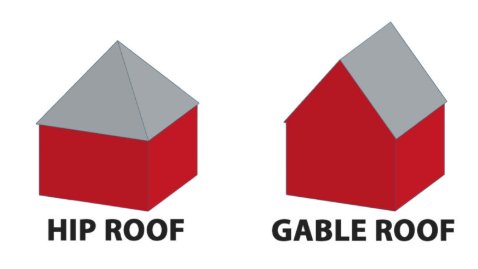 (Pro-Tech Roofing INC, 2026)
Figure 2-Simplified representation of wind load on buildings.
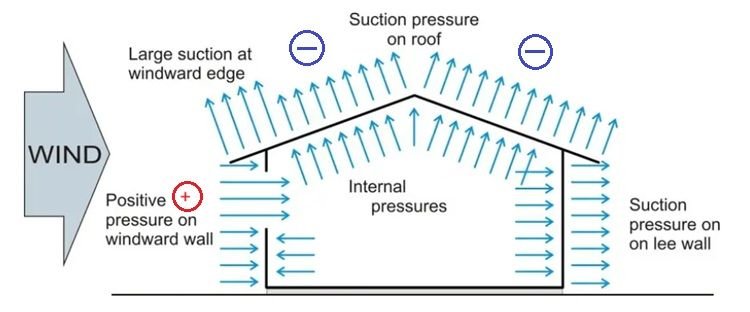 (Structville integrated services, 2022)
How different geographical factors affect roof resistance to the wind?
Where a house is built determines the kinds of winds it will face:
- Prairie or flat regions, like parts of Alberta get fast, unobstructed winds.
- Coastal areas get strong, steady winds and hurricanes.
- Mountain areas experience gusty, unpredictable winds.
- Forested or urban areas have slower winds because trees and buildings block airflow.
Terrain that rises or falls changes the direction and speed of wind:
- Wind accelerates when moving uphill
- Wind tumbles and swirls when moving downhill
- Houses on hilltops get the strongest winds
- Houses in valleys may get gusty, unpredictable winds
How do roof openings affect internal air pressure during strong winds?
If there is only one opening that lets wind enter the structure
When strong wind blows over a roof, it creates low pressure on the outside. If there is an opening — like broken shingle, or damaged panel — wind can rush inside the attic or house. This incoming air raises the internal pressure. Once wind enters the structure, the air becomes trapped and pushes upward from the inside. This increases uplift because the roof is now being:
- pulled up by suction on the outside
- pushed up by internal pressure on the inside
This double force makes the roof much more likely to lift or peel away. With vents on both sides, wind can enter one side and exit the other. This prevents air from getting trapped inside the attic.
- Less trapped air
- Lower internal pressure
- Reduced upward push on the roof
This makes the roof less likely to lift compared to a roof with only one opening. Just make sure those vents are designed to keep water out while letting air flow.
"What is the function of the roof pitch in reducing wind resistance?
Roof pitch represents how steep your roof is. The roof pitch significantly influences wind resistance and the overall durability of a structure. Wind damage to a roof is caused by two forces. The first is positive pressure, which occurs on the windward side of the house where the wind directly pushes against the vertical wall and the slope of the roof. This force attempts to press the structure inward and downward. The second and often most damaging force is negative pressure, commonly referred to as suction or uplift. As wind flows over the peak of the roof, it accelerates, causing a drop in air pressure above the surface, a principle described by Bernoulli’s equation. This low-pressure zone creates a powerful vacuum that attempts to lift the roof system away from the structure. Moderately pitched hip roofs perform better compared to other roof geometries regardless of which direction the wind blows. Moderate roof slopes aren’t as prone to uplift that can pull off entire roofs and they also limit the lateral force that can cause building collapse". (EZ.pdh, 2026)
Figure 3-Roof pitches and their implications for wind forces.
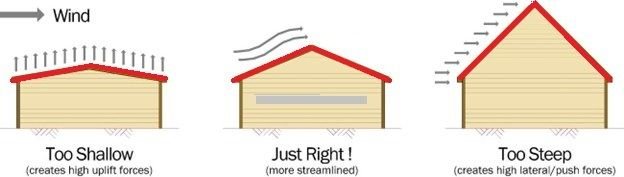 (EZ-pdh Durability by Design Help, 2006)
Variables
Independent variable: Shape of the roof-pyramid hip vs gable
Dependent variables: How much the roof moves when exposed to wind How long it takes for roof to start moving when the wind is applied
Controlled variables: Wind speed Wind direction Materials roofs are made of Distance from the fan Roof height Weight used to hold roof Size of house roofs are put on
Procedure
Materials:
Cardboard - 5 sheets 25cm x 30 cm each Shoebox lid Ruler Pencil Glue or cello tape Utility knife or scissors Hair dryer Stopwatch Measuring tape Scale 8 cm long yarn 11 g of plasticine 15 marbles tissue paper
Procedure:
Setup:
House Structure
- Before you start make sure you have all the materials and flat working surface.
- Using pencil and ruler draw a rectangle measuring 28 cm by 7.5 cm to represent the walls of the house.
- Carefully cut rectangle with a utility knife or scissors.
- Use a pencil to divide this rectangle into four smaller rectangles with widths of 8 cm, 6 cm, 8 cm, and 6 cm.
- Fold the rectangle along each dividing line marks to form the four walls.
- Press firmly along each dividing line so the folds create a clear, distinct crease.
- Bring two edges measuring 7.5cm together to form a box shape.
- Tape or glue the edges to create the house structure.
- Using pencil and ruler draw two rectangles 6cm x 8cm for house base.
- Cut rectangles.
- Glue them on the top and bottom of the house.
- Glue the house box to the shoebox lid.
- Put marbles in the shoebox lid.
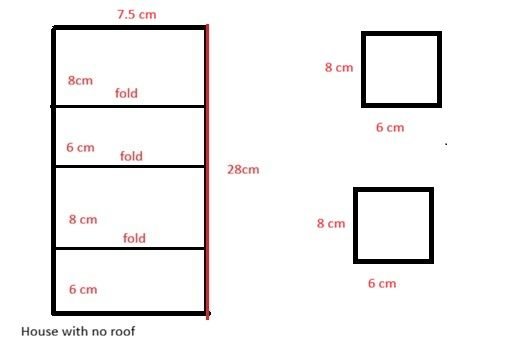 Gable Roof structure - 4cm height
- Using a pencil and ruler, draw two identical isosceles triangles, each with a 6 cm base and a 4 cm height.
- Carefully cut triangles with a utility knife or scissors
- Measure the length of the equal sides of one triangle carefully using a ruler
- Draw a rectangle that is 8 cm long and twice the length of the triangle’s side (the measurement you just took).
- Carefully cut rectangle with a utility knife or scissors.
- Using pencil and ruler draw a line down the center of the rectangle to divide it into two equal halves.
- Fold the rectangle along the center line to form the two sloping sides of the gable roof.
- Press firmly along each dividing line so the folds create a clear, distinct crease.
- Attach the two triangles to the folded rectangle using tape or glue to complete the gable roof.
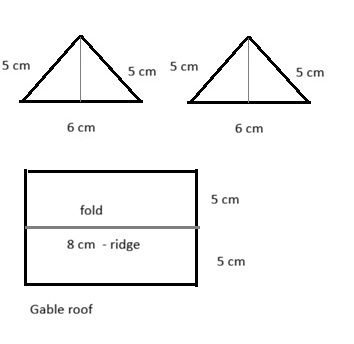
Gable Roof structure - 6 cm height
- Using a pencil and ruler, draw two identical isosceles triangles, each with a 6 cm base and a 6 cm height.
- Carefully cut triangles with a utility knife or scissors
- Measure the length of the equal sides of one triangle carefully using a ruler (7cm)
- Draw a rectangle that is 8 cm long and twice the length of the triangle’s side (the measurement you just took).
- Repeat steps 5-9 from the Gable Roof structure with 4 cm height.
Pyramid hip roof structure - 4 cm height
- Using a pencil and ruler, draw 2 identical isosceles triangles, each with a 6 cm base and 6.5 cm sides.
- Using a pencil and ruler, draw 2 identical isosceles triangles, each with a 8cm base and 6.5 cm sides.
- Carefully cut all triangles with utility knife or scissors.
- Place pairs of identical triangles across from each other.
- Connect all sides of triangles using glue or tape to form a pyramid.
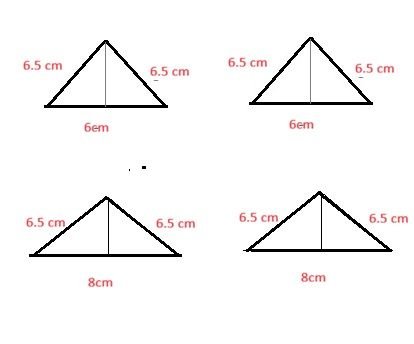 Pyramid hip roof structure - 6 cm height
- Using a pencil and ruler, draw 2 identical isosceles triangles, each with a 6 cm base and 8 cm sides.
- Using a pencil and ruler, draw 2 identical isosceles triangles, each with a 8cm base and 8 cm sides.
- Carefully cut all triangles with utility knife or scissors.
- Place pairs of identical triangles across from each other.
- Connect all sides of triangles using glue or tape to form a pyramid.
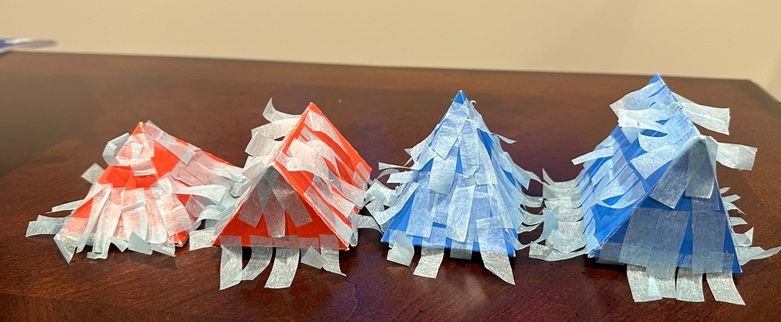
Tissue paper Cut 100 small pieces of tissue paper each 0.5cm x 1.5 cm and glue them on all roofs.
Weights
- Measure two separate 5‑gram portions of plasticine.
- Stick the plasticine to each end of the string.
- Roll each plasticine peace into a smooth ball.
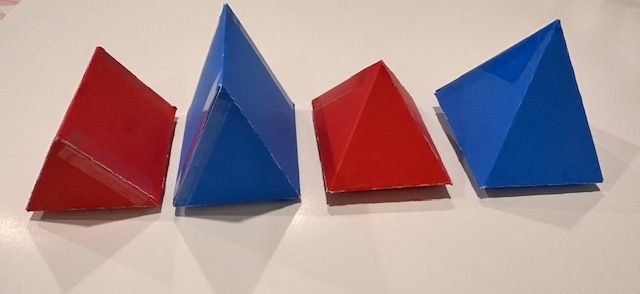
Experiment:
Step 1: Gable Roof - 4cm
- Place the shoebox lid with the house and marbles on a flat, stable surface.
- Set the gable roof on top of the house model.
- Place the thread with the weights across the roof so that a weight hangs on each side.
- Adjust the weights so they are positioned evenly on both sides.
- Stick plasticine onto the roof edges.
- Secure the thread to the roof ridge using 1 g of plasticine.
- Use a measuring tape to mark 65 cm from the front of the house.
- Place the fan on the marked line.
- Ensure nothing is between the fan and the house that could block airflow.
- Turn the fan on to high.
- Start the stopwatch at the same moment you turn on the fan.
- Record the time when the roof first begins to move.
- Record the time when the roof fully detaches.
- Turn off the fan.
- Measure the distance the roof travelled using a measuring tape.
Pyramid hip roof - 4cm
- Place the Pyramid hip roof on top of the house model.
- Repeat steps 2 to 12
Gable roof - 6cm
- Place the gable roof with higher pitch (steeper slopes) on top of the house model.
- Repeat steps 2 to 12
Pyramid hip roof - 6cm
- Place the Pyramid hip roof with higher pitch (steeper slopes) on top of the house model.
- Repeat steps 2 to 12
Observations
Gable roof observations:
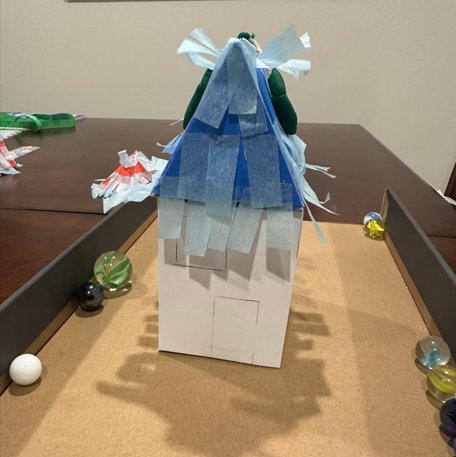
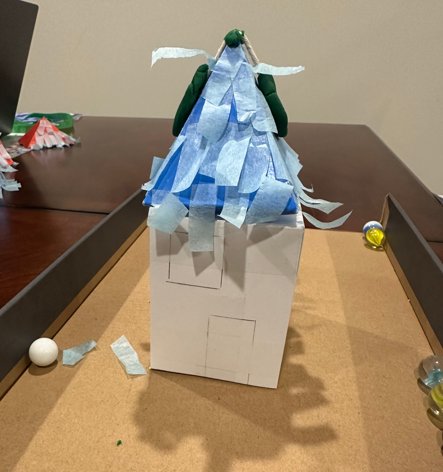
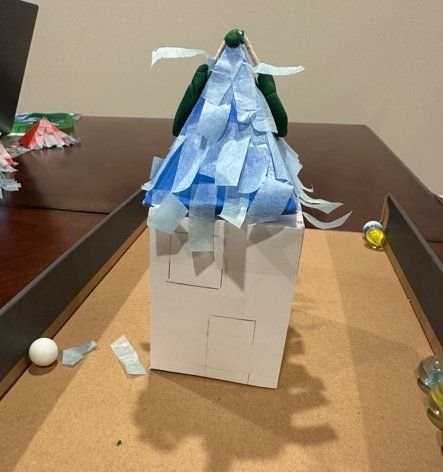
- The wind pushes hard against the flat front wall and presses paper against the wall
- Paper pieces nearest to the corners, edges and ridge lift the most.
- Paper at the back lifted more than those at the front or middle.
- Higher pitch gable roof shakes more and detaches faster than lower pitch gable roof.
- Paper pieces behave similarly for both slopes, those placed along sides, corners and ridge lift more.
- Paper along the ridge of steeper roof lifts more.
Pyramid hip roof observations:
- Airflow lifts the paper pieces along the edges more than those in the center of the triangular faces.
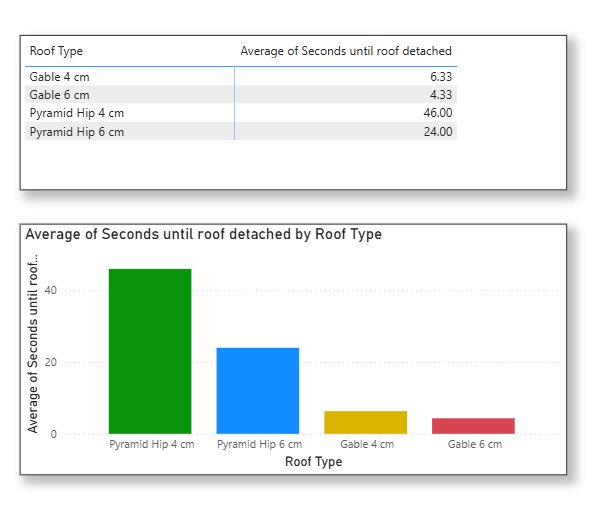
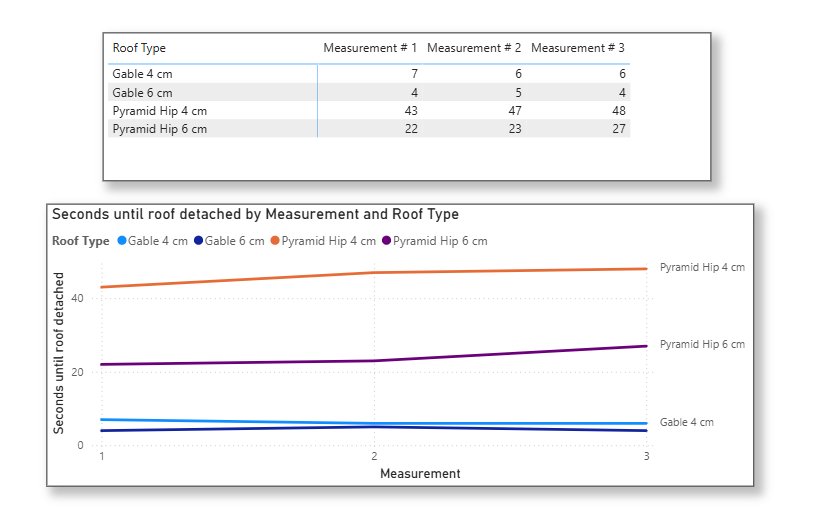
- Steeper pyramid hip roof detaches from the house faster than lower pitch pyramid hip roof.
- Steeper pyramid hip roof detaches from the house slower than lower pitch gable roof.
- Both pyramid hip roofs shake less than gable roofs.
Analysis
Measurements Distance between fan and roof - 65 cm
| Roof Type | Roof Height | Seconds until roof moved for 1 cm | Seconds until roof detached |
|---|---|---|---|
| Gable | 4 cm | 3 s | 7 s |
| Gable | 4 cm | 3 s | 6 s |
| Gable | 4 cm | 4 s | 6 s |
| Gable | 6 cm | 2 s | 4 s |
| Gable | 6 cm | 2 s | 5 s |
| Gable | 6 cm | 3 s | 4 s |
| Pyramid Hip | 6 cm | 4 s | 22 s |
| Pyramid Hip | 6 cm | 5 s | 23 s |
| Pyramid Hip | 6 cm | 5 s | 27 s |
| Pyramid Hip | 4 cm | 10 s | 43 s |
| Pyramid Hip | 4 cm | 11 s | 47 s |
| Pyramid Hip | 4 cm | 12 s | 48 s |
Conclusion
The results of this investigation show that the pyramid hip roof moves less and stays in place longer than the gable roof when exposed to wind from the front. There is a substantial difference between the two roof types due to their shapes. The flat vertical face of a gable roof redirects wind toward the sides, increasing wind speed and decreasing air pressure over the roof surface. This creates uplift demonstrated by the tissue paper flying up, against gravity, making the roof more likely to separate from the house. In contrast, the pyramid hip roof has four sloping triangular sides that push the wind upward and around the structure. This causes the wind force to be distributed more evenly across the entire roof, and causes a smaller area to be affected by uplift compared to gable supporting my hypothesis. The roof pitch also played a major role in wind resistance. Lower-pitched roofs performed better than higher-pitched ones because steeper sides create a larger surface area exposed to wind. A larger area results in greater uplift force, increasing the likelihood of roof movement or failure. Overall, the pyramid hip roof design proved to be more stable and more wind-resistant than the gable roof under the same testing conditions.
Application
The real‑world value of this project lies in helping architects design buildings that are safer and more wind‑resistant, especially in places with strong, frequent winds. Calgary is area known for powerful wind gusts, and severe summer winds and storms that can cause significant property damage. By understanding how different roof shapes respond to varying wind forces, designers and homeowners can make more informed choices that improve structural stability, reduce damage, lower repair costs and more importantly improve safety.
Sources Of Error
Keeping the height of the fan consistent was a source of issues. When the fan was sat too low, the airflow hit only the walls of the model house and barely reached the roof. When it was positioned too high, the airflow skimmed over the roof instead of striking it directly. In both situations, the reduced wind impact made the roofs seem stronger and more resistant than they truly were giving misleading results.
Finding the ideal distance from the fan to the house was another problem. When the fan was too far there wasn't a significant source of wind causing no roof movement. When the fan was positioned too close, the wind force became unrealistically strong and caused every roof, regardless of design, to collapse immediately.
Finding the proper weight to put on the house was a difficulty as well because if too much weight is applied the roofs won't move at all and if there isn't enough weight the roofs lack support and move straight away.
I didn't anticipate the house vibrating when exposed to the "wind" which was a challenge because the if the house is shaking then the roof becomes less stable affecting the accuracy of the results. The solution to this was was gluing the house to a shoebox lid and placing marbles in the shoebox lid for extra steadiness.
Keeping weights in the middle of the roof side was important. If the string is too long, it will cause friction when the roof starts moving, which can hugely affect results.
Citations
Under (Air) Pressure: Bernoulli’s Principle. (2026, January 18). Canadian Space Agency. https://www.asc-csa.gc.ca/pdf/eng/youth-educators/activities/science-and-technology/under-air-pressure-bernoullis-principle.pdf
Bernoulli’s Principle. (2026, January 18). National Aeronautics and Space Administration. https://www.nasa.gov/wp-content/uploads/2023/06/bernoullisprinciple-5-8-02-09-17-508.pdf
14 Types of Roof Lines: Which One Fits Your Home? (2026, January 18) architecturecourses.org https://www.architecturecourses.org/home-and-garden/types-roof-lines
TECHNICAL BULLETIN. (2026, January 24) Roofing Contractors Association of British Columbia 2024-July-1-Technical-Bulletin-Wind-Loads-and-Responsibility-for-Roof-Design.pdf
Pitch (roof). (2026, January 24) Roof pitch: Definition, Measurement https://professionalmetalroofing.ca/pitch/
Home Shapes And Roofs That Hold Up Best In Hurricanes. (2026, January 24) New Jersey Institute of Technology https://www.sciencedaily.com/releases/2007/06/070619155735.htm
The Science Behind Wind Damage: Understanding Roofing Dynamics (2023, January 24). (Visited on 2026, January 24). https://roofadvance.com/the-science-behind-wind-damage-understanding-roofing-dynamics/
Obinna, U (*2022, March 25.) How to Apply Wind Load on Roofs of Buildings. (Visited on 2026, January 31) Structville.com https://structville.com/2022/03/how-to-apply-wind-load-on-roofs-of-buildings.html
Durability by Design Help. (2026, January 31) EZ.pdh https://www.tulsaprotech.com/hip-vs-gable-roof/
Hip vs. Gable Roof: A Complete Comparison. (2026, January 31). Pro-Tech Roofing INC. https://www.tulsaprotech.com/hip-vs-gable-roof/
Acknowledgement
Vianny Fenske-Teacher, science fair leader and supervisor
Mariana Sanchez Hernandez-Homeroom teacher, STEM committee
Spencer Abbott-University of Calgary student and mentor
Mirjana Matic-Parent supervisor