
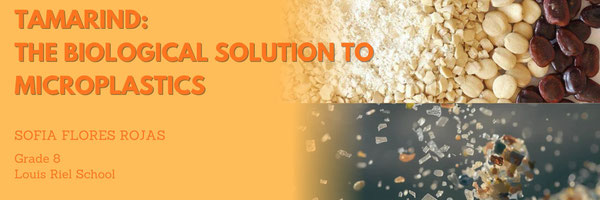
Tamarind: The Biological Solution to Microplastics
Sofia Flores Rojas
Louis Riel School
Grade 8
Presentation
No video provided
Hypothesis
If tamarind seed powder (TSP) is added to water contaminated with microplastics then it will facilitate the removal of the microplastics, because of its flocculational abilities, creating an efficient method of cleaning the water.
Research
RESEARCH
MICROPLASTICS:
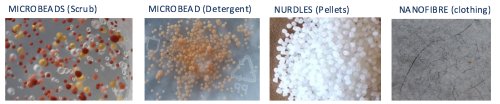
- synthetic, solid plastic particle that is less than five millimeters (about the size of a pencil eraser) in length
- Microbeads: Tiny plastic spheres historically used as exfoliants in personal care products like face washes, body scrubs, and toothpastes (many countries have since banned these).
- Microfibers: Tiny threads shed from synthetic clothing (polyester, nylon, acrylic) during washing or wear.
- Plastic Pellets: Also known as "nurdles," these are the raw, lentil-sized plastic material used in manufacturing to create other plastic products, which can spill during transport.
- Difficult to remove due to particle size, and the fact they are hydrophobic
CURRENT TREATMENTS FOR MICROPLASTICS
- Effective treatments uses polyacrylamide (synthetic polymer, highly efficient)
- Used in the City of Calgary 0.4 mg per 1 litre = removes up to 99% of particles
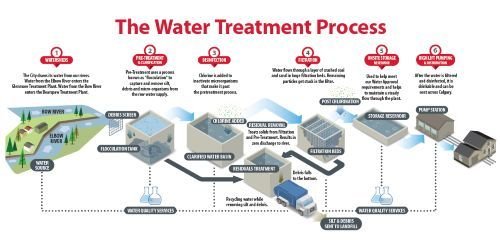
- In tanks, aluminum sulfate, sand and cationic polyacrylamide create a neutral PH ideal for flocculation
- Used under Provincial Regulations that ensure the safety of the consumers
- Removes 54% of hard microplastics from the water currently
- Reverse osmosis = filters that are less than 0.01 micron wide
- More effective than polyacrylamide, it removes up to 99.99% of microplastics
Waste Water Treatments at the City of Calgary
- Pine Creek wastewater treatment ACWA/City of Calgary
- Mainly uses tertiary water filtration
- Flocculation is a tool to supplement the main method
- UV light disinfection
- Biological good bacteria to eliminate harmful viruses from water
TAMARIND:
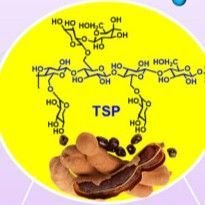
- Fruit-bearing tree that is native to Africa
- Pod-like fruit with multiple seeds within
- Chemical Formulation of TSP ( Tamarind Seed Polysaccharide) Comprised of three main sugars—glucose, galactose, and xylose
- The tamarind seed comprises two main parts: seed coat and kernel. The seed coat constitutes approximately 28.6% of the total seed mass and primarily consists of crude fiber and tannins. In contrast, the seed kernel contains 65–73% non-starch polysaccharide
FLOCCULATION
- Used in the City of Calgary’s pre-treatment for potable water = Polyacrylamide
- They neutralize the electric charges that separate particles
- In the City of Calgary potable water treatment, aluminum sulfate, quartz sand, and cationic polyacrylamide are combined to create a neutral PH for ideal flocculation.
- Allow them to form flocs (larger groups of particles)
- Sediment to the bottom and allow for easier removal
- Common flocculants: aluminum sulfate (alum), iron salts, and organic polymers
- Different durations to allow for more effective measurements flocculation typically ranges from 15-45min

CATIONIC POLYACRYLAMIDE:
- Synthetic polymer that carries a positive electric charge
- Preparation of cationic polyacrylamide uses large amounts of energy and chemicals
- Creates waste water and waste gas

- Q: Tell me more about yourself
A: My name is Tushar Sawant, and I’m currently the Team Lead at the City of Calgary for Process Engineering. I’ve worked in the potable water treatment plan for the past 9 years.
Q: How does the City of Calgary use synthetic polymers in the Potable Water Treatment?
We use cationic polyacrylamide that carries a positive electric charge. It's also mixed with a quartz sand which creates an ideal balance for flocculation around a neutral PH (Potential of Hydrogen).
Q: What are the dangers of using Cationic Polyacrylamide?
A: For the use of PAM, there are regulations in place that control how much can be safely used. Currently we use around 0.4 mg of polyacrylamide per litre of water, which is enough to remove 99% of particles. With these regulations there isn't any harm posed to the water consumers, so long as the quantity is under the recommended amount.
Q: Can tamarind seed powder replace synthetic polymers in large-scale water treatments?
A: The City of Calgary uses up to 2,000 kg of polyacrylamide in a month, so the supply of a polymer must be consistent and in large quantities, not to mention, each grain is perfectly uniform and regulated.
Q: How is flocculation currently being used in the city of Calgary?
A: Flocculation is used in our pre-treatment. “Raw water enters large mixing tanks where aluminum sulphate, sand and polymer are added which attach to particles in the water creating what is known as"floc ". This makes the particles heavy, causing them to settle to the bottom of the settling tank. The resulting clarified water moves on to a Clarified Water Basin, while dirty water at the bottom of the tank is pumped to a Residuals Treatment Facility. At this stage 99 per cent of sediment has already been removed from our drinking water. [16]
Q: What percentage of the microplastics are being removed?
A: In Calgary, most of our raw water comes from The Bow River Watershed or from the Bow Glacier, so there are few microplastics, if any, in our water. In the pre-treatment, 99% of contaminants or particles are removed, before going on to the next stages of the treatment. However there isn't any sampling to determine whether there are any microplastics in our water.
Q: How can the results of my project be applied?
A: Tushar: It's not impossible for tamarind to replace polyacrylamide, but, and I don't mean to be discouraging, it would need tremendous amounts of research and experimentation. Try applying your results to rural areas or Native communities that don't have access to clean water. Settling ponds are a common treatment, and the tamarind could be used there as a biodegradable polymer.
Q: What are some extensions to my project that you would recommend?
A: Try experimenting with different quantities of TSP and see if it would have the same effectability, as well as testing whether the addition causes a change in PH or turbidity. You could also try turning the TSP into a gel or a liquid, by adding it to warm water.
Variables
Variables
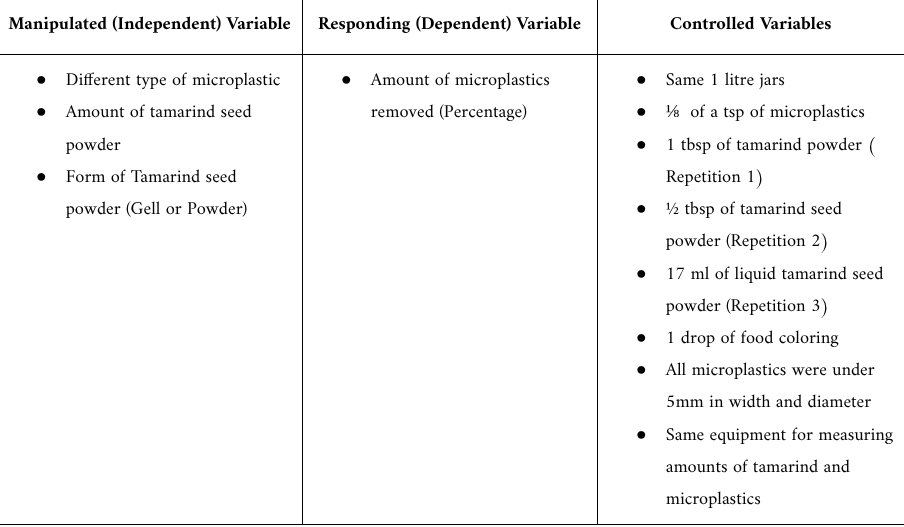
This table represents my contolled, manipulated and responding variables. Some variables in the controlled section only apply to my 3rd or 2nd experiment.
Procedure
PROCEDURE:
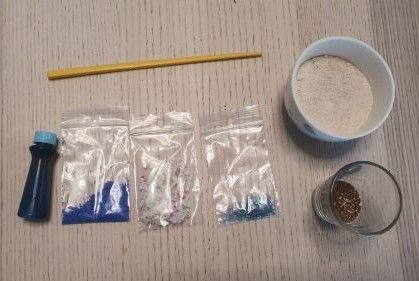
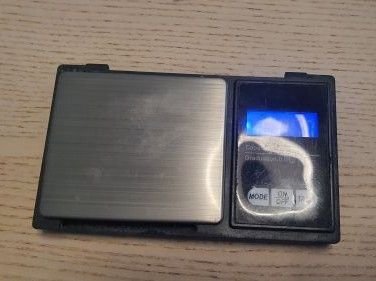
MATERIALS
PREPARATION (A)
Tamarind Seed Powder
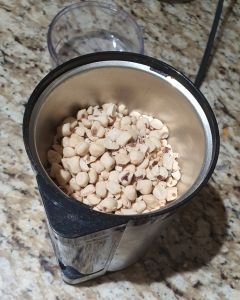
- Separate and dry tamarind seeds
- Remove testa (outer coating) and grind seeds (coffee grinder) until left with fine powder.
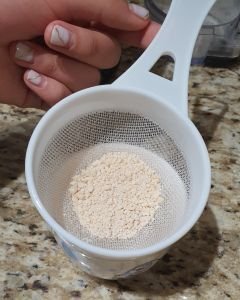
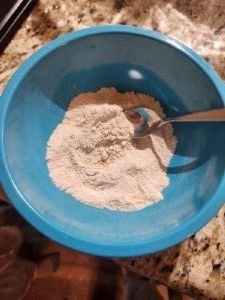 3 Types of Microplastics: Polyester, Nitrile and PET 1
- Cut into pieces no larger than 5 mm in width or diameter
- Store separately
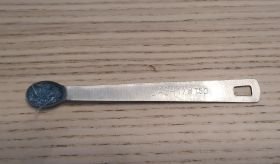
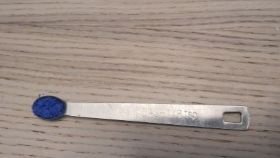
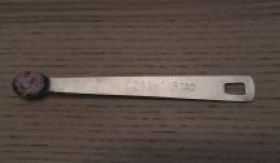
EXPERIMENT 1: 1 Tbsp of Tamarind Seed Powder
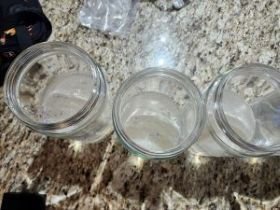
1. Fill six glass jars ( 2 for each microplastic ) with 1 litre of water each\, and 1 drop of blue food colouring.
2. Label the jars A (control) and B (Tamarind)
3. Measure 8.57g or 1 tbsp of powdered tamarind seed powder 3 times
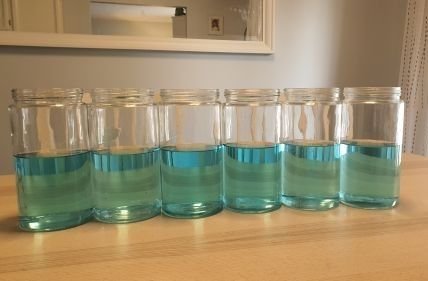 SAMPLE 1: Polyester
4. Measure 0.04g / 1 DASH of polyester fibres twice
5. In jar A sprinkle the polyester over the surface of the water
6. In jar B sprinkle the polyester and quickly cover in 8.57 g of powdered tamarind seeds.
SAMPLE 1: Polyester
4. Measure 0.04g / 1 DASH of polyester fibres twice
5. In jar A sprinkle the polyester over the surface of the water
6. In jar B sprinkle the polyester and quickly cover in 8.57 g of powdered tamarind seeds.
SAMPLE 2: Nitrile 4. Measure 0.06g / 1 DASH of cut Nitrile gloves twice 5. In jar A sprinkle the glove pieces over the surface of the water 6. In jar B sprinkle the glove pieces and quickly cover in 8.57 g of powdered tamarind seeds
SAMPLE 3: (PET 1) Plastic Bottle
4. Measure 0.21 g / 1 DASH of cut plastic bottle pieces (PET 1) 5. In jar A sprinkle the bottle pieces over the surface of the water 6. In jar B sprinkle the bottle pieces and quickly cover in 8.57 g of powdered tamarind seeds
(PART C) SEPARATION OF MICROPLASTICS FOR MEASUREMENT
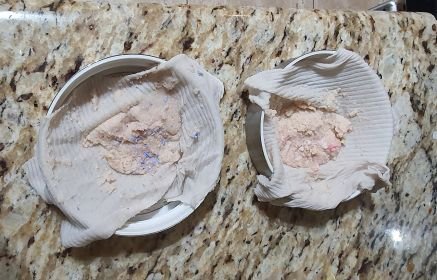
1. Remove all polyester fibre and tamarind left on the surface of the water.
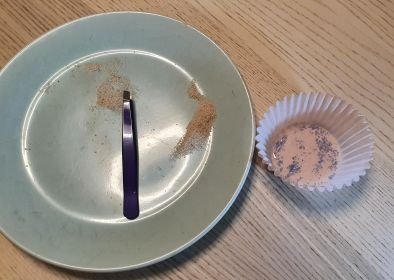
2. Pour the rest of the water/tamarind/polyester through a piece of cotton to drain all the excess water
3. Separate the fibres from the tamarind using pliers and weigh using a micro scale
4. Using the amount that was initially added and the amount of removed polyester\, formulate a percentage
PREPARATION (B)
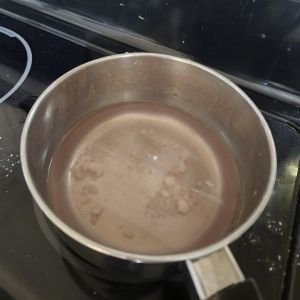
- Put 0.65 g of TSP into a pot into 1 litre of boiling water
- Stir and monitor consistently for 45 min
- Maintain a temperature below boiling
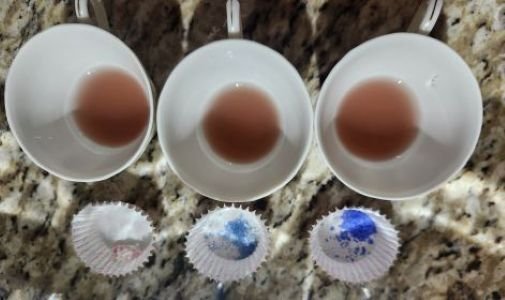
- Reduce the water until all that is left is a thick liquid and tamarind paste (it should be a soft pink colour)
EXPERIMENT 2 : LIQUID / PASTE TSP
1. Fill three glass jars ( 1 for each microplastic ) with 1 litre of water each. 2. Label the jars A (control) and B (Tamarind Liquid/Paste). 3. Measure 17 ml of liquid tamarind seed paste
SAMPLE 1: POLYESTER 4. Measure 0.04 g / 1 DASH polyester fibres 5. In jar B sprinkle the polyester and stir in 17 ml of tamarind liquid paste
SAMPLE 2: Nitrile 4. Measure 0.06 g / 1 DASH of cut Nitrile gloves 5. In jar B sprinkle the glove pieces and stir in 17 ml of tamarind liquid paste
SAMPLE 3: (PET 1)
4. Measure 0.21 g / 1 DASH of cut plastic bottle pieces (PET 1)
5. In jar B sprinkle the bottle pieces and stir in 17 ml of tamarind liquid paste
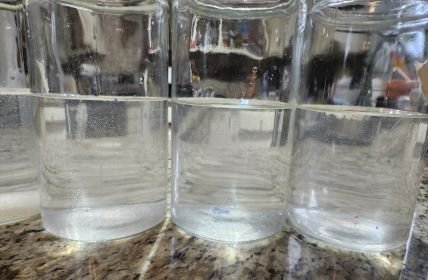
Repeat Part C for this experiment
PREPARATION: Repeat Preparation (A)
EXPERIMENT 3 : ½ Tablespoon of Tamarind Seed Powder
1. Fill three glass jars with 1 litre of water each 2. Label the jars A (control) and B (Tamarind). 3. Measure 4.25 of powdered tamarind seed powder
SAMPLE 1: POLYESTER 4. Measure 0.04 g of polyester fibres twice 5. In a jar sprinkle the polyester and quickly cover in 4.25 g of powdered tamarind seed
SAMPLE 2: Nitrile 4. Measure 0.06 g of cut Nitrile gloves twice 5. In a jar sprinkle the glove pieces and quickly cover in 4.25 g of powdered tamarind seeds
SAMPLE 3: (PET 1) 4. Measure 0.21 g of cut plastic bottle pieces (PET 1) 6. In a jar sprinkle the bottle pieces and quickly cover in 4.25 g of powdered tamarind seeds
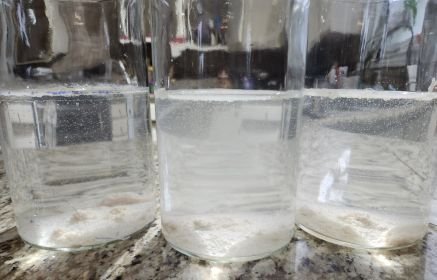 Repeat part C for this experiment
Observations
OBSERVATIONS:
1 Tbsp (8.57 g) of Tamarind Seed Powder:
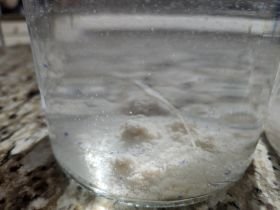
The heavier plastics , such as the PET 1 and Nitrile took longer to be attracted by the tamarind and therefore longer to sink
Likewise the lightest microplastic (the polyester) was the first to be absorbed by the tamarind. So heavier microplastics take nearly twice as long to be absorbed. Curiously, after 10 min, all the tamarind and microplastics stopped sinking to the bottom, as if the experiment had reached a standstill. Flocculation takes an average between 15 - 45 min, so the speed of the absorption was below average. In that case prolonging the experiment for a longer duration would not create a difference in the amount of microplastics attracted by the tamarind.
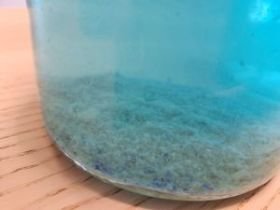
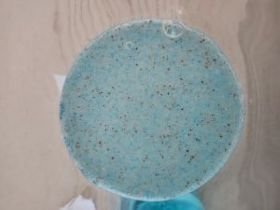
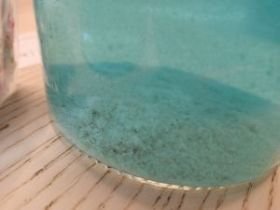
Percentage of Microplastics removed in comparison to total TSP 1 tablespoon Polyester: 0.35% Nitrile : 0.70% PET 1 : 2.5%
1/2 Tbsp (4.25 g ) of Tamarind Seed Powder:
Only the polyester fibres were 100% removed from the surface of the water, both the PET 1 and the Nitrile primarily remain on the surface of the water. The previous ratio of 1 tbsp to ⅛ of a tsp was far more successful across all microplastic types
Percentage of Microplastic in comparison to total TSP ½ tablespoon Polyester: 0.70% Nitrile : 1.4% PET 1 : 5%
I infer that if the percentage of microplastic to tamarind under 1% of microplastic to tamarind, then it will be attracted under 5 min, and will have a higher success rate than higher percentages of microplastics.
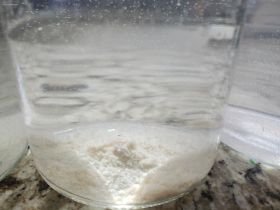
17 ml of Paste/ Liquid Tamarind Seed Powder:
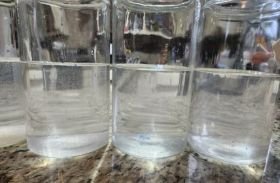
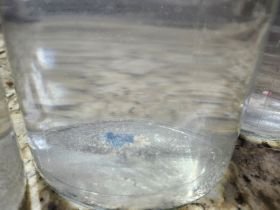
PET 1 has sedimented to the bottom of the jar and is surrounded by tamarind particles. For 7 min the gloves remained in a suspension, I think that the water and the Nitrile gloves have a very similar density, so it achieved neutral bouyancy. After 10min only a few had sedimented and most remained on the surface of the water, over 90%. The polyester has about 60% at bottom of the jar, but still far less than the 100% removal displayed by both amounts of TSP. Overall, far less effective than the TSP.
Analysis
Analysis:
Effectiveness of Removal by Method: The amount of tamarind seed powder that was most effective in causing the microplastics to sediment was 1 tbsp or 8.57 g. Additionally, I noticed that if the percentage of microplastics was under 1% in comparison to the total amount of TSP then its effectiveness of removal would be over 90%. Across all microplastic types, 1 tbsp of tamarind seed powder displayed 90 to 100% efficiency. In the 2nd rendition of my experiment, (where I used liquid/paste TSP), both the Nitrile and PET 1 were not attracted by the tamarind, with over 75% remaining on the surface of the water. Only the polyester had a removal rate of over 65%, though still significantly lower than the previous success of the TSP. In the 3rd rendition of my experiment, since there had been some tamarind seed powder that had created flocs by itself, I decided to experiment with a smaller dosage. I measured ½ tbsp or 4.25 g of TSP and ran my experiment again, with the same parameters as the first. Using the reduced amount, it yielded an equal amount of success with the polyester fibres, sedimenting 100% or all 0.04g. 66% of the glove pieces created flocs with the tamarind powder, and 38% of the PET 1 (plastic bottle), slightly more than the TSP fluid/paste but still less than the 1 tbsp.

The quantity necessary for most effective removal of microplastics would be 1 tbsp of TSP to ⅛ of a tsp of microplastics, as seen that lesser quantities of TSP are up to 30% less effective, as observed in the 3rd reiteration of my experiment. Furthermore, the investigation of the effects of the tamarind seed powder on the water PH and turbidity would allow for refinement. Microplastics that weigh less and are less dense, such as the polyester fibres, were absorbed more rapidly and the progression of sedimentation followed onwards following this.
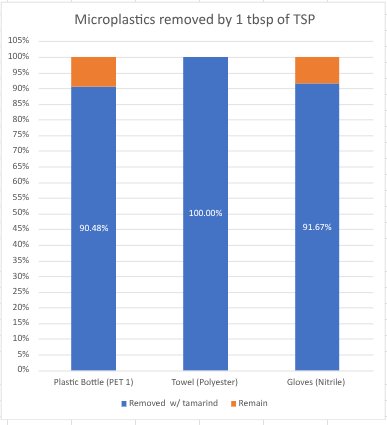 Using 8.57 g of tamarind seed powder, it was able to sediment 90- 100% of microplastics across all types, with the polyester gone from the surface of the water in 2 min.
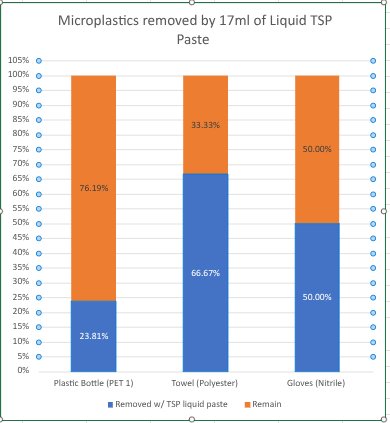 Using 17 ml of liquid tamarind seed powder paste, 23 - 66% of microplastics were sedimented, although it was less succesful than the first rendition by aprox. 30-70%
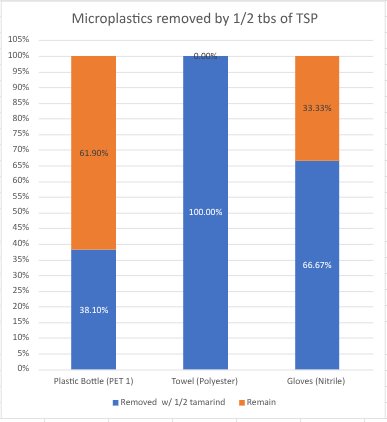 With 1/2 of a tbsp or 4.25 g, it succesfully removed 38- 100% of all microplastics, earning the same sucess for polyester as 1 tbsp of TSP.
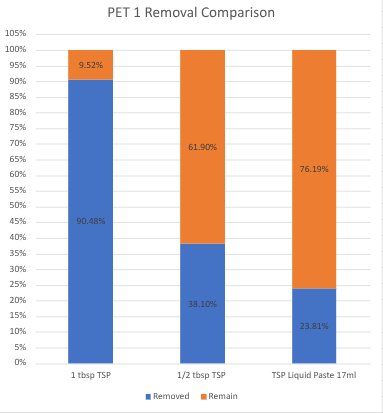 When looking at PET 1 and the effectiveness of removal across all forms and amounts of tamarind seed powder, 1 tbsp of TSP was by 50% the best method, removing 90.48%.
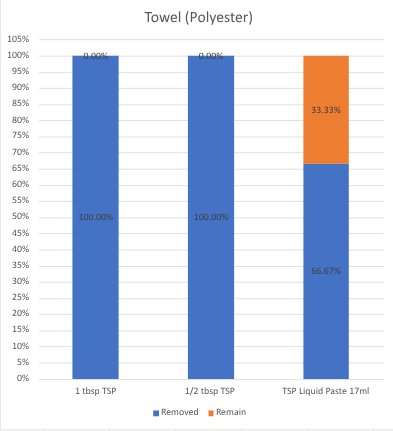 The polyester was by far the easiest microplastic to remove, with 100% sedimented by both amounts of tamarind seed powder. Only with the TSP paste was the percentage below 100%.
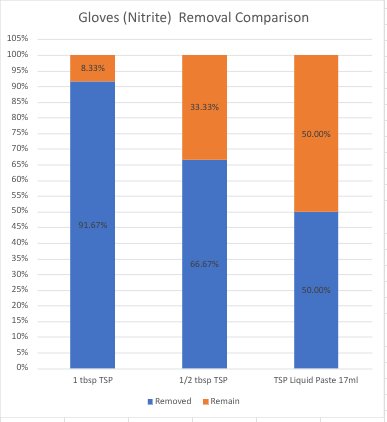 Nitrile Gloves had a sucessful removal rate from 50 - 91%. The best performing was by 30%, 1 tbsp of TSP.
Conclusion
In conclusion, tamarind does in fact facilitate the removal of microplastics from water through flocculation, proving my hypothesis correct. The quantity necessary for most effective removal of microplastics would be 1 tbsp of TSP to ⅛ of a tsp of microplastics, as seen that lesser quantities of TSP are up to 30% less effective, as observed in the 3rd reiteration of my experiment. Furthermore, the investigation of the effects of the tamarind seed powder on the water PH and turbidity would allow for refinement.
Application
The results of my experiment can be used for non-potable water treatment. For example , tamarind can assist in removing microplastics or contaminating particles in turbid water from rural areas or Native reserves , from water sources such as ponds, lakes and rivers. In a study conducted by Anwar Yimer and Bayisa Dame, they used papaya seed extract as a coagulant to treat samples from the Tulte River in Ethiopia. The papaya seeds yielded result in lowering the turbidity and removing suspended contaminants. Similarly, tamarind seed powder can be added to sedimentation ponds, and the cleaned water can then be used for irrigation, feeding livestock, utilities, and waste removal.
With further research, its capabilities can be used to treat the largest body of water on Earth, the Ocean and supposedly can remove nano plastics from the human body. This would need more extensive experimenting, as to see if the effectiveness would decrease in saltier water.
Sources Of Error
- Microscale may not be exact
- Consistency of the sizing of the microplastic (could affect efficiency)
- Tamarind powder may not be uniform
Citations
- American chemical society Research Update: Okra, fenugreek extracts remove most microplastics from water - American Chemical Society
- Microplastics: A Real Global Threat for Environment and Food Safety: A State of the Art Review Microplastics: A Real Global Threat for Environment and Food Safety: A State of the Art Review - PMC
- Government of Canada Microplastics: more than a drop in the ocean
- Microplastics detectable by size Microplastic sizes detectable by different techniques.
- Investigating the Use of Plant-Derived Polymers on the Reduction of Microplastics in Freshwater Samples acs.digitellinc.com/p/s/investigating-the-use-of-plant-derived-polymers-on-the-reduction-of-microplastics-in-freshwater-samples-476311
- Single-use plastic ban Single-use Plastics Prohibition Regulations: Overview - Canada.ca
- Microbead Plastic ban Microbeads - Canada.ca
- Tamarind Seed Polysaccharide https://www.sciencedirect.com/science/article/abs/pii/S0268005X2400496X
- Polyacrylamide Polyacrylamide | Water Treatment, Soil Stabilization & Flocculation | Britannica
- Microplastics in water Review Article Microplastics in water: Occurrence, fate and removal)
- Flocculation What is flocculation in water treatment? | Malvern Panalytical
- Ultrafiltration UF What is Ultrafiltration? How an Ultrafiltration Membrane Works
- Reverse Osmosis Does reverse osmosis remove microplastics?
- Application of Polyacrylamide Applied Polymer Systems How Polyacrylamide works!
- ACWA Waste Water Treatment About ACWA
- Calgary Water The Water Treatment Process
- Tertiary Water Filtration Tertiary Wastewater Filtration | Xylem Canada.
- Application of Tamarind Seed Powder as a Natural Coagulant in Drinking Water Purification
- Papaya seed extract as coagulant for potable water treatment in the case of Tulte River for the community of Yekuset district, Ethiopia Papaya seed extract as coagulant for potable water treatment in the case of Tulte River for the community of Yekuset district, Ethiopia - ScienceDirect
Acknowledgement
Acknowledgements
I have many thanks to give, so I'll start with the most important person.
For my Mom, without her support, I'd still be on the floor procrastinating and I simply wouldn't get much done. If it's printing, helping to format, or showing me the capabilities of Excel she is there for me every step of the way. Thanks Mom!
For Tushar Sawant, Team lead and Engineer at the City of Calgary potable water treatment, thank you for taking the time to answer my questions and helping to expand my project.
For the unamed Indian Auntie at Bombay Spices, without you I wouldn't have known how to separate the seeds from the tamarind fruit, nor had an extra vote of confidence I needed.
To all whom unknowigly led me to CYSF and supported me, I thank you.