
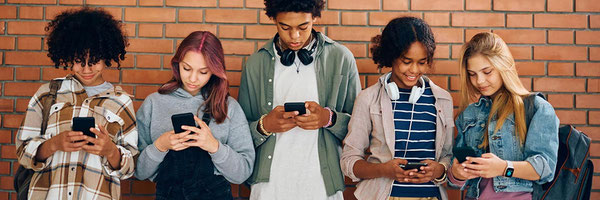
The Effects Of Social Media On Eighth Graders
Andrew McMorris, Wesley Straathof
Connect Charter School
Grade 8
Presentation
No video provided
Problem
We will be conducting two tests and gathering research to determine the degree of the effect that social media has on students enrolled in grade 8 at Connect Charter School. The purpose of this study is to further our society’s knowledge when it comes to threats to learning and mental health. This is a prominent issue because it impacts millions of people daily, regardless of their age. We hope that by providing information regarding this subject, it will lead to further awareness in this area.
Method
For our two tests, we will do as follows:
Test One
When conducting this experiment, we will set up a booth in the main hallway of the school, with signs containing QR codes that will lead to the google form questionnaire. We will have two questions on this survey, one titled “How Would You Say You Feel After Using Social Media For Fifteen Minute’s,” With the four answer’s being “More Happy Than Before,” “Same As Before,” “Less Happy Than Before,” and “Way Less Happy Than Before.” Our second question will be titled “In Your Opinion, Is Social Media Overall Positive Or Negative,” with the awnsers being “Positive,” “Negative,” and “Other,” with a section for them to justify their choice. The survey will remain open for three days, and will only be open for grade eights to respond to.
For this test, we hypothesize that the majority of people will choose a answer on the lower side of the emotional spectrum, being Less Happy Than Before and Way Less Happy Than Before. We also theorize that there will be a few outliers, as this experiment is being done in a school environment, and a select few will participate with the sole intent of skewing our results. The reason we think this way is because we have gathered research suggesting that social media will almost always negatively affect mood as well as eighth grader’s ability to focus.
Test two
For our second experiment, we will randomly select 12 people with no bias. These people will then be separated into two groups randomly, before taking a test of medium difficulty with four questions. After the test is finished, we will record the scores and then give the subjects the next step. If they are in group one, they will be given an iPad loaded up with YouTube shorts to scroll on for 15 minutes. If they are in group two, they will quietly talk amongst themselves for 15 minutes. After the timer is up, we will give both groups a test of the same difficulty as before, and compare that result to their earlier result. We will then see how the results were changed based upon what group they are in. The tests are generated using an ai platform, Microsoft copilot, to ensure that the difficulty of the tests are as close to equal as possible
For this test, we hypothesize that the students in group two will find the test easier and that their short term memory and recall will be better then the people who used social media during the fifteen minute period. We believe this because our research (see below) shows significant evidence that use of platforms such as Tik Tok degrades memory recall as well as capacity to learn new information.
Research
Experts say the hours teenagers spend on texting and social media are interlaced with a teenagers life. Raising anxiety and lowering self-esteem. A study done by the Royal Society for public health in the UK took people of ages of 14 year olds through 24 found that social media platforms like Facebook, Snap Chat, instagram led to a higher level of poor body images, anxiety, loneliness, and signs of depression. This also has a big impact on your day to day life, meaning that if you are constantly feeling lonely, and are always anxious you will struggle with school. Staying on task and staying focused is hard. Your mind is constantly drifting back to social media and the feeling of butterflies in your stomach. A article published by the Youth and Society published a survey where they took of 1459 middle schoolers and analyzed their results of how the using of social media such as X, Facebook, Snapchat, and Instagram showed that academic achievement decreased and the level of quality work decreased with the using of social media.A study conducted by Gordon and Ohannessian analyzed middle schoolers and their grades they found as the usage of social media increased their grades decreased even when controlling Grade, ethnics ,age and gender. But their test they did focused only on ages 11 to 15 years of age to see what the effects of social media were, and how social media effects them on a daily basis.
This is some background knowledge that I learned from social media. When I was around the age 11-12 I was obsessed with YouTube shorts, in other words I was addicted. During this time I saw a massive decline in my attention span. I noticed when I was out and about I would always feel bored and I would always feel the need to watch YouTube shorts. I could not sit still. I would be bouncing off the walls like a monkey. This really had a big impact on me in school because I could not sit still. I found that I was always shaking my knee and my feet and I was always zoned out. Which really impacted my grades. I was always a good student and had good grades but when I got social media in my life I saw a slow decline in success. Knowing that I’m in middle school (grade 8) I started to cut social media out for the better of me and my life to see if it would improve my academic career. I found that when I started to quit social media my attention span increased not by much but I definitely saw an improvement. And with this I found that my academics and grades went up. I felt more involved in school. It made school easier for me and the outcome of my grades.
Also science experts say that social media and even the sound of a message coming through has an impact on people’s brains and can lower self esteem and build extremely anxiety levels among teenagers. Teenagers are losing major skills when growing up because of social media and text. Teenagers are always scrolling, texting in their free time leaving them with no social skills. Teenagers are losing their skills to interact with other people rather than just texting them over their phones. They are missing out on key body language when they aren’t face to face. You aren’t able to see how your actions are doing on a person across a platform, but in real life you can experiment with your words face to face and see how your words are affecting them.
As said by the America Physiological Association teenagers are spending just under 5 hours a day on social media. That's one fifth of your day wasted on social media platforms. Meaning in average including school you spend half your day on social media and school combined. Meaning we spend more time on our phones and social media than we go to a school each day which is mind boggling. 41% of the highest use of social media by teenagers rate their mental health really low and very poor. With a number of cases of these people harming themselves in the past.
Data
Our first test, the survey, received only three responses, with each respondent selecting a different answer to the questions based on opinion. The first respondent indicated that they thought they felt “Less Happy Then Before Using Social Media.” This same respondent believes that social media has an overall negative effect on students in eighth grade. Our second respondent selected the option titled “Same As Before Using Social Media.” For the second question, the respondent indicated that they believed that “Social Media Can Be Good Or Bad, Depending Upon How You Use It.” The third and final respondent showed that they too thought they felt the same as before using social media. For the second question, they shared their belief that social media is overall positive.
For our second test, the study, the majority of students who participated answer all of the questions correctly. There were five participants who got one or more of the questions wrong. Subject one got a 4/4 on the first test, and after talking amongst friends for fifteen minutes, received a 4/5 on the second test. Subject two scored a 3/4 on the first test, and after watching YouTube for 15 minutes, improved their score by getting a 5/5 on the second test. Subject seven got a 3/4 on the first test, and talking improved their score to a 5/5 on the second test. Subject ten received a 4/4 on the first test, and after using social media, scored a 2/5 on the second test. Subject twelve got a 4/4 on the first test, and after using social media, their accuracy went down to a 4/5. In addition to this, we noticed that the people who were talking finished 2 minutes before the people on social media.
Conclusion
Thanks to our research and our data, we have determined that social media is overall negative on the brains of eighth grade teenagers. In the area of mood, we conducted an opinion based survey that showed the majority of people believed that they felt less happy than before using social media, and they believed that social media was overall negative. in the area of memory and recall, we have come to the conclusion that social media has a negative effect on our subjects. With the exception of a few outliers, the majority of students who watched social media decreased on the next test, with people who were conversing improved their scores from the previous test. In addition to this, the people who were in group one (talking and chatting) finished an average of 2 minutes earlier than the people in group two (social media), while still scoring higher than them. This shows that social media decreases the accurateness and speed of which you can recall information. This fact is supported by our research, in which we have discovered other similar tests conducted by professionals that has data that is similar to our findings.
In conclusion, social media decreases the speed that you can recall information with. It will also increase the chance that you will remember the wrong information, causing slow and inaccurate students. People believe that using social media decreases the quality of their mood, but that is opinion based and not proven with fact. In addition to this, there is a risk that students will find something inappropriate for their age level. Overall, social media is almost entirely negative. A couple other reasons, such as communication could be a good use for social media, but that is not the purpose of this study. This matches what we predicted in our hypothesis, solidifying our belief that social media is a negative influence on eighth grade
Citations
Effects of social media on Teenagers Published in the 2020s but last update February 20 2026 published by Rachel Ehmke. This article is about how social media affects teenagers and teenagers growing up without some social skills .
Social media use and academic achievement Published March,12,2024, published by Jessica Henderson. This article is about use of social media and how it ties in with academic success.
How social media affects adolescence brains development. Published in 2023 last update may 12,2023, published by Levi Fishman. This article is about the impact on teenagers brain development and how teenagers are addicted to using social media.
THow much time teenagers spend in social media an the affect on their mental health Published,April 1 2024 by Tori DeAnglis. This article is about how long teenagers spend scrolling on social media and how it impacts teenagers natal health.
Acknowledgement
We wish to say thank you to Mr. Neil, our coordinator, for providing invaluable assistance throughout the project.
We also wish to thank Andrew’s science teacher, Ms. Malcolm, for giving us a space to work during recesses
Last but not least, thank you to all the CYSF organizers who made it possible to even be here today