

How does shape and surface area affect air resistance and fall speed?
Sahibjot Pardesi
Khalsa School Calgary Educational Foundation
Grade 5
Presentation
No video provided
Hypothesis
I think, the parachute shape will take the longest time to reach the ground because it has the most surface area and it will most impacted by air resistance. I think, the crumbled ball will be the first the reach the ground because it has the least surface area and hence air resistance will be minimal.
Research
I learned that as the object falls towards the ground, it keeps increasing in speed. If an object reaches the terminal velocity, which is when the drag force equals the gravitational pull, it stops increasing in speed. The exact time an object will reach terminal velocity depends on the object’s weight, texture, size, and shape. Newton’s third law states that for every action, there is an equal and opposite reaction. So, when objects fall through the air that is a downwards action to which air resistance is pushing upwards. That is the opposite reaction.
Aristotle’s theory states that heavier objects fall faster than lighter objects. His theory was ignored for almost 2000 years until Galileo Galilei came along. Galileo proved aristotle’s theory wrong by going up the Leaning Tower of Pisa and dropping two balls with different weights . Both balls hit the ground at the same time proving Aristotle’s theory incorrect.
Variables
Independent Variables: Shape of the object, and the surface area. Dependent Variables: Time it took to reach the ground. Controlled Variables: The weight of the objects, and the type of paper used.
Procedure
- Make different shapes like cone, crumpled ball and a parachute.
- Drop them from the same height and measure the time it takes for them to reach the ground.
- Repeat the process with other shapes.
- Repeat this process four times.
- Calculate average time it took to drop for each shape.
Observations
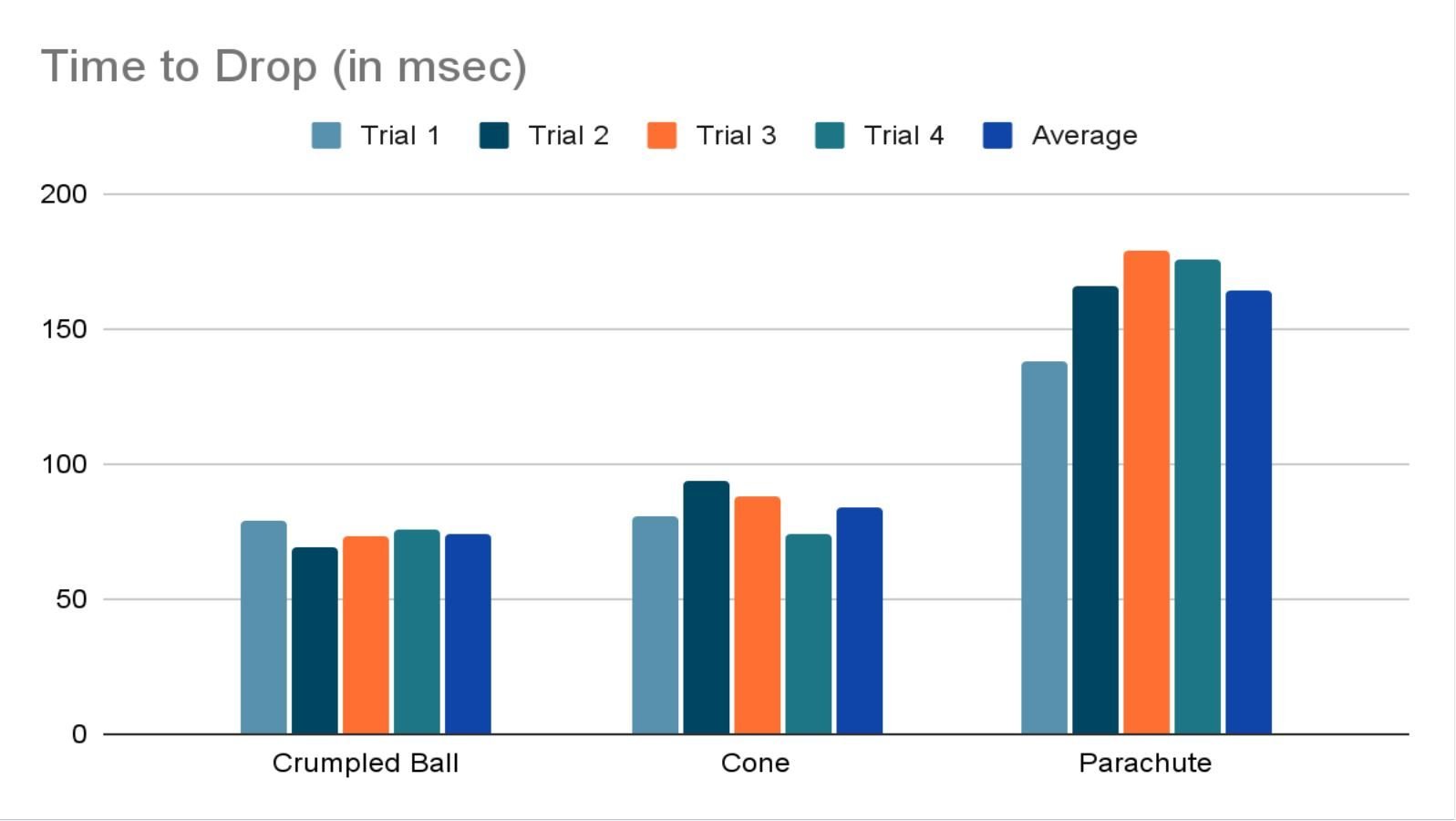
| Particulars | Crumpled ball | Cone | Parachute |
|---|---|---|---|
| Trial 1 | 79 millisec | 81 msec | 1.38 sec |
| Trial 2 | 69 msec | 94 msec | 1.66 sec |
| Trial 3 | 73 msec | 88 msec | 1.79 sec |
| Trial 4 | 76 msec | 74 msec | 1.76 sec |
| Average | 74 msec | 84 msec | 1.64 sec |
Analysis
The parachute had the most surface area, it reached the ground the slowest with an average of 1.64 sec. Whereas,the crumpled ball had the least surface area and took the shortest time to reach the ground with an average of 74 msec. On the other hand, the cone had a surface area in the middle, so it reached the ground with an average of 84 msec. No shape was able to reach Terminal Velocity because the height was very small.
Conclusion
From this experiment, we can prove that shape and surface area does affect air resistance and fall speed and the results prove that. The parachute, having the largest surface area took the longest time to reach the ground while the cone was in between the other two samples. Since the crumpled ball had the smallest surface area, it hit the ground the fastest.
Application
Engineers can use this information to design parachutes. Parachutes are used by many people. They are used by the army, astronauts returning from space, skydivers, and paragliders. This information tells engineers that the more surface area an object has, the greater time it stays in the air. Using this information, engineers can design parachute that slow down the fall of a person even more than parachutes do today. Parachutes should have the most surface area they can and the shape should be as flat as possible.
Sources Of Error
- On some of the trials, I stopped the Stopwatch a few Milliseconds after the shape had touched the ground. It would be more accurate if I had reacted sooner.
- I used tape which might have increased the weight by a few milligrams.
- Also since I used tape it might have increased the fall speed since the surface of the tape is smoother than the surface of the paper.
Citations
Air resistance. (2021, December 16). Primary Science Online. https://primaryscienceonline.org.uk/glossary-of-terms/air-resistance/
Debunked. (2023, June 3). Do heavy objects actually fall faster than light objects? DEBUNKED [Video]. YouTube. https://www.youtube.com/watch?v=ZgqJ5wQF944
Free fall and air resistance. (n.d.). https://www.physicsclassroom.com/class/newtlaws/Lesson-3/Free-Fall-and-Air-Resistance
How does air resistance impact a falling object? | TutorChase. (n.d.). https://www.tutorchase.com/answers/ib/physics/how-does-air-resistance-impact-a-falling-object
Manocha Academy. (2023\, October 28). Motion under Gravity | Free fall [Video]. YouTube. https://www.youtube.com/watch?v=6mFGzESlmxI
NASA Glenn Research Center. (2024\, July 18). Falling Object with Air Resistance | Glenn Research Center | NASA. Glenn Research Center | NASA. https://www1.grc.nasa.gov/beginners-guide-to-aeronautics/falling-object-with-air-resistance/
Parachutes: Does size matter? (2025, September 25). Science Buddies. https://www.sciencebuddies.org/science-fair-projects/project-ideas/Aero_p017/aerodynamics-hydrodynamics/parachutes-does-size-matter
Phantastic Physics. (2025, April 22). Do heavier objects fall faster? (Gravity & Air Resistance Experiment) [Video]. YouTube. https://www.youtube.com/watch?v=Vn5EK9pwEws
Acknowledgement
I would like to thank my mom and dad for helping me with this project. This project would not have been possible without them. I also would like to acknowledge my teacher for guiding me throughout this project.