
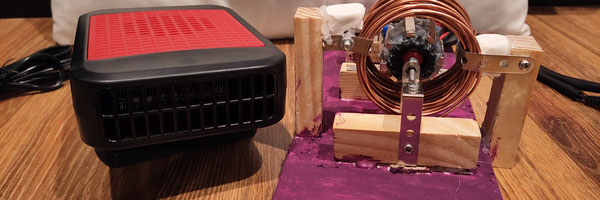
Efficiency of Lenz effect heater versus a conventional space heater.
Asna Syed
Sir Winston Churchill High School
Grade 11
Presentation
No video provided
Hypothesis
According to the law of conservation of energy, energy is neither created nor destroyed, but instead transformed into other forms such as thermal, electrical, mechanical, or radiant energy. During these transformations, some energy is inevitably dispersed as heat, which affects the overall efficiency of many systems. Based on this principle, my hypothesis is that a Lenz’s Law–based heater would be able to increase temperature under SATP conditions more efficiently than a resistive heater. This is because, during the transportation of electrons in a resistive heater, energy is lost as heat through the Joule effect, where electrical resistance converts electrical energy into thermal energy. In contrast, a Lenz’s Law–based heater uses changing magnetic fields to induce eddy currents directly within a conductor, which may produce heat more efficiently. Although both heaters rely on the Joule effect to generate heat, this experiment focuses on efficiency—specifically, which heater experiences the least energy loss and heats up most effectively relative to the electrical energy input. Which according to this, I believe to be the Lenz-law effect heater.
Research
Lenz Law: Lenz’s Law was discovered by Heinrich Lenz in 1834 which describes electromagnetic induction, where a changing magnetic field induces a current in a nearby conductor. This current will always flow in a direction that opposes the change in magnetic flux that produced it. When the magnetic flux changes continuously, circulating currents known as eddy currents are generated. Due to the electrical resistance of the conductor, these currents produce heat. This process uses the law of conservation of energy, as the current resists changes in magnetic flux. Modern applications of Lenz’s Law include induction heating and technologies designed to harness renewable energy. Implementing Lenz’s Law in practice presents several challenges. A common misunderstanding associated with the law is the negative sign in Faraday’s equation, EMF = –dΦ/dt. It indicates that the induced current opposes the change in magnetic flux, which is critical for maintaining energy balance. Interpreting this negative is essential, as it ensures energy is conserved during opposing flux changes (not violating the law of conservation). Despite these challenges, Lenz’s Law has been used as the foundation for the development of generators, transformers, induction heating systems, and magnetic braking technologies. However, these systems have not yet reached their full efficiency potential. Some question whether the negative sign in the equation contradicts the law of conservation of energy; it does not. The negative simply accounts for the opposing magnetic flux. Changes in conductor properties, such as increased surface area, can enable larger eddy currents to form, resulting in greater heat generation and enhanced system efficiency. The negative also accounts for the fact over time it is inevitable the magnet will heat up which causes its polarity to weaken.
Eddy currents: Eddy currents are electrical currents that form within conductors when they are exposed to a changing magnetic field. The first observations of these currents were made by François Arago in 1824, when he found that conductive materials could become magnetized through motion and magnetic interaction (Aragos Rotation Experiment 1824). These observations were later explained by Michael Faraday in 1831 through Faraday’s Law of Induction, which states that when the magnetic field around a conductor changes, voltage is induced in said conductor, then if the conductor provides a closed path, this voltage causes an electrical current to flow (eddy currents), which circle through the conductor. In 1834, Heinrich Lenz introduced Lenz’s Law, which explains the direction of these currents. It states that the induced current will flow in a direction that opposes the change in magnetic field that produced it. Essentially the current will flow in opposite to the change in magnetic field. Because of this, eddy currents create a secondary magnetic field that resists the original magnetic change (reason for the negative in Faraday's equation). When a conductor moves/surrounds a non-uniform magnetic field, electromotive forces (EMFs) are generated within loops of the material. These EMFs cause the eddy currents to dissipate energy as heat, further proving Faraday's and Lenz's Law. This heating effect is a direct result of the loss of electrical energy within the conductor.
Joule Law: Joule’s Law explains the relationship between work and heat energy within a system. It states that the amount of work done on or within a system directly correlates to the heat added to that system. The law was established by James Prescott Joule in 1840 through a series of experiments studying energy conversion. One of Joule’s main experiments involved stirring water using paddles connected to falling weights. As the weights dropped, they turned the paddles, causing them to stir the water and increase its overall temperature. Joule measured the temperature rise and compared it to the amount of mechanical work done by the falling weights. Using the heat equation (Q=mcΔT), he was able to measure the heat produced. Through this experiment, Joule demonstrated that mechanical energy could be converted into thermal energy. This discovery helped confirm the principle of energy conservation, that energy is not created or destroyed, but instead transformed from one form to another.
Resistive Heaters Fundamentals: Resistive heaters work by passing an electric current through a material that resists the flow of electricity. This resistance turns electrical energy into thermal, which then warms the surrounding area through conduction, convection, or radiation. The first practical resistive heater was created by Albert Leroy Marsh in 1905, when he developed a high-resistance alloy called nichrome that could safely generate heat without melting (Still used till this day).
Variables
Manipulated variable:
- Type of heater
Responding variable:
- Temperature raised above SATP
- Energy output
Controlled variable:
- Distance of thermometer from heater
- thermometer
- Energy input
- Space of room
- Max time will be 1 hour
- Type of magnets
Procedure
Procedure for creating Lenz Law heater:
Materials
- 6V motor, MONTOY Build-It-Yourself kit, Stripper and wire cutter, Clay (polymer or air-dry), 3 × 3 cm neodymium magnets (x2), 1 cm circular neodymium magnets (x8), 2.5 cm screws (various), Drill and drill bits, Cardboard, Jenga blocks 2.1 × 7.6 cm (x6), Foam, Super glue, Baseboard: 31.7 × 10.3 cm, thickness 1.3 cm, copper wire: 12 ft, Hot glue gun
Base Construction
- Place 2 Jenga blocks horizontally toward the center of the baseboard with a 4.5 cm gap between them
- Drill four pilot holes from the bottom of the baseboard into the Jenga blocks (2 per block, evenly spaced)
- Screw in 4 screws from the bottom, ensuring they are flush
- Stack 2 more Jenga blocks on top of the original stands, side by side
Motor Mount
- Place the motor on top of the two horizontal Jenga blocks
- Use 2 D09 pieces from the MONTOY kit to secure the motor: bend across the motor body and mark where they meet the side of the Jenga blocks
- Drill pilot holes and secure the motor with the D09 pieces, sandwiching the motor
- Fill any excess space along the sides of the motor with foam to reduce vibration
- Attach an S25 screw with the ridged part facing away from the motor. Fill the drive side with hot glue and quickly press onto the gear; let dry
- Repeat on the other side with a 6.3 cm screw, placing hot glue on the S25 side, and push it in
- Slide a nut onto the other side and attach S25 + T01 pieces, facing each other. Add a locking nut and secure tightly
- Fill the gap between the wheels with hot glue, keeping it level to increase the surface area of the rotating part
Magnet Installation
- Attach the 3 × 3 cm neodymium magnets opposite each other on the wheels; ensure the same polarity faces outward
- Attach 4 circular neodymium magnets in a square pattern and fill remaining gaps on each side, keeping polarity consistent
Vertical Supports
- Place 2 vertical Jenga blocks on either side of the baseboard along the edges, 3.5 cm apart
- Drill pilot holes from the bottom and screw the vertical Jenga blocks into place
- Hot glue 2 × 2 cm clay cubes on top of each vertical support, and another clay cube centered between the two supports
Copper Coil Stand
- Roll the copper wire into a coil approximately 8 cm in diameter
- Bend D09 pieces around the coil and clay cubes, forming a U-shape to hold the coil
- Mark the pilot hole locations, then drill and secure the U-shaped holders with screws cut in half
- Ensure the coil is evenly spaced and stable on the vertical supports
Horizontal Stand & Axle Placement
- Place the motor and axle assembly on the horizontal Jenga stands
- Cut 2 X3 pieces in half to create L-shaped supports. Center the axle and motor, mark the positions, and drill pilot holes
-
Screw the L-shaped supports into the horizontal Jenga blocks to hold the axle in placeVertical Axle Support
-
Use E5 pieces (x2) to create a box-like vertical support
- Attach an A6 and a nut through the box to align with the axle screw
- Mark and drill a pilot hole on the baseboard without going through it
- Place a 1.5 × 1.5 cm cardboard piece under the hole for support
- Cut another screw in half and secure the box-like vertical support to the baseboard
- Attach B805 (trimmed) to the support so it aligns with the axle. Apply super glue and press firmly
Final Assembly
- Place a horizontal Jenga block between the vertical box supports. Drill a pilot hole and secure with a flush screw
- Ensure the motor, axle, and coil are all aligned, free to rotate, and not touching other components
- Check that all screws, nuts, and glue connections are tight but allow rotation where necessary
- Test the motor briefly to ensure smooth rotation without wobbling.
- Confirm the copper coil is properly positioned around the rotating magnets
- Add any additional foam or clay supports to reduce vibration if needed
- Connect the motor to a power source and test
Procedure for Testing both heaters:
- Gather materials; both heaters, infrared thermometer, power source, timer
- Find a small room removing any hazardous materials (anything flammable or combustible)
- Place whichever heater being tested first on the floor ensuring safe distance away from any flammable objects
- Using the infrared thermometer, take the temperature of the room
- Recording it on a sheet of paper
- Plug in the power source to an outlet and attach whichever heater is being tested first
- Turn on the heater and set a timer for 1h
- Leave the room and close the door
- After an hour is over return back to the room taking the temperature using the infrared thermometer not pointed directly at the heater but in the general space of the room
- Turn off the power source
- Wait for the room to cool back down before repeating the test again from a total of 3 times of each heater
Observations
| Type of Heater | Time ran for (1hour) | Starting temp degrees (K) | Final temp (K) |
|---|---|---|---|
| 12V heater | 1h | 297.1 | 347.2 |
| 12V heater | 1h | 296.1 | 347.8 |
| 12V heater | 1h | 297.3 | 345.4 |
| Average | |||
| 296.8 | 346.8 |
| Type of Heater | Time ran for (1hour) | Starting temp degrees (K) | Final temp (K) |
|---|---|---|---|
| Lenz Law heater/ 6V | 1h | 295.7 | 310.9 |
| Lenz Law heater/ 6V | 1h | 295.6 | 307.8 |
| Lenz Law heater/6V | 1h | 296.1 | 311.2 |
| Average | |||
| 295.8 | 310 |
Analysis
Both heaters performance graphs
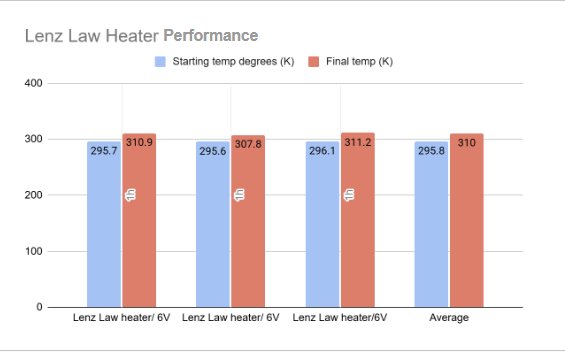
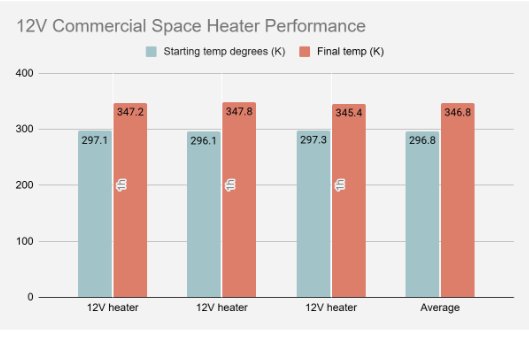 The overall goal of this experiment was to test if a heater created using Lenz Law effect would be more efficient than a commercially built resistive heater. Using the results above and considerations, we can calculate the efficiency of each machine:
Overall Variable Tables:
| Variable Type | Variable | Value / Description | Equation / Calculation |
|---|---|---|---|
| Room Information | Room length | 157.2 cm | — |
| Room width | 54.3 cm | — | |
| Room height | 80.6 cm | — | |
| Room volume (Vroom) | 0.688 m³ | V = Length × Width × Height = 1.572 × 0.543 × 0.806 m³ | |
| Air density (ρ) | 1.2 kg/m³ | — | |
| Mass of air (m) | 0.826 kg | m = ρ × Vroom = 1.2 × 0.688 | |
| Manipulated Variables | Type of heater | 12V heater | — |
| Voltage (V) | 12 V | — | |
| Current (I) | 16.6 A | — | |
| Time heater ran (t) | 1 hour (3600 s) | — | |
| Responding Variables | Starting temperature (T₁) | 297.1 K | — |
| Final temperature (T₂) | 347.2 K | — | |
| Temperature change (ΔT) (test 1 for commercial heater) | 50.1 K | ΔT = T₂ − T₁ = 347.2 − 297.1 | |
| Energy absorbed by air (Qair) | 41589.51 J | Qair = m × c × ΔT = 0.826 × 1005 × 50.1 | |
| Sample Calculation | Heater efficiency (η) | 5.79 % | η = (Qair / ElectricInp) × 100% = (41589.51 / 717120) × 100 |
| Controlled Variables | Specific heat capacity of air (c) | 1005 J/(kg·K) | — |
| Air pressure | 88.6 kPa | — | |
| Electrical energy Input | 717120 J | ElectricInp= V × I × t = 12 × 16.6 × 3600 (1h) |
Using this information we can now calculate the efficiency of all three tests of the commercial space heater:
| Commercial heater | Efficiency | Average |
|---|---|---|
| Test 1 | 5.79 % | 5.80% |
| Test 2 | 5.98% | — |
| Test 3 | 5.52% | — |
- We can see that the overall average efficiency for the commercial is 5.80% which makes sense as the heater was used in a small space that was not completely air tight
Using the same chart with a few sectioned changed we can layout the variables once more: Variable Type
| Variable | Value / Description | Equation / Calculation |
|---|---|---|
| Room Information | Room length | 157.2 cm |
| Room width | 54.3 cm | — |
| Room height | 80.6 cm | — |
| Room volume (Vroom) | 0.688 m³ | V = Length × Width × Height = 1.572 × 0.543 × 0.806 m³ |
| Air density (ρ) | 1.2 kg/m³ | — |
| Mass of air (m) | 0.826 kg | m = ρ × Vroom = 1.2 × 0.688 |
| Manipulated Variables | Type of heater | 12V heater |
| Voltage (V) | 6 V | — |
| Current (I) | 3 A | — |
| Time heater ran (t) | 1 hour (3600 s) | — |
| Responding Variables | Starting temperature (T₁) | 297.1 K |
| Final temperature (T₂) | 347.2 K | — |
| Temperature change (ΔT) (test 1 for Lenz Law heater) | 15.2 K | ΔT = T₂ − T₁ = 310.9 - 295.7 |
| Energy absorbed by air (Qair) | 12617.97 J | Qair = m × c × ΔT = 0.826 × 1005 × 15.2 |
| Sample Calculation | Heater efficiency (η) | 19.47% |
| Controlled Variables | Specific heat capacity of air (c) | 1005 J/(kg·K) |
| Air pressure | 88.6 kPa | — |
| Electrical energy Input | 129600 J |
Using this information we can now calculate the efficiency of all three tests of the Lenz Law heater:
| Lenz Law heater | fficiency | Average |
|---|---|---|
| Test 1 | 19.47% | 18.15% |
| Test 2 | 15.63% | — |
| Test 3 | 19.34% | — |
- As shown the overall efficiency of the Lenz Law heater is much higher
Analysis
As shown in the data, the Lenz Law heater performed better in terms of efficiency, with an average efficiency of 18.15%. Although it only increased the room temperature by approximately 15 K, the total electrical energy input was significantly lower than that of the commercial heater. Because efficiency is calculated as useful energy output divided by total energy input, the lower power consumption resulted in a higher overall efficiency percentage. In contrast, the commercial heater increased the room temperature by approximately 50 K, which is a much larger temperature change. However, its efficiency was only about 5.80%. The lower efficiency can be better understood by comparing the total energy input and electrical requirements of each heater. The commercial heater operated at 12 V, which is double the voltage of the Lenz Law heater (6 V). However, voltage alone does not determine power. The commercial heater required 16.6 A, while the Lenz Law heater required only 3 A. This means the commercial heater used over five times more current. Using the electrical power relationship P=V×IP = V \times IP=V×I, the commercial heater consumed significantly more electrical power overall. According to Joule’s Law, resistive heaters generate heat as electrical current passes through a resistive material. During this process, some energy may be lost through inefficiencies such as heat dissipation into surrounding materials, internal resistance losses, and heat escaping into the environment. Therefore, even though the commercial heater produced a larger temperature increase, it required substantially more electrical energy to do so, resulting in a lower calculated efficiency compared to the Lenz Law heater.
Conclusion
In conclusion, my hypothesis was supported as the Lenz Law heater proved more efficient than the conventional resistive heater. This is because, in a resistive heater, electrical energy is lost as electrons flow through resistive materials, producing heat along the path. In contrast, the Lenz Law heater uses magnetic induction to create eddy currents in the conductor, which efficiently converts the motion of these currents into thermal energy with minimal energy loss.
Application
Based on the experiment results, a Lenz Law heater proved to be much more efficient than a standard 12V heater. If we are able to scale this model up, I have no doubt that its efficiency and performance would improve even further. Transitioning to a heater that uses less energy while maintaining heat output could have significant benefits. As Canadians, we experience cold weather for the majority of the year, and many families struggle to keep their homes warm due to financial constraints. A heater based on this design could help families avoid choosing between staying warm at night and affording groceries. These heaters also have a long lifespan and are relatively easy to maintain, as over time, magnets lose some of their polarity due to heating. Additionally, ethical methods now exist to recycle neodymium magnets with minimal environmental impact. I am aware that EMFs (eddy currents) can have negative effects on the nervous system, as moving electrons may pose a risk of electrical shocks. If Lenz Law heaters were implemented on a larger scale, these risks could become relevant. However, many of these concerns can be mitigated in household settings, as heaters are typically located in basements or areas away from main living spaces. The effects of EMFs generally occur over extended periods, but in this design, the eddy currents are not left floating freely—they are harnessed to heat the coil, which then transfers thermal energy into the room through a fan. I believe that creating a Lenz Law heater on a larger scale would be highly beneficial and could serve as a more efficient and sustainable alternative to conventional heating methods.
Sources Of Error
Several sources of error may have influenced the results of this experiment. One potential source of error was the construction of the heater itself. Wooden materials were primarily used as structural supports, and these materials may have absorbed some heat during operation. This could have reduced the measurable heat output in the room, affecting the calculated efficiency. Another possible source of error was the use of copper wire instead of copper tubing. Copper tubing would have provided a greater surface area, which may have allowed for more efficient heat transfer. The smaller surface area of the copper wire could have limited the overall heating performance. The experiment was conducted in a closet that was not completely air-sealed. Gaps around the door and other openings may have allowed heat to escape, lowering the recorded temperature increase which ultimately affects the calculated efficiency. There were also limitations in the design process. This heater was built using a Lenz Law–based approach, where I struggled to find existing reference models or viable designs to use for comparison. As a result, the construction process relied heavily on trial and error not a set procedure, which may have introduced inconsistencies. Finally, a theoretical error calculation can not be completed because no established theoretical model or prior research on this specific Lenz Law heater design was available, there was no theoretical value against which to compare the experimental results.
Citations
Google Gemini was used to double check facts insuring the wording in my own words did not go against the concepts explored and for grammar errors. All research was done in my own words, only thing copied are the formulas. APA formatting was used for citations
Commons Princeton. (2018). Eddy currents [PDF]. https://commons.princeton.edu/motorcycledesign/wp-content/uploads/sites/70/2018/06/eddy_wiki.pdf
Duffy, A. (n.d.). Eddy currents. Boston University. https://physics.bu.edu/~duffy/sc545_notes03/eddy.html
EM GeoSci. (n.d.). Lenz’s law. https://em.geosci.xyz/content/maxwell1_fundamentals/formative_laws/lenz.html
IDC Technologies. (n.d.). Quantum mechanics: Eddy currents [PDF]. https://www.idc-online.com/technical_references/pdfs/electrical_engineering/Quantum_Mechanics_Eddy_Currents.pdf
Johnson, P. (n.d.). Joule heating. Oklahoma Christian University. https://classes.oc.edu/PhysicsLab/JOULE.htm
Leonardo Energy. (n.d.). Why use copper rather than aluminium as the conductor in power cables? https://help.leonardo-energy.org/hc/en-us/articles/205394842-Why-use-copper-rather-than-aluminium-as-the-conductor-in-power-cables
LibreTexts. (n.d.). Eddy currents. In University Physics Volume 2. https://phys.libretexts.org/Bookshelves/University_Physics/University_Physics_(OpenStax)/University_Physics_II_-Thermodynamics_Electricity_and_Magnetism(OpenStax)/13%3A_Electromagnetic_Induction/13.06%3A_Eddy_Currents
LibreTexts. (n.d.). Faraday and Lenz’s laws. https://phys.libretexts.org/Courses/Georgia_State_University/GSU-TM-Physics_II_(2212)/07%3A_Electromagnetic_Induction/7.01%3A_Faraday_and_Lenzs_Laws
LibreTexts. (n.d.). Lenz’s law. In University Physics Volume 2. https://phys.libretexts.org/Bookshelves/University_Physics/University_Physics_(OpenStax)/University_Physics_II_-Thermodynamics_Electricity_and_Magnetism(OpenStax)/13%3A_Electromagnetic_Induction/13.03%3A_Lenz's_Law
National Science Foundation. (n.d.). [Article associated with NSF Award 10588438]. https://par.nsf.gov/servlets/purl/10588438
Northwestern University. (n.d.). What is inertia? https://www.qrg.northwestern.edu/projects/vss/docs/Propulsion/2-what-is-inertia.html
Pyrosales. (n.d.). Process heaters for industrial and commercial applications. https://www.pyrosales.com.au/blog/news/process-heaters-for-industrial-and-commercial-applications/
ResearchGate. (n.d.). Lenz’s law: Direction of induced current in magnetic fields. https://www.researchgate.net/publication/396084631_Lenz's_Law_Direction_of_Induced_Current_in_Magnetic_Fields
Royal Society Publishing. (2022). Joule’s 1840 manuscript on the production of heat. https://royalsocietypublishing.org/rsnr/article/76/1/117/48392/Joule-s-1840-manuscript-on-the-production-of-heat
ScienceDirect. (2015). [Article S1359836815007210]. https://www.sciencedirect.com/science/article/abs/pii/S1359836815007210
ScienceDirect. (n.d.). Joule heating effect. https://www.sciencedirect.com/topics/engineering/joule-heating-effect
Superb Heater. (n.d.). The invention history of coil heater. https://www.superbheater.com/info/the-invention-history-of-coil-heater-102866511.html
JPC France. (n.d.). Historical foreword to air heaters technology. https://www.jpcfrance.eu/technical-informations/heating-systems/historical-foreword-to-air-heaters-technology/
OpenStax. (n.d.). 13.6: Eddy currents. In University Physics II – Thermodynamics, Electricity, and Magnetism (OpenStax). LibreTexts. Retrieved March 3, 2025, from https://phys.libretexts.org/Bookshelves/University_Physics/University_Physics_(OpenStax)/University_Physics_II_- Thermodynamics_Electricity_and_Magnetism(OpenStax)/13%3A_Electromagnetic_Induction/13.06%3A_Eddy_Currents
Duffy, J. (n.d.). Eddy currents. Boston University Physics. Retrieved March 3, 2025, from https://physics.bu.edu/~duffy/sc545_notes03/eddy.html
IDC-Online. (n.d.). Quantum mechanics: Eddy currents (Technical reference). Retrieved March 3, 2025, from https://www.idc-online.com/technical_references/pdfs/electrical_engineering/Quantum_Mechanics_Eddy_Currents.pdf
De Keulenaer, H. (2022, June 3). Why use copper rather than aluminium as the conductor in power cables? Leonardo Energy. Retrieved March 3, 2025, from https://help.leonardo-energy.org/hc/en-us/articles/205394842-Why-use-copper-rather-than-aluminium-as-the-conductor-in-power-cables
Yang, Y., Adhikari, S., & Matthaeus, W. H. (n.d.). Electron dissipation and electromagnetic work. National Science Foundation. Retrieved March 3, 2025, from https://par.nsf.gov/servlets/purl/10588438
Northwestern University. (n.d.). What is inertia? Propulsion Project. Retrieved March 3, 2025, from https://www.qrg.northwestern.edu/projects/vss/docs/Propulsion/2-what-is-inertia.html
Rodriguez, J. (2020, October 26). Disposing and recycling HVAC equipment & materials. Indoor Temp. Retrieved March 3, 2026, from https://indoortemp.com/resources/disposal-and-recycle-hvac-equipment
Okon Recycling. (2025, September 5). Neodymium magnet recycling: Securing rare earth supply for a sustainable future. Okon Recycling. Retrieved March 3, 2026, from https://www.okonrecycling.com/magnet-recycling-and-applications/sustainability-and-magnets/neodymium-magnet-recycling/
Biology Insights. (2025, August 15). Are magnets actually harmful to humans? The real risks. Biology Insights. Retrieved March 3, 2026, from https://scienceinsights.org/are-magnets-harmful-to-humans-the-real-risks/
EMFs.info. (2026). Electric and magnetic fields. EMFs.info. Retrieved March 3, 2026, from https://www.emfs.info/research/known-effects
World Health Organization. (n.d.). Radiation: Electromagnetic fields – questions and answers on electromagnetic fields. WHO. Retrieved March 3, 2026, from https://www.who.int/news-room/questions-and-answers/item/radiation-electromagnetic-fields
Acknowledgement
I would like to thank my friends and family for their support. Especially to my dad and uncle who helped me whenever I was stuck. I'd also like to thank my friends for their support and little check ups while I was making the project it meant a lot to me. Because of this project I was able to learn many things about how modern heaters works and truly spend time looking at them rather then just turning it on and calling it a day. I was able to truly appreciate all the time and effort that goes into building the heaters that warm us all.