
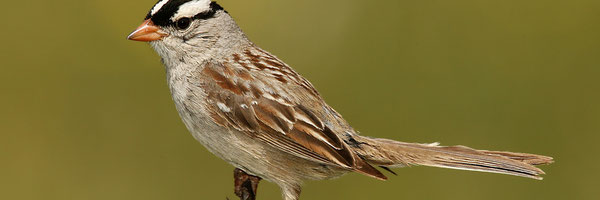
Family Song Correlations in Dual-Dialect Population of White-Crowned Sparrow
Anders Lewis
Branton School
Grade 9
Presentation
No video provided
Problem
Birdsong is a topic of particular interest on the subject of ornithology. Beginning in the 1940s, but mainly in the 1970s and 1980s, studies have been primarily based on the white-crowned sparrow (Zonotrichia leucophrys), because of its conspicuous dialects and widespread population. The existence of regional dialects amongst a species of songbird, much like differing accents in humans (Marler and Tamura, 1962), has proven that white-crowned sparrows learn their songs sensorimotorally instead of being born with them. A lab study by Douglas Nelson and Peter Marler was conducted in 1994 on the selection-based process in which a nestling will learn its song, proven to be composed of two main phases. First, a “sensory phase”, in which the youngster will listen intently to other birds around it and commit up to seven song types to memory (only two main song types exist within the area used for this study), typically within its first 50 days of life. Second, a “sensorimotor phase” where the nestling will “babble”, much like a human infant, and create its own “plastic songs”; imitations of those it heard, mostly starting in the 6-9 months of age range. During the following breeding season, the bird will typically sing two or more song types at the beginning of the season, eventually selecting and retaining only the one that best matches that of its neighboring rivals (Nelson, 1992). This information leads directly to the subject of this study: Do songbirds retain similarity to their fathers’ songs during and after their first breeding season?
Method
The population of birds used in this study were recorded by Dr. Lein and colleagues from 1984 to 1988 within a 2 kilometre grid at Fortress Mountain, Alberta. This region consists of two subspecies of the white-crowned sparrow (Zonotrichia leucophrys oriantha and Zonotrichia leucophrys gambelii), each possessing a distinct dialect and range. The Fortress Mountain area is an example of where both subspecies overlap, creating a particular melange of dialects and a highly diverse population. Traditionally, each subspecies has its own song and trill type, but with the interaction at Fortress Mountain, we see a peculiar mix of dialects; for example, a bird might have a gambelii song structure and an oriantha trill, or any combination of the two. This has created a diverse dataset of specimens, perfect for analyzing the inter-family correlations of white-crowned sparrows. (image) Many influential studies of the white-crowned sparrow have been conducted out of Fortress Mountain; such as Mate choice by female white-crowned sparrows in a mixed-dialect population (Chilton, Lien, and Baptista, 1989), which concluded that females choose mates on a basis of characteristics other than song type. Another popular region for birdsong studies of the white-crowned sparrow have taken place in southern California, but mostly in several small, well-defined ranges of a single dialect. That makes this the first study to ever correlate the songs of parent birds with that of their offspring in a natural, multi-dialect population of songbirds.
To run this experiment, three songs were collected from each bird in a 24-subject dataset as well as three from each of their fathers. Every bird in the recordings was banded and identified via a sequence of coloured bands on their legs; the standard for bird field identification in ornithology. All of the recordings used in this study were collected in old cassette tapes, which I analyzed and collected six songs from each family of birds; three from the son’s recordings and three from the father’s. I then used the program Signal, a software for analyzing and comparing animal calls, to convert the original waveforms from cassette recordings into spectrograms, which can be digitally compared and used for the study. These spectrograms are then overlaid in turn with the rest, the point of highest correlation recorded in correlations tables, which just chart the comparisons of each song to the others in a grid. We can also represent this visually as a confusion matrix. (image) After downloading the correlation tables from Signal, I then used ChatGPT to compute the average father-to-son correlation and put it into an Excel Spreadsheet, in which I double-checked and reformatted the information. ChatGPT was also used to transfer the data into charts. All information put through AI was thoroughly re-confirmed before it was added to this project. I then organized the spreadsheet data into a bar graph with standard deviation, showing overall correlation between self-to-self comparisons and family comparisons. This then lets us seethe differences between the similarities of the birds’ own songs (average \~70% correlation), and that of its progeny (average \~18% correlation). (image) Although we can now get a sense of how similar a parent bird is to its offspring, the information is without context. To judge just how different these covariances are, I then compared each of the fathers and sons to another bird from their generation selected at random. This was done to prevent accidental father-to-son correlations, which would mess with the data. Instead, the random correlations were compared by generation, proving to eliminate the chance of faulty data. The results for these comparisons were averaged by category and added to the chart with self-to-self and family correlations. We now can interpret the 18% correlation from family comparisons alongside random comparisons from the dataset to provide a baseline context of “not well correlated”.
Research
Much of the necessary research to do this project came either directly from Dr. Lein or from scientific papers he handed me to read. These are comprised of the following:
- P. Marler and M. Tamura, 1964. "Culturally Transmitted Patterns of Vocal Behavior in Sparrows".
- D. Toews, 2017. "From song dialects to speciation in white-crowned sparrows".
- P. Marler and M. Tamura, 1962. "Song 'Dialects' in Three Populations of White-Crowned Sparrows".
- D. Nelson and P. Marler, 1994. "Selection-based learning in bird song development".
- M. Lein and K. Corbin, 1989. "Song and plumage phenotypes in a contact zone between subspecies of the White-crowned Sparrow (Zonotrichia leucophrys)".
- G. Chilton, M. Lein, and L. Baptista, 1989. "Mate choice by female white-crowned sparrows in a mixed-dialect population".
I also used excerpts from CornellLab Birds of the World in my research, as well as several field identification books on birds in Alberta and North America.
- National Geographic. Field Guide to the Birds of the United States and Canada. second edition ed., Washington, D.C, National Geographic Partners LLC, 2025.
- McGillicray, Bruce W., et al. Field Guide to Alberta Birds. Edmonton, Alberta, The Federation of Alberta Nationalists, 1998.
- Catchpole, C., and P. Slater. Birdsong. New York, Press Syndicate of the University of Cambridge, 1995.
- Welty, and Baptista. The Life of Birds. fourth ed., New York, Saunders College Publishing, 1988.
Data
After comparing spectrograms of each bird from Fortress Mountain in separate categories, it has been shown that there is 72.9% average covariance between the birds’ own song recordings, 18.1% average between father-son pairs, and 18.9% in random comparisons. We can conclude that there is no significant difference (p<0.01%) between family and random comparisons, and that there is significant difference (p<0.01%) between self comparisons and comparisons involving different birds. The results are shown in the table below. (image) Fig.3 This violin chart shows all comparisons by category. On the Y axis, “1” represents total correlation, such as you would get from comparing the same recording twice, or 100% correlation. The first two categories are a bird's song being compared to itself, the third represents family comparisons (Father-Son), and the final two categories are a bird’s song being compared to another’s song selected at random.
Conclusion
After analyzing the data from the comparisons, it has been concluded that there is no paternal influence in the development of birdsong in a dual-dialect population, as a bird’s song, on average, is of the same similarity to a random other male from the region than it is to its own relatives. This suggests a high diversity of Fortress Mountain, which is exactly what we see in the population. This is supported by Table 1, classifying birds by their song and trill types. Moreover, it seems that the songs of Fortress Mountain are growing in diversity, as is shown by the chart below. (image) Fig. 4 This chart classifies the birds compared in random correlations (Father-Father [cross] and Son-Son [cross]) by the difference of their first breeding year, and how this affects the range of covariance.
As we can see, the variation in correlation increases at the same time as the difference in the bird’s first breeding year. This suggests that the dataset is diversifying over time, which is supported by the information shown in Fig. 3. Peculiarly, although the range widens as the difference in breeding year increases, there is no significant difference (p<0.7%) in the means throughout the different categories, suggesting that the population is diversifying at a set rate, instead of spontaneously. Interestingly, I also noticed a similarity between the figures of Fig. 3 (Song correlation) and Fig.4 (Covariance by breeding year), which all sit around 18-20% correlation. The extended chart is shown below. (image) In summary, this study concluded that, as of my dataset, white-crowned sparrows’ songs do not correlate to their father any more than they do to another randomly selected male in a dual-dialect population. Of the categories measured in this project, self correlations (a birds’ song being compared to different replicates of itself), average 72.9% covariance, a normal number in the world of birdsong comparison. This is significantly different (p<0.01%) than family and random comparisons. Father-son comparisons have a mean 18.1% covariance, which is not significantly different (p<0.01%) than random comparisons, which average 18.9% covariance. Family correlations have never before been measured in the field, proving to be what we can consider a “low” correlation number, at least in a two-dialect population. If a birds’ song is equally similar to its father and to a random neighbor, it definitely did not retain its fathers’ song throughout its lifetime.
There are several revisions I would like to make on this study before concluding from whom birds learn their songs. Aside from expanding the dataset, I am interested to see how these results would look in a single-dialect population, because just from looking at the first table, it is clear that almost half the birds did not copy their fathers’ song type. If the father-son pairs sing different songs, correlations are not necessary to conclude that there is no family heritage of song and trill type in the birds of Fortress Mountain. If this experiment were done in a single-dialect population, we might find if there is paternal influence in the birds that do copy their fathers, and why a bird might choose not to. For example, a nestling bird will commit up to seven different song types to memory within its first 50 days of life. Going into its first breeding season, the bird will then select and retain only the song type that best matches that of its neighboring rivals. At Fortress Mountain, we can assume that the majority of birds memorized both song types as nestlings, then, by chance, ended up with the one that they were most exposed to during their first breeding season, just being whichever one they happen to hear the most. This then validates the fact that half the birds change song types. There are two options, each with about an even number of birds singing them, so it makes sense that half the birds would change. This could also explain the range of song covariances over time. Based on the evidence of this study, the fathers’ and sons’ songs have 18% similarity, so if we have 82% difference between generations, this could explain the steady rate of the population diversification. Now, obviously, the population is not rapidly changing by 80% each generation, but take into consideration that 80% difference is not just composed of the song itself, but also how loud and how high it was sung, how much background noise there was in the recording, and other factors that might slightly alter the covariance. These all account for rather small portions of the overall correlation, but it may partially explain the widening diversity over time. This is the first study ever to compare a birds’ song to its’ father with a dataset collected on the field. Another interesting topic I would like to explore as a follow-up project would be to see how nestlings correlate to their siblings. A father-son pair may have had different influences when committing songs to memory, but siblings were together the entire time they were memorizing songs. My hypothesis is that this would make a kind of generational similarity amongst a family or small population of birds, creating a kind of general differentiating over time, which may also support the range of covariances over time at Fortress Mountain. A better way to test this would be to compare the average correlation within each year of the birds with a larger dataset. It is extremely likely that all the data of this project will not significantly change with a larger dataset, but it would help to validate the results. I plan to publish this project as a paper with a dataset of around 50 birds with revised recordings (as you can see from the charts, there are some outliers, most likely bad recordings), and do another study with a single-dialect population. Sadly, this study can not be repeated again at Fortress Mountain, because between the time the birds were recorded and banded in the 1980s and now, the ranges have changed; gambelii birds seem to be gradually moving north. Today, the only song to be heard in the meadows of the great Fortress Mountain is that of Zonotrichia leucophrys oriantha.
Citations
- P. Marler and M. Tamura, 1964. "Culturally Transmitted Patterns of Vocal Behavior in Sparrows".
- D. Toews, 2017. "From song dialects to speciation in white-crowned sparrows".
- P. Marler and M. Tamura, 1962. "Song 'Dialects' in Three Populations of White-Crowned Sparrows".
- D. Nelson and P. Marler, 1994. "Selection-based learning in bird song development".
- M. Lein and K. Corbin, 1989. "Song and plumage phenotypes in a contact zone between subspecies of the White-crowned Sparrow (Zonotrichia leucophrys)".
- G. Chilton, M. Lein, and L. Baptista, 1989. "Mate choice by female white-crowned sparrows in a mixed-dialect population".
- National Geographic. Field Guide to the Birds of the United States and Canada. second edition ed., Washington, D.C, National Geographic Partners LLC, 2025.
- McGillicray, Bruce W., et al. Field Guide to Alberta Birds. Edmonton, Alberta, The Federation of Alberta Nationalists, 1998.
- Catchpole, C., and P. Slater. Birdsong. New York, Press Syndicate of the University of Cambridge, 1995.
- Welty, and Baptista. The Life of Birds. fourth ed., New York, Saunders College Publishing, 1988.
- “White-crowned sparrow.” Wikipedia, https://en.wikipedia.org/wiki/White-crowned_sparrow#/media/File:White-crowned-Sparrow.jpg. Accessed 3 March 2026.
Acknowledgement
I would like to acknowledge Dr. M. R. Lein at the University of Calgary. He provided me with access and taught me how to use the Signal software, provided all the recordings and datasets used for this project, as well as many scientific papers as background knowledge, and boundless knowledge on birdsong and white-crowned sparrows. None of this project would have been possible without him. He has shown me great compassion in teaching me, and I appreciate all of his efforts with gratitude. I would also like to thank my mother and father for getting me interested in ornithology in the first place, indroducing me to Dr. Lein, and helping me with graphing my data. My greatest thanks to everyone.
Attachments
No Log Book Provided
View Extra Attachment: report/data/exhibit/etc(may download a file)