
Wildlife in Urban Areas: Keep or Kick Out
Evrett Sansom
Western Canada High School
Grade 11
Presentation
No video provided
Problem
In 2018, the UN stated that 55% of the global human population lived in cities. That number is only growing and predicted to reach 68% by 2050. That will be roughly 6.7 billion people living in urban areas. With highly developed and populated spaces comes greater habitat loss within the area because of the need to create homes for people to live in, as well as roads, skyscrapers, factories, and so much more. This wildlife is often not replaced. For example, in Calgary, we often replace naturally occurring prairie grass with Kentucky blue grass. A lack of greenery can create a more polluted city environment and worse mental health among citizens, yet more plants means more tax dollars being spent on city cleanup, especially during autumn. Trying to keep animals out of cities invites smaller "pests" such as pigeons, rats, and stray pets to take over, while a heavily animal populated city become covered in roadkill and large animals that may pose a threat to citizens. Should we kick out all non-human beings from our cities, embrace all nature to make our cities barely distinguishable from the outside, or is the answer somewhere in between, and if so, to what degree? Through research, this project will give a percentage score of how many plants and animals should be in a city depending on the biome that it is situated in. This will be done through the examination of the current state of many major cities around the world as well as hypothetical scenarios of different nature percentage scores.
Method
Breakdown of how a nature score is given to a city:
- Determine the number of species of birds located in the wild areas outside of the city and within the boundaries of the city using at least three different sources for each. Use the data to provide a percentage that represents the difference between the biodiversity inside and outside the city.
- Determine the number of bird individuals located in the wild areas outside of the city and within the boundaries of the city using at least three different sources for each. Use the data to provide a percentage that represents the difference in bird populations inside and outside the city.
- Repeat steps 1 and 2 for mammals, reptiles and amphibians, and plants.
- Average all animal species scores for an animal biodiversity score.
- Average the animal biodiversity score and the plant biodiversity score for the total biodiversity score.
- Average all animal population scores for a final animal population score.
- Use the animal population score with the plant population score to give a final population score based on weighted calculations depending on the ratio of plants to animals in the surrounding natural environment of the city.
- Average scores from steps 5 and 7 to give the city a nature score.
Research
All of my research has been written by hand, therefore I have provided pdf documents to the notes. First is my calculations for nature scores, and second is my notes on how cities become more green, and wildlife in urban spaces.
Data
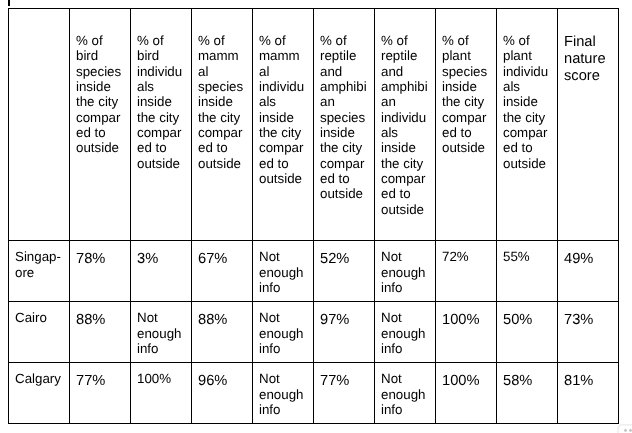
The CYSF software does not support data tables, so here is a Google Docs link to this project's data: https://docs.google.com/document/d/1xGjrsiEhE04yrll165UcrlanmCHrkBC2Cur50zQbp-c/edit?tab=t.0
Conclusion
After viewing three different cities in three very different biomes, Calgary had the highest percentage of nature within its city limits, with a score of 81% similar to the surrounding natural area. A lot of this is due to its low density and lower population. We seem to be doing pretty well without major immediate physical damage to the environment, which may suggest that all cities could do the same or better. More than half of Calgary is considered green space, which means that the city takes up much more space than if the city was more dense. This allows for a nuanced discussion about urban sprawl. An 80 percent score is possible, and over 100 percent would mean that many animals would begin to become reliant on humans, which is never good for the people living in cities nor the animals, especially large animals that could harm humans. Take Skoki who was a grizzly bear at the Calgary Zoo for example. Skoki had to move to the zoo because he became too reliant on humans, came close to them often, and was about to be euthanized. More studies sill have to be done, but my conclusion is that around a 90% nature score would be the best spot for a city to be in order to cause the least amount of harm to the environment as possible.
Human behaviour such as knowing how to interact with nature may play an even larger role in order for us to be in harmony with nature as a global community. Of course small municipalities can reach a higher nature score because of the lack of busyness that deters many animals, and large downtown cores.
A ten percent jump in nature score is significant since Calgary would have to increase our population of plants and animals by 20%.
Citations
(2021). The Book of HOPE; A Survival Guide for Trying Times. Goodall, Jane and Abrams, Douglas with Hudson, Gail. Celadon Books.
(Sept, 2024). Atlas Obscura; Wild Life. Giaimo, Cara and Foer, Joshua. Workman.
(March 2025). Abundance. Klein, Ezra and Thompson, Derek. Avid Reader Press.
(Nov 9, 2022). These cities are encouraging people to protect biodiversity, Here’s how. Ellerbeck, Stefan. Weforum.org. https://www.weforum.org/stories/2022/11/biodiversity-cities-wildlife-nature/
(Jul 3, 2017). Which is the world’s most biodiverse city?. De Jong, Feike. TheGuardian.com. https://www.theguardian.com/cities/2017/jul/03/which-worlds-most-biodiverse-city-extreme-cities
Map of Life. Mol.org. https://mol.org/dashboard/regions
(2025). Rainforests and deforestation. Plitnik, George R. EBSCO.com. https://www.ebsco.com/research-starters/earth-and-atmospheric-sciences/rainforests-and-deforestation
Global Biomes Explorer App. (Now Expired) https://www.arcgis.com/apps/View/index.html?appid=144b1d74a5964d728b25aeb0542de485
Guides - iNaturalist. https://www.inaturalist.org/guides/
BirdLife DataZone. https://datazone.birdlife.org/country/factsheet/
(2010). Density and Diversity of Water Birds and Terrestrial Birds at Paya Indah Wetland Reserve, Selangor Peninsular Malaysia. M.N. Rajpar. SciAlert.net. https://scialert.net/fulltext/index.php?doi=jbs.2010.658.666#:~:text=Seaby%20(2007).-,RESULTS,0.11%20birds%20ha%2D1).
(2018) Preliminary Assessment of the Bird Species Composition and Feeding Guilds in Forest Plantation and Natural Forest Areas, Kinarut, Sabah Malaysia. Andy R. Mojiol, Emilda Markus, Sharon Shen, Wing-Shen Lim, and Micheal Fisher. Journal.UTS.edu.my. https://journal.uts.edu.my/Home/ArticleDownload?articleId=BJOST070106#:~:text=The%20Shannon%2DWiener%20Diversity%20Index,being%20of%20a%20forest%20ecosystem.
Wildlife of Malaysia. Wikipedia.org. https://en.wikipedia.org/wiki/Wildlife_of_Malaysia
Malaysia. Fatbirder.com. https://fatbirder.com/world-birding/asia/malaysia/
(2025). 22nd Fall Migration Bird Census (2025) report. Singaporebirdgroup.Wordpress.com. https://singaporebirdgroup.wordpress.com/category/bird-survey-and-census/
List of Mammals of Singapore. Wikipedia.org. https://en.wikipedia.org/wiki/List_of_mammals_of_Singapore
(Dec 26, 2023). Total number of mammal species, by country. Butler, Rhett A. Worldrainforests.com https://worldrainforests.com/03mammals.htm
(Apr 2019). Quantifying species richness and composition of elusive rainforest mammals in Taman Negara National Park, Peninsular Malaysia. Asrulsani Jambari, Selvadurai Sasidhran, Hazril Rafhan Abdul Halim, Khairul Amirin Mohamed, Adham Ashton-Butt, Alex M. Lechner, Badrul Azhar. Sciencedirect.com. https://www.sciencedirect.com/science/article/pii/S2351989418304487 68% of the world population projected to live in urban areas by 2050, says UN. UN.org. https://www.un.org/uk/desa/68-world-population-projected-live-urban-areas-2050-says-un
(Mar 30, 2025). Rapid Assessment of Non-Volant Mammals in Selected Areas of Peninsular Malaysia. Pmc.NCBI.nlmn.gov. https://pmc.ncbi.nlm.nih.gov/articles/PMC12017281/
Fauna of Singapore. Wikipedia.org. https://en.wikipedia.org/wiki/Fauna_of_Singapore
Taman Negara. Wikipedia.org. https://en.wikipedia.org/wiki/Taman_Negara
One million Trees Movement. NEA.gov.sg. https://www.nea.gov.sg/docs/default-source/default-document-library/annex-e---factsheet-on-one-million-trees-movement.pdf
(Jan 21, 2022). Calgary bird count maps reveal where magpies and geese flock to. Pike, Helen. CBC.ca. https://www.cbc.ca/news/canada/calgary/calgary-bird-count-map-magpies-geese-population-1.6321859
(Feb 20, 2025). The Calgary Count results will be presented, plus those from the Fish Creek Park New Year’s Day Count. Lefebvre, Bob. BirdsCalgary.com. https://birdscalgary.com/category/bird-research/
City of Calgary Biodiversity Report PDF
Fish and wildlife indicators - Vertebrate species. Alberta.ca. https://www.alberta.ca/fish-and-wildlife-indicators-vertebrate-species
Caring for our urban forest. Calgary.ca. https://www.calgary.ca/parks/trees.html
(2023). Calgary - The 2023 Canadian City Parks Report. CCPR.Parkpeople.ca. https://ccpr.parkpeople.ca/2023/cities/calgary-2022
(Jan 4, 2026). BIRD OF THE WEEK – RESULTS LETHBRIDGE CHRISTMAS BIRD COUNT 2025. Helen Schuler Nature Centre. Facebook.com. https://www.facebook.com/helenschulernaturecentre/posts/bird-of-the-week-results-lethbridge-christmas-bird-count-2025the-lethbridge-chri/1495373472596896/
(Apr 1, 2019). The ground layer of the rainforest. Butler, Rhett A. WorldRainforests.com. https://worldrainforests.com/05-rainforest-floor.html
(Jul 22, 2025). Singapore’s regreening is a model for cities everywhere. DiGirolamo, Mike. Mongabay.com. https://news.mongabay.com/podcast/2025/07/singapores-regreening-is-a-model-for-cities-everywhere/
Avibase - Bird Checklists of the World; Cairo. Avibase.bsc-eoc.org. https://avibase.bsc-eoc.org/checklist.jsp?region=EGqh
Nile wetlands blues. Hafez, Yasmine. NileWaterLab.org. https://nilewaterlab.org/realities/yasmine/
Egypt’s Biodiversity / Wild Life. EgyptHeritage.com. https://www.egyptheritage.com/BiodiversitySite/WildLife/Mammals.html
(Jul 31, 2024). Cooling Down a City: Singapore’s Urban Greenery Policies to Mitigate Urban Heat. Kaitoh Hidano, Ng Zu Xiang and Kim Jeong Won. ESI.NUS.edu.sg. https://esi.nus.edu.sg/docs/default-source/esi-policy-briefs/esi-pb-75_cooling-down-a-city.pdf
(Aug 17, 2023). Singapore: Designing a Megacity in Harmony with Nature 🌳. PBS Terra. Youtube.com. https://www.youtube.com/watch?v=3w3QCcItxTo&t=252s
(Jun 21\, 2020)\, 6 Animals Living Their Best Lives in Cities | Synurbic Species. SciShow. Youtube.com. https://www.youtube.com/watch?v=BnTrXzLtNDA
(Apr 19, 2021). Can Wild Animals and Humans Coexist in Cities?. Above The Noise. Youtube.com. https://www.youtube.com/watch?v=sE0ebSGDltw
Acknowledgement
I would like to thank my parents who support me every year in my participation in the CYSF, and to all those who have inspired me to care about the Earth's natural enivronment and it's protection.
AI was not used in the creation of this project, which includes but is not limited to text generation, image generation or statististics, however some sources recommended by Google's AI overview were used for research.