
East Asian vs North American Sunscreens : A Comparitive Analysis
Abigail Li
Louis Riel School
Grade 8
Presentation
Hypothesis
If UV beads are exposed to UV light through sunscreens, then the Asian sunscreens will be able to provide less of a colour change to the UV beads, because Asian sunscreens use innovative filters (ingredients that blocks UV rays) that help protect the skin against harmful UV radiation, which is able to decrease the amount of UV light that is able to penetrate the layer towards the UV beads.
Research
Why can’t all countries use the same ingredients in their sunscreen? Not all countries are able to be able to both access and use the same ingredients, due to government regulations. For example, North American brands do not include many of the ingredients found in East Asian sunscreens. This is because of the FDA regulations, as they disapprove the use of many ingredients. In fact, the FDA has only approved 2 common sunscreen ingredients, zinc oxide and titanium dioxide. The FDA classifies many ingredients, including sunscreen itself as an over the counter drug.
How do sunscreen companies test the effectiveness of their sunscreen? All companies must include an SPF label and UVA/UVB. SPF determines how long it will take for radiation to occur on the body. For example, SPF 50 is more effective than SPF 30, as it means that SPF 50 takes 50 times longer for sun radiation to damage the skin. UVA and UVB are similar, but do not act the same. UVA rays are more harmful than UVB rays, as they penetrate the skin more and can cause early formation of wrinkles. UVB rays are the main causes of sunburn and sun damage, as the rays are the largest effect of skin cancer.
How does sunscreen block out UV rays from the sun? When sunscreen is applied to the skin, a mini layer forms that is able to block out and reflect the UV rays, therefore protecting the skin. The newer chemical filters found in Asian sunscreens are able to also absorb the UV radiation. Zinc oxide and titanium dioxide are referred to as physical blockers that reflect the UV rays, while chemical filters have the ability to turn the radiation into heat and reducing the penetration of the skin layer.
Variables
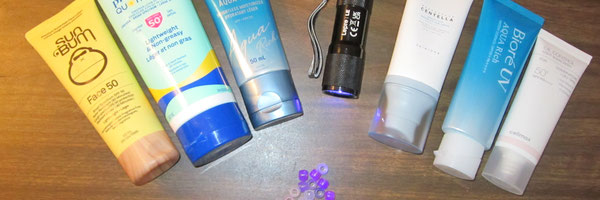
Manipulated: Sunscreen Brands The sunscreens that will be tested throughout my experiment will be different, as I am testing 3 East Asian sunscreens and 3 North American sunscreens.
Controlled: 1. Amount of sunscreen For each trial, the amount of sunscreen applied to the UV beads will stay a controlled amount of 1/8 of a teaspoon. This measurement will stay precise throughout the trials to ensure that there will be no unequal amounts of sunscreen applied. 2. Intensity of the UV light The UV light will have an intensity of 395 nanometres, as described on the packaging. This was constant for all of the trials, as well as the distance and exposure time of the UV light. 3. Amount of UV beads Each trial had a constant quantity of UV beads, which was 10. All of the UV beads came from the same brand and lot number.
Responding: Change of colour within the UV beads As the UV light will represent UV rays, the beads will change in colour, based off of how well each sunscreen protects the UV beads.
Procedure
Procedure 1: Preparing the testing surface
- Remove the glass from a picture frame, for it to look like a rectangle
- Lay out plastic wrap over the picture frame until the surface is covered
- Use tape to hold down plastic wrap for a smooth surface
- Spread out (exact number will be counted when conducting experiment) UV beads onto plastic wrap, ensure the surface is smooth
- Repeat steps 2-4 for every trial
- Position UV light 30 cm away from UV beads
Procedure 2: Testing the Sunscreens
- Apply ⅛ teaspoon of sunscreen onto UV beads (MUST BE ACCURATE)
- Spread sunscreen evenly across UV beads using spatula
- Let the sunscreen rest for 1 minute
- Turn on UV light
- Start timer/stopwatch immediately once the light turns on
- Expose the UV beads for 60 seconds and when time is up turn off the light
- Allow UV beads to cool down for 10 seconds
- Photograph and document the change of colour in the UV beads
- Repeat steps 3 times for each sunscreen, to provide a representation of constant UV ray exposure
Observations
Feel/Texture -Asian sunscreens felt much richer and creamier in terms of application compared to North American brands (sun bum). -Sun Bum had a gooey feel -- Asian brands had a lightweight feeling --> evident in many articles that talk about the elegance of Asian sunscreens -notice the trends and common themes within the data Specific Data:
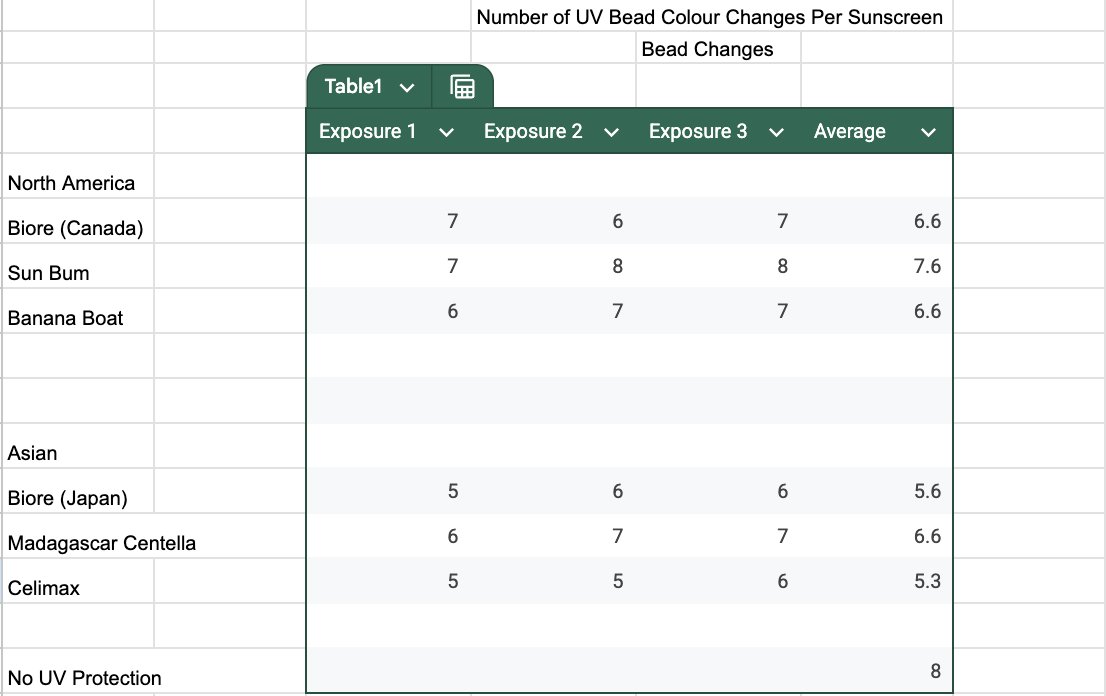
No UV protection - 8 changes --> very dark shades when exposed
Celimax (# of beads w/ colour changes) E.1: 5/10 E.2: 5/10 E.3: 6/10
Madagascar Centella E.1: 6/10 E.2: 7/10 E.3: 7/`0
Biore Japan E.1: 5/10 E.2: 6/10 E.3: 6/10
North America Sun Bum E.1: 7/10 E.2: 8/10 E.3: 8/10
Banana Boat E.1: 6/10 E.2: 7/10 E.3: 7/10
Biore Canada E.1: 7/10 E.2: 6/10 --> excess sunscreen became absorbed during the rest time E.3: 7/10
Analysis
GRAPHS:


TABLE:
Conclusion
My hypothesis was somewhat correct. There was a small difference between the number of beads that changed colour, between the Asian and North American sunscreens. Although there were not significant differences of the colour changes of the beads, the numbers do prove that Asian sunscreens were better at protecting the UV beads against UV rays. Further, the evidence from the graphs are able to determine which sunscreen was the best at protecting the UV beads against the UV light.
Application
APPLICATION Based on my experiment, I believe that the FDA should update their laws about the ingredients allowed in sunscreen. This proves that the regulations are also outdated, due to the better composition of ingredients found in the Asian sunscreens, such as bemotrizinol. There are many factors to build off my project, such as sweat and water resistance, longer exposure time and testing under real sunlight and skin.
EXTENSION Next time, I would try to resolve many of my mistakes throughout the experiment. These include having the UV light at a stable distance from the UV beads, and testing a wider variety of sunscreens, by taking European/Australian sunscreens into consideration. This can determine if North America is seriously behind in terms of the approval of sun protection, and how the FDA should update their regulations. --> time frame, keeping as similar to testing on real human skin
SO WHAT The sun’s UV rays oppose many harmful risks towards the body, which increase the chances of harmful diseases, such as melanoma. Melanoma is a type of skin cancer, that is caused by UV radiation and is one of the most preventable cancers. Sunscreen is able to protect the skin against the radiation from the sun, and is heavily recommended by organizations and doctors.
Sources Of Error
A few sources of error were that all of the UV beads should've been facing the same direction, although I tried to keep the format of the beads alike. The UV light was suspended in the air, but I was holding it which may have shifted the distance throughout all the trials. My time couldn’t be exact, as it was very difficult to precisely stop the timer at the exact millisecond for each trial.
Citations
https://www.theguardian.com/wellness/article/2024/jun/12/safest-sunscreen-to-use https://skeptics.stackexchange.com/questions/44172/are-us-sunscreens-less-effective-due-to-fda-regulations https://www.choice.com.au/health-and-body/beauty-and-personal-care/skin-care-and-cosmetics/articles/sunscreen-test https://www.fda.gov/drugs/understanding-over-counter-medicines/sunscreen-how-help-protect-your-skin-sun https://brightgirl.com/blogs/bright-ideas/whats-the-difference-between-asian-and-us-sunscreens?srsltid=AfmBOoq34JhZ0qmTJDmRZo7ahSzS7oChEx5KVM7ImVAgZd0ZTcQKiZJN https://uihc.org/health-topics/what-difference-between-uva-and-uvb-rays
Acknowledgement
Throughout my experiment, I would like to provide a few acknowledgements to those that helped improve my project along the way. First, the continuous support provided by my family by doing everything that they could to support me along the science fair process. Next, my teachers as they have been giving me constant feedback on my topic, all from the first stage of deciding if I should enter science fair. Their support along the way has provided me with stronger ideas and ways to elevate my project to the highest level. Plus, everyone in general that has been a part of my journey, such as my science fair coordinator, and friends that push me to my best.