
Stopping lung cancer before it starts
Deeksheta Prabhu, Manasvi Gottipati
Glamorgan School
Grade 6
Presentation
No video provided
Problem
Current lung cancer management focuses heavily on treating advanced-stage tumours, yet 5-year survival rates remain low because many tumours are resistant to conventional therapies due to specific, untreated gene mutations. There is a critical gap in preventative, molecular-level interventions that can stop these mutated cells from forming tumours or sensitize them to radiation before they progress into invasive cancer cells. That's why our question was about preventing non-small cell lung cancer before it even had a chance to form.
Method
Our project aims to identify genetic mutations that appear in the early stages of lung cancer. We used the (Mayoclinic) source to identify common mutations in pre-cancerous lung tissue. We then conducted a literature review of radiotherapy procedures, specifically focusing on brachytherapy and Low-Dose Computed Tomography (LDCT) screening. We researched a model where early detection of these mutations allows for precise radiation targeting to destroy these cells, thus stopping cancer progression.
Research
- Question: How can we extract genetic mutations from DNA?
- Sub Question: Which type of extraction technology is most effective?
-
Independent Variable: Types of Treatments Dependent Variable: Result of Research Controlled Variable: The Lung Cancer Cells
-
What is a Genetic Mutation?
-
A genetic mutation occurs when DNA is changed. Mutations result from errors in DNA replication during cell division, with exposure to mutagens or viral infections. Germline mutations that occur in eggs/sperm) can be passed on to future generations, while somatic mutations (that occur in body cells) are not passed on. These changes can range from a single DNA “letter” swap (point mutation) to large-scale gene deletions or rearrangements.
How Do Genetic Mutations Cause Lung Cancer? * Gene Mutations (Genetic Mutations) lead to cancer when the cycle of cell division and replication occurs over and over again, producing cancer cells. Gene mutations can be caused by tobacco smoke, air pollution, chemicals, naturally occurring radon gas or viruses, including viral fevers and infections with severe symptoms.
What Is A Tumour? * A tumour is a clump of cells that can grow anywhere in your body that has a lot of blood supply. Abnormal proliferation occurs when damaged and dying cells in your body don’t stop dividing and multiply when signalled to do so. This leads to excess tissue growth, which invades normal tissues and organs, eventually spreading throughout the body and forming a large clump anywhere on the body.
How Does a Tumour Cause Lung Cancer? * Tumours cause cancer when they are malignant; benign tumours do not lead to cancer. A benign tumour is basically a common skin wart, and it remains confined to its original growth place in the body. Malignant tumours are capable of spreading to the surrounding normal tissue. This leads to a spread all over the body and produces cancer cells, causing cancer. Tumours can grow from the trachea or windpipe and slowly grow into the lungs, eventually leading to the bronchus and bronchioles.
Which Type Of Therapies Work For Lung Cancer? * If lung cancer is diagnosed, it is treated in several ways depending on the type of lung cancer and how far it has spread. People with non-small cell lung cancer can be treated with surgery, chemotherapy, radiation therapy, gene therapy or a combination of these treatments. But people with small-cell lung cancer are mostly treated with radiation therapy because it is more effective than the other therapies.
What Is Radiation Therapy? * Radiation therapy is also known as radiotherapy. This type of cancer treatment uses intense energy beams to kill cancer cells. Radiation therapy mostly uses X-rays. Lots of types of radiation therapy exists including proton radiation. Modern methods of radiotherapy are precise, aiming directly at where the cancer is located (the lungs), which doesn’t affect healthy tissues surrounding the cancer cells. With the treatment success over the entire course of therapy and with some early-stage cancer actions, it kills 80% of cells.
What are the procedures for Radiation Therapy? * Radiation treatment that goes inside the body is called brachytherapy. Brachytherapy is also a type of cancer treatment; in this procedure, a provider places a small, solid implant directly into the cancer cells. Then the implant damages genetic material and controls how the cancer cells grow and divide. They provide daily sessions with a linear accelerator machine, which is painless and monitored from a control room with pre-programming.
What Types of Procedures Are There to Extract Gene Mutations Before They Become Cancer Cells? * Most medical procedures focus on detecting and mitigating gene mutations before they progress into cancer cells. Doctors use a combination of genetic screening, prophylactic, also known as (preventive) surgery, and emerging gene- editing therapies. For individuals with confirmed high-risk mutations, the most effective way is to remove the threat before cancer develops throughout the body, even with the risk of not surviving.
Which Procedure Is More Effective Before Gene Mutations Become Cancer Cells? * The most effective procedure is low-dose computed tomography (LDCT) screening. It is the key procedure for early detection, aiming to find abnormalities (which could include pre-cancerous changes or very early-stage cancer) when they are most treatable. If a localized tumour is found, (LDCT screening) will work best for tumours and block the cancer cells.
What is (LDCT) Screening? * LDCT screening is a low-dose computerized tomography (LDCT) scan of the lungs to look for lung cancer. If lung cancer is detected at an early stage, it can be cured with radiation therapy. Lung cancer screening is usually reserved for people at high risk of lung cancer. This machine works by using a special CT scanner with less radiation to take detailed 3D pictures of the lungs.
What is the Procedure Of The (LDCT) Screening? * To get a low-dose CT scan, you lie on a narrow table. The table passes through a large doughnut-shaped machine that uses a low amount of radiation to take pictures of your lungs. A camera moves around in the scanner, taking many images (slices). Computer software then stacks these slices together to make a 3D picture of the body. The procedure is not painful and only takes a few minutes to complete.
What Is The Procedure If A Malignant Tumour Is Found? * If a Malignant tumour is found, the patient is sent for surgery, chemotherapy, radiation therapy, gene therapy, or a combination of these treatments. If the tumour is spread, then Surgery is not possible, but if it has just started growing, surgery is possible.
What is the Procedure If Gene Mutations are Found * If gene mutations are found in the screening, then Chemotherapy, Radiation Therapy, or Gene therapy can be used. * What is Gene Therapy? * Gene therapy is a technique that uses a gene to treat, prevent or cure a disease or medical disorder. Often, gene therapy works by adding new copies of a gene that is broken, or by replacing a defective or missing gene in a patient’s cells with a healthy version of that gene.
What is the Procedure for Gene Therapy? * The procedure for Gene Therapy consists of many different types of processes, but the most progressive 2 types are viral vector-based gene therapy and RNA gene therapy in the past few years.
How Does the Viral Vector-Based Gene Therapy Work? * There are 2 different types of vectors: adeno-associated virus and lentivirus. Adeno-associated virus brings new genes into the nucleus, but the gene stays separate from the cells’ own DNA. It does not become a part of the cells’ genome. The new gene will be lost over time as the cells divide.
Lentivirus vectors act differently; they insert the therapeutic gene directly into the cells' DNA, so that the gene is part of the genome when the cells divide. The cells are copied and passed on to future generations.
How does the RNA Gene Therapy Work? * The tools act like a tiny army, sending messages to block the harmful proteins or directly control the cells by targeting DNA proteins. They work as machinery and fix the proteins throughout vaccines. Resources: Gene therapy - Mayo Clinic, What Is a Genetic Mutation? Definition & Types, Mutation, CRISPR Gene Therapy: Applications, Limitations, and Implications for the Future - PMC, Gene Mutations Cause Cancer, The Development and Causes of Cancer - The Cell - NCBI -NIH, Radiation therapy - Mayo Clinic, The Development and Causes of Cancer - The Cell - NCBI Bookshelf, Lung Cancer Gene Mutations: What Are They and How Do, Lung Cancer Gene Mutations: What Are They and How Do, What you should know about low-dose CT scans, Gene Therapy, https://www.promega.ca/applications/gene-therapy-tools//
Data
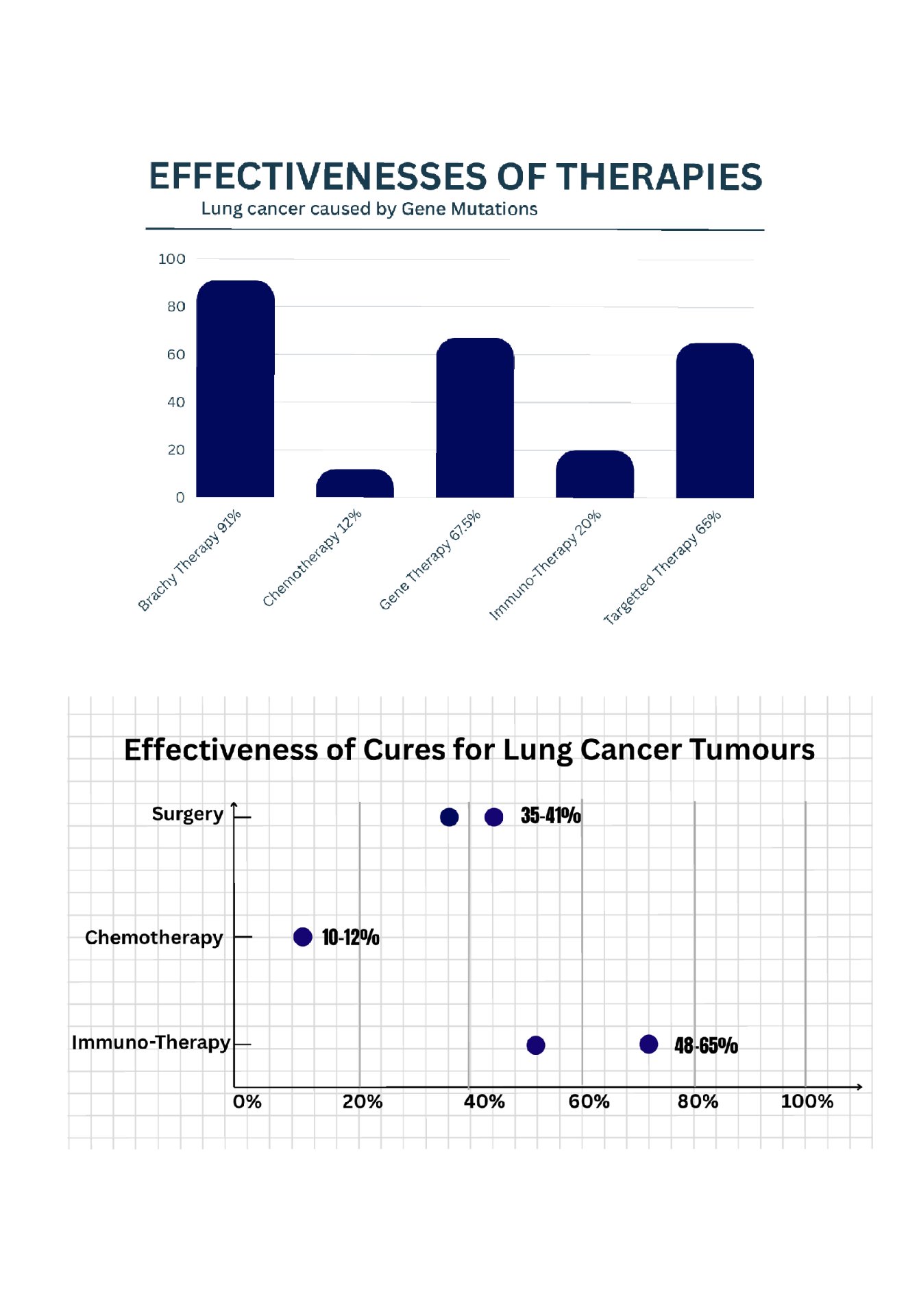 These two bar graphs state the effectiveness of the cures for tumours and lung cancer caused by gene mutations, with multiple therapies listed above with their percentage of effectiveness.
Conclusion
Therefore, it is possible to extract gene mutations before they become lung cancer cells using radiation therapy, which has been tested to be the most effective therapy among all others. Radiation therapy is the only technology to extract gene mutations and is so far most effective. specifically brachytherapy is included in radiation therapy, like after it reaches the body, its name is changed, so 2 effective cures/extraction methods are best for lung cancer before they first form.
Citations
Credits
- Definition & TypesMutation
- CRISPR Gene Therapy: Applications, Limitations, and Implications for the Future - PMC
- Gene Mutations Cause Cancer
- The Development and Causes of Cancer - The Cell - NCBI -NIH
- Radiation therapy - Mayo Clinic
- The Development and Causes of Cancer - The Cell - NCBI Bookshelf
- Lung Cancer Gene Mutations: What Are They and How Do
- What you should know about low-dose CT scans
- Gene Therapy
Acknowledgement
We would like to express our sincere gratitude to everyone who supported us throughout this project. A special thank you to our teachers for their valuable guidance and patience. We are also deeply grateful to our Glamorgan school for arranging this program, providing the specific advice that made our experiments possible. Finally, thank you to our parents for their constant encouragement and for providing the materials needed for our display.