
The Health Effects of Allura Red
Nuriyah Shariff
Balmoral School
Grade 6
Presentation
Problem
My project is about the coloured dye Allura Red. My question for this project is "What are the health affects of Allura Red?" In many countries Allura Red has been banned. In countries where it is not banned consumption rates of food dyes like Allura Red have gone up. The goal of my project is to research the long-term and short-term health effects of using and consuming Allura Red.
Method
In order to research the health effects of Allura Red I searched the "what are the health effects of Allura Red" on Google. I then looked at the AI Overview to find resources for information. Before deciding if I was going to use the site I determined whether the site was reliable. For example, I knew that the National Library of Medicine was reliable. If I decided to use the site I would read and summarize scientific articles for my project. I also researched long-term and short-term effects of Allura Red. Another thing I researched was products containing Allura Red and how much Allura Red is acceptable to consume.
Research
Thesis
Allura Red can cause a variety of health effects which can affect a person both physically and mentally.
What is Allura Red?
Allura Red is a coloured dye that is used in many products. It is one of 9 food additives approved by the Food and Drug Administration (FDA). It is most commonly used in foods but is also used in other products as well such as lotions and cosmetics. Allura Red is often in foods that attract children, for example candy and chips. Allura Red is harmful to human health and can cause many health effects. In many countries Allura Red has been banned. A acceptable daily intake has been established by Joint Expert Committee on Food Additives (JECFA). The ADI (Acceptable Daily Intake) is 0-7 mg per kg per body weight a day in food and beverage products.
Allura Red in Foods and Beverages
Allura Red is used in a variety of products such as foods and beverages, these are some examples:
- Candy & Gum
- Cakes & Frosting
- Cereals
- Chips
- Energy Drinks
- Gelatins
- Ice Cream
- Baked Goods
- Soda/Pop
- Yogurt
- Pain relievers
- Spices & Powder Mixes
- Dressings & Sauces
Example Amounts


20 oz bottle of Red Gatorade=15 to 42.7 mg
In order to actually reach the limit you would have to drink about 10 liters of Gatorade per day
Original Skittles=33.3mg
Ingestion
Allura Red can enter the body two ways. One way it can enter the body is through eating or drinking certain foods and beverages. It can also enter the body through absorption of some lotions and cosmetics.
Names
| Name | Place |
|---|---|
| Allura Red | Canada & Europe |
| Red.40 | United States and Canada |
| E129 | Europe |
| INS No.129 | India |
| Red 40 Lake | United States |
| FD&C Red No.40 | United States |
| FD&C Red No.40 Aluminum Lake | United States |
What are the Health Effects?
| Health Effect | Time (Short-Term or Long-Term) |
|---|---|
| ADHD (Behavioural Problems) | Short-Term |
| Hyperactivity | Short-Term |
| Allergic Reactions | Short-Term |
| Hypersensitivity Reactions | Short-Term |
| Cancer/Colorectal Cancer | Long-Term |
| Migraines | Short-Term |
| DNA Damage | Long-Term |
| IBD (Inflammatory Bowel Disease) | Long-Term |
Health Effects
Attention-Deficit/Hyperactivity Disorder (ADHD) in Children
One health effect of Allura Red is worsening symptoms of ADHD in children. Allura Red doesn't cause ADHD but rather worsens the symptoms of children who have ADHD. In the past 50 years the amount of food dye consumption has gone up and simultaneously there has been an increase in the number of behavioural problems such as ADHD. Children with ADHD may be sensitive to food dyes like Allura Red causing behavioural issues. Research shows that kids with ADHD have better symptoms when coloured dyes like Allura Red are reduced or eliminated from their diet. It also suggests that the cause of the behavioural symptoms that some children experience when consuming dyes could be if the child has immune hypersensitivity to the chemicals in Allura Red.
Hyperactivity in Children
Another health effect is hyperactivity in children. When children use or consume Allura Red it can worsen their behavior. Allura Red can also cause hyperactivity in toddlers. Even if the child doesn't have pre existing problems, Allura Red can still cause behavioural issues. When children use or consume Allura Red they may have trouble focusing or sitting still. Allura Red can impact the behavioural outcomes of a child. When a child consumes Allura Red it can cause an allergic reaction which may cause inflammation. The inflammation caused by the allergic reaction can then lead to neurobehavioural issues. Research suggests that the more Allura Red exposure there is the more hyperactive children will be.
Hyperactivity Symptoms
These are some of the symptoms of hyperactivity caused by Allura Red:
- Constant fidgeting
- The inability to concentrate
- The inability to sit still
- Excessive movement
- The inability to wait
- Interrupting conversations
- Little or no sense of danger
- In adults the symptoms can be restlessness and excessive talking
Allergic & Hypersensitivity Reactions
Allura Red can cause allergic reactions. People who are sensitive to Allura Red may experience allergic reactions. The cause of the allergic reaction is the body releasing the chemical histamine when it is consumed or absorbed. Allura Red can also cause hypersensitivity reactions. That is when the body sees the small molecules of Allura Red as a threat. The result of this is the body launching an attack which causes inflammation, neurobehavioural problems or autoimmunity. Autoimmunity is when your body sees the healthy cells as a threat and attacks causing hypersensitivity symptoms. Although, the symptoms of allergic reactions and hypersensitivity reactions are not well-defined or clear it is still an effect that some people face.
Allergy Symptoms
The symptoms range from mild to severe:
- Headaches
- Hives & Asthma
- Skin irritation
- Sneezing & Watery Eyes
- Difficulty/Trouble Breathing
- Face Swelling
- Dizziness
- Fainting
- Low blood pressure
Cancer
Allura Red was thought to be a healthier alternative as a food additive without links to cancer, but it was found to have links of its own. Allura Red contains p-Cresidine which is thought to be a carcinogen. It also has traces of benzene which is a byproduct of making Allura Red. Benzene it also thought to be a cancer causing substance. It is not clear how much exposure of the dye it would take to potentially increase the risk of cancer. Allura Red may cause colorectal cancer in the colon. It may not be linked to only a single type of cancer.
Colorectal Cancer (CRC)
One type of cancer that is thought to be cause by Allura Red is colorectal cancer. Early onset colorectal cancer (EOCRC) has been on the rise for the past 40 years. EOCRC is when people have colorectal cancer in their 20's or 30's. High processed diets can affect risk of EOCRC. Allura Red is often in many high processed foods that people often consume large amounts of. An experiment was done in vivo on mice to see how a western high fat diet plus Red 40 affected the size and weight of the liver, kidney and spleen verses a low fat diet. They found that a western diet increased the weight of all the organs and the Allura Red increased it more. Western style High-fat diets with Red 40 have a possible impact of CRC and EOCRC.
Migraines
Coloured food dyes such as Allura Red have been linked to migraines. Those who experience migraines often have certain triggers. Allura Red may be a migraine trigger for some people. People who have a sensitivity or intolerance to Allura Red may experience migraines or headaches. It is not yet known why food dyes trigger migraines and headaches.
DNA Damage
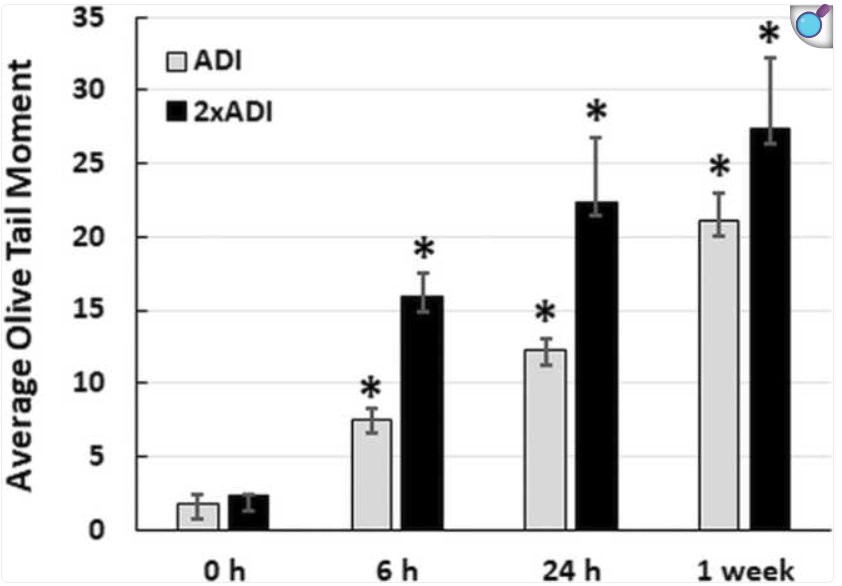
Allura Red can also cause DNA damage. The amount of DNA damage depends on how much Allura Red is used or consumed. Although, it causes DNA damage it doesn't significantly stop cell growth. An experiment was done and they found that the growth of the Red 40 treated cells and non-treated cells were the same. Allura Red can also cause DNA damage in the colon. An experiment was conducted where one group was given the Acceptable Daily Intake (ADI) and the other group was given double that amount. Both groups had DNA damage in the colon but the group that was given more Allura Red had more DNA damage.
IBD (Inflammatory Bowel Disease)
Long-term consumption of Allura Red can cause Inflammatory Bowel Disease (IBD). Continuous exposure to Allura Red can harm gut health and promote inflammation. Allura Red disrupts the function of the gut barrier which produces a chemical that causes the microorganisms of the gut to change. This disruption increases the likelihood of colitis. An experiment was conducted on mice and they found that the mice introduced to Allura Red earlier were more likely to develop colitis. Another experiment was conducted with 3 groups of mice. One group was on a standard chow diet., another group on a daily Allura Red diet and the third group on a weekly Allura Red diet. The findings were that intermittent Allura Red exposure (similar to human exposure) did not increase the likelihood of colitis. They also found that the mice that consumed daily Allura Red developed mild colitis.
Alternatives
| Alternative | Food(s) it can be used in |
|---|---|
| Beet/Beet Juice | Beverages, Sauces and Desserts |
| Red radishes | Confectionary and Dairy Products |
| Purple Sweet Potatoes | Pastries and Desserts |
| Red Cabbage | Dairy Products |
| Black Carrots | Fruit Juices and Dairy Products |
| Maraschino Cherries | Cake Batters and Frosting |
| Paprika | Meat, Seafood and Soups |
| Pomegranate Juice | Dressing |
| Annatto Seeds | Dairy Products |
| Hibiscus Powder | Tea and Confectionary |
| Radish and Potato Extracts | Beverages and Dairy Products |
Data
DNA Damage Data
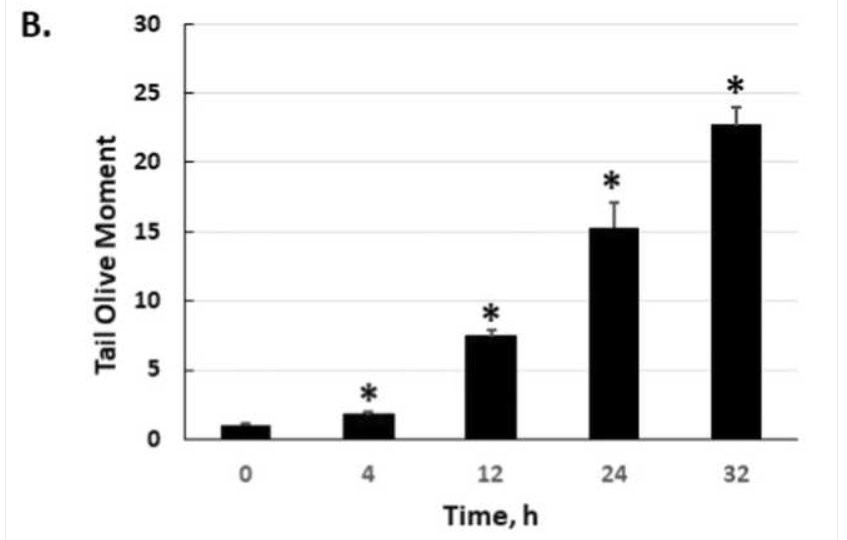
Red.40 DNA Damage In Vitro Over Time
 (See citation 4)
This chart is about the DNA Damage caused by Allura Red in vitro. The data shown by this chart is that the amount of DNA Damage in the test tube goes up as the Allura Red is given for a longer time period. If you have a longer tail moment it means that there is more DNA damage. In conclusion, this data shows that the more repeated exposure time there is the more DNA damage of the cells there is.
(See citation 4)
This chart is about the DNA Damage caused by Allura Red in vitro. The data shown by this chart is that the amount of DNA Damage in the test tube goes up as the Allura Red is given for a longer time period. If you have a longer tail moment it means that there is more DNA damage. In conclusion, this data shows that the more repeated exposure time there is the more DNA damage of the cells there is.
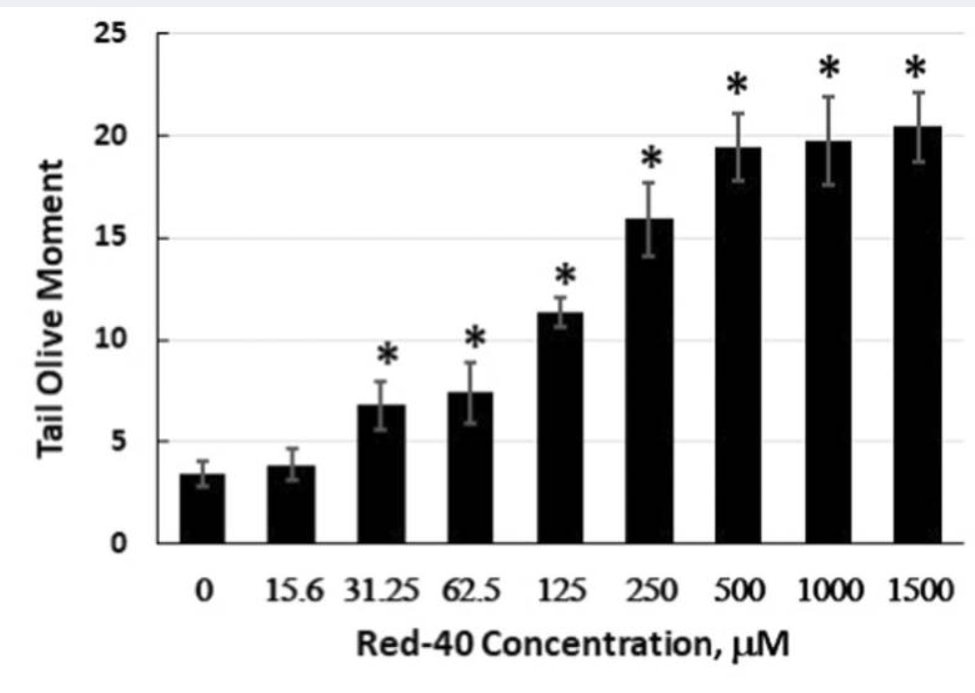
Red.40 Causes DNA Damage In Vitro by Dose
 (See citation 4)
This chart shows that Allura Red is also dose-dependent. Depending on how much Allura Red is given there will be a certain amount of DNA damage. If you have a longer tail moment there is more DNA damage on the cells because of a higher dose. In conclusion the DNA damage caused by Allura Red is both time and dose dependent.
(See citation 4)
This chart shows that Allura Red is also dose-dependent. Depending on how much Allura Red is given there will be a certain amount of DNA damage. If you have a longer tail moment there is more DNA damage on the cells because of a higher dose. In conclusion the DNA damage caused by Allura Red is both time and dose dependent.
Red.40 DNA Damage In Vivo (Mice)
 (See citation 4)
This chart shows the amount of DNA Damage in vivo. The test was done on mice to see if Allura Red caused DNA damage in the colon. One group was given the Acceptable Daily Intake (ADI) and the other group was given twice that amount for 6 hours 24 hours and 1 week. This chart shows that the more Allura Red consumed the more DNA Damage was caused. In conclusion, the group given more Allura Red had more DNA Damage than the group consuming less.
(See citation 4)
This chart shows the amount of DNA Damage in vivo. The test was done on mice to see if Allura Red caused DNA damage in the colon. One group was given the Acceptable Daily Intake (ADI) and the other group was given twice that amount for 6 hours 24 hours and 1 week. This chart shows that the more Allura Red consumed the more DNA Damage was caused. In conclusion, the group given more Allura Red had more DNA Damage than the group consuming less.
Conclusion
Conclusion
Allura Red can be ingested or absorbed into the body which can lead to numerous long-term and short-term health effects especially when consumed excessively. The health effects are both physical and mental. One way to reduce these health effects is by using alternatives. There are multiple names for Allura Red which are important to be aware of. When Allura Red is consumed excessively it can have negative effects. The health effects of Allura Red are ADHD/Behavioural Problems in Children, Hyperactivity in Children, Allergic Reactions, Hypersensitivity Reactions, Cancer/Colorectal Cancer, Migraines, DNA Damage and Inflammatory Bowel Disease (IBD).
What's Next
One way that I can continue my research is by investigating other coloured dyes that may affect human health. I could include dyes that are used in products like medicine, cosmetics and personal care products as well. It would be interesting to see how many products coloured dyes are used in and if they have physical and mental health effects.
I could also compare alternatives of Allura Red to see which one is the least detrimental to human health and if it can be a suitable replacement. Determining, what circumstances alternatives can be used in and if they are healthy would be very fascinating.
Citations
[1] Allura Red AC. American Chemical Society. (2025, July 21). https://www.acs.org/molecule-of-the-week/archive/a/allura-red-ac.html
[2]Rovina, K., Siddiquee, S., & Shaarani, S. M. (2016, May 27). Extraction, analytical and advanced methods for detection of Allura Red AC (E129) in food and beverages products. Frontiers in microbiology. https://pmc.ncbi.nlm.nih.gov/articles/PMC4882322/
[3]Cleveland Clinic, J. Z. (2025, December 5). Is Red Dye 40 safe? https://health.clevelandclinic.org/red-dye-40
[4]Zhang, Q., Chumanevich, A. A., Nguyen, I., Chumanevich, A. A., Sartawi, N., Hogan, J., Khazan, M., Harris, Q., Massey, B., Chatzistamou, I., Buckhaults, P. J., Banister, C. E., Wirth, M., Hebert, J. R., Murphy, E. A., & Hofseth, L. J. (2023, September 6). The synthetic food dye, red 40, causes DNA damage, causes colonic inflammation, and impacts the microbiome in mice. Toxicology reports. https://pmc.ncbi.nlm.nih.gov/articles/PMC10502305/#ab0020
[5]Mittler, M., & More, D. (2025, November 26). Red Dye 40 and your health. Verywell Health. https://www.verywellhealth.com/red-and-yellow-may-be-the-cause-3956894
[6]DeSilva, S. (2025, May 23). The red deception: The truth about red 40. The Cornell Healthca. https://www.cornellhealthcarereview.org/post/the-red-deception-the-truth-about-red-40
[7]Geng, C., & Washington, N. (2022, February 25). Red Dye 40 and ADHD: List of foods, symptoms, and more. Medical News Today. https://www.medicalnewstoday.com/articles/red-dye-40-adhd
[8]Vojdani, A., & Vojdani, C. (n.d.). Immune reactivity to food coloring. Alternative therapies in health and medicine. https://pubmed.ncbi.nlm.nih.gov/25599186/#:\~:text=During%20the%20past%2050%20y,defend%20the%20body%20against%20them.
[9]Kwon, Y. H. E. (2022, December 20). Common food dye can trigger inflammatory bowel diseases, say McMaster researchers - Faculty of Health Sciences. McMaster University. https://healthsci.mcmaster.ca/common-food-dye-can-trigger-inflammatory-bowel-diseases-say-mcmaster-researchers/
[10]Lennon, A. (2022, December 22). IBD: Common red food coloring causes intestinal inflammation, colitis. Medical News Today. https://www.medicalnewstoday.com/articles/ibd-common-red-food-coloring-may-cause-intestinal-inflammation-colitis#:\~:text=Implications%20for%20IBD,checked%20by%20Jennifer%20Chesak%2C%20MSJ
[11]Vega, E. N., Ciudad-Mulero, M., Fernández-Ruiz, V., Barros, L., & Morales, P. (2023, November 12). Natural sources of food colorants as potential substitutes for artificial additives. Foods (Basel, Switzerland). https://pmc.ncbi.nlm.nih.gov/articles/PMC10670170/#sec4-foods-12-04102
[12] Wolf, J. (2025, February 28). Natural alternatives to artificial food coloring. University Hospitals. https://www.uhhospitals.org/blog/articles/2025/02/natural-alternatives-to-artificial-food-coloring#:\~:text=A%20Rainbow%20of%20Natural%20Alternatives,the%20desired%20colored%20is%20achieved.
[13]Enterprises, T. (2025, January 22). What is red dye 40 and what are the red 40 alternatives. Tides Commodity Trading Group, Inc. - Tides Trading. https://tidestrading.com/what-is-red-dye-40-and-what-are-the-red-40-alternatives/
[14]Wrostald\, R. E.\, & Giusti\, M. M. (2003\, June). Allura Red AC - an overview | sciencedirect topics. Science Direct. https://www.sciencedirect.com/topics/biochemistry-genetics-and-molecular-biology/allura-red-ac
[15]First-ever study reveals amounts of food dyes in brand-name foods. Center for Science in the Public Interest. (2025, November 24). https://www.cspi.org/new/201405071.html#:\~:text=Target%20Mini%20Green%20Cupcakes%2C%20which,are%20made%20by%20Mars%2C%20Inc.
[16]How many molecules of Allura Red would you consume if you drank one 20-ounce bottle of Gatorade? | homework.study.com. (n.d.). https://homework.study.com/explanation/how-many-molecules-of-allura-red-would-you-consume-if-you-drank-one-20-ounce-bottle-of-gatorade.html
Family: Parents:Galib and Zahara.S Sisters: Aleena and Inaaya.S
Acknowledgement
Credits to the American Chemical Society, National Library of Medicine, PubMed, Cleveland Clinic, VeryWell Health, Cornell Health, Medical News Today & McMaster University.
I would like to thank my family, especially my parents and sisters for helping and assisting throughout my project. I also would like to acknowledge and thank my science fair coordinator Ms. Emilie Ontko because without her I would not be doing this.