
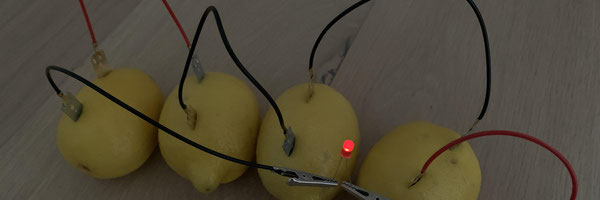
Fruit Batteries
Ellie Wang
Westmount Mid/High School
Grade 6
Presentation
Hypothesis
For my experiment, my hypothesis is that the potato battery will light up the LED bulb the brightest and the longest. Potatoes have a high voltage, which will cause tiny electricity waves to light up the LED bulb. They are extremely rich in phosphoric acid, a special acid that when contacts with specific things, its reaction produces the light from the battery. Potatoes also have lots of fluid in them, which will help ions move around more freely in the potato.
Research
Lemon Battery Research:
Lemons belong to a group of fruits called 'citruses'. This family of fruits includes limes and grapefruits. Citruses contain a sour acid called 'citric acid'. This acid acts as an electrolyte for the battery. An electrolyte is a special substance that produces charged particles, called ions, when caused by a chemical reaction with specific things. The citric acid in a lemon can dissolve into the lemon's juice. When citric acid is dissolved in a liquid, it turns into a substance with many ions in it. These ions carry electric waves that break into positive and negative waves. In order to turn the charged waves into electricity, there needs to be an electrode that contains two things - an anode and a cathode. An anode is the negative electrode, and the cathode is the positive electrode. In my experiment, the anode is zinc, while the cathode is copper. The zinc causes the citric acid to lose electrons (charged particles), and the copper attracts the electrons. The electrons continually flow through the two metals, which creates electricity! A lemon produces around 0.88 volts of electricity, so there needs to be multiple lemons in order to light up the LED bulb, which usually requires 2.0 volts in order to be lit. Usually, a lemon battery stops working if the anode has been corroded from the use of it, or the lemons have dried out.
Orange Battery Research:
Oranges also belong to the same family of fruits as lemons called 'citrus fruits'. Oranges produce electricity the same way lemons do, with an anode and a cathode, zinc and copper. Similarly, the ions of the citric acid flow through the zinc and copper, creating an electric current, making the LED bulb light up. An orange produces around 0.8 volts, which is slightly weaker than a lemon, and a lemon has more citric acid than an orange, meaning that most likely, the orange batteries will be weaker than the lemon batteries.
Potato Battery Research:
Potatoes have a special type of acid called 'Phosphoric acid'. This acid, along with several other salts and substances in the potato, acts similarly to citric acid. When plugged in with an anode and a cathode (zinc and copper), the moist interior of a potato acts as the electrolyte. The electrons circle in a cycle around the connected system of the battery, and light up the LED bulb. The voltage of a potato is about 0.85 volts, but it may vary from potato to potato. A potato has lots of liquid in it, which helps ions move more freely around it. Fact about potato batteries: If you boil a potato for around 8 minutes, it can break down the potato's internal structure, allowing the voltage to increase up to 5 volts, making the LED bulb last up to 40 days! But, all of the fruits and vegetables will be raw in my experiment.
Banana Battery Research:
A banana is rich in a mineral called 'potassium', which is also found in citric fruits and potatoes, as well as a variety of other foods. Potassium conducts electricity when provided with an anode and a cathode (zinc and copper), similar to the rest of the fruits/vegetables, so it produces ions. A banana battery uses the banana's interior moisture as the electrolyte, which transfers ions around the banana. The electrons go in a cycle, lighting up the LED bulb. A banana has around 0.75 volts. Since a banana doesn't have much fluid inside it, it will most likely result in the ions not being able to move around freely, which might affect how well it is powered.
Variables
The variables in my experiment are the Independent Variable, the Dependent Variable, and the Controlled Variable.
Independent Variable: The Independent variable in my experiment is the change of the different fruits and vegetables I am testing.
Dependent Variable: The Dependent Variable in my experiment is the measurements of how bright and long the different batteries will light the LED bulbs.
Controlled Variable: The Controlled Variable in my experiment is how each set of batteries contains only four of each test subject, and that the equipment used to power the items is the same. All of the fruits and vegetables are all raw and have not been changed in some way that will allow it to be weaker or more powerful. All of the batteries will all be placed in the same setting and temperature.
Procedure
I first assembled my materials. For each of the batteries, I used four of each test subject, four zinc strips and four copper strips, clips that could attach onto each metal strip, and a red LED bulb.
Lemon Battery: I rolled the lemons around to release the citric acid inside. I then stuck a zinc strip and a copper strip in each lemon. Using the clips, I clipped one end of each one to a zinc strip on a lemon, then another one to the copper strip on the lemon beside that one. The wires essentially allowed the lemons to be connected to each other, so the battery was supported by four lemons. I connected the last zinc strip and copper strip to the two legs that were sticking out of the LED. The longer leg was for the copper, and the shorter leg was for the zinc. As soon as it stuck together, the LED lit up. I timed how long it lasted for and how bright the light was. I did this experiment three times to ensure that the results were accurate.
Orange Battery: I did the same steps as the lemon battery. I gathered four oranges, and rolled them to juice out some of the acid. Then, I connected the metal strips together with the LED, and timed it. I also did the experiment three times again.
Potato Battery: I got four potatoes and stuck the zinc and copper into them. I clipped the metals together with the zinc to the copper. After the LED was lit, I timed it and did the experiment three times.
Banana Battery: I rolled four bananas gently on the table to loosen up its minerals inside and help the ions move more freely. I then inserted the metal stripes with one of each into each banana. I connected each one with the same pattern of zinc to copper. Lastly, I connected the ends to the red LED bulb, and timed how long it lit up for. I did the experiment three times. I took the average of all three of the scores to get a final time for each of the fruits/vegetables.
Observations
I recorded each time until the LED that was connected to each battery was very hard to see.
Lemon Battery: Average: 47 minutes 1 Experiment: 46 min 2 Experiment: 54 min 3 Experiment: 41 min
Orange Battery: Average: 29 minutes 1 Experiment: 32 min 2 Experiment: 30 min 3 Experiment: 25 min
Potato Battery: Average: 39 minutes 1 Experiment: 33 min 2 Experiment: 42 3 Experiment: 42
Banana Battery: Average: 26 minutes 1 Experiment: 25 min 2 Experiment: 22 min 3 Experiment: 31 min
The best battery was the lemon battery, followed by the potato battery, the orange battery, and the banana battery.
Analysis
| Experiments: | Lemon | Orange | Potato | Banana |
|---|---|---|---|---|
| 1st | 46 min | 32 min | 33 min | 25 min |
| 2nd | 54 min | 30 min | 42 min | 22 min |
| 3rd | 41 min | 25 min | 42 min | 31 min |
| Averages: | 47 min | 29 min | 39 min | 26 min |
Conclusion
In conclusion, the lemon battery lasted the longest. This result did not support my hypothesis - that the potato battery would last the longest. The lemon battery was likely better than the potato battery because it is very rich in citric acid, which helped it stay lit for a very long time. Citric acid is very high in ions, so it also boosts the power of the electricity. Lemons also have a strong voltage. This project was very cool and fun to do, and it's a great way to understand how chemical reactions can turn into electricity.
Application
This way of creating electricity can be researched and developed even further to create an alternative resource that produces powerful energy. We can study the way of this chemical reaction and use it to further evolve technology in our world. This is a great activity to help us understand more about natural produced power.
Sources Of Error
- Some of the fruits may have had varied voltage measurements, making the results slightly off.
- Some of the fruits also may have had slightly different levels of ripeness, but they were around the same.
- The batteries were all built and tested in the same temperature and setting, but if there were different temperatures, the results may have been different.
- The distances of each fruit and vegetable’s anode and cathode may have been different.
Citations
Activity: Build-a-Battery Workshop: Explore Electrolytes - American Chemical Society. (2024). American Chemical Society. https://www.acs.org/education/celebrating-chemistry-editions/2024-ccew/build-a-battery-workshop-explore-electrolytes.html Huber, Z. (2024, March 24). Anode and cathode. Superengineer.net. https://www.superengineer.net/blog/electronics-anode-cathode#:~:text=The%20most%20common%20definition%20of,For%20electronics%20engineers
Acknowledgement
I would like to thank the judges at my school science fair : Preston, Andy, Kelly, Siddhaef, and Jerric. They gave me feedback on my experiment. Thank you to my parents, who supervised me while I was testing my experiment.