
Improving Grip Performance in an Articulating Model of Prosthetic Hand Using Different Materials
Ayaan Ali, Timothy Nguyen
Connect Charter School
Grade 8
Presentation
No video provided
Hypothesis
Our hypothesis for our experiment is that using materials with properties with high friction material that has a rougher/grippier texture will allow for more grip. We predict that either rubber or silicone will be the most beneficial material due to their properties and will benefit our articulating hand in most gripping types (Holding objects like pencils vs holding cups with weights). We hypothesize that the best material will either be rubber or silicone due to them being considered some of the best materials for grip and also because of our research which dives a bit into why these materials are good.
Research
We are doing our study to find materials that can improve daily use of manual prosthetics that lack grip, and our research will help us set a baseline and know which materials will be best to use, and also test multiple grip types to make sure our experiment is as accurate as it can be. The reason behind doing this study, without looking at the scientific part is to hopefully create a prototype or get knowledge to hopefully build a manual prothesis that benefits people who cannot afford myo-electric prosthetics with advanced technology, and many who use manual prosthetics struggle with the grip aspect due to the hand being build as a replacement, not a machine that will help you in your daily life. With that being said, we aren't inventing a new hand, we're just trying to build a foundation and do some research for something better and greater.
Keywords
Polymer: A polymer is a large molecule/macromolecule that is formed by linking together smaller particles called monomers, and these monomers can dictate the flexibility.
Grip: The ability of an object or our hand to hold an object, or to be able to grasp tightly onto it.
Prosthetics: Artificial limbs people use to replace their lost or damaged limbs
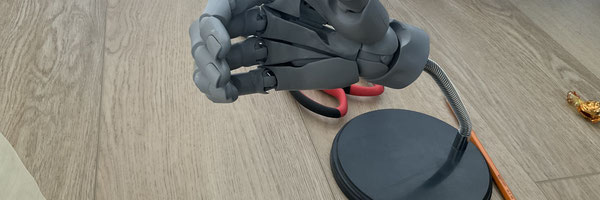
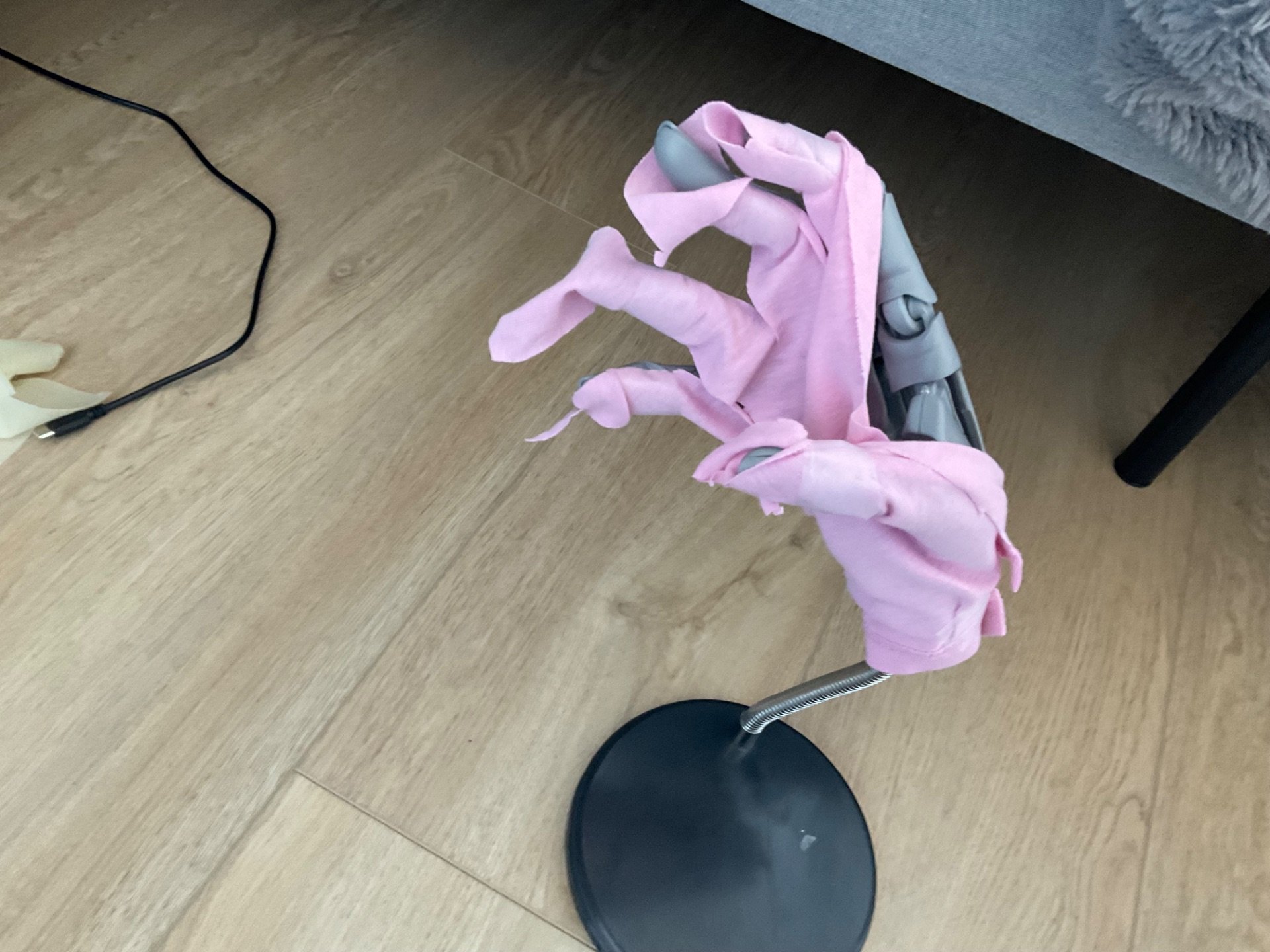
Articulating hand: A fake model of a hand that artists usually use to draw the human hand accurately, and also a very simple version of a hand model/prosthetic.
Viscoelasticity: A property of materials that display both solid like and fluid like properties when deformed.
viscosity: The fluids ability to flow
elasticity: How much a solid could return back to its original state from stress when it is deformed
myo-electric: It uses your electrical signals from your muscles allowing for the prosthesis to contract or move.
static: A form of electricity when there is a imbalance of a positive charge and a negative charge moving to make it balanced.
subatomic particles: essential matter/particles that makes up atom.
electrons: one of the 3 basic subatomic particle. Electrons have a negative charge.
protons: one of the 3 basic subatomic particle. Protons have a positive charge.
neutrons: one of the 3 basic subatomic particle. Neutrons have neither a negative charge of positive charge.
molecules: The smallest particle in a substance that still retains its chemical properties.
friction: It is the force opposite of motion as it reduces movement.
Types of Prosthetics
- Passive Prosthesis: This is just to replace your existing limb, and fill in the part you don't have like fingers for example. Usually the first type of prosthetics that people use when they lose a limb. Since it doesn't have high tech, it is usually for cosmetic purposes, as you have to move each finger by yourself. This is easily adjustable and adaptable. This is the closest to our testing model.
- Body Powered Prosthesis: Operates using a pulley system and you use the residual muscle you have to pull on a cable that allows your prosthesis to move.
- Myoelectric Prosthesis: a myoelectrical prosthesis is an electrical device that responds to electrical signals coming from your muscles. Myo means muscles and it is most commonly used for household activities like gripping stuff, clenching, etc… Electrodes on your skin read your muscle contractions and send signals to the prosthetic hand to open or close. Unlike the body powered prosthesis, it is more efficient and uses less power making it a better option
Material study: Silicone, Foam, Rubber, Fabric, and Plastic
- Silicone is a human made polymer used in many prosthetics because it has properties such as being flexible, almost like rubber, and being durable. The structure of its molecules allows the material to bend and stretch without breaking. These properties greatly help our articulating hand because of the contact area in silicone. Silicone is also hydrophobic, meaning it will repel water, allowing the surface to be consistent. Silicone has many different types, but for our study we will use silicone rubber, to not overcomplicate our study.
- Rubber is easily one of the best materials for our study due to its molecular properties, such as micro-mechanical interlocking, which allows rubber to fill into gaps on the surface it is exposed to, essentially locking the rubber with the object allowing for a lot of grip. Rubber is also very flexible allowing for it to grip onto the objects better.
- Foam is also a great material with a lot of grip, mainly due to viscoelasticity, which allows foam to combine viscosity with elasticity, which allows for the foam to sink once pressure is applied, creating more surface area allowing for more grip. Foam also has thousand of tiny pores which suck the moisture from the object allowing for grip even in wet conditions.
- Plastic isn’t known for being the most grippy material, but still has moderate amounts of grip due to the static electricity, essentially when electrons are transferred and opposites attract so the static electricity creates a tiny layer of grip when in touch with another material such as plastic or water.
- Fabric isn’t usually a great material for gripping on its own, but it does usually have a tiny layer of silicone or rubber allowing for more grip, and natural fabrics such as wool have higher friction than synthetic ones, which allows for more grip.
Grip
There are many different ways to grip an object, and human adjust their grip to the shape, texture, and weight of an object. The main gripping methods are classified in 2 sections, the power and precision grip. Power grip can be defined as using all your fingers to wrap around an object, with the thumb reinforcing for support, and this is usually used for holding bigger or heavier objects. Precision gripping uses less force and your thumb and fingers work together to precisely hold an object for fine control, and this allows for more accuracy. There are also around 5 main subsections for these grip types - Tripod, Hook, Pinch, Spherical, and Cylindrical grip.
Tripod Grip:
When gripping a pencil, you usually use 3 fingers: the thumb, the pointer, and the middle finger. This is called a tripod grip, prioritizing control, which is in the precision grip class.
Hook Grip:
The hook grip is a type of hand grip used mainly for carrying objects. When you carry a plastic bag, for example, you usually carry it in a hook-like shape. This is the hook grip, it prioritizes stability and strength over fine motor control.
Pinch Grip:
This grip is classified in the precision grip class as it is used for picking up small objects like a coin, for example, and it prioritizes fine motor control.
Spherical Grip:
Due to its name, we can see that this grip prioritizes carrying a spherical object like an orange, soccer ball, etc... It is classified in the power grip category.
Cylindrical Grip:
This grip is used for holding a cylindrical shape like a cup/bottle as its name suggests. It is classified in the power grip category. .
When we first tested the articulating hand out, we saw that when holding a smooth circular cup, it often fell out right away. When holding a pencil, it had more duration than the cup. The pencil was in a shape of an octagon with tiny ridges making it easier to grip. We also tested out a pen with a part of rubber when then hand was holding the rubber, it had the longest duration of time but when it gripped the metal part, it slipped out right away. This shows that the shape and texture of the object affects the outcome of grip.
Variables
Variables:
Independent: The type of gripping material we use for the articulating hand
Dependent: Grip performance -> how long the object stays gripped in the hand, if it slipped, whether it survived dynamic disturbance or not
Controlled: Same prosthetic hand stand, same holding position for the hand, same object and shape, same environmental conditions (Where the testing happens), same number of trials (3)
Procedure
Here is our procedure for our study, before doing our study as a brief guideline to follow, and later on we will add our actual procedure incase any part of it changes
Materials:
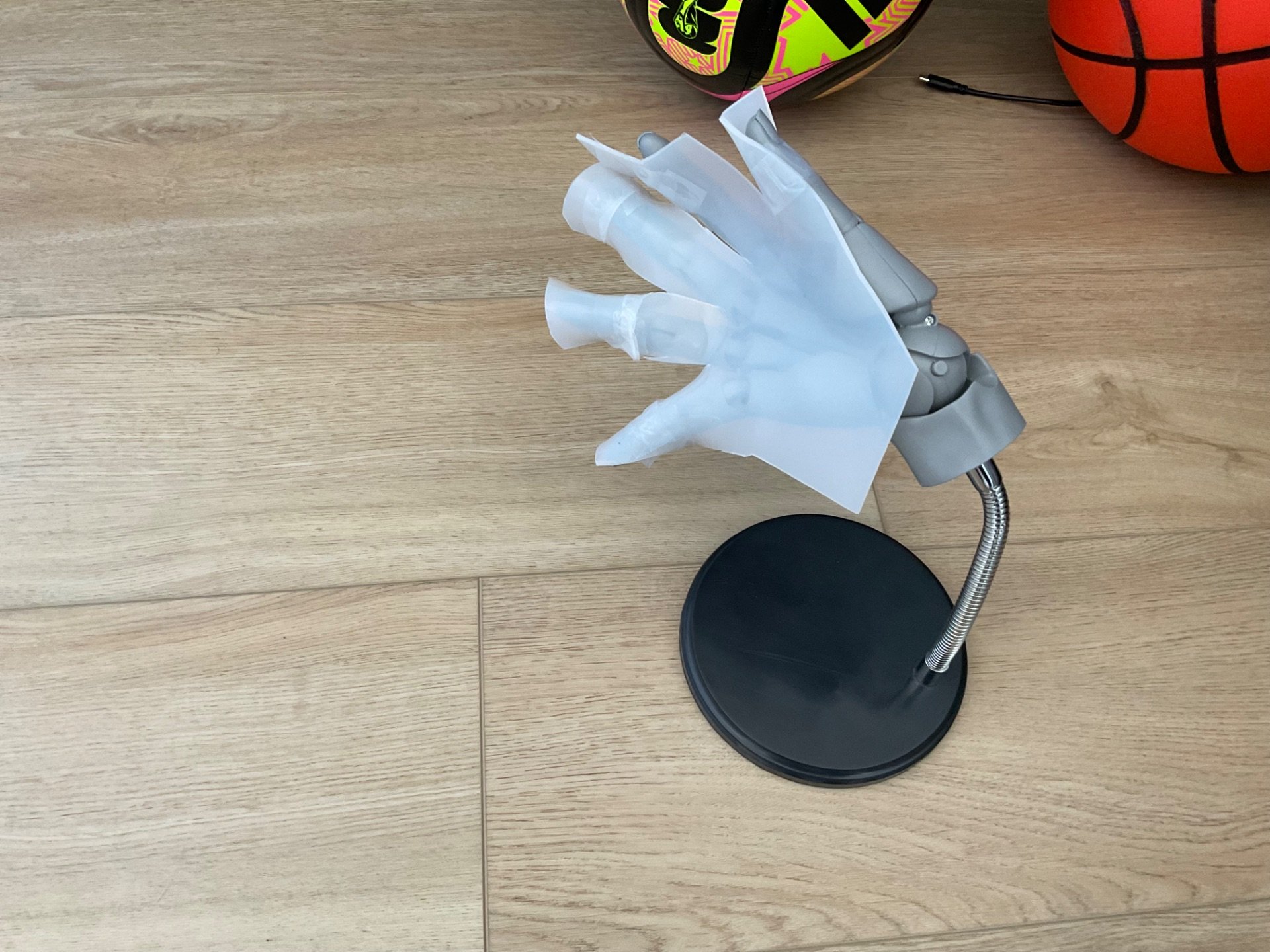
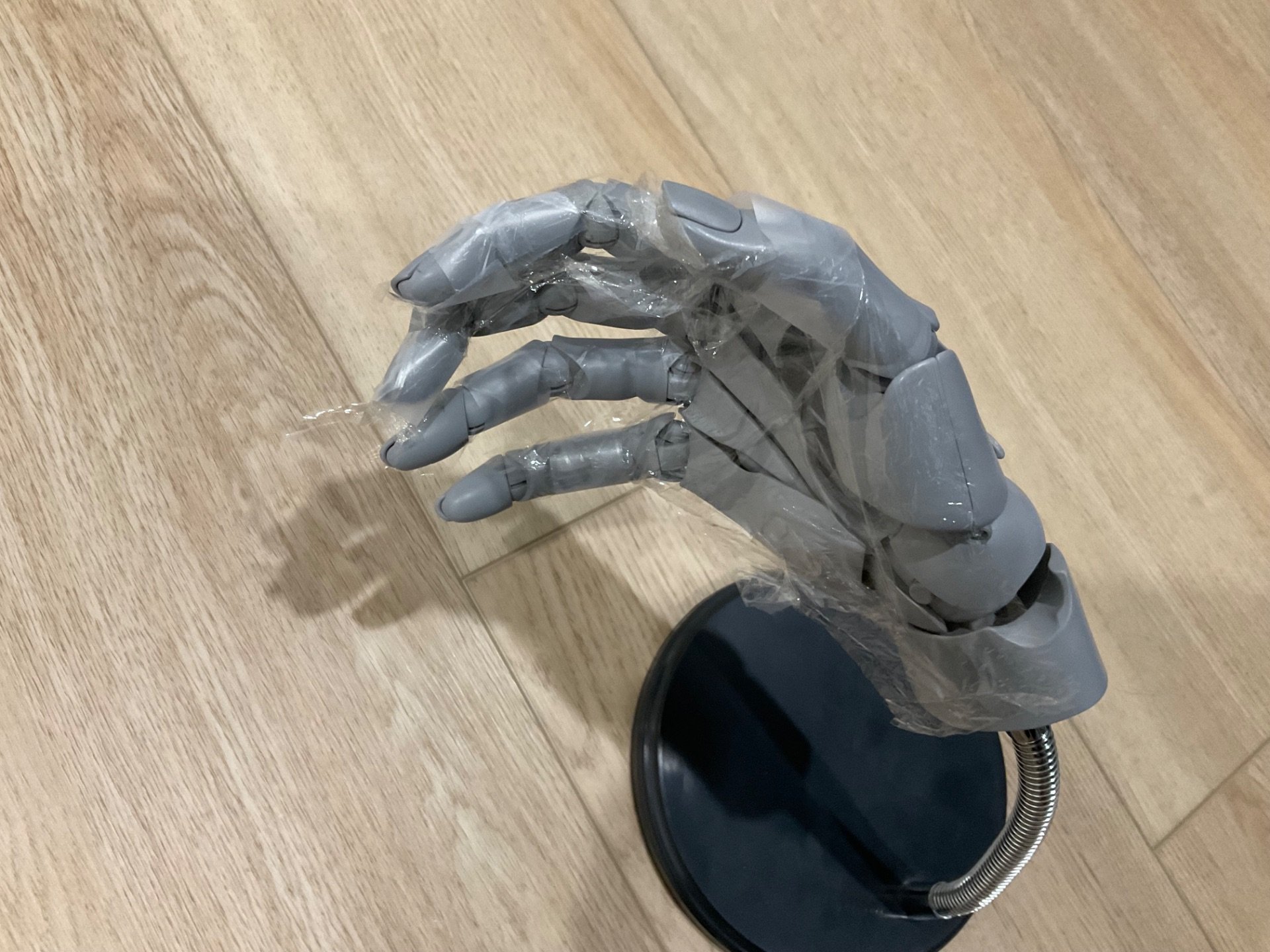
For the hand: Silicone rubber sheets, normal rubber sheets, plastic/sedan wrap, fabric (Polyester), and articulating hand
Objects to hold: Plastic cup, 22 quarters, small foam bouncy ball, plastic water bottle (disposable kind), pencil, and a round pen
Before actual procedure
First step: Acquire our articulating hand and set it up, same surface and hand position depending on the grip type
Second step: Set up our materials which include our grip materials and our objects to hold
Third step: Cut our materials to fit the hand
Fourth step: Test objects which include, pencil, pen, plastic cup, plastic cup with weights, and plastic water bottle, with water and without, and a small foam bouncy ball, using the different kinds of grips and hand positions (tripod, cylindrical, precision, power)
Fifth step: Test the holding time, how the grip is affected with or without the material, and repeat around 3 times to find average grip time and how it holds, and if the material performs extremely well, we will test the weighted objects normally and then also introduce a shaking aspect where we shake the hand from the base to see how long it can last in a dynamic disturbance.
Sixth step: Repeat process for all materials
Actual procedure
For the pencil, we positioned the pencil and tried to grip the pencil using the tripod grip, using the thumb, pointer, and middle finger.
Pen: We positioned the pen the same way as the pencil, using the tripod grip and the thumb, pointer, and middle finger.
Plastic Cup: We turned the articulating hand sideways, with the stand in the same spot, and held the plastic cup using all fingers in a cylindrical grip, positioning it at different angles for the best results.
Plastic water bottle: Positioned it almost the same as the plastic cup but tilted the hand a bit more, and used the cylindrical grip
Plastic water bottle with water: Same as the plastic water bottle, except this had weight so we adjusted the fingers a bit more to hold it better, we did fill it up exactly halfway with water.
Weighted plastic cup: We used exactly 22 quarters, and put them in the plastic cup, and then used the cylindrical grip to hold it, but the weight did kind of make the stand lean over a bit so we held it down with one hand.
Small foam bouncy ball: Used the pointer and thumb to grip it, sort of a bigger pinch grip, and the hand was positioned sideways
When we tested the rubber, it just had the same great results the whole time, with no variation, so we decided to add a shaking aspect where we shook the base (not the hand but the bendable rod it was connected to) to add dynamic disturbance. We shook it until our weighted plastic cup, which we were testing for this, fell.
We wrapped the rubber around the hand using tape and making cuts in the rubber so it fit the hand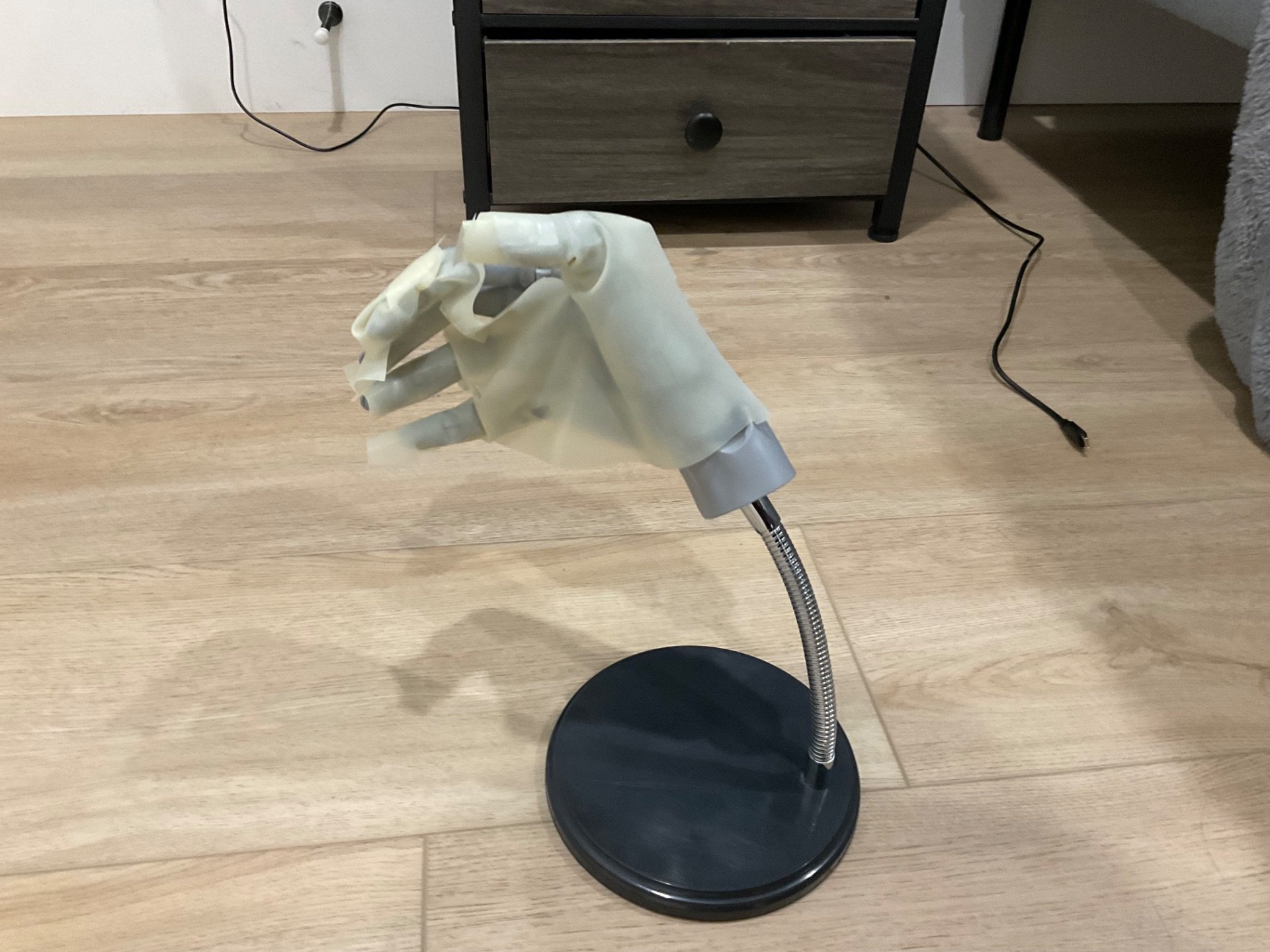
When we used dynamic disturbance for silicone and rubber, we made sure to apply the same amount of force for shaking so the tests would be equal.
Observations
Grip Testing of the Articulating Hand
This is our observations for each material and how it held each object and its performance:
No materials, just the articulating hand
When we were testing the articulating hand with our Tripod Grip test, there was absolutely no grip. It’s most likely due to the plastic articulating hand having no sort of precision grip or a good material to make up for the lack of gripping ability. This means it wasn’t able to grip the pencil or pen in any sort of way.
When we tested the power/cylindrical grip on the plastic cup, with no weights, it held up pretty well, but it had slippage and wasn’t fully gripped at times. The hand overall held the plastic cup well but not in a fully stable position 100% of the time.
When we tested the cylindrical grip on the weighted plastic cups, which had 22 quarters, we noticed the grip went down slightly and more slippage was noticeable, might not be a material solved issue due to weight being counteractive to grip.
Testing the plastic water bottle, with no water, we noticed it held the bottle pretty well, probably due to the fact that the bottle had ridges, which was a bit of a mistake on our end, but it held the plastic water bottle really well, but on the part with no ridges, there was a lot of slippage.
When we tested the plastic water bottle with water inside off it, the grip decreased a ton, probably because the articulating hand doesn’t have the strength to support that weight and compromises the grip.
When we tested the small foam bouncy ball, it surprisingly displayed the best grip, probably due to the ball using foam which probably enhanced how well the hand could grip the ball
Rubber
When we tested the tripod grip, the rubber seemed to have made the articulating hand a brand new hand, and could hold the pencil for virtually as long as it wanted, and there seemed to be close to zero slippage, and I also noticed the pencil and rubber kind of stuck together. For the pen, the results were the same, full grip onto the pen and was able to hold the pen for prolonged periods of time. The result did not change even through 3 repeated tests, and the rubber was like glue.
When the articulating hand with rubber held the plastic cup, it was easily one of the biggest changes I’ve noticed. On the no material test, the hand grasped the cup pretty well, but you could still push it a bit and it would slip, and you could notice how close it looked to falling out, but with the rubber, it stayed in place extremely well, and I even had some struggle pulling the cup out, and the rubber almost acted like actual grip force.
While also testing the plastic cup with weights, we noticed that the weight evenly balanced out with the grip the rubber was providing, and it stayed in place and grasped, unlike the no material test, where the weight just was greater than the grip the articulating hand by itself could provide.
Testing the plastic water bottle with no water, we immediately noticed the grip just adjusted to the shape of the cup, in a way, and it didn’t matter if we put it on the part with ridges or no ridges, the articulating hand held the plastic water bottle firmly.
Even with water in the plastic bottle, the grip remained the same and would only slide a tiny bit, but not enough to drop.
Since rubber performed so well and we couldn’t find a “weak point”, so we decided to add our dynamic disturbance effect which is essentially shaking the metal rod connected to the articulating hand so the hand moves to simulate real life movement of the hand. When we tested this using the plastic cup with weights, the shaking did move the cup and weights in different directions, so the material couldn’t hold onto the cup for long, and it fell after 5 shakes.
The foam bouncy ball just stayed in place the entire time and we couldn’t really notice too much since it wouldn’t slip at all.
Plastic
Testing the tripod grip using the plastic, we immediately noticed that the plastic looked like it had tension between itself and the pencil, and it held pretty well in a stable fixed position but we noticed it slid a bit if adjusted. The plastic provided grip but it wasn’t enough to hold the pencil for a prolonged period of time. Using the pen, there wasn’t a crazy difference, but because of the shape difference between a pen and a pencil, the pen slid a lot and would eventually just slide until it reached a point where it was positioned perfectly in between the fingers, and even then, it wasn’t fully stable.
When we tested the plastic cup with no weights, the plastic wrapped around the hand seemed to almost slide with the plastic cup, and even though there was signs of grip and the hand held the cup well, the grip just wasn’t consistent enough throughout the 3 repeats of our test. In the first one it seemed to hold fine, the second it just kind of slipped out of the fingers, and in the third it slid a bit and then stabilized.
After testing the plastic cup with weights, we noticed something pretty weird which was that the hand could not hold the cup with weights at all, not even a bit, didn’t matter how the hand held it, it would just slide. We believe this is because plastic is already low friction and adding weights just adds to the already low friction which causes the cup to slide as much as possible and have no grip.
Testing the empty plastic water bottle, the results were a bit here and there; The plastic seemed to make the bottle slip even more, so the hand could never really get a good grip onto the bottle, in test 2 and 3 there were evident signs of being able to grip the water bottle but it did slip a lot and the hand and plastic covering the hand could quite never hold onto the ridges of the plastic water bottle.
With a plastic water bottle filled with water, we noticed that the results weren’t much different from the weighted plastic cup, since the hand just could not hold the water bottle in the slightest bit, which we said previously, might be due to the low friction and the weight also pulling the bottle down.
Plastic is the first material we’ve tested that could not properly hold the foam ball, because it just kept sliding out of the fingers or not even being gripped by the fingers, and even through our 3 repeats one thing was evident, the plastic coating the hand just could not get a grip onto the foam bouncy ball.
Silicone
When the articulating held the pencil in the tripod grip using the silicone, it had a very surprising result, which was that the pencil slipped out of the hand 1 out of the 3 repeats, and even in the last repeat of our test it was slipping, which is pretty weird since all of our past materials seemed to hold the pencil just fine. However, when we used the pen, the hand and the silicone were able to grip it super tight and it just would not slip or fall out of place. I think this might have to do something with the shape of the objects and maybe the hexagon shape of the pencil wasn’t ideal for the silicone.
The silicone was able to grip the plastic cup with no weights extremely well, and held onto it like a shell, ensuring there was absolutely no slippage, and even throughout our 3 repeats the results stayed the same. When I tried to pull the cup out of the hand I literally heard squeaking because of how amazing the grip was.
Even with the weights, the plastic cup was still gripped extremely well by the silicone and the articulating hand, and we couldn’t find a single issue with the grip. The silicone almost just like molded around the cup and secured it in place, so there wouldn’t be any slippage.
Testing the plastic water bottle, the first thing we noticed was that there was some initial slippage on two out of the three test repeats, but it never fell out of place and eventually just stabilized itself within the grip of the silicone and the hand, and from there it never slipped.
Once testing the plastic water bottle with water, we noticed that there was evident slippage in test 2 out of our 3 repeats, but in tests 1 and 3, the hand gripped the bottle perfectly fine and the only real issue was that the weight was weighing the hand down which did tip over the water bottle a bit, but other than that there were absolutely no issues.
When we tested the small foam bouncy ball, we couldn’t really notice much of an issue at all, the ball stayed in place, slipping a tiny bit only once, and the hand seemed to be able to grip it really well.
Since the silicone performed so extraordinarily in all of our tests, we decided to use our dynamic disturbance test, which as previously mentioned, is where we take the weighted plastic cup, put in the cylindrical grip, and shake the hand from the base. When we did this, the hand held onto the cup so well, that after 13 whole shakes it finally fell.
All I can say is that silicone has performed extremely well so far.
Fabric
Testing the tripod grip in general with the fabric, we noticed there was just no grip, like it could not hold a pencil or pen, and the fabric was just making the pencil slide out of the tripod grip, and in test 2 of our 3 repeats we did notice that the tripod grip held up with the fabric for around two seconds but then it just slid out of the grasp. Overall it was just not great at the tripod grip
Testing the plastic cup with no weights, we noticed that the hand could grasp the cup using the cylindrical grip but it was just really inconsistent, in our first test it held up fine, with a tiny bit of slippage but not enough to cause the cup to fall, and then in our second it just fully slid out of the fabric and hand. There was evident signs of grip but it just wasn’t great and even when I felt the material and fabric it just did not feel like it could hold objects well.
While testing the plastic cup with weights, the results were even worse, since the cup just slid out of the hand every single time because of the low friction of the fabric added to the increased weight. There wasn’t really that much to notice aside from the fact that the fabric just couldn’t hold and grip onto objects properly.
Testing the plastic water bottle, the results were decent, the hand was holding the plastic water bottle fine but we did notice that the fabric was just slipping on certain parts and wasn’t really the deciding factor for the grip, I feel that the ridges in the plastic water bottle were one of the main reasons why it didn’t fall out of the hand.
Testing the plastic water bottle with water, our results were just bad, like it would just not hold onto the bottle and it kept slipping and spilling water, overall I don’t have much to say aside from the fact that the fabric could not grip or handle weighted grip.
For the bouncy foam ball, it only slipped once in the 3 repeats of our testing, and aside from that I couldn’t really notice much and the fabric was holding the ball decently.
We can’t do our dynamic disturbance test since fabric performed terribly.
Analysis
Results
Silicone: Performed the best overall, and has close to no flaws. It successfully managed to hold all tested objects including the weighted cup, and plastic water bottle with water. It only really had a problem in holding the pencil, likely due to the pencils small contact area and its hexagon shape. When testing the dynamic disturbance, silicone showed the best results out of the two materials that were tested with dynamic disturbance, lasting 13 whole shakes, which shows us it has strong stability under movement.
Rubber: Performed slightly below silicone, still managed to show excellent grip. It showcased precision and power grip efficiently. The only real issue was that it could not sustain weighted loads under movement (Our dynamic disturbance). Aside from that, rubber performed excellent.
Plastic: Performed poorly overall, showing frequent slippage, especially while trying to grip heavier objects. Its performance was only a bit better than the baseline articulating hand itself, mainly struggling in power grip tests.
Fabric: Not much different from plastic, performed mediocre and didn't have much strengths. Showed noticeable slippage with both small and heavy objects and was very inconsistent in our repeats of tests. Lacked the strength and stability required for effective gripping.
No material: The articulating hand alone didn’t have much grip. Smooth and weighted objects fell quickly, showing us that additional material was needed to improve functionality and gripping ability.
Conclusion
The original purpose of this experiment was to determine which material would most improve the grip performance in a manual articulating hand (Used as a model for a manual prosthetic) in order to find how we could improve grip in a low cost prosthetic. In our hypothesis, we stated that materials with high friction and flexibility, such as rubber and silicone would perform the best and showcase the strongest grip across multiple grip types. The results and our testing supported our hypothesis. Silicone performed the best overall, showing its strong performance in both precision and power gripping. Rubber also performed excellent, but showed flaws when exposed to movement. Plastic and fabric showed close to zero improvement compared to the baseline articulating hand, due to their inability to grip most objects.
Our testing shows that high friction, flexible polymers such as silicone and rubber greatly improve grip by increasing surface contact and stability. This research and testing could potentially contribute to improving manual prosthetics for people who cannot afford myoelectric prosthetics. Using this materials to improve grip could make life a bit easier for amputees.
Future testing could include combining materials, trying to measure the actual force of the grip and how the friction looked on the smallest level, or testing durability over long term use.
Application
Doing this study can benefit amputees in a positive way. The big problem with most amputees and their prosthetics is that most can’t afford myoelectric prosthetics, and people from lower end countries use manual prosthetics or something close to that, and manual prosthetics aren’t mainly used for holding objects and that means they don’t have good grip, and obviously it can’t generate grip power since it isn’t high quality, so using materials such as silicone and rubber to coat the hands would allow manual prosthetics to become a bit more useful, since if one of your hands are occupied you would be able to use the prosthetic and not have to worry about your object falling out of the prosthetic.
Sources Of Error
Errors and how we could fix them next time:
1. We used a plastic water bottle with ridges\, which could’ve increased grip since ridges are irregular texture which can positively affect grip\, we could fix that next time by using a fully smooth plastic water bottle
2. We used a small foam ball\, and since it was foam\, it could’ve made the ball itself easier to hold which might’ve messed up the results for that object. Next time we can try to use a plastic ball.
3. We originally planned on using foam\, but due to shipment and buying issues we weren’t able to buy it\, which means we used 4 materials instead of 5.
Citations
Material research: https://www.inmr.com/chemistry-properties-of-silicones/ https://www.americanchemistry.com/chemistry-in-america/chemistries/silicones https://www.sciencedirect.com/org/science/article/pii/S2164632525000253#:\~:text=Apart%20from%20differences%20in%20production,its%20chemical%20and%20oil%20resistance. https://www.elastoproxy.com/physical-properties-of-rubber-basics-for-buyers-and-designers/ https://www.xometry.com/resources/materials/what-is-plastic/ https://www.as-enterprises.com/blog/properties-of-foam-that-make-it-an-amazing-industrial-material/ https://pubmed.ncbi.nlm.nih.gov/18272451/ https://www.sciencedirect.com/science/chapter/edited-volume/abs/pii/B9781845695392500028 https://www.textileschool.com/199/physical-properties-and-characteristics-of-fabrics/
Types of prosthetics: https://www.armdynamics.com/our-care/finger-and-partial-hand-prosthetic-options-1 https://my.clevelandclinic.org/health/treatments/prosthetic-arm
Types of grips: https://en.wikipedia.org/wiki/Thumb#Grips (Some of the grip knowledge was also known by Tim beforehand) https://www.twinkl.ca/teaching-wiki/tripod-grip https://www.theottoolbox.com/cylindrical-and-spherical-grasp-development-korxx-blocks/ https://www.theottoolbox.com/hook-grasp/ https://www.kenhub.com/en/library/anatomy/anatomy-of-grip https://www.researchgate.net/figure/The-various-types-of-prehension_fig1_256757242
Acknowledgement
We would like to thank our teachers, Mr Bennett and Mrs MacDonald for showing us an opportunity to participate in CYSF, and also thank Mr Neil for being our coordinator and giving us information on what to do. We would also like to thank our parents for funding this and helping keep us on track. Finally, we thank CYSF for this opportunity.