
The Science of Cooking
Ava Jagusch
Nickle School
Grade 6
Presentation
No video provided
Hypothesis
If the baking powder is reduced, then the cookies will have risen less because baking powder is a leavening agent, which means it provides lift, so less baking powder should equal less lift.
Research
Baking powder acts as a leavening agent in cookies, providing lift, because it produces carbon dioxide gas when it is combined with wet ingredients and exposed to heat (like cookie batter in the oven). The bubbles create more rise and less spread.
Variables
Manipulated: Varying amounts of baking powder
Responding: Measuring the height and diameter
Controlled:Temperature,ingredients, same pan, same spot in the oven, cooled pan (because if i make the test cookies one batch after another the pan will already be hot and will cook different), size, weight, amount of time in oven
Procedure
Link for the cookie recipe: cookies
Prepared the base cookie mixture: We began by making the cookie dough following the standard recipe, including all ingredients except the baking powder. This ensured that the control group and the manipulated variable groups could be accurately compared. We mixed all the initial ingredients thoroughly until a consistent dough was formed.
Separated the dough into bowls: After preparing the base dough, we divided it into three separate bowls. These bowls represented the different test groups for the manipulated variable—the amount of baking powder.
Added the manipulated variable: We added baking powder to the three bowls in varying amounts: one bowl received the full recommended amount, one received half the amount, and the last bowl received none. This allowed us to test the effect of baking powder while keeping all other variables constant.
Shaped the cookies: Using a tablespoon measure, we scooped dough from each bowl to ensure all cookies were the same size. We rolled each portion into uniform balls and measured their diameter to confirm consistency. This ensured that cookie size did not affect the results.
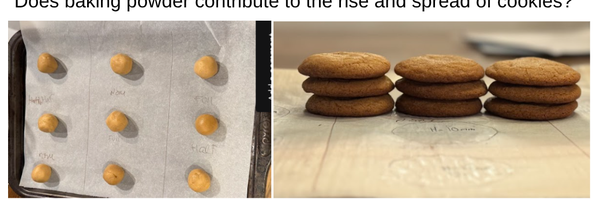
Arranged the cookies on the baking sheet: We placed the cookie dough balls on a baking sheet in three rows and three columns, corresponding to their respective groups. This careful placement minimized the risk that oven positioning would influence the baking outcome, isolating baking powder as the only manipulated variable. The table below details the cookie placement on the baking sheet.
| full | half | none |
|---|---|---|
| half | none | full |
| none | full | half |
Baked the cookies: We preheated the oven to 350°F and baked the cookies for exactly 9 minutes. During baking, we took pictures through the oven window without opening the door so the baking process was not disturbed.
Removed the cookies to halt cooking: Once baking was complete, we immediately removed the cookies from the baking sheet to prevent further cooking from residual heat.
Cooled the cookies before observation: We allowed the cookies to cool completely before beginning data collection. This ensured accurate measurement of differences in texture, height, or spread caused by the varying amounts of baking powder.
Observations
Before baking, all three batches of cookie dough appeared identical in color and consistency. No visible differences in texture or appearance were observed among the dough samples prior to placing them in the oven. While baking, all cookies were observed spreading when viewed through the oven window. The oven door remained closed during the baking process. After baking, visible differences were observed among the three groups. The cookies containing the full amount of baking powder appeared taller and had a visibly fluffy top. The cookies containing half the amount of baking powder appeared darker in color than the other groups. All cookies within the half-baking-powder group were consistent in color with one another. The cookies containing no baking powder appeared shorter and more spread out compared to the other groups. Once cooled,quantitative measurements were recorded. The average height of the cookies with no baking powder was 10 mm, the half-baking-powder cookies averaged 12 mm in height, and the full-baking-powder cookies averaged 14 mm in height. The average diameter of the cookies with no baking powder was 30 mm, the half-baking-powder cookies averaged 28 mm in diameter, and the full-baking-powder cookies averaged 25 mm in diameter (see Table 1).
| Manipulated Variable: Amounts of Baking Power |
| --- |
| None |
| Color |
| Texture |
| Average Height |
| Average Diameter |
Then the cookies were broken in half by hand to observe internal texture and were also eaten to evaluate texture and taste. The cookies with no baking powder were very crunchy with slight softness. The cookies with the full amount of baking powder were very soft and had a fluffy top. The cookies with half the amount of baking powder were slightly chewy and slightly crunchy. The taste of all three groups was observed to be the same.
| Observation | None (0 baking powder) | Full (full amount) | Half (½ amount) |
|---|---|---|---|
| Color | Lighter than half group | Lighter than half group | Darker than the other groups; all half cookies were the same darker color |
| Texture | Very crunchy with slight softness | Very soft with a fluffy top | Slightly chewy and slightly crunchy |
| Height (average) | 10 mm | 14 mm | 12 mm |
| Diameter (average) | 30 mm | 25 mm | 28 mm |
Analysis
The two responding variables we tested for were height and diameter, shown in Graph 1 and Graph 2, respectively.
The results detailed in Graph 1 show how the height responded to the varying amounts of baking powder. The results show that the more baking powder you use the higher the height. Specifically, the average height of the full baking powder cookies is 13mm, the average height of the half baking powder cookies is 11.7mm, and the average height of the no baking powder cookies is 10mm.
 The results detailed in Graph 2 show that by the trends if there is less baking powder then the cookie will have a bigger diameter.The average diameter of the full baking powder cookies is 59.4mm, the average diameter of the half baking powder cookies is 62.7mm, and the average diameter of the no baking powder cookies is 63.7mm. These two responding variables show a connection in Graph 3. The connection is that the diameter and height move in opposite directions. When the cookie is tall then the diameter is small and when the cookie is short then the diameter is big.

It can be seen in Graph 3 that the flatter your cookie is the shorter it will be in height, which also means that the taller your cookie is the less diameter it will have. This then shows that baking powder is a leavening agent so more baking powder equals more rise and a smaller diameter.
 It can be reviewed in Table 1 the texture of the cookies compared to the amount of baking powder. The texture of the no baking powder cookies were very crunchy with very little softness, the texture of the half baking powder cookies were very chewy and crunchy, the texture of the full baking powder cookies were very soft with a very fluffy top.
| Full | Half | None |
|---|---|---|
| very soft with a fluffy top | very chewy and crunchy | very crunchy with very little softness |
The leavening agent, which is baking powder, contains both a base and an acid which means when the cookie is heated or the ingredients get wet this releases carbon dioxide gas. The carbon dioxide gas creates bubbles in the cookies as they bake in the oven and when mixing the ingredients to make the dough. The bubbles create rise in the cookies, this then shows that the more baking powder you add the smaller the diameter will be.
Conclusion
Overall, it can be concluded that the hypothesis is confirmed. When the baking powder was reduced the cookies rose less and we can conclude then that baking powder is a leavening agent. Cookies that had full amounts of baking powder were taller, this means that the baking powder created lift and less spread, also a more cake-like texture. Some of the limits that we had were how long the dough sat out for, measurement error, hot spots in the oven, and cooking time. The results also confirmed the research that baking powder is both a base and an acid; it releases carbon dioxide when heated or when the ingredients get wet.
Application
Understanding how to use baking powder in the real world can make a more desirable texture, height , and diameter throughout the baking world. Adding more than the required amount of baking powder means that there will be less spread and more rise, this means adding more cookies to the tray which leads to not having to bake as many cookies and conserving energy.
Sources Of Error
The sources of error that could have happened were the temperature in the oven might not be what it says to be, the temperature could he been disproportionate with whare the cookies were placed, the dough sat out while making the other batches which meant that the baking powder had more time in other dough than others to react with the other ingredients, the measurement of the ingredients could have been a little more or a little less than what they were supposed to be, measuring the cookies with the ruler could have been a little bit wrong considering all the tilted heads and angles.
to correct these errors next time
Citations
research: co-pilot: summary provided with prompt: https://www.seriouseats.com/cookie-science-baking-powder#:\~:text=Baking%20powder%20is%20a%20two%2Din%2Done%20chemical%20leavening,even%20water%20to%20set%20off%20the%20reaction.v
Acknowledgement
thank you mom and dad for helping me with helping me with my whole project especially understanding analysis and hypothesis, thank you for buying me the things I needed for baking my cookies.