

Does study music really affect the ability to absorb information?
Saanvi Prakash
Connect Charter School
Grade 6
Presentation
Hypothesis
If we test for speed and accuracy before and after listening to classical or “study” music, we will find that accuracy and speed will increase after listening to classical music, because focusing on the music while doing a task will help with not getting sidetracked, as all of the focus will be towards the task needing completion.
Research
Music reduces stress:
Research studies show that relaxing music changes how a person reacts physically and mentally, due to hormone changes, when facing stress. Studies show that music improves your mood, which naturally reduces stress levels. Research also shows that learning outcomes are better when somebody is in a good mood. Another research shows that to improve sleep before a test, turning classical music on before bed can slow brainwaves because of their tone and rhythms.
Music motivates:
It provides a reward system: Finish this task, and you will get rewarded with your favourite song. It motivates you to keep going with your work, with the promise for music.
Music increases focus:
A research study shows that classical music specifically can help the brain absorb and understand info easier. Since the brain breaks information into smaller pieces, music can engage your brain to understand what is happening better, and also pay better attention to events. A research similar to this one showed that students who attended a lecture with classical music in the background performed better on a multiple choice quiz than students who attended the lecture in silence. The research also states that it is possible that the students remained motivated to focus during the lecture with the classical music. Music activates both sides of the brain, and using both sides can increase learning and improve memory.
Many sources state that music with slower tempos, no lyrics, and repetitive or ambient tunes generate a state of calm focus, which helps with minimizing distractions, maintains a consistent work pace, and makes tasks more enjoyable. These three requirements fall directly into the parts of classical music.
Some music is a bad choice:
Research studies show that music with lyrics is more harmful intellectually, than instrumental music, which has a smaller effect. Multiple sources state that classical, lo-fi, and jazz, to name a few, are the best choice to study. The effects of certain styles of music can also depend on the task getting completed. Slower, calmer, and quieter music is most suggested for reading and math, and rhythmic beats are good for memorization. Avoiding faster, and louder music, and sticking to slower music helps with focusing and absorbing new information.
Music in the brain:
Music is shown to activate many parts in the brain. The ability to remember music that you've heard before-- those memories are stored in the hippocampus. This may connect to showing success in work. If you've showed success while listening to a certain kind of music, when you hear it again, the hippocampus will connect back to that moment.
Doing different things with music, like reading music, playing an instrument, and dancing, activates the cerebellum. The cerebellum is involved in almost all cognitive functions dealing with music perception.
Music has also shown to be connected to areas dealing with emotion, which is the nucleus accumbens. This part of the brain deals with pleasure, reward, and addiction. Songs associated with pleasurable memories will connect to the nucleus accumbens.
Relaxing music can lower the production of cortisol, which in turn reduces stress, high blood pressure, and high heart rates, all factors for increasing focus.
Music is also connected to the amygdala: this part deals with emotion, and in music, is sensitive to emotions in style, tone, or voice.
According to a Harvard study, music is also connected to the temporal lobe, which has some very specific temporal gyri, that help process tone and pitch of music.
The biggest detail is that music is connected to the prefrontal cortex, which manages thinking, emotions, and behavior. The brain relies on these skills to make decisions, plan, solve problems, adjust to new situations, and stay focused.
How does music actually help?:
Many studies say that some genres of music, mainly instrumental and classical, create concentration by improving mood and reducing anxiety. This act is sometimes referred to as the Mozart Effect. This act suggests that some musical compositions can increase spatial-temporal reasoning and mental performance for a certain amount of time. However, other researches argue that music with lyrics and high tempo can distract and lower focus from cognitive tasks, which leads to lower comprehension and reduced productivity.
The effect of music on an individual may also relate to factors such as personality type, task difficulty, and personal preference. These factors create a more complex realm for the relationship of music and concentration. Task difficulty depends on what the cognitive task asks: Whether it requires attention for longer periods of time, and whether it involves reading, arithmetic, spatial, or memory components. A few other players in this relationship are age, musical training, (like playing an instrument or reading sheet music) and the baseline for attention. Another big factor is ADHD: Neurodivergent learners typically show a different reaction to classical music than a neurotypical learner.
Many studies positively say that music with lyrics affects learning and focus. Lyrics are more likely to interfere with verbal tasks, while instrumental music has a much smaller effect, and can also help, depending on what the task asks. Recent controlled experiments state that lyrics provided a medium affect on verbal tasks, while simply instrumental showed almost none or small positive effects.
Variables
Independent:
The independent variable in my project is the sound in the background of the experiment. The first round, the participant will not listen to any music before or during the experiment. The second round, the participant will listen to classical music before and during the experiment.
Dependent:
The dependent variable in my project is the time taken to read the story, as well as the accuracy of the answers to the questions.
Controlled:
The controlled variable in my project is the level and word count of the stories and questions asked, as well as the time given to complete the task and the time in the breaks.
Procedure
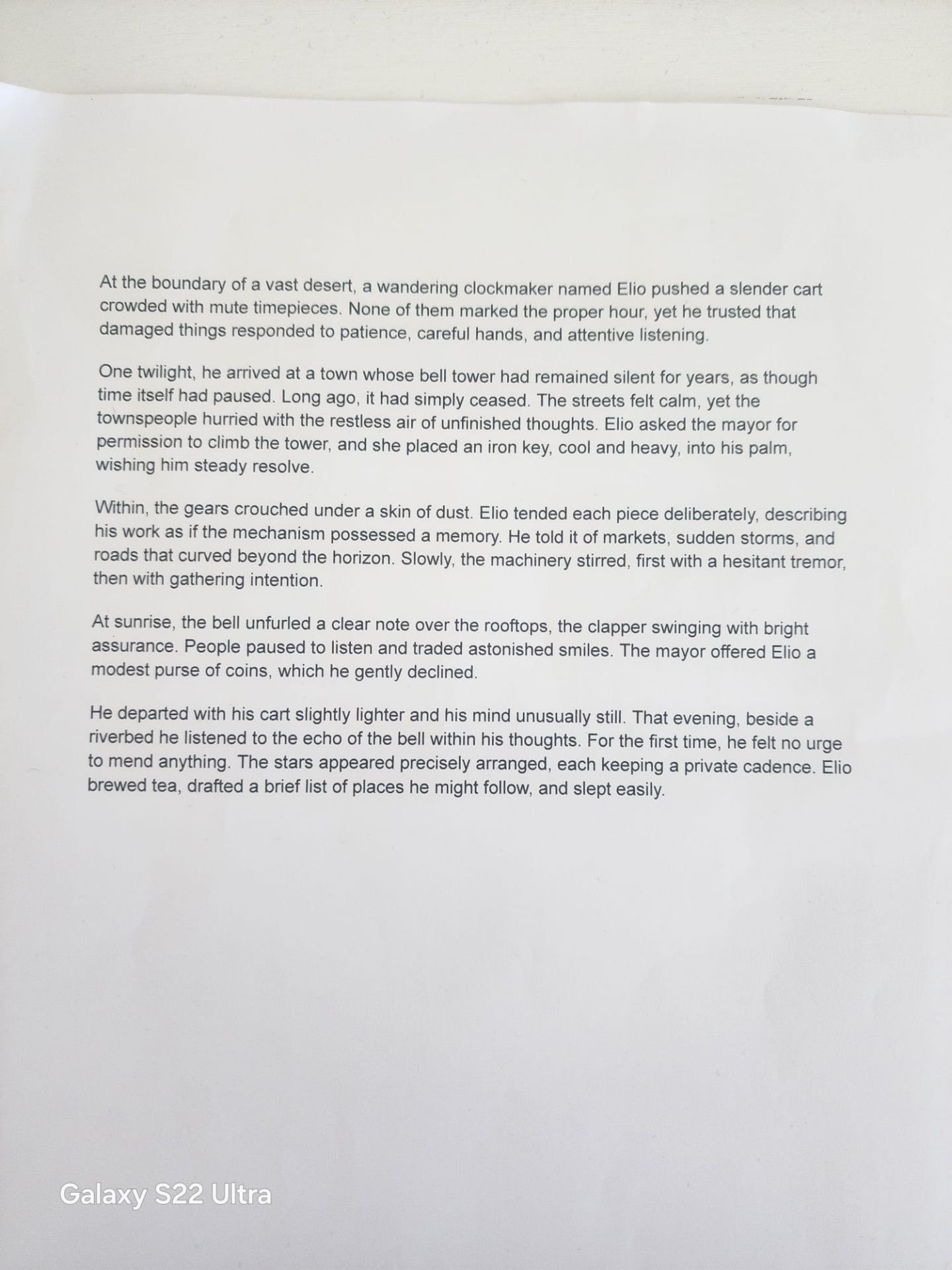
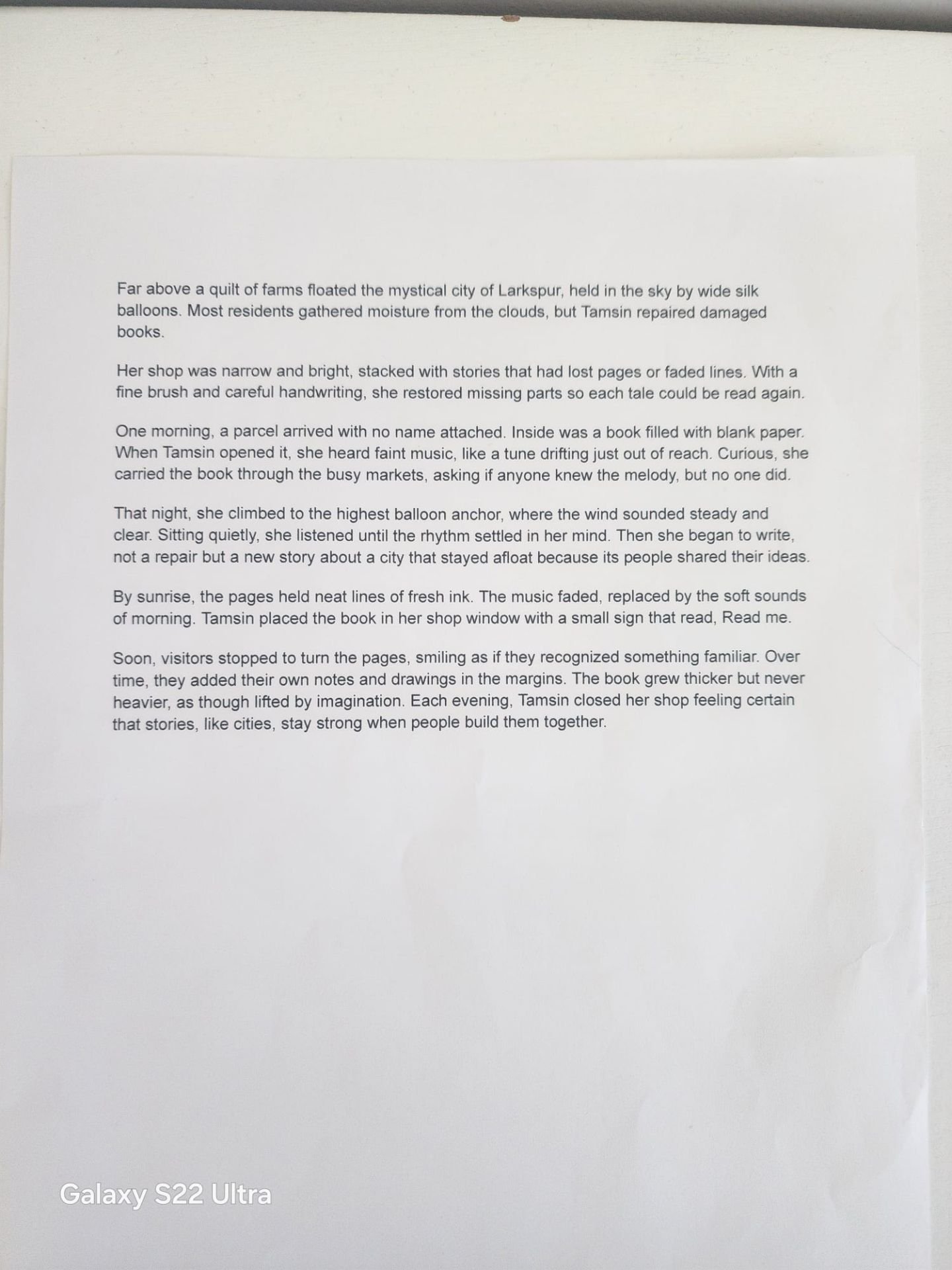
Step One: Find two short stories with the same reading level.
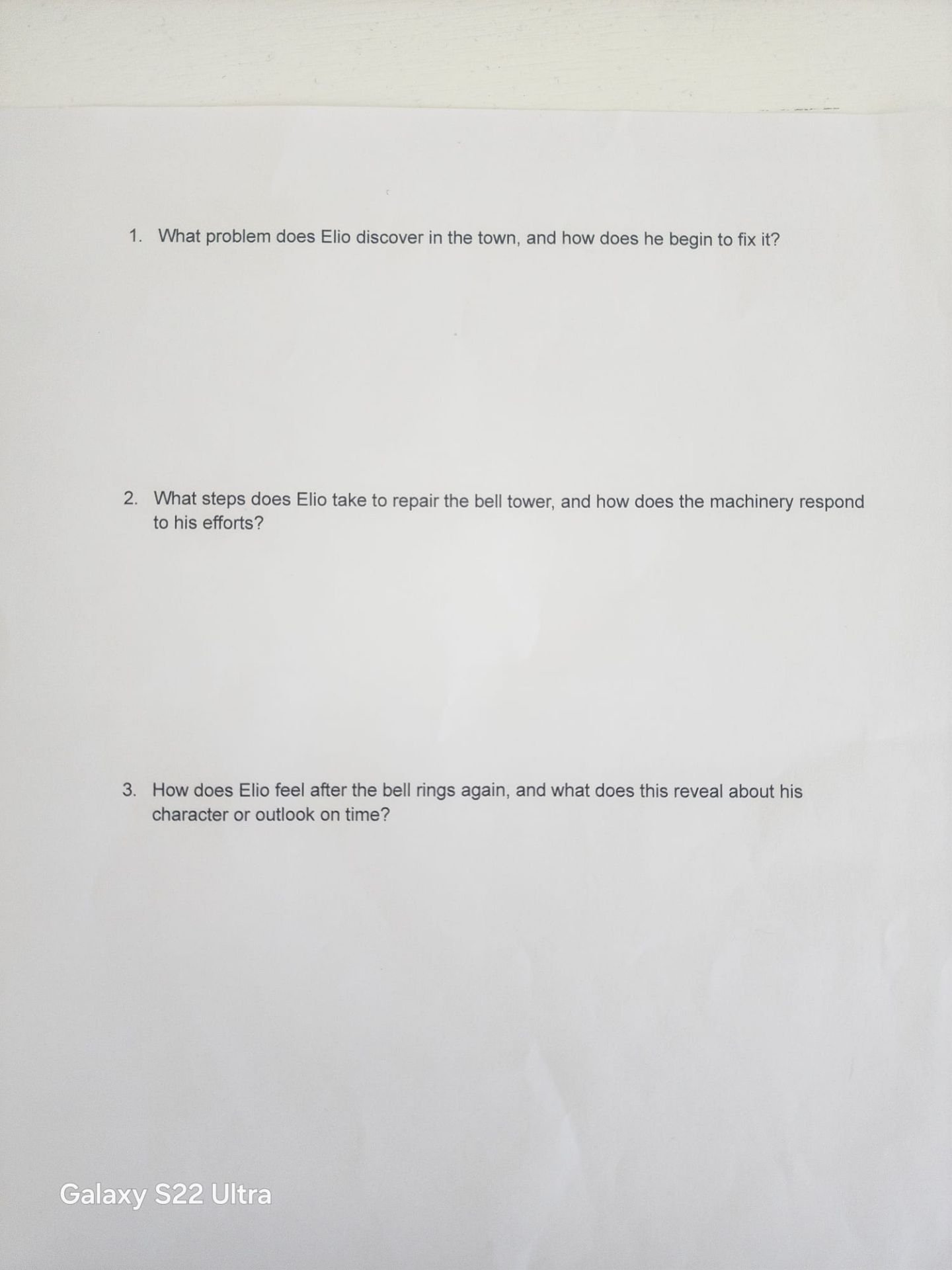
Step Two: Create three questions to answer on the stories after reading.
Step Three: I will make sure that the participant has not listened to any music within the last five minutes before the start of the experiment.
Step Four: The participant will read the first story in complete silence, with a time limit of three minutes. The participant will not be allowed to continue reading after the time limit.
Step Five: The exact time the participant takes to read the story will be recorded.
Step Six: The participant will be given a break of two minutes. This will be spent in silence.
Step Seven: The participant will answer the three questions on the first story with a time limit of three minutes, in complete silence. They will not be allowed to continue answering after the time limit.
Step Eight: The exact time taken to answer will be recorded.
Step Nine: The participant will receive a break of five minutes.
Step Ten: Classical music will be playing in the background during the break.
Step Eleven: The participant will be reading the second of the two short stories. They will have a time limit of three minutes, and they will not be allowed to continue reading after.
Step Twelve: The exact time taken to read will be recorded.
Step Thirteen: The participant will receive a break for two minutes.
Step Fourteen: Classical music will be playing in the background during the break.
Step Fifteen: The participant will answer the three questions based on the previous story. They will be given a time limit of three minutes, and will not be allowed to continue answering after the time limit.
Step Sixteen: Classical music will be playing in the background during answering.
Step Seventeen: The exact time taken to answer will be recorded.
Step Eighteen: I will be comparing times and accuracy of reading and answering both when listening to music, and when in silence.
Step Nineteen: Repeat steps 3-18 to ensure accurate results.
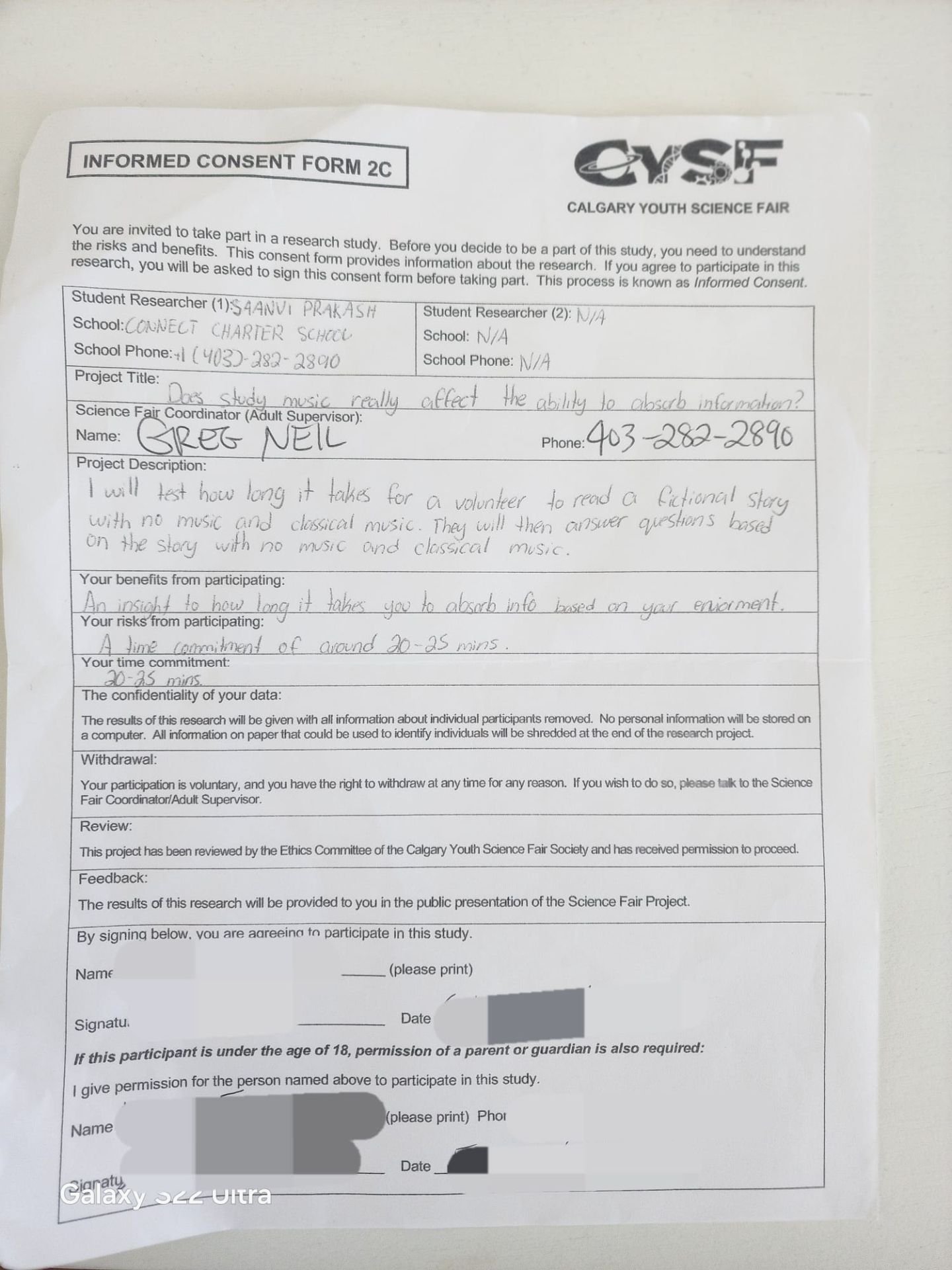
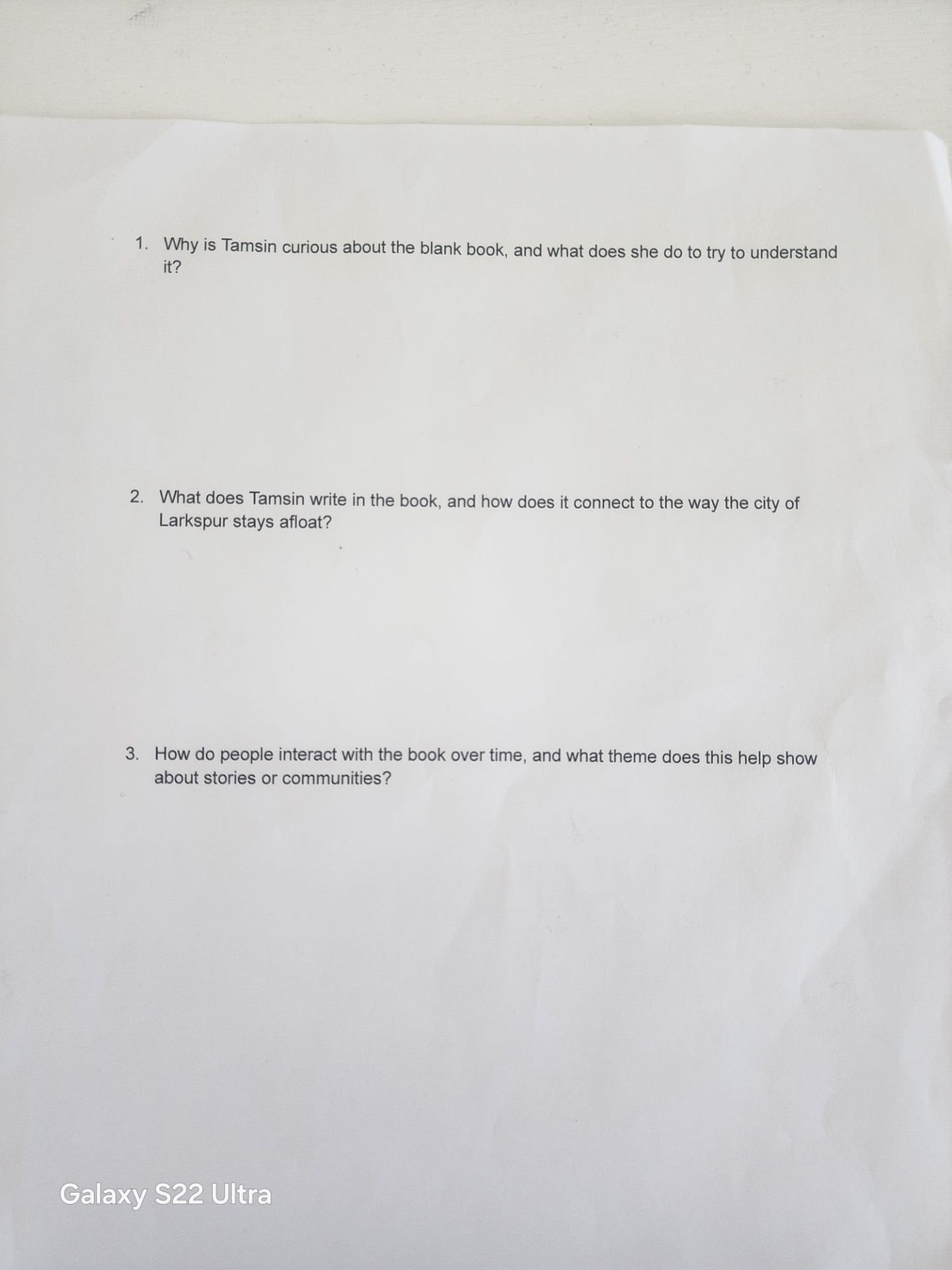
Samples of consent forms, short stories, and questions asked:
Observations
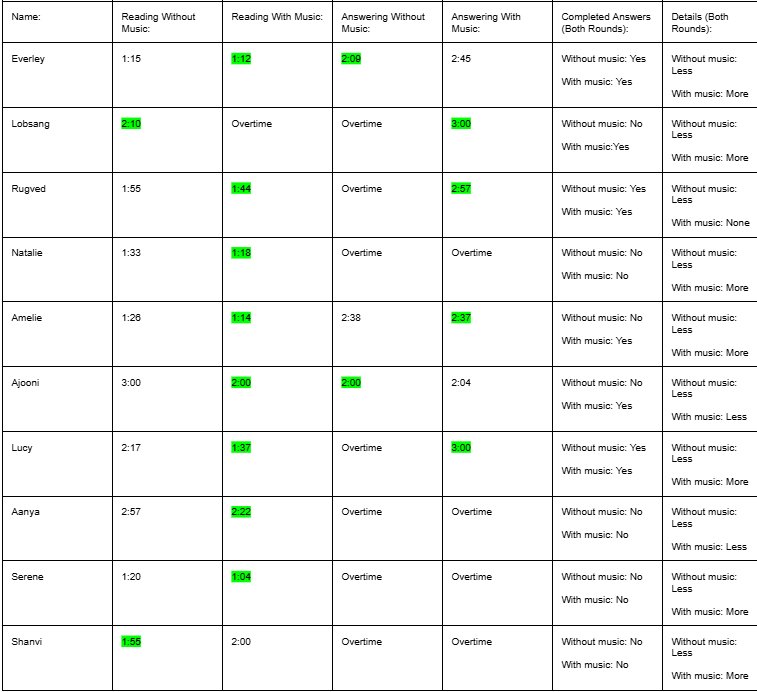
For most of the participants, a trend was noticed. The participant finished reading the short story with music faster, and also finished answering the questions with music quicker. The questions answered with music were fully completed, and consisted of more detail than the previous answers to a different story without music.
By just watching the participants answering the questions, the speed of writing while listening to music was a lot faster than writing without music.
Almost all of the participants had one overtime in their total data, symbolizing that three minutes was not enough to process and answer the questions, with and without music.
Analysis
Time reading with music:
The observations provided in a chart and with a few explanations state that classical music does help with focusing and retaining information. 80% of subjects reported faster timing to read the second story, which is the one read with classical music playing. On the other hand, 20% did not perform better with classical music, showing that they are examples of individuals who would not perform well with classical music playing. Potential reasons for this outcome may be personal preference and personality type. The individual may also be a neurodivergent learner. Age and task difficulty are not considered factors in this situation, because all subjects were around the same age, and they all performed the same task, however, each subject can have a different reading level.
Time answering with music:
40% of subjects reported faster answering while listening to music. 75% of those subjects had more detail in the answers written with music than the answers written without. The one individual with an exception had less detail while listening to music, and their answers were not relevant. All four subjects finished writing their answers with music.
20% of subjects finished quicker while not listening to music. Once again, this could depend on factors like personality type and personal preference, as well as being a neurodivergent learner. 40% did not finish answering during both rounds, stating that the time limit of three minutes was not enough for these individuals.
70% did not finish answering the first round, when they didn't listen to music, and approximately 43% of the subjects who didn't finish the first round did finish answering while listening to music. The remaining four individuals did not finish answering the first round, when there was no classical music, and did not finish the second round, when there was classical music, stating once again that three minutes were not enough for these individuals to answer.
Details included:
100% of subjects did not have much detail while answering the first round, when they didn't listen to classical music, and 70% showed more detail in their answers the second round, in which they listened to classical music. The remaining 30% did not have as much detail both rounds, and one individual did not have any at all while listening to music, whereas they had some but less when not listening to music.
Conclusion
The purpose of this research study was to test if classical music really does help absorb information. My hypothesis stated that after listening to classical music, the speeds for reading and answering will increase. My hypothesis was partially correct, in which that after listening to classical music, speed did increase, but so did other factors such as if the answers were complete and if they contained more detail. This is because the parts of the brain activated while listening to classical music are part of the areas in the brain that deal with focus and concentration, memory, emotions, and thinking. These factors directly contribute to increasing attention span, focus, and connecting with the music.
There is a positive relation between classical music and brain activity while reading. Classical music activates higher centres in a way that helps improve comprehension and give better understanding of the text read. This further on may have a significant impact on productivity. It is also proved that time taken while reading and listening to classical music is less than no music. This can be related to increased focus, concentration, and accuracy of the brain with music. A very minimal percentage of subjects did not perform better with music as compared to without music. This could be related to their personal likes and dislikes of classical music, unfamiliarity to the music, or reading in a new environment.
Application
Students can play classical music during individual studying to enhance their focus and concentration to deepen their learning. In classroom settings, teachers can play classical music in the background to develop interest and focus in certain subjects which are difficult for students. Because classical music has proved to significantly impact brain activity positively, the research provided here can be used in other fields like medicine, rehabilitation, and certain brain sport like chess, Scrabble, sudoku, and Rubiks Cubes, as these activities require a high level of mental effort and cognitive skills.
Sources Of Error
My sample size was only ten participants, and a limited range of age groups of eleven and twelve years. Another limitation could be personal likes and dislikes of classical music, and familiarity versus non-familiarity to the music. The experiment duration was short, and results could vary if the reading text was longer and there were more questions to answer.
Citations
Sources on information about how music impacts memory, concentration, and speed.
https://www.ethicaldigital.ca Author: UNKNOWN Year of publish: Unknown
https://pmc.ncbi.nlm.nih.gov/articles/PMC10162369/ Author: UNKNOWN Year of publish: Unknown
https://pmc.ncbi.nlm.nih.gov/articles/PMC6975138/#:\~:text=The%20nucleus%20accumbens%20(NAc)%20is,as%20a%20source%20of%20analgesia. Author: UNKNOWN Year of publish: Unknown
https://pmc.ncbi.nlm.nih.gov/articles/PMC10605363/#:\~:text=Central%20to%20our%20emotional%20resonance,musical%20exposure%20(Table%201). Author: UNKNOWN Year of publish: Unknown
https://www.healthline.com/health/does-music-help-you-study Author: CRYSTAL RAYPOLE Year of publish: September 9, 2025
https://www.yourclassical.org/story/2024/05/14/how-classical-music-helps-you-study Author: CYNTHIA DICKISON Year of publish: May 14, 2024
https://www.yourclassical.org/story/2024/07/31/benefits-of-listening-to-classical-music Author: CYNTHIA DICKISON Year of publish: July 31, 2024
https://www.nu.edu/blog/can-music-help-you-study-and-focus/ Author: NU EDITORIAL CONTRIBUTERS Year of publish: November 6, 2025
https://www.kennedy-center.org/education/resources-for-educators/classroom-resources/media-and-interactives/media/music/your-brain-on-music/your-brain-on-music/your-brain-on-music-the-sound-system-between-your-ears/#:\~:text=People%20have%20an%20amazing%20ability,are%20stored%20in%20the%20hippocampus. Author: SEAN MCCOLLUM Year of publish: September 5, 2019
https://www.hopkinsmedicine.org/news/articles/2022/08/harnessing-the-healing-power-of-music#:\~:text=Songs%20associated%20with%20strong%20memories,pleasure%20center%20of%20the%20brain.&text=Relaxing%20music%20can%20lower%20the,heart%20rates%20and%20blood%20pressure. Author: MARK SHAPIRO Year of publish: August 31, 2022
https://www.calm.com/blog/stress-and-memory#:\~:text=Studies%20show%20that%20high%20stress,it%20harder%20to%20think%20clearly. Author: UNKNOWN Year of publish: February 5
https://www.sciencedirect.com/science/article/abs/pii/S1053811913004989#:\~:text=Subcortical%20brain%20structures%20of%20the,emotions%20in%20voice%20and%20music. Author: STEFAN KOELSCH, STAVROS SKOURAS, THOMAS FRITZ, PERFECTO HERRERA, CORRNIA BONHAGE, MATS B. KUSSNER, ARTHUR M. JACOBS Year of publish: November 1, 2013
https://my.clevelandclinic.org/health/body/prefrontal-cortex Author: UNKNOWN Year of publish: September 29, 2025
https://my.clevelandclinic.org/health/body/24894-amygdala Author: UNKNOWN Year of publish: April 11, 2023
https://hms.harvard.edu/news-events/publications-archive/brain/music-brain#:\~:text=Brain%20Areas%3A%20Working%20in%20Concert&text=These%20include%3A,%2C%20timing%2C%20and%20physical%20movement. Author: DEBRA BRADLEY RUDER Year of publish: Summer 2020
https://www.levinemusic.org/how-music-affects-memory-and-concentration/ Author: UNKNOWN Year of publish: July 20, 2023
https://iledu.in/ Indian Journal of Legal Review Author: S. SHUNMUGA SUNDARI & DR. S. MARUTHAVIJAYAN Year of publish: 2025
https://www.musicnotes.com/blog/7-ways-classical-music-positively-affects-the-brain/#:\~:text=Incorporating%20Classical%20Music%20into%20Daily,mind%20and%20body%20for%20sleep. Author: UNKNOWN Year of publish: May 13, 2024
https://www.classicfm.com/discover-music/benefits-listening-to-classical-music/ Author: UNKNOWN Year of publish: October 17, 2023
Images:
https://stixmindfulness.co.uk/blogs/stix-stories/the-brain-series-the-hippocampus?srsltid=AfmBOor4ayNLjie15zt9HuJZxcBrzVQKseLEHIiAhn4tfa8NKgvV4Rq3
https://www.simplypsychology.org/nucleus-accumbens.html
Acknowledgement
I’d like to thank all of my subjects for volunteering and being part of this research study. A.K, E.C, A.W, L.T, N.Q, S.L, A.P, S.R, R.S, and L.L. This research wouldn’t be possible without you guys, and I’m so grateful.
I’d also like to thank my very closest friends for continuously supporting me with my project, and outside of my project as well. A.K, E.C, A.W, G.S, A.S, K.C, A.S and C.A, you guys are so awesome and I’m so lucky to have you guys as my friends. Keep being so amazing!
I’d like to thank all of my teachers for helping me with this project and being so supportive. Ms. Caitlin Price, Ms. Claire Gerein, who is currently a student teacher at Mount Royal University, and my science fair coordinator, Mr. Greg Neil, thank you for your continued support and encouragement.
And finally, a huge thank you to my parents for always being my biggest supporters. Mom, I wouldn't be able to finish this project without your help, support, and dedication. Thank you for always guiding me and steering me in the right direction. I love you guys!
Use of AI Acknowledgment:
AI summary:
Used to summarize websites with Google Summary. No AI information is posed as my own.
chatgpt.com:
Used to create short stories and questions. No AI information is posed as my own.