

How aided hearing differs from standard hearing in perceiving different sounds.
Grayson McLean
West Island College
Grade 8
Presentation
No video provided
Hypothesis
My hypothesis is that individuals with regular hearing will correctly identify about 85% of the presented sounds, while individuals using assisted‑hearing devices will correctly identify about 75%. People who use assisted‑hearing devices typically already have some natural hearing ability, so they can still perceive many sounds accurately. However, I predict that their sound perception will remain about 10 percentage points lower than that of individuals with typical hearing because assisted hearing, while helpful, does not provide the same level of acoustic detail as regular hearing.
Research
Standard hearing refers to people with hearing ability as expected for their age. Non-standard hearing refers to people with abnormal hearing ability as expected for their age.
Cochlear implant hearing aid refers to an external medical device used to provide electrical signals that can be transferred to nerves to take impulses to the brain when there are no nerve signals coming from the inner cochlear.
Variables
Independent/Manipulated Variable (what you change): the sound we use. Dependent/Responding Variable (what you measure): measure how long the sound waves take. Controlled Variables (what stays the same): the human, level of sound.
Procedure
Once consent form has been complete, person carrying out the test sits down and completes a survey while listening to different types of sounds that are being played through a laptop with volume set at level 85, making sure that the distance between the person and the speaker is sensible and the level of sound is comfortable for the person listening. This was repeated for people with and without standard hearing.
Play a range of different types of sounds (eg nails on blackboard, footsteps, door closing, background conversation) to a subject. Survey the subject, asking them to describe the sound, qualitatively (what do they think made the sound) and quantitatively (eg: on a scale, how annoying is the sound, how loud is the sound, how high/low is the sound ). Subjects range in age and also if they use / don't use a cochlear aid. Sounds will be played within a safe dB range to all subjects.
Observations
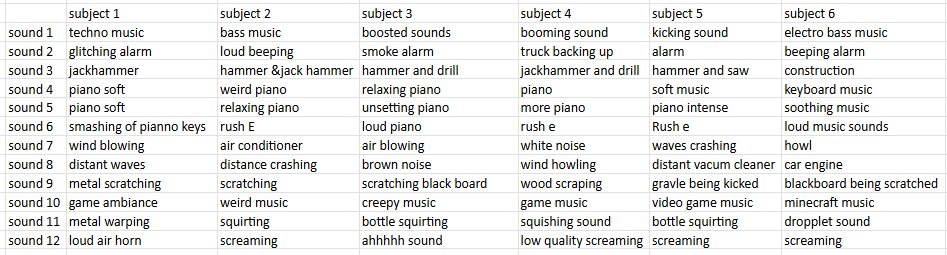 During the experiment, I observed that after several exposures to the soothing sounds, participants’ hearing responsiveness noticeably declined. In contrast, the non‑soothing sounds consistently caught them off guard and elicited a stronger reaction.
Analysis
From what I observed during testing, most people were able to hear and understand single sounds or medium‑level sounds without much difficulty. However, when more than two sounds were played at the same time, many participants became confused or had trouble figuring out what they were hearing. This shows that when the brain has to deal with several sounds at once, it becomes harder for people to separate them and understand each one clearly. Even though they can still hear the sounds, their brains struggle to process all the information at the same time, which leads to mistakes or confusion. This pattern suggests that the more crowded or noisy the sound environment becomes, the harder it is for most people to comprehend what they are listening to.
Conclusion
In this experiment, I found that people have different hearing abilities, and they each reacted to the sounds in their own way. Some participants were better at hearing soft sounds, while others understood loud sounds more easily. A few people could handle more than one sound at the same time, but many struggled when multiple sounds were played together. This shows that hearing is not the same for everyone, and each person’s brain processes sound differently. Overall, the results suggest that sound perception depends on both the loudness of the sound and how many sounds are happening at once, and different people have different strengths when it comes to understanding them.
Application
The way this can apply to real world use is the fact that this can help us learn that when someone asks you to repeat yourself or say it louder it might actually mean they cant understand the tone or hear the tone your using so maybe try adjusting your tone.
Sources Of Error
A few variables in the experiment could not be fully controlled, and they may have influenced the results. Differences in subjects’ ages and overall hearing quality could have affected how accurately each person identified the sounds. Environmental factors also introduced potential error; depending on where the test was conducted, the room may have been echoey or overly sound‑dampened, which can change how certain frequencies are perceived. These uncontrolled factors create variability in the data and may reduce the consistency of the results across subjects.
Citations
References 10.4 the ear - from air waves to perception. (2025, September 11). Biology LibreTexts; Libretexts. https://bio.libretexts.org/Workbench/Human_Physiology%3A_A_Students_Open_Path_to_Understanding_the_Body/10%3A_The_Physiology_of_Sensory/10.04%3A_10.4_The_Ear_-_From_Air_Waves_to_Perception?utm_source=copilot.com Hearing. (2017, February 8). Cleveland Clinic. https://my.clevelandclinic.org/health/articles/17054-hearing?utm_source=copilot.com Hinson, J. (2023, May 3). How hearing works: A simple guide to ear anatomy. Audiologists.org. https://audiologists.org/resources/hearing-wellness/how-hearing-works How does hearing work: From ear canal to brain. (2026, March 4). ScienceInsights. https://scienceinsights.org/how-does-hearing-work-from-ear-canal-to-brain/?utm_source=copilot.com How we hear. (n.d.). American Speech-Language-Hearing Association. Retrieved March 5, 2026, from https://www.asha.org/public/hearing/how-we-hear/?utm_source=copilot.com
Acknowledgement
I would like to thank all of my participants for agreeing to take part in my testing. I also want to thank Dr. Sumner for guiding me through this project and helping me stay on track throughout the process. Finally, I would like to thank my parents for their support and for helping me complete this work.