
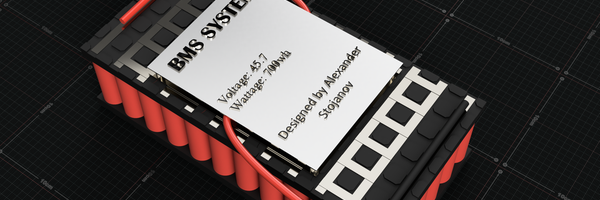
Using recycled 18650 cells as a power source for a custom modified electric Bike
Alexander Stojanov
Sir Winston Churchill High School
Grade 12
Presentation
No video provided
Problem
Lithium ion cells, one of the most important technologies on the planet, are being wasted. By Powering 70% of global devices (International energy agency) lion cells are used everywhere from consumer electronics to new green energy initiatives and popular electric vehicles. However despite their importance in society they remain one of the most unnecessarily wasteful products in the world, Lion cells currently are 95% recyclable quoted by the Canadian renewable energy association, yet only 5% of all produced cells are expected to be recycled wasting significant quantities of resources and producing unnecessary waste, quoted by a stanford research paper “ Recycling lithium-ion batteries to recover their critical metals has significantly lower environmental impacts than mining virgin metals”. The paper goes on to state how recycling cells rather than producing new emitted 58% -81% less greenhouse gasses, used 72% to 82% less water, and used 77% - 89% less energy in production.
These statistics become essential when looking at the exponentially increasing demand for lithium ion cells. As of 2021 the United States department of energy predicted lithium ion cell demand to rise between 5-10 fold by 2030, similar reports from McKinsey & Company estimating an increase in demand of 6.7 times between 2022-2030, so far these estimates have been largely confirmed, between 2024 - 2025 alone demand for Lion cells have increased by 25% -30% and deployment between 2020 - 2025 has increased 6x, the main driver for this rapid uptake is largely marked on the popularity of electric vehicles being EVs, Ebikes, Escooters etc, representing 70% of current Lion cell deployment.
So what can be done to increase Lion cell sustainability with their increasing importance in EV’s and how will this project try to solve it? While recycling Lion cells can involve large facilities and industrial equipment a major impact can be made by simply reusing existing viable cells. Currently many online marketplaces and vendors have previously used and tested Lion cells on sale that can be repurposed and reused by the buyer, this both extends the lifetime of the cell whilst providing a significantly cheaper alternative to commercially sold cells which retail around $4.44 each compared to ¢0.61 per for the cells used in this project. While I plan on making many electronic projects with the attained cells their main purpose will be powering a custom Ebike which this project revolves around.
This project seeks to produce an Ebike capable of long range and high speed transport whilst being powered solely by used 18650 Lithium ion cells to, cut down on cost, reduce waste and pollution, promote battery sustainability, promote more sustainable options for transport and prove the viability of reusing cells extending their operational lifetime in real world applications before being properly discarded and recycled.
Method
Research Objectives:
- analyze the batteries longevity and viability in long term usage
- Learn about the capabilities of repurposed 18650 cells and their viability of being recycled in further projects.
engineering Objectives:
- Bike must have a range greater than 25km
- Bike speed must be greater than 30km/h
- The total cost must be under $1300
- All components must work reliably without faults when powered
- Bike must be easy and convenient to use
- Ebike Battery must be easily recharged and used
- The bike must be safe to operate at all times
- Brakes must have enough stopping power to slow bike to a complete stop at high speeds
Mechanical design process
The mechanical design revolves around the maintenance of mechanical integrity of the bike frame, preventing damage from excessive forces placed onto the frame during operation at high speeds. The added mechanical features include:
- The addition of torque arms the the motor and bike frame to spread out the rotational force placed onto the dropouts from the hub motors rotation over a great area lowering the chance of the dropouts shearing off of the bike of which would cause a critical failure endangering the riders safety and irreparably damaging the bike frame.
- Installation of electronic peripherals to the bike handlebars including an lcd display screen and throttle to control speed.
- Spoking a new wheel frame capable of housing a hub motor
- installing of the 2000w hub motor onto the bike dropouts frame with heavy fasteners to mitigate shifting.
Electronic design process
The electronics for the bike excluding the battery focus on the regulation, use, and distribution of electricity between components of the bike. The bike's circuitry revolves around its ESC (electronic speed controller), this device regulates power and information for the entire bike. The ESC is connected to the bike throttle, motor, and battery. Using information from the throttle ie engaged, nonengaged the ESC determines how much power should be sent to the motor. When designing a high power electronic system bottlenecks and ratings must be looked at consistently to prevent electrical issues with the system, with the motor rated for 2000w at 48v an amperage of 41.6A is expected to be flowing through the circuit at full power as V x A = W, (volts) x (Amps) = (watts), within the circuit the ESC, motor, wires, battery, have specific ratings for amps and volts which must be taken into account when assembling and combining components. The ESC for example has a rating for 48v and 40A ± 1A, the wires however have a maximum rating for 600v and 45A, meaning the ESC is a greater bottleneck to the maximum amount of power able to be put through the circuit rather than the wires.
Battery design process
Some background information to help understand the design of high power batteries:
When you think of electric car/bike/scooter battery you may envision a singular large battery that powers the vehicle, however inside each of these large batteries there are hundreds to thousands of cells or smaller batteries within them that create the entire pack, these cells are generally standardized called 18650 cells 18mm in diameter and 65 mm in height. To create the large pack these 18650 cells need to be connected in a way to both increase the total power capacity whilst also increasing in voltage to be able to power a high voltage device such as a motor, the way this is done is by connecting the cells in series and parallel connections , series connections are when a metal strip connects from the positive end of on cell to the negative end of another, this creates a larger potential difference between the 2 battery ends doubling the voltage, whilst parallel connections increase the total capacity of the battery while the voltage remains constant by connecting multiple negative or positive ends in a row with a conductor, the image here represents a 2d schematic drawing made from a model of the battery I designed in fusion 360 (3d modeling software), each strip going vertically represents a parallel connection (-,-) whilst the horizontal strips represent a series connection (-,+).
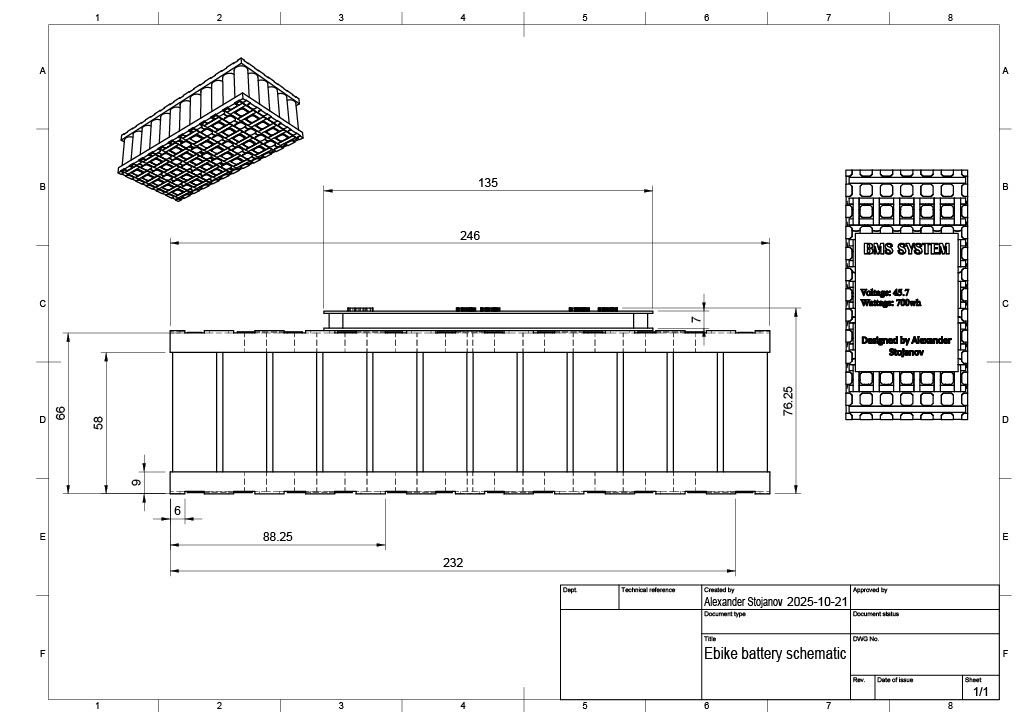 Counting all the connections in this battery creates a 12s6p battery or 12 batteries in series (width) and 6 batteries in parallel (height) (72cells total) with each series connection adding the voltage of its batteries to create a larger voltage and each cell being nominally 3.7v you get 12 x 3.7v = 45.7v
Thus the battery has a total voltage of 45.7 volts to run all electronic systems.
The parallel connections on the other hand increase capacity without changing the voltage so the taller the battery gets the more capacity it gains.
Using cell holders, nickel strips, 18650 cells,and a spot welder I built the battery in a 12s6p configuration holding 72 cells in total with a nominal voltage of 45.7v and a theoretical capacity of 698.4wh (watt hours, eg it can supply 698.4 watts of power for 1 hour)
Counting all the connections in this battery creates a 12s6p battery or 12 batteries in series (width) and 6 batteries in parallel (height) (72cells total) with each series connection adding the voltage of its batteries to create a larger voltage and each cell being nominally 3.7v you get 12 x 3.7v = 45.7v
Thus the battery has a total voltage of 45.7 volts to run all electronic systems.
The parallel connections on the other hand increase capacity without changing the voltage so the taller the battery gets the more capacity it gains.
Using cell holders, nickel strips, 18650 cells,and a spot welder I built the battery in a 12s6p configuration holding 72 cells in total with a nominal voltage of 45.7v and a theoretical capacity of 698.4wh (watt hours, eg it can supply 698.4 watts of power for 1 hour) Paired with this pack is a BMS or battery monitoring system to improve safety, BMS systems have many built in safety systems including high temperature cutoff, LVC (low voltage cutoffs) , overcharge protection, along with bluetooth compatibility to stream data to an iphone or other bluetooth device, however the main purpose of BMS systems is charge balancing within each parallel row on the batter. When a battery is charged equal charging to every cell is not guaranteed as internal resistances within the pack cause energy losses and alter cell charge rates, over time differences in charge between cells can cause overcharging, and unequal load damaging the cells inside and shortening their lifespan dramatically.
 This wiring diagram shows the connections between parrallel cell groups to the BMS controller and wiring to the battery output capable of charging and discharging the cells along with attachmenets for temperature sensors and additional connectors.
To be clear, building any battery pack of this size can be extremely dangerous if proper safety precautions are not taken into account. During the batteries design electrical gloves, safety goggles, and thick clothing are worn at all times and construction was constricted to well ventilated open rooms without fire hazards nearby along with a fire-extinguisher present at all times. Hazards working with high power batteries and electronics include: fire, explosions, electrocution, toxic smoke inhalation, and chemical burns.
{Do not attempt to recreate anything shown in this project without proper supervision and guidance.}
Cell reclamation process
Being a critical point of this project, previously used cells are the sole power source for the Ebike. In total I obtained 250 18650 cells in the form of 25 house modem battery backups through an American supplier due to the extremely limited Canadian supply of high quality second hand cells. When broken down each pack contained 10 cells in a 2s5p format connected by nickel strips electronically welded to the cells along with a small BMS system regulating the cells. Broken down further with light tools the individual cells were still unable to be implemented into a battery pack due to residual spot weld markings left on the cells from previously being electronically welded. This was solved through the long process of machining off the excess metal with metal files, chisels, and a high speed dremel with a diamond tip. Note that all machining was done with extreme caution as puncturing the steel cap of the cell can cause an internal short circuit resulting in potential fire and explosion. To further ensure safety and proper functioning of the pack all 250 cells were tested with a digital multimeter, a minimum threshold of 2.7 V was chosen due to li ion cells discharged below this level are usually too chemically degraded to function properly. Testing concluded that all 250 cells were viable with the lowest recorded cell voltage being 2.9v and highest being 3.8v all being within an acceptable range. Following testing the highest voltage cells were organized into a group and analyzed for any indentations, markings, or damage that could hinder battery operation, overall 8 cells were excluded due to damage when being extracted. Finally any cuts or openings in the cells plastic wrap was reinforced with electrical tape and all caps covered with non conductive paper tips to further reduce any chance of unwanted contact that could cause cells to short circuit and potentially catch fire and potentially have a thermal runaway explosion
Systems overview
| Component | Specification |
|---|---|
| Motor | 2000 W rear hub, 48 V |
| Battery | 45.7 V, 700 Wh custom lithium-ion pack |
| Battery Configuration | 12S6P (72 cells total, 18650 format) -> converted to 14S6P (84 cells) |
| Controller | 2000W sinewave controller |
| Frame | Standard aluminum mountain bike frame |
| LCD display | S966 LCD display |
| Max Speed | 53.5 km/h |
| Range | 24 km |
| Safety Systems | BMS with balancing, voltage protection, and current limiting |
| Design Software | Autodesk Fusion 360 |
| Testing Tools | iPhone-based speed tracking, multimeter voltage readings, lcd display data |
Battery pack redesign
A redesign of the Mk:1 battery pack was needed due multiple issues in its production including weak battery welds, improper securing of the BMS to the pack, a lack of cell insulation and most importantly a design flaw in the cell format causing too low a voltage to properly run the Ebike motor at high load due to an unexpectedly large voltage drop. The Mk:2 redesign included a change in the cell format from 12s6p to 14s6p generating an additional 7.4V to the pack and resolving low voltage issues allowing smooth continuous operation of the motor, the overall integrity of the Mk:2 battery pack has also been greatly increased through an increase in the number of welds per cell from 4 to 8, insulation has also been improved through additional layers of electrical and kapton tape mitigating the chances of potential short circuits.
Mk:1 specifications
| Voltage (V) | 45.7 |
|---|---|
| Amperage (Ah) | 15.28 |
| Capacity (Wh) | 698.4 |
| Cell count | 72 |
| Format | 12s6p |
Mk:2 specifications
| Voltage (V) | 53.1 |
|---|---|
| Amperage (Ah) | 15.34 |
| Capacity (Wh) | 814.8 |
| Cell count | 84 |
| Format | 14s6p |
Note on safety
While noted multiple previous times I cannot understate how incredibly dangerous working with lithium ion batteries can be when proper safety precautions are not taken into account. To be clear, lithium ion cells can electrocute you, burn you, catch fire, produce toxic fumes and explode under the right circumstances. For these reasons strict safety precautions need to be taken at all times when working on or handling large batteries, during the V1 and V2 battery production gloves, goggles and thick clothing were worn at ALL TIMES with N95 masks during dremel work and fire extinguishers were always nearby within a well ventilated room. During the battery production 1 fire, 2 major shorts, and multiple smaller shorts have occurred releasing toxic vapourized plastic and metal compounds into the air.
As for the Ebike itself, going 55km/h on a converted mountain bike frame is inherently NOT SAFE. Helmets, gloves, and thick clothing are mandatory when riding as I prefer my cranium and bones unshattered by asphalt, riding was also restricted to lowly populated roads with bike paths and riding during poor weather was limited.
Overall as the battery stands all components are wrapped with insulative tape, welds have been thoroughly inspected, and proper safety precautions have been taken for this project to be safe for public viewing and testing but I strongly urge that you don't attempt projects similar to this one without serious research into safety and truly understand the risks of high energy battery development.
Analysis
Recorded Statistics
Mk:2 battery Charge time: 2h 37min
Mk:2 battery range: 23.8km (varies with intensity of usage)
top speed: 54.5km/h
Acceleration: 0km/h - 52km/h in 6.4s = 2.259m/s^2
Average internal cell resistance: 150mΩ
Efficiency calculations and comparisons
Theoretical Range:
The theoretical range of the Ebike can be calculated using the average watt hours per km travelled and the total wh of the battery, the estimated watt hours per km referenced from other Ebikes is around 25wh/km,
battery Mk1: Wh / cell = 9.7
total cells/pack: 72
Wh per km: 25
(9.7wh x 72) = 698.4wh
698.4wh / 25wh/km = 27.94km
Combined: wh / cell: 9.7 total cells: 250 wh per km: 25 (9.7wh x 250) = 2425wh 2425wh / 25wh/km = 97km
Discussion: These statistics show the theoretical maximum range of an Ebike with power packs consisting of all 250 cells reclaimed, actual figures are likely to differ due to the unaccounted extra weight of the cells, bike speeds, high inclination, external temperature, and various other environmental factors that interfere with motor efficiency.
This also assumes each cell has 100% capacity without degradation which is unlikely, currently each cell is estimated to have between 75% - 85% original capacity, however this figures cannot be proven without proper measuring devices.
Theoretical lifetime range of salvaged cells
Using cell capacity data and theoretical and energy usage data for ebikes we can calculate how many km of total range the salvaged will have over their entire lifetime:
Total cells: 250
Wh / cell: 9.7
Wh per km driven: 25
Viable cell cycle count: 400
note: cycle count varies between 300-500 with proper usage Capacity per cycle: 9.7wh x 250 = 2425 wh total capacity/ cycle
Lifetime capacity: 2425 wh x 400 cycles = 970,000wh lifetime capacity
970,000 wh / 25 wh/km = 38,800km theoretical lifetime range
Note: this figure is assuming good cell quality and proper usage procedures Discussion: This shows an approximate of 38,800km of theoretical lifetime range assuming each cell is starting with 100% original capacity and cells are used and stored properly over their entire lifetime, this also does not take into account environmental factors when using the Ebike and does not have the user pedal alongside the motor to increase range.
Actual figures are likely lower, this data should be used as an estimate for maximum potential usage.
Efficiency calculations of E-bike vs the average Canadian car
E-bike emissions average using the Canadian national average for CO2 emissions per Kwh generated Wh per km: 25
CO2 emissions per kWh (1000wh) electricity generated (Canadian national average): 140g (stats canada)
1000 Wh/100gCO2 = 7.14 Wh/gCO2
25Wh/km / 7.14Wh/gCO2 = 3.5g CO2 / km An e-bike produces 3.5 grams of CO2 per kilometer in distance travelled
Car emissions: Average CO2 emissions per km by canadian cars/km: 206gCO2/km (stats canada)
difference: 206g CO2/km / 3.5g CO2/km = 58.8x more efficient
The Ebike produces 58.8x less CO2 per km compared to the average Canadian car when electricity is used with the Canadian national average for Carbon emissions per Kwh generated being the highest in Canada.
E-bike emissions using the Quebec provincial average for CO2 emissions per Kwh generated. Wh per km: 25
CO2 emissions per kWh (1000wh) electricity generated (Quebec provincial average): 1.2g (stats Canada)
1000 Wh/1.2g CO2 = 833.3 Wh/g CO2
25Wh/km / 833.3Wh/g CO2 = 0.03g CO2 / km An e-bike produces 3.5 grams of CO2 per kilometer in distance travelled Car emissions:
Average CO2 emissions per km by canadian cars/km: 206gCO2/km
difference: 206g CO2/km / 0.03g CO2/km = 6866x more efficient
The Ebike produces 6866x less CO2 per km compared to the average Canadian car when electricity is used with the Quebec provincial average for Carbon emissions per Kwh generated being the lowest in Canada.
Discussion: Using data on the Wh used per Km and data by stats Canada on the average Canadian cars emissions and electricity emissions per Kwh by province these calculations have shown significant carbon emissions reductions ranging from 58.8x - 6866x less CO2 produced by the Ebike per km driven compared to the average Canadian car depending on the province producing energy. Nonetheless these figures confirm the major environmental benefits Ebikes show in reducing carbon emissions whilst still retaining ranges exceeding 24km and speeds up to 50km/h posing as a great option for city wide commuting. note that the energy emissions per Kwh produced were used from the provinces of Alberta and Quebec as they represent the provinces with the highest and lowest CO2 emissions per Kwh generated, thus giving the best picture on carbon savings nationally. Secondarily note the carbon emissions by province where from 2017 as data was more comprehensive, figures shown may slightly differ to modern statistics.
Failures and improvements:
While the ebike was a success in many regards as every engineering project has there are many resolved and and worked on problems that need to be assessed:
1. Battery voltage design failure: The V1 battery had a critical design failure in its voltage output stemming from too few cells in series , while expected to work in the combination the V1 battery failed due to an unexpectedly large voltage drop when the motor was powered under load, this lead to the triggering of an automatic safety system in the BMS controller called an LVC (low voltage cutoff) which halts all power output from the battery when internal resistance to the flowing of current exceeds a preset threshold, the V2 battery resolved these issues by increasing the battery resting voltage to 53v through 2 added series groupings thus resolving the issue.
2. Throttle failure: After repeated use of the ebike the throttle unexpectedly stopped working with no input reaching the controller, the problem was traced back the throttle being poorly manufactured and not rated for its application, the solution was to replace the existing throttle with a new one, thus far the new throttle has not had any failures or issues.
3. Wheel failure: With the motor coming unspoked and unattached to any wheel I had to manually install spokes from the motor to the surrounding rim using a small spoke tightening tool, however due to a lack of precise equipment the wheel remains uneven and oblong in shape causing bumping and vibrations when moving at higher speeds, the solution is to dedicate some time into properly spoking the rim or get it professionally tuned at a bike store.
4. Mitigate vibrational impact at high speed improvement: When travelling at high speed vibrations occur between the bike frame and electronic components causing unwanted noise and rattling with the potential for wear and damage to the bikes electronics, This can be mitigated by adding padding around all components and upgrading fasteners on the bike.
5. Reduce rusting of steel components during winter improvement: with some of the fasteners and washers being made of ungalvanized steel moderate rust had been formed on the bike components this problem being extenuated by winter conditions of wet roads with high salt content on the surface causing increased rusting, can be improved by replacing steel components with galvanized steel or other metal less susceptible to rusting.
6. Improve winter riding ability improvement: due to Alberta's poor winter road conditions consisting of heavy snowfall and ice roads remain extremely difficult to traverse, combined with Li ion cells chemistry to lower in voltage in cold temperatures multiple modifications need to be made for easier winter riding including: tire modifications for better grip ideally fat tire or studded, insulated case for Li ion cells to prevent voltage drop and reduced performance in cold conditions.
Conclusion
Conclusion:
In this design study I was able to successfully engineer a custom modified electric bike capable of speeds exceeding 55km/h, ranges of 24km and a rapid acceleration of 2.36m/s^2, most notably the project was powered entirely be reclaimed lithium ion 18650 cells producing 2 power packs composed of 12s6p and 14s6p cellular configurations.
This project has proven the potential of reclaiming and reusing viable 18650 cells as a viable power source for commercial use and low power EV’s. Using data obtained from the BMS controller and experimentation the cells proved to have a significant remaining lifespan and viability in future usage.
While initially unaccounted for, voltage drop within the bikes circuitry proved to be the most significant issue of the project. Eventually forcing a redesign in cell formatting between the Mk:1 and Mk:2 packs, changing from 12s6p to 14s6p to increase voltage and counteract drops under load.
Most importantly Environmentally this project has shown major promise in reducing CO2 emissions. By extrapolating public emission standards this project has removed between 145.5Kg - 242.5Kg of CO2 that would have been produced in the creation of new cells for the project all whilst removing harmful electronic waste from ending up in landfills and being significantly more affordable at 7.2x cheaper/cell.
With potential for public action more research and studies remain needed on the safety of reusing cells, longterm lifespan, and scaled affordability are needed, this project serves to bring awareness to potential solutions on reducing battery Ewaste especially with our exponentially increasing use and reliance lithium ion cells in everyday life.
Citations
https://www.youtube.com/watch?v=ZxhIs_xxVY0
https://www.instructables.com/How-to-Make-a-Lithium-Battery-for-an-Electric-Bicy/
https://www.youtube.com/watch?v=QMQYfk2RKtU
https://github.com/ztrpevski/lcd-s966-manual-2024/blob/main/S966%E8%8B%B1%E6%96%87
%E8%AF%B4%E6%98%8E%E4%B9%A6-1203.pdf
https://www.jkbms.com/wp-content/uploads/2024/06/JK-BMS-User-Manual-for-PB-series-jkbms. com_.pdf
https://www.canada.ca/en/health-canada/services/household-products/battery-safety.html
https://theicct.org/wp-content/uploads/2021/06/EV-life-cycle-GHG_ICCT-Briefing_09022018_vF.pdf
https://www.cer-rec.gc.ca/en/data-analysis/energy-commodities/electricity/report/archive/2017-canadian-renewable-power/canadas-renewable-power-landscape-2017-energy-market-analysis-ghg-emission.html?=undefined&wbdisable=true#:\~:text=Inventory%20Report%202017-,Description:,h).
https://www.sciencedirect.com/science/article/abs/pii/S092134492500254X
https://news.stanford.edu/stories/2025/01/recycling-lithium-ion-batteries-cuts-emissions-and-strengthens-supply-chain
https://www.greenli-ion.com/post/economic-advantages-of-investing-in-battery-recycling#:\~:text=Recycling%20saves%2040%2D60%25%20vs,saving%20$2%2D4/kg.
https://www.mckinsey.com/industries/automotive-and-assembly/our-insights/battery-2030-resilient-sustainable-and-circular
https://www.iea.org/commentaries/global-battery-markets-are-growing-strongly-and-so-are-the-supply-risks
https://www.xtar.cc/news/10-things-to-know-about-lithiuim-ion-battery-internal-resistance-224.html#:\~:text=A:%20Ohm's%20Law%20states%20that,18650%20cells'%20IR%20and%20ranking:
https://forums.electricbikereview.com/threads/diy-build-my-own-e-bike-battery-tips.58209/
https://www.energy.gov/sites/default/files/2021-06/FCAB%20National%20Blueprint%20Lithium%20Batteries%200621_0.pdf
https://endless-sphere.com/sphere/threads/use-tesla-cells-to-make-battery-for-ebike.107165/
https://www.evlithium.com/Blog/18650-battery-voltage-guide.html
https://batterybro.com/blogs/18650-wholesale-battery-reviews/18306003-battery-safety-101-anatomy-ptc-vs-pcb-vs-cid?srsltid=AfmBOooPHGuoaPG6RJOBJfXoLi0OSpbr4CMK1DZmaQcOKPTs9E_mvGKo
https://forums.electricbikereview.com/threads/need-some-bms-advice-please.51761/
https://leoguarbikes.com/blogs/news/is-your-ebike-controller-failing-7-warning-signs-to-watch-for
https://www.reddit.com/r/batteries/comments/1ebu6lz/ressources_to_learn_how_to_build_diy_ebike_battery/
Acknowledgement
I would like to thank both my parents and teachers who have helped and advised me through the process of designing my dream of high power electric bike, specifically my father Boris stojanov and teacher Rob morgan for their greatly helpfull knoledge in electrical engineering and high power electronics.