
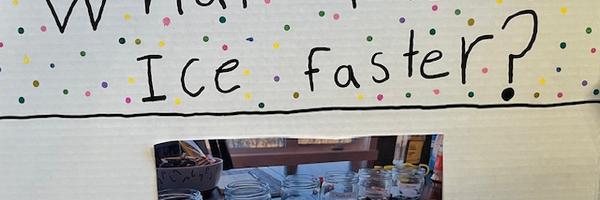
what melts ice faster
Everleigh Dahl, Imogen Colville
William D. Pratt School
Grade 5
Presentation
Hypothesis
Our hypothesis is we think that the salt is going to melt the ice fastest. We think that because people use a special type of salt to melt ice on roads and sidewalks
Research
We mostly researched on google about salt, pepper, rocks, and cinnamon and how salt is bad for the environment and sugar helps plants grow.
All about salt: Salt, (sodium chloride), is a important mineral and chemical compound essential for life, used for flavouring and preserving food, maintaining bodily functions (like nerve signals and fluid balance), and in industrial processes like road de-icing and chemical manufacturing. It's a crystalline solid, also known as halite (rock salt). Its found naturally in seawater and underground deposits.
All about pepper: Pepper is the spice from the Piper nigrum vine. It's used globally for flavor, though they come from different plant families, with Piper native to India and Capsicum to the Americas. "True" pepper (Piper) was historically so valuable it was used as currency, driving exploration, while Capsicum peppers offer heat via capsaicin (except bell peppers) and vast variety.
All about sugar: Sugar is a sweet carbohydrate providing energy, found naturally (fructose in fruit, lactose in milk) or added to foods, with common forms like sucrose (table sugar from cane/beets), honey, and syrups. While the body needs simple sugars like glucose for fuel, refined sugars offer energy without nutrients, and hidden sugars appear in many forms (syrups, words ending in "-ose") on food labels, making moderation crucial.
All about cinnamon: Cinnamon is a popular spice from the inner bark of Cinnamomum trees, known for its warm, sweet flavour, used in sweet and savoury dishes, teas and even traditional medicines for its antioxidants and potential blood sugar benefits, with the two main types being common, spicy Cassia (North America/Asia) and delicate, sweeter Ceylon (Sri Lanka). It's available as sticks or powder, derived from the tree's coiled, dried bark, and offers flavor through its essential oil. Types of cinnamon:
- Cassia: The most common type, including Indonesian, Chinese, and Saigon varieties, known for its strong, spicy taste, dark color, and thick bark.
- Ceylon (True Cinnamon): Lighter in color with a more subtle, complex flavor, featuring papery, multi-layered quills.
All about rocks: Rocks are naturally made of solid materials made of minerals, split into three main types—igneous. sedimentary (layers of sediment), and metamorphic (changed by heat/pressure)—that constantly transform through the Earth's rock cycle, forming the planet's crust and valuable resources. One main Type of Rock
- Igneous:
Formed from cooled magma or lava (molten rock)
.Examples: Granite, basalt.
- Formation: Magma cools slowly underground (intrusive) or lava cools quickly on the surface (extrusive).
Variables
The variables in this project are salt, sugar, pepper, rocks, and cinnamon. We are going to use each of these items to see what melts ice faster. We changed the ingredients in the ice We kept the room temperature the same each experiment we did with the ice
Procedure
First we put 3 ice cubes into 6 different jars. After that we put 1/2 teaspoon of salt, pepper, rocks, sugar and cinnamon into each of the jars, we left one just plain. Next we set a stopwatch to see how long it took the salt, pepper, sugar, cinnamon, rocks and the plain one to melt. finally we watched the ice melt for about 1 hour and 15 minutes and that is how long it took to melt the ice with the salt
Observations
We observed that at 6 minutes the salt and sugar have melted the ice the most. We also observed that when we put the rocks on the ice they slid right off. We are surprised by how fast the sugar is melting the ice. The sugar took about 1 hour and 30 minutes to melt the ice.
Analysis
the ice in the control (nothing added), cinnamon, pepper, and rock jars melted at similar rates which tells us that you shouldn't add cinnamon and rocks to ice because it doesn't seem to help it melt ice faster.
Conclusion
In conclusion, we found that the salt makes the ice melt faster. But salt is bad for the environment and can kill plants. So sugar is the best option because even though it is not the fastest, it is better for the environment.
Application
We would put sugar on the ice if we don't have salt because its better for the environment and it still melts ice faster then cinnamon, rocks, and pepper.
Sources Of Error
We didn't experience any errors because we made sure to address any potential errors. For example, we made sure to put the same amount of ice in all of the jars (salt, sugar, pepper, cinnamon and rocks).
Citations
https://www.hopkinsmedicine.org/health/wellness-and-prevention/facts-about-sugar-and-sugar-substitutes https://www.britannica.com/ https://nutritionsource.hsph.harvard.edu/salt-and-sodium/
Acknowledgement
thank you to our group for supporting each other and thank you to Mia for stepping in to help us in a emergency. Thank you to Ms. Strohbach and Mr. Adler for helping us with our project.