
Hotter Lava, Faster Flow
Atharvan Parashar
Nickle School
Grade 6
Presentation
No video provided
Problem
How does lava temperature affect the thickness (viscosity) and speed of lava flow, and how does this influence the shape of shield volcanoes like Kīlauea?
Method
Materials
- sugar water
- Egg whites
- Stretch tube
- Container
- Scale
- Paint(brown and black)
- BrushPaper
- Scissors
- Cutter
- Newspaper
- Bulletin board
- Plastic wrap
- Plastic bowl
-
Glue
Variables * Temperature (unable to do so represented with viscosity) * It will flow more and and spread further * Same amount of subject, same height ,same length
Procedure
-
Prepared two tubes, each 30 cm long (1 foot), to represent the volcano slope.
-
Measured 100 ml of water, 100 ml of room-temperature honey, and 100 ml of slightly heated honey using a measuring cup.
-
Poured water into the first tube and timed how long it took to travel 30 cm using a stopwatch.
-
Poured room-temperature honey into the first tube and timed how long it took to travel 30 cm using a stopwatch.
-
Repeated the same process for heated honey.
-
Recorded all observations and times in a notebook.
Research
About The Kilauea Volcano
- Kilauea is the most active volcano on earth. (Hawaii, USA) .
- It is a Shield Volcano, meaning it is a wide in shape with gentle slope. It erupts frequently because it is right above a mantle plume which is a mushroom like column from the crust-mantle boundary.
- Because it erupts so frequently, it is less explosive in nature.
- If you compare this to a cone volcano eruption then you will notice that the cone’s is more explosive as gas builds up more.

- It erupts frequently because it is right above a mantle plume which is a mushroom like column from the crust-mantle boundary.
- Because it erupts so frequently, it is less explosive in nature.
-
If you compare this to a cone volcano eruption then you will notice that the cone’s is more explosive as gas builds up more.What is a Shield Volcano
 What is a Shield Volcano
* Shield volcanoes are formed by runny lava.
* This hot and runny Lava is known as Basaltic Lava which has a low viscosity and has a composition rich in iron and magnesium.
* Lava flows far before cooling which creates a wide, gently sloping, flat shape.
* Kīlauea is a shield volcano because its lava spreads easily.
What is a Shield Volcano
* Shield volcanoes are formed by runny lava.
* This hot and runny Lava is known as Basaltic Lava which has a low viscosity and has a composition rich in iron and magnesium.
* Lava flows far before cooling which creates a wide, gently sloping, flat shape.
* Kīlauea is a shield volcano because its lava spreads easily. Lava Temperature and Flow
* Lava comes from melted rock inside the Earth
* Hot lava’s range is 1000 celsius - 1200 celsius which is less thick and that means it has a low viscosity
Lava Temperature and Flow
* Lava comes from melted rock inside the Earth
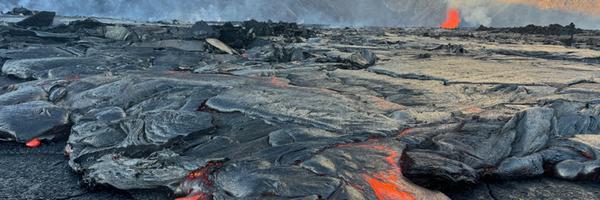
* Hot lava’s range is 1000 celsius - 1200 celsius which is less thick and that means it has a low viscosity Picture of a hotter type of lava.
*
* We can study lava flows to predict where lava will travel.
Picture of a hotter type of lava.
*
* We can study lava flows to predict where lava will travel.
Data
| Liquid Type | Volume (ml) | Distance Traveled (cm) | Time Taken (seconds) | Flow Speed (cm/s) |
|---|---|---|---|---|
| Honey | 100 | 30 | 10 | 3.0 |
| Water | 100 | 30 | 1 | >30 |
Conclusion
Conclusion
Our hypothesis stated that if lava is hotter, then it will flow faster and spread farther, forming a wide, gently sloped shield volcano like Kīlauea, because higher temperature lowers viscosity. The results of our experiment support this hypothesis. The low-viscosity liquid (water) flowed much faster and farther than the high-viscosity liquid (honey), and the honey piled up near the crater while the water spread out. This clearly demonstrates that lava viscosity, which is affected by temperature, controls how quickly lava moves and how far it travels.
The experiment worked very well as a prototype. Using honey and water allowed us to visually model how lava flow speed influences the shape of a volcano. The model also reinforced background research: Kīlauea’s basaltic lava is hot and runny, which explains why it forms a wide, gently sloped shield volcano instead of a steep cone.
Overall, this project shows that temperature and viscosity are key factors in volcano formation, and that simple models can effectively demonstrate complex geological processes. The experiment successfully connected theoretical knowledge with visual, hands-on observations, making it easier to understand why some volcanoes are wide and gentle while others are steep and dangerous.
Applications
This experiment can help scientists predict how far the lava will go that can help save lives, property, and other things. It also can help predict lava paths as the less the viscosity the more force it will have so hot lava can take different paths. Scientists can figure out the heat of lava inside volcanoes to figure out the radius and possibly what path it will take.
Citations
Kīlauea Volcano (general information): “Kīlauea.” U.S. Geological Survey, U.S. Department of the Interior, 2026, https://www.usgs.gov/volcanoes/kilauea. (USGS)
Shield Volcano Definition / Facts: “Kīlauea.” Encyclopædia Britannica, Encyclopædia Britannica, Inc., Feb. 3, 2026, https://www.britannica.com/place/Kilauea. (Encyclopedia Britannica)
Viscosity Explanation (general science concept): “Earthword: Viscosity.” U.S. Geological Survey, https://www.usgs.gov/communications-and-publishing/news/earthword-viscosity. (U.S. Geological Survey) 2018 Kīlauea Eruption Home Destruction: “2018 Eruption and Summit Collapse.” National Park Service, U.S. Department of the Interior, https://www.nps.gov/havo/learn/nature/2018-eruption.htm. (nps.gov)
Units of viscosity: “Viscosity.” Encyclopædia Britannica, Encyclopædia Britannica, Inc., 17 Jan. 2026, https://www.britannica.com/science/viscosity. This explains that the SI unit for dynamic viscosity is the pascal‑second (Pa·s). Formula to calculate speed (velocity):
Urone, Paul Peter, and Roger Hinrichs. College Physics 2e, OpenStax, 13 Jul. 2022, https://openstax.org/books/college-physics-2e/pages/2-3-time-velocity-and-speed. This source defines average speed = distance ÷ time and that speed is measured in metres per second (m/s).
Acknowledgement
Thank you very much Ms. Burkell for giving me this opportunity and guiding me through my first science fair. I really hope with your guidance I can learn and apply knowledge to help other people. Thank you Papa and Mama for purchasing the items and helping me make the project.