
The Science of Allergies
Luna Alvarez
STEM Innovation Academy Jr. High SW
Grade 8
Presentation
No video provided
Problem
Main Question: Can increasing awareness about how allergies work help reduce the risks faced by people with allergies?
Problem: Allergies are a serious condition that must be treated properly in an emergency. It can be difficult for people with allergies to maintain a regular lifestyle because there is often a lack of knowledge about them. Allergies are not just a small health issue — they can be life-threatening and must be treated seriously, especially in an emergency. A severe allergic reaction can happen suddenly and become dangerous within minutes. If people are uneducated about allergies, they may not recognize the warning signs or know how to respond quickly, which can put someone’s life at risk. People without allergies may not know how to help someone who is having an allergic reaction, and they may not understand what precautions to take. Additionally, at school, students with allergies can struggle to manage their condition if others are unaware or uneducated about it. In conclusion, allergies are a dangerous condition that people need to understand in order to reduce risks for those who have them.
Project Goal/Objective: My goal throughout this project is to educate people about allergies so they can help create a safer environment for those who have them. By increasing awareness and understanding, I hope to reduce the risks people with allergies face and help them feel less anxious and more secure in their daily lives.
Method
1. Find important topics to reaserch To guide project to properly and throughly answer main question.
Ideas to research:
-
What are allergies
-
Different types of allergies
-
Effects of allergies
-
Allergic reactions and intensities
-
Methods of treatment
-
Methods of diagnosis
-
How do allergies work within the body
-
How do allergies impact different people
-
Hypoallergenic
-
Outgrowing an allergy
-
Cross-contamination
-
Allergy vs. Intolerance
-
IgE vs. non-IgE meditated allergy
2. Reaserch Thouroughly reaserch and learn about chosen topics, to better understand all aspects of allergies.
3. Sources and Information I will be finding as much information as possible, to best understand allergies. Throughout this project, I will use various sources including reliable webistes, online sources, and other media. All of my sources will be put into a table, and then MLA cited.
4. Use reaserch to write information peices for trifold Once I have gatherd an appropiate amount of reaserch for each question, I will write my information peices that will be displayed on the trifold. The peices of information will be thorough, and detailed, to allow people to fully understand allergies.
5. Make Trifold Once all the information peices are completed, I will print them out, and display them on my board, along with other images, to provide a detailed explenation of allergies.
6. Share and Present Lastly, I will present my work to teach people about allergies, and raise awarness.
7. Now What? It is important to reflect on my project after concluding, to find ways to apply this knowledge to the real world. I hope that by teaching people about allergies they can better understand the risk, in daily life.
Research
What is an allergy? Allergies are a common condition experienced by many people around the world. For many Canadians, this condition affects daily life by limiting everyday activities and requiring constant awareness. Allergies limit everyday activities, such as eating at restaurants, attending social events, or even spending time outdoors, and requires constant awareness of their surroundings. In some cases, allergies can cause intense symptoms or even lead to life-threatening situations, making them an important health concern. It is important to educate ourselves and others about how allergies work, how to recognize symptoms, and how to respond in an emergency can help prevent dangerous situaations and create safer environments for everyone.
How do allergies work? Allergies happen when you come into contact with a certain substance that your immune system marks harmful; this substance becomes an allergy trigger or also known as your allergen. As a result, the immune system creates a protective protein called antibodies called immunoglobulin E (IgE) that stays alert for your allergens. IgE attaches to the immune cells (such as mast cells and basophils that are alarm cells). When the body then encounters the allergen, the allergen attaches itself to the IgE on the mast cels, resulting in the mast cells produce chemicals, specifically histamine. Histamine and other chemicals cause allergy symptoms, because they are trying to protect the body. The symptoms are the bodies way of fighting back, and trying to protects itself, although nothing is threatening the body.
Allergy vs. Intolerance Food allergies are commonly confused with intolerances, due to their similar behaviour of symptoms. However, they are very different conditions. It is important to know whether you have an allergy or an intolerance because they require very different treatments, especially in an emergency. While a food allergy affects the immune system, an intolerance affects the digestive system. Additionally, eating even a small amount of your allergen can be extremely dangerous, as the immune system reaction can range from mild to life threatening. In contrast, with a food intolerance, you can have a small amount of the food with minor symptoms such as stomach pain or bloating, they are generally not life-threatening. In summary, understanding difference between a food allergy and intolerance, can help ensure the right treatment is given, and prevent health risks.
IgE meditated allergies vs. Non-IgE meditated allergies IgE meditated and Non-IgE meditated are both allergies, with different ways that they use the immune system. The term IgE stands for Immunoglobulin E, which is a special type of antibody that the immune system produces when it detects an allergen. The word mediated refers to the specific mechanism by which the immune system triggers allergic symptom.
In an IgE meditated allergy, the immune system uses IgE antibodies and can cause more serious and life-threatening reactions.
In contrast, non-IgE meditated allergies don't make IgE antibodies; instead, they use other parts of the immune system, such as the T-Cell, and do not create serious reactions.
Cross Contamination Cross-contamination occurs when an allergen accidentally comes into contact with food that would otherwise be safe to eat. This can happen either directly, such as when two foods touch, or indirectly, such as when the same utensils, surfaces, or equipment are used without being properly cleaned. When this happens, the safe food becomes contaminated and can become dangerous for someone with a food allergy. Even small amounts of the allergen can cause a range of symptoms from mild reactions to life threatening reactions such as anaphylaxis. Cross-contamination can happen in your own kitchen, restaurant, or factory. In food manufacturing facilities, companies may include a precautionary statement on packaging, such as “may contain” or “produced in a facility that also processes…” to warn consumers that the product could have been unintentionally exposed to an allergen during production. These warnings help people with allergies make safer choices about the foods they eat. For people with food allergies, understanding and preventing cross-contamination is essential to keeping everyday meals safe.
How can we prevent cross contamination - If food is store bought avoid foods that say\, “May contain X” (X is the allergen) - Wash your hands thoroughly with soap and water before and after handling food. - Use separate cutting boards for allergen-free foods and foods containing allergens. - Use separate knives\, spoons\, and cooking utensils to avoid accidental contact. - Store allergen-free foods on higher shelves to prevent spills or crumbs from contaminating them. - Keep allergen-containing foods in clearly labeled\, sealed containers. - Avoid sharing food\, drinks\, or utensils with others. - Be cautious with shared appliances like toasters\, microwaves\, or deep fryers. - Read ingredient labels every time\, even if you have bought the product before (recipes can change). - Inform restaurant staff clearly about your allergy before ordering.
What is hypoallergenic? The term hypoallergenic is used to describe products that are designed to reduce the likelihood of triggering allergic reactions. In general, it suggests that the product contains fewer or less common allergens. Although hypoallergenic product might work for some people, there is no scientific, medical or legal definition of hypoallergenic. This means companies can decide what is hypoallergenic to them, and label their product without being required to meet any government-prescribed standard. It is important to always read through the ingredients of a product if you have a common allergy or check with a medical professional.
The term hypoallergenic is also commonly used when describing certain dog breeds. Hypoallergenic dogs are bread to produce less dandruff. Although these dogs can be tolerated by some people with lower allergy intensity, no dog is fully hypoallergenic because the allergy triggers can be some from the dandruff, saliva, urine, skin, and hair/fur.
Overall, while the term hypoallergenic suggests reduced risk, it does not guarantee that a product or animal is completely safe for someone with allergies. Understanding this distinction is important for making informed and safe decisions.
Allergy Immunotherapy Allergy immunotherapy is slowing making your immune system more comfortable with the allergen, and slowly desensitizing the allergy. Immunotherapy for allergies comes in two ways: Shots or Pills.
Immunotherapy with allergy tablets (SLIT) Sublingual (under the tongue) immunotherapy is an alternative way to treat allergies without injections. The tablets are placed under the tongue for one to two minutes and then swallowed as they dissolve. The process is repeated, from three days a week to as often as daily. The tablets will increase your tolerance to the allergen and reduce your symptoms over time. For continued effectiveness, treatment may be needed for three years or longer. Allergy tablets are currently available for ragweed and grass pollen in Canada.
Allergy immunity shots can gradually desensitize your immune system to specific allergens. The process involves a series of small injections over several months, and can last around 3-5 years. Each allergy shot contains a tiny amount of the allergen, just enough to alert the immune system but not enough to cause allergy symptoms. Over time, the dose of allergens increases with each shot. The immune system gets used to the allergens and learns not to react to them, so symptoms improve over time. Allergy shots are mainly used for allergies to insects, pollens, pets, dust mites, and other environmental elements, but are not used for food allergies.
Out-Growing an Allergy In some cases, it is possible for a person to outgrow an allergy over time. This happens most commonly in childhood, although it does not occur with every type of allergy. Scientists do not fully understand the exact biological reasons why some allergies disappear. Factors such as younger age because immune system develops faster, frequent exposure to allergen to desensitize immune system, and a weaker more mild allergy because the immune systems response is less intense, are believed to play a role in out-growing an allergy. Additionally, while some individuals outgrow allergies, the opposite can also happen. A person can develop a new allergy at any point in their life, even if they have never reacted to that substance before because at any time the immune system can become sensitized to the substance, since the immune system is always developing. Overall, the science behind why some people outgrow allergies is still not fully understood, since it is different for everybody, but it is important to stay aware about allergies because the immune system is always adapting and you can get or lose an allergy at any time.
Why are allergies different for everybody? Allergies are different for everybody because it depends on how your immune system reacts to a substance. Some allergies are mild, while others can be life threatening. It all has to do with your immune system. There can be many differences between allergies, including different allergen triggers, if your allergy is year-round or seasonal, and if your allergy is IgE-Meditated, or non-IgE-Meditated.
What causes an allergy? Allergy symptoms are triggered when you come in contact with the substance that your body has marked as dangerous, due to an overreaction in the immune system. One can come into contact with the allergen in many ways, such as inhalation, ingestion, injection, through your eyes, direct contact with the skin, or through cross-contamination. It is important to know the ways that an allergen can get into your body, and cause a reaction, so that you can prevent risk.
What is anaphylaxis? Anaphylaxis is a severe and potentially life-threatening allergic reaction. It is considered the most serious form of an allergy because it can affect multiple systems in the body at the same time. The symptoms and reactions that an anaphylaxis allergy can be serious or life threatening, which is why it is important to always carry epinephrine (EpiPen). Having access to this medication can be lifesaving in an emergency, as it quickly stops or reverses reactions, until you can get to the hospital. Understanding the seriousness of anaphylaxis and responding quickly can make the difference between recovery and a life-threatening situation.
How can we make it safer for people with allergies? Being educated about allergies is very important, not only to protect yourself but also to prevent putting others at risk. Allergic reactions can range from mild reactions to life-threatening emergencies, so understanding how allergies work can save lives. Additionally, awareness and preparation are vital to reduce risks, and ensuring a safe environment for everybody. Some ways schools can keep allergic students stay safe starts with strict sanitary rules, to prevent cross-contamination. Creating safe allergen-free zones in parts of the school can provide comfort and ensure safety for children with severe allergies, such as peanuts. Additionally, implementing a no sharing food policy can help prevent accidental exposure to an allergen. Lastly teachers and staff should be properly trained to recognize signs of an allergic reaction and to administer emergency treatments like EpiPens. These precautions help create a safer environment where students can learn and participate without fear.
Individuals also have an important responsibility for their own safety. Carrying an EpiPen or other prescribed treatment at all times is crucial in case of a severe reaction. Wearing a medical bracelet or alert tag can inform others of your allergies in emergencies. Keeping a detailed diary of symptoms, exposures, and triggers can help both you and your healthcare provider understand your allergies better and prevent future reactions.
In summary, it is important to stay educated on allergies so that precautions can be made to prevent risks, and allow people to live without constant worry.
Diagnosing Allergies There are three main ways that help an allergist diagnose an allergy. These ways include blood tests, skin prick tests, and oral food challenges.
Skin Prick: The skin prick is one of the more common ways to diagnose an allergy. The process includes an allergist or medical professional adding a small drop of an allergen to the skin, poking the area with a needle, allowing the skin to absorb the substance. Additionally, there are negative (Saline) and positive (Known allergen) controls in this test, to ensure actual results. After 15-30 minutes (Depending on clinic) the doctor will check for any swelling, redness, or hives. After comparison to the negative control substances, the doctor would identify if the substance came out positive, therefore an allergen, and will be able to give a diagnosis.
Oral Food Challenge: Oral food challenges are a great way to confirm allergies. During this test, a medical professional will feed a small amount of the allergen (May be mixed with another food) to the patient. The amount of allergen increases, in timed intervals. The result of the severity of the reaction will allow the doctor to de-label the allergy if there is no reaction, or the allergy will be confirmed, and further medical action will happen.
Blood Test: Blood tests add a small amount of an allergen to your blood and measure the amount of Immunoglobulin E (IgE) that sticks to the allergen. The amount of IgE helps an allergist identify the seriousness of the allergy.
Treatments: Although there is no definite cure for allergies, there is medicine that can help control symptoms, and emergencies.
Decongestants: Decongestants are a good way to provide temporary relief to symptoms from allergic reactions. Although decongestants do not solve the problem, they are a good way to provide relief. Decongestants work by causing blood vessels to constrict. This helps relieve congestion caused by the dilation of blood vessels in the nasal passages. They come in the form of pills, liquids, drops and nasal sprays. When your body senses an invader such as the allergy trigger, it immediately sends extra blood to the blood vessels in your nose to help fight it. This causes the blood vessels and tissues in your nose to swell up, making you feel stuffed up. Nasal decongestants narrow the swelling in the blood vessels in your nose. They also reduce the swelling of your nasal tissues, which opens your airways and makes it easier to breathe. Nasal decongestants don’t treat the cause of your symptoms or speed up your recovery. But they can provide short-term symptoms of relief.
Antihistamines: Antihistamines are a common medication, available both over-the-counter and by prescription, that help relieve allergy symptoms. They come in many forms, including eye drops, nasal sprays, pills, liquids, capsules, injections, and skin creams. The name “antihistamine” comes from “anti,” meaning against, and “histamine,” a chemical your immune system releases to send messages between cells. The main job of antihistamines is to block these cellular messages. While histamine has several functions in the body, it is most well-known for its role in triggering allergic and anaphylactic reactions. The specific type of histamine involved in allergies is called H1. By blocking histamine, antihistamines can help reduce or prevent the uncomfortable symptoms caused by allergies.
Epinephrine: Epinephrine is the first-line treatment for a severe allergic reaction (also known as anaphylaxis). It helps people in life threatening conditions by reducing or reversing these severe symptoms very quickly. It opens the airways and reduces swelling. It helps maintain heart function and blood pressure. As epinephrine causes the blood to be diverted away from the skin, it can help reduce hives and itching. Epinephrine can also prevent a further release of histamine, the chemical that responds to allergens and ushers in symptoms. When it’s injected, it quickly travels through the bloodstream and attaches to special receptors on cells called alpha and beta receptors. These receptors act like switches that tell different parts of the body what to do. Epinephrine relaxes the muscles in the airways, which helps them open up so the person can breathe more easily. At the same time, it tightens blood vessels, which raises blood pressure and reduces dangerous swelling, especially in the throat and face. It also stimulates the heart to beat faster and stronger, helping blood circulate properly when blood pressure drops during an allergic reaction. In addition, epinephrine slows the release of chemicals like histamine, which are responsible for allergy symptoms such as hives and swelling. Overall, epinephrine works fast to reverse the life-threatening effects of severe allergies, buying time until the person can get full medical treatment.
Symptoms: Symptoms can vary based on the allergen, intensity, type of contact, and person as a whole.
- Rash - Runny Nose - Stuffy Nose - Tightness in throat - Itchiness - Swollen Eyes (allergic conjunctivitis) - Diarreah - Anaphylaxis Symptoms - Vomiting - Edema - Hives - Stomach Cramps - Shortness of breath - Dizziness - Tingling in the mouth - Sneezing - Swelling
Different types of Allergies: There are many different types of allergies, it is important to know what you are allergic to, to ensure your safety. The following are the main allergy categories. There are many more allergies, not listed.
Food: Food allergies are the most common type of allergy and can affect people of all ages, though they often begin in childhood. Common triggers include peanuts, tree nuts, eggs, soy, fish, and shellfish. Symptoms can range in severity of symptoms, from mild to anaphylaxis. Because food allergies can appear suddenly and vary in severity, they require careful management, including reading labels, avoiding allergens, and sometimes carrying emergency medication like an epinephrine auto-injector.
Latex: A latex allergy is an allergic reaction to natural rubber latex, a protein found in the sap of rubber trees grown in Africa and Southeast Asia. Natural rubber latex is used in many everyday products, including gloves, balloons, erasers, and other items made from natural rubber. Because latex appears in so many products, an allergy to it can pose a serious health risk. Synthetic latex, which is not made from rubber tree sap, provides a safe alternative for those with latex allergies. People with latex allergies need to be careful and choose latex-free products whenever possible.
Mold: Mold allergies can occur year-round because mold, a type of fungus, can grow in many different environments, both indoors and outdoors. Common places include damp areas like bathrooms, basements, kitchens, and around leaking windows or pipes, as well as outdoors on soil, leaves, and decaying plants. People with mold allergies may experience reactions as soon as they are exposed, with symptoms such as sneezing, runny nose, itchy eyes, coughing, or even asthma flare-ups. Since mold spores are tiny and easily airborne, avoiding exposure can be challenging, making it important for people with mold allergies to reduce dampness in their homes and stay aware of mold-prone areas.
Pet: Allergies to pets are very common and affect many people around the world. People who are allergic to pets are usually reacting to proteins found in the pet’s hair or fur, skin flakes (dander), saliva, urine, and feces. These proteins can become airborne and easily spread throughout the home, triggering symptoms such as sneezing, itchy or watery eyes, runny nose, coughing, or even asthma attacks. Pet allergies can occur with a variety of animals, including cats, dogs, rabbits, and small rodents, making it important for those affected to manage exposure, clean living spaces regularly, and take any necessary medications to control symptoms.
Pollen: (Seasonal Allergic Rhinitis) A pollen allergy is one of the most common triggers for seasonal allergies. Many people know pollen allergy as “hay fever,” but experts usually refer to it as “seasonal allergic rhinitis.” There are 3 main types of pollen allergy: tree pollen allergy, grass pollen allergy, and weed pollen allergy. During pollen season, it is important to carry your allergy treatment with you, as symptoms can be difficult to manage.
Insects: There are many different kinds of insects, or “insect-like bugs,” that can cause allergic reactions, including bees, wasps, hornets, cockroaches, mosquitoes, and even certain spiders or mites. Depending on the insect and allergy, it can be venom, saliva, body parts, or excretions that trigger an allergy. People with known insect allergies often need to take precautions, such as carrying emergency medication, avoiding areas with high insect activity, and seeking medical attention immediately if stung or bitten.
Drug: True allergies to medicine (drugs) only happen to a few people, since they are commonly misinterpreted as an adverse reaction (The side effects of a medicine) due to the similarity in symptoms. Drug allergies can be serious and unpredictable, so even though they are rare, they require careful attention.
Data
I mainly used qualitative data, and reaserch, but I do have one graph to add to my project.
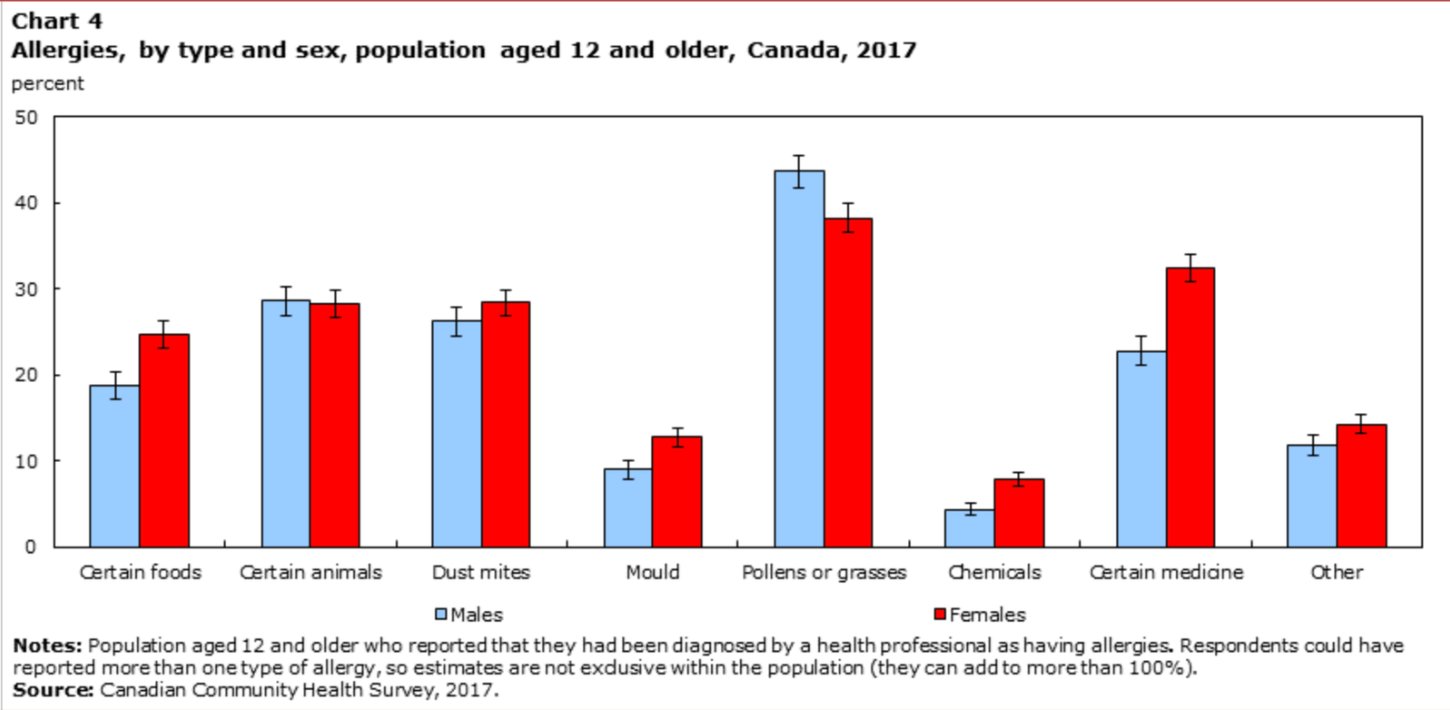 This is a graph from 2017, by health Canada that shows allergies by type, sex, and population
Conclusion
In conclusion, allergies are a common condition that affect many people around the world. Doctors use methods such as blood tests, skin prick tests, and oral food challenges to diagnose allergies and identify their severity. Allergies develop when the immune system reacts too strongly to a harmless substance, releasing chemicals that cause symptoms ranging from mild to severe. A wide variety of triggers—including foods, pollen, insect stings, medications, and pet dander and more—can lead to allergic reactions. Several treatments are available to help manage symptoms and reduce risk. Medications such as antihistamines and decongestants can relieve everyday symptoms, while epinephrine can be life-saving in severe emergencies. Although some allergies may be outgrown over time, there is no guaranteed cure. However, immunotherapy—given through allergy shots or tablets—can help gradually desensitize the immune system and make reactions less intense over time. Understanding what allergies are is essential for recognizing symptoms early and responding correctly, especially in emergency situations. Awareness is particularly important in places like schools and public spaces, where quick action can make a significant difference. By learning about allergies and sharing that knowledge with others, we can reduce misunderstandings, improve safety, and build a more supportive and informed community for people living with allergies.
Citations
Sources:
Format = Page title, Website name, URL, date (If there is one)
Allergies, Mayo clinic, https://www.mayoclinic.org/diseases-conditions/allergies/symptoms-causes/syc-20351497, Aug 24, 2024
Allergy medications: Know your options, Mayo Clinic, https://www.mayoclinic.org/diseases-conditions/allergies/in-depth/allergy-medications/art-20047403, March 28, 2025
Anaphylaxis, Clevland Clinic, https://my.clevelandclinic.org/health/diseases/8619-anaphylaxis, October 20th, 2023
Diagnosis, Food Allergy Canada, https://foodallergycanada.ca/food-allergy-basics/food-allergies-101/diagnosis/#:\~:text=Skin%20prick%20test,then%20mixed%20with%20that%20allergen,N/A
Hypoallergenic: Is There Really Such a Thing?, Healthline, https://www.healthline.com/health/allergies/hypoallergenic, April 26, 2019
Allergy Symptoms, Asthma and Allergy foundation of America, https://aafa.org/allergies/allergy-symptoms/#:\~:text=What%20Is%20an%20Allergy?,household%20products%20are%20other%20examples, November 2015
Tips for avoiding common allergens in food, Government of Canada, https://www.canada.ca/en/health-canada/services/food-allergies-intolerances/avoiding-allergens-food/tips-avoiding-common-allergens-food.html, May 6, 2019
Cross-contact (Cross-contamination), Allergy Quebec, https://allergies-alimentaires.org/en/cross-contamination/#:\~:text=Cross%2Dcontact%20(Cross%2Dcontamination,the%20risk%20of%20cross%2Dcontact., N/A
Can You Get Rid of Allergies Forever? What the Science Says, Bass Medical Group, https://www.bassmedicalgroup.com/blog-post/get-rid-of-allergies-forever#:\~:text=Can%20You%20Outgrow%20Allergies?,or%20stress%20can%20alter%20reactions, October 28, 2025
Tween Science: Can we really “outgrow” food allergies?, University of Pittsburgh , https://www.pittmed.pitt.edu/news/food-allergies-not-always-forever-exposure-immune-system-antibodies#:\~:text=The%20exact%20science%20is%20a,from%20the%20Winter%202024%20issue., Winter of 2024
Can You Outgrow Allergies?, Healthline, https://www.healthline.com/health/allergies/can-you-outgrow-them#Food-allergies-in-adults, December 17, 2016 , May 16, 2016
Types of Allergies, Asthma and Allergy Foundation of America, https://aafa.org/allergies/types-of-allergies/, October 2015
Drug Allergies, Asthma and Allergy Foundation of America, https://aafa.org/allergies/types-of-allergies/medicine-drug-allergy/ , May 2024
Food Allergies, Asthma and Allergy Foundation of America , https://aafa.org/allergies/types-of-allergies/food-allergies/ , December 2022
Insect Allergies , Asthma and Allergy Foundation of America, https://aafa.org/allergies/types-of-allergies/insect-allergy/ , October 2015
Latex Allergies , Asthma and Allergy Foundation of America, https://aafa.org/allergies/types-of-allergies/latex-allergy/, September 2024
Mold Allergies, Asthma and Allergy Foundation of America , https://aafa.org/allergies/types-of-allergies/mold-allergy/ , September 2024
Allergic Bronchopulmonary Aspergillosis (ABPA) , Asthma and Allergy foundation of America , https://aafa.org/asthma/asthma-triggers-causes/health-conditions-that-trigger-asthma/allergic-bronchopulmonary-aspergillosis/#:\~:text=Allergic%20bronchopulmonary%20aspergillosis%20(ABPA)%20is,of%20breath%2C%20much%20like%20asthma. , June 2019
Pet Allergy, Asthma and Allergy Foundation of America , https://aafa.org/allergies/types-of-allergies/pet-dog-cat-allergies/ , September 2024
Pollen Allergies , Asthma and Allergy Foundation of America , https://aafa.org/allergies/types-of-allergies/pollen-allergy/, September 2024
Pollen Allergy , Cleveland Clinic , https://my.clevelandclinic.org/health/diseases/pollen-allergy, 20 November 2023
Allergy Immunotherapy , American college of Allergy, Asthma, and Immunotherapy , https://acaai.org/allergies/management-treatment/allergy-immunotherapy/ , N/A
Immunotherapy with allergy tablets, American college of Allergy, Asthma, and Immunotherapy, https://acaai.org/allergies/management-treatment/allergy-immunotherapy/immunotherapy-with-allergy-tablets/ , N/A
How can decongestants be used to treat allergies, Healthline, https://www.healthline.com/health/allergies/decongestants, October 25, 2024
Nasal Decongestants, Clevland Clinic , https://my.clevelandclinic.org/health/drugs/24923-nasal-decongestant, April 20, 2023
Antihistamines, Clevland Clinic, https://my.clevelandclinic.org/health/treatments/antihistamines , July 26, 2024
Food allergy vs. food intolerance: What's the difference?, Mayo Clinic, https://www.mayoclinic.org/diseases-conditions/food-allergy/expert-answers/food-allergy/faq-20058538, February 28, 2024
Food Allergy and Intolerance, Better Health Channel, https://www.betterhealth.vic.gov.au/health/conditionsandtreatments/food-allergy-and-intolerance, April 10, 2022
Epinephrine: Life-saving medication for severe allergic reactions , Food Allergy Canada, https://foodallergycanada.ca/wp-content/uploads/5_Epinephrine_Web_March2021.pdf, May 2020
What is Epinephrine?, Asthma and Allergy Network, https://allergyasthmanetwork.org/anaphylaxis/what-is-epinephrine/#:\~:text=Epinephrine%20for%20anaphylaxis%20reduces%20or,the%20first%20sign%20of%20anaphylaxis., N/A
What is a food Allergy?, Food Allergy Canada, https://foodallergycanada.ca/food-allergy-basics/food-allergies-101/what-are-food-allergies/#:\~:text=There%20are%20two%20categories%20of%20food%20allergies:,last%20longer%20than%20IgE%20mediated%20allergy%20symptoms. , N/A
What can you do to support safe and inclusive school environments for children with food allergies?, Northern Health Stories, https://stories.northernhealth.ca/stories/what-can-you-do-support-safe-and-inclusive-school-environments-children-food-allergies#:\~:text=For%20example%2C%20some%20schools%20have,mature%20enough%20to%20do%20so). May 24, 2017
Health Fact Sheets Chronic Conditions, 2017, Government of Canada, https://www150.statcan.gc.ca/n1/pub/82-625-x/2018001/article/54983-eng.htm?utm_source=chatgpt.com , November 14, 2018
Acknowledgement
I would like to thank my teachers who supported the STEMIA school science fair, Ms. Perez and Mr. Joseph.
Another huge thanks to my past teacher Ms. Lehti, who encoureged me to join science fair.
Thank you mom, and dad, for your support and feedback that helped me get so far.
Lastly, a massive thanks to Jiya Sidhu, a friend of mine who helped me get through this project, I couldent have done it without her.