
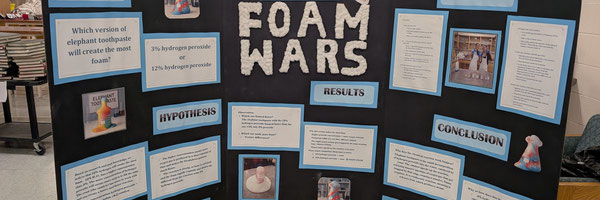
Foam Wars: Elephant Toothpaste
Kaitlyn Libal, Nadira Gadad
St. Rose of Lima Junior High School
Grade 9
Presentation
Hypothesis
Hypothesis: Based on research and past knowledge, we believe that 12% hydrogen will create the most foam. 12% H2O2 has a higher concentration than 3%. More concentration of hydrogen peroxide will create more oxygen to fill the soap. The yeast (the catalyst) has more to work with, and can create a hotter and faster reaction.
Research
Background research
Elephant toothpaste is a famous science experiment that makes a huge, foamy eruption that looks like toothpaste being squeezed out of a giant tube. It doesn’t use real toothpaste or have anything to do with elephants, the name just comes from how big and dramatic the foam looks.
Why does this happen? How does this happen?
- 3% hydrogen peroxide has the same chemical reaction as stronger versions, just a smaller reaction. The yeast mixture, our catalyst speeds up the process of breaking down the hydrogen peroxide into water and oxygen gas. The oxygen gas is released quickly, and the dish soap traps the gases to form bubbles, creating foam. Warm water activates the yeast so the reaction is fast. 3% hydrogen peroxide is a lot weaker than 12%, so it produces less oxygen, so the foam rises slowly and doesn’t shoot high.
- 12% hydrogen peroxide has the same chemical process as 3% elephant toothpaste, but the reaction is a lot faster and dramatic because the peroxide is more concentrated. With 12% hydrogen peroxide this breakdown happens very quickly. The higher concentration means more oxygen gas is produced in a short amount of time, and makes the breakdown process much faster. The reaction is strong, so heat is released and the foam rapidly expands and shoots up, different from the reaction with 3% hydrogen peroxide.
Why does the chemical reaction work/happen
Elephant toothpaste is the rapid decomposition of hydrogen peroxide into the water , catalyzed by yeast. The catalyst speeds up the reaction, releasing massive amounts of oxygen gas that get trapped by dish soap, creating a massive, foamy eruption. It is exothermic reaction , meaning it releases heat, which produces steam
Variables
For our project, comparing 2 different types of elephant toothpastes, our variable was the percentage of hydrogen peroxide. We compared elephant toothpaste with 3% hydrogen peroxide and elephant toothpaste with 12% hydrogen peroxide.
Procedure
Procedure:
- Set up your area.
- Put on a flat surface.
- Put both container beakers on the flat surface.
- Put on your safety goggles and gloves.
- Prepare the dish soap mixture with 3% peroxide.
- Pour ½ cup of 3% hydrogen peroxide into the Dish Soap container.
- Add 1 tablespoon of dish soap.
- Add a few drops of red food coloring for the dish soap
- Gently swirl the container to mix the ingredients without making foam yet.
- Prepare the dish soap mixture.
- Pour a cup of 12% hydrogen peroxide into the dish soap container.
- Add 1 tablespoon of dish soap.
- Add a few drops of blue food coloring.
- Gently swirl to mix.
- Prepare the yeast catalyst.
- In a small cup and add 2 ¼ teaspoons of dry yeast.
- Add ¼ cup of warm water.
- Stir gently and let the mixture sit for about 2 minutes. This activates the yeast and the catalase enzyme inside it.
- Start the reaction with 3% peroxide.
- Quickly pour about half of the yeast mixture into the Dish Soap container.
- Step back and watch the reaction.
- As the foam rises, use a ruler to measure the maximum height of the foam from the bottom of the container to the top of the foam and observe the obvious difference of which created the most.
- Record your measurement and observations.
- Start the reaction with 12% peroxide.
- Quickly pour the remaining half of the yeast mixture into the dish soap container.
- Step back and watch the reaction.
- Measure the maximum foam height with the ruler and observe.
- Record your measurement and observations.
Observations
- Which one foamed faster?
The elephant toothpaste with the 12% hydrogen peroxide rose out of the becker after 2 seconds. The one with 3% hydrogen peroxide rose after 3 seconds, making the 12% hydrogen peroxide faster than the 3%.
- Which one made more foam?
The elephant toothpaste with the 12% hydrogen peroxide rose to 2 inches and the one with 3% only rose to 1 inch. We can also visibly see a difference in size between the two.
- Texture differences?
The 12% hydrogen peroxide elephant toothpaste was more thick and foamy. The 3% had a low viscosity and was more diluted, similar to water.
Analysis
| % of Peroxide | Volume of Peroxide (mL) | Yeast Amount (tsp) | Time Until Overflow | Max Foam Height | |
|---|---|---|---|---|---|
| 3% | 355 mL | 2 1/4 tsp | 3 second | 1 inch | |
| 12% | 355 mL | 2 1/4 tsp | 2 seconds | 2 inches |
Conclusion
The elephant toothpaste with the 12% hydrogen peroxide rose to 2 inches and the one with 3% only rose to 1 inch. We can also visibly see a difference in size between the two.
Why does this happen? How does this happen?
- 3% hydrogen peroxide has the same chemical reaction as stronger versions, just a smaller reaction. The yeast mixture, our catalyst speeds up the process of breaking down the hydrogen peroxide into water and oxygen gas. The oxygen gas is released quickly, and the dish soap traps the gases to form bubbles, creating foam. Warm water activates the yeast so the reaction is fast. 3% hydrogen peroxide is a lot weaker than 12%, so it produces less oxygen, so the foam rises slowly and doesn’t shoot high.
- 12% hydrogen peroxide has the same chemical process as 3% elephant toothpaste, but the reaction is a lot faster and dramatic because the peroxide is more concentrated. With 12% hydrogen peroxide this breakdown happens very quickly. The higher concentration means more oxygen gas is produced in a short amount of time, and makes the breakdown process much faster. The reaction is strong, so heat is released and the foam rapidly expands and shoots up, different from the reaction with 3% hydrogen peroxide.
Why does the chemical reaction work/happen
Elephant toothpaste is the rapid decomposition of hydrogen peroxide into the water , catalyzed by yeast. The catalyst speeds up the reaction, releasing massive amounts of oxygen gas that get trapped by dish soap, creating a massive, foamy eruption. It is exothermic reaction , meaning it releases heat, which produces steam
Application
Our project can be applied in 2 different ways:
1. It can be applied in medicine. Elephant toothpaste demonstrates how our body protects itself using enzymes. 3% hydrogen peroxide is used to clean wounds by disinfecting them. In our bodies\, cells produce hydrogen peroxide\, catalase breaks it down into water and oxygen\, just like the reaction in elephant toothpaste.
2. It can be applied in manufacturing and safety engineering. 12% hydrogen peroxide can be dangerous and corrosive. It is used for hair bleaching\, paper bleaching\, industrial cleaning\, and processing textiles. Elephant toothpaste is an example of how high concentrations of hydrogen peroxide create faster and more aggressive reactions. This shows us that using potential harmful substances should be handled with extreme care and safety.
Sources Of Error
The sources of error we found in our elephant toothpaste experiment was that we originally didn't warm up the 3% hydrogen peroxide and the 12% hydrogen peroxide . After doing so we found that the elephant toothpaste of both of the different types of hydrogen peroxide rose faster and had a more violent reaction. Through this process of trial and error me and my partner learned the importance of trying new things and knowing you can always change things for the better.
Citations
Finio, Ben. “Make Elephant Toothpaste.” Scientific American, Scientific American, 1 Aug. 2019, www.scientificamerican.com/article/make-elephant-toothpaste/.
https://www.sciencebuddies.org/stem-activities/elephant-toothpaste
Convergence 9 - Sciences, Technologies Societe
https://aglab.ars.usda.gov/let-s-get-to-work/elephant-toothpaste
Acknowledgement
I would like to acknowledge and thank the organizers of CYSF for all of their hard work to even make this possible. We appreciate the opportunity to challenge our selfs in a fun productive environment and share our knowledge with others. We would like to give a big thanks to our science teacher, Mr. Landa, for all his support and giving up his breaks. We give gratitude to our classmates who helped us film and take pictures of all of our experiments. Both Mr. landa and our friends have put in lots of effort and time into helping us succeed. We thank you!
Sincerely, Nadira and Kaitlyn