
Smart Cane for visualy impared
Kamyar Dowlatabadibazaz
Sir Winston Churchill High School
Grade 11
Presentation
Problem
As per the Government of Canada, there were over 78,076 fall-related hospitalizations in Canada (Public Health Agency of Canada, 2023). This represents a statistic that is, and has been rising for years. Currently, falls overwhelmingly account for the most common injury related visit to the hospital in Canada, causing 89% of injury related hospitalization. As Canada's population continues to age, the issue is only expected to expand. Another group of people past the elderly that is effected by difficulty in vision are the blind and visually impaired. An estimated 1.5 million Canadians have visual impairments. These visual impairments not only make life difficult, but pose a extreme risk for the safety of the individuals (Removing Barriers for People with Visual Impairments, 2020). At home, or on the streets, visual impairments lead to countless incidents including falls, slips, and even pedestrian collisions, many of which lead to death, with the visually impaired experiencing a 37.9% greater amount of falls (Seresirikachorn et al., 2025). After recognizing the danger of falls, direct link between vision and fall accidents, as well as the current and growing implication of this topic, the question arisen is why there is no widespread device guiding the visually impaired. Today the same technology is being used to guide the visually impaired and the elderly that has been used for decades. As tech implements into all aspects of life, there is a large gap in this vital sector. Current simple canes do not indicate distance until the cane itself reaches the destination/obstacle, for instance, a wall. This means that one can only assess the risk for a few meters ahead. Additionally, for areas where there is no obstacle, but there is still danger, like a stairwell, cliff, or crosswalk, there is little to no way for the person to recognize the danger. Finally, the issue of attaining aid once tripped occurs. One in five seniors who fall or trip experience the "Long lie", which means being on the floor without aid for over 1 hour (The Long Lies Study, n.d.). This occurs when seniors live alone, as a result of inability to call or reach help. In return, this causes sever implications for the individual, and can be a matter of life or death. This once more represents a issue with current senior tools and canes, which can be solved via technology.
All of this has means that the current canes are not sufficient for ensuring safety of the user, and hence why the Smart Cane has been created. Smart Cane aims to fix the issues and limitations canes face today. It faces the problem modernizing the cane, and reducing the impacts lack of vision and aid have. The creation, experimentation, and analysis all aim to answer this question.
Method
The primary aspect of this project was the construction of the cane itself, which amounted to hours of research, assembly, trial and error, shopping, and fixing issues. The design has been adapted numerous times and improved upon, representing growth over nearly a year of work to create the final prototype today, which still has areas of improvement.
The idea of a "Smart Cane" first emerged to me following an engineering/robotics club I attended at the University of Calgary called "Engineering Unleashed", run by "Project 90". Here, I was introduced to sensors and making circuits with them, and this introduction led me to think about how I could use these sensors and skills I had learnt to apply them to real world issue.
About 2 months following the program, the thought of utilizing these sensors on canes first emerged to me, and I began to do research. Through this process, I saw there was little to no commercial product that utilized these technologies, although there were a few papers highlighting the possibility of the technology. This is where I saw the solutions that did exist were not only very expensive, but limited in their scope, as most implemented a simple Ultrasonic sensor, only able to detect obstacles in front of the user. This is when I began the Smart Cane, which initially implemented only an RFID tag to trigger a vibration motor in the handle. This approach was taken as I saw this lacking in all of the commercial options. An RFID allows for a cane to detect obstacles/areas of danger that are not physical obstacles in front of the user (Stairwells, crosswalks). This is done as the RFID sensor triggers the motor when it detects a corresponding RFID tag, which is a small, battery-free device that can be placed nearly anywhere, with a single sensor being able to detect an unlimited amount of these tags if close enough. This meant that the issue of undetected stairwells or even sidewalks could be solved by placing these tags across homes and even cities.
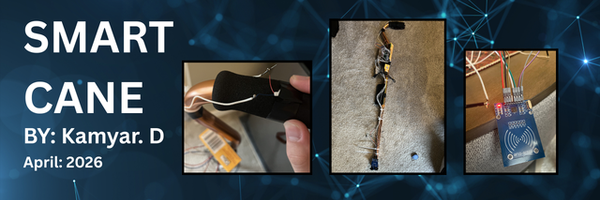
The initial system was tested on a breadboard, not yet assembled onto the cane. Using the sensor and a transistor, as well as a microcontroller, I was able to get the system working and run the required code. Once the sensing and triggering of the vibrator were both functional, I began to assemble it onto the cane, which required soldering wires alongside the length of the cane, having to reach from the handle where the vibrator was, down to the bottom where the sensor was placed.
Following this portion of the cane becoming operational, I began to extend the functionalities of the cane and added an ultrasonic sensor. This meant that the cane could now detect both flagged / dangerous areas with the RFID, as well as physical obstacles at a desired distance up to 4 meters away. Finally, i implemented two tilt sensors as well as a digital siren. These meant that if the user had a fall, the cane would sound out loud to grab the attention of aid.
After nearly a year, the cane was fully functional. After 3d printing a casing for the microcontroller and cleaning up the wiring, the cane was ready for experimentation.
Following the creation of the cane, research and experimentation was, and is still being done on
1. The issues and shortcomings with current aids for the visually impaired and elderly population 2. The effectiveness of innovative canes\, with the current prototype used for data.
Regarding the collection of the data, tests were done on obstacle detection in numerous locations, including indoor and outdoor, with different obstacles. Over 10 different environments and scenarios are to be experimented on.
Testing regarding the reliability of the alarm system was / will also conducted, with the focus on the reach of the sound, which included conducting tests in different noise environments.
Finally, testing on the range and effectiveness of the RFID tag was / will be done, once more in different environments, including a stairwell and a crosswalk
All the data is to be recorded and converted into statistics, which could then be analyzed and compared with secondary research.
Analysis
Live link to analysis + conclusion in case I update it: https://docs.google.com/document/d/1rtcARN3W1qWy2K9yn9TeNDNE4Yfrbk5LAvNDef2gSkE/edit?usp=sharing
Experimentation and data collection were done in the functions of:
- Ultrasonic sensor
- RFID tag
- Tilt/accident sensor
Additional Analysis will be done on the price.
Each section will be analyzed with reference to the intended outcome as well as comparison/improvement on current canes.
- Ultrasonic Sensor
As per the data collected, it can be evaluated that the ultrasonic sensor works drastically better when the cane is swiveled left and right. This causes the sensor to cover a greater horizontal range, better picking up obstacles. This was demonstrated in the first test, where a lack of this movement caused the participant to pass the obstacle with no detection from the cane, and then collide with another obstacle ahead. In contrast, once this method of swaying the cane was adopted, the issue of detection on a horizontal aspect was no longer experienced, with detection on every other attempt. Another vital factor to note is the vertical performance of the cane. As demonstrated in test #1, the cane lacks the ability to detect obstacles that are above the sensor situated at the bottom. While most obstacles do start from the floor, meaning they are detected, test #1 showed a scenario where this is not the case, as the participant lightly collided with an elliptical. These show that there are limitations on both the horizontal and vertical obstacle detection of the cane. For horizontal detection, a potential fix may be a rotating sensor via a motor. Despite this, a sweeping movement is already widely used by canes by the visually impaired, and represents an easy solution, adding a second layer of protection that is the cane itself, in case the sensor fails. On the vertical aspect, several solutions are possible. Placing secondary sensors, angled up, would provide detection higher up, at a lower maximum range. The cane also demonstrated its ability to guide a user through an environment and allow them to pass safely. This was shown in tests #5 and #6, where the participant made it past numerous walls, cabinets, and obstacles thanks to the early and high range of the detection of the sensor. Overall, these limitations demonstrated limitations that are not too difficult to fix in a second prototype. Their current form of the ultrasonic sensor itself represents a substantial improvement compared to the current cane. Current canes provide zero detection at all, leading to more frequent collisions, less reaction time, and a near-zero ability to detect obstacles at a height. A detection of up to 5m, but set to 30cm ahead, means reaction time for obstacles is greatly larger, and a reception of obstacles at a limited height from the ground is possible. The most vital flaw of the current system that has been observed is the interruption errors. In 2 of the 5 tests, the device prematurely turned off. This may be because of the charge level of the battery bank, which is well below maximum. Nevertheless, this represents a real reliability issue that needs to be addressed. A small blinker when the battery is low, or the use of a permanent power bank, could solve this issue.
- RFID Tag
The primary task of the RFID system is to detect hazardous areas that do not include obstacles that an Ultrasonic sensor can pick up. This represents an aspect that current canes have zero ability in today. The greatest challenge to this approach is establishing long-range and reliable tag detection. During the testing, it was observed that the cane was triggered at a range of approximately 3cm. This represents a real limitation in the design. If this product wants to become a reliable and widespread tool, it must achieve ranges of between 15-30cm. RFID tags and readers do exist with ranges up to 10m, although a far greater difficulty and higher price are associated with them (Zheng & Seven, 2025). They represent an obvious improvement in the next prototype of this product. Another aspect of the RFID’s effectiveness is the angle of the tag. As per experiments, the orientation of the tag itself did not affect results, representing a positive aspect. Despite this, the tags above 4cm were not detected. This likely links back to the limitation of the range of the reader itself, and could be solved with an extended range. The RFID’s represent a huge potential for the cane. Past implications in stairwells and danger areas in buildings and homes are created in a reliable system; the tag concept could be implemented at crosswalks around the city. This is vital because it would mean the visually impaired could traverse the streets with far less concern, especially in the many cities without bump-outs near lights. Once more, this could only be operational with the increase of the range, making this a vital improvement for the product.
- Tilt / accident sensor
The tilt sensor has the responsibility of detecting accidents when they do happen, and making sure the siren is loud enough to garner the attention of aid that would otherwise not realize the accident. During experiments done, it was seen that the sensors had a 100% success rate in being triggered in the falls, which were each conducted in different directions. This means no matter how the fall, the siren is sounded. This is made possible through the use of two sensors in opposite directions, which create a full spectrum for detection. Past the reliability of the device, its reach was also measured. The device was heard all the way two stories below, with the recorder and decibel reader in a room on the opposite side of the home, and the cane two floors above. In addition, it is important to gauge the quantitative value of the alert. On each of the 3 tests in different locations, decibel readings were collected. In the farthest locations, a decibel reading of 32 dB was indicated when the alarm triggered. This is a quiet sound, and means the alert would only work if the basement were quiet. Despite this, a reading of 57 dB one floor below the device represents moderate sound, representing a normal conversation or residential street (Savchuk, 2021). The reach of the sound is vital, as it is the sound and alerting of others that can help prevent Long Lie, which currently affects ⅕ of the elderly who fall. While the current sound level is sufficient, even for outdoor applications, increased sound can be a benefit, and one achieved simply through a larger siren. This tilt-sensing mechanism of the cane represents an extremely reliable and useful aspect of the smart cane, and implements a cutting-edge innovative technology that, although seemingly useless, can have huge impacts.
- Price
Following analysis on the effectiveness, impacts and value of the cane, placing its expected price into perspective is also vital.
Smart Cane aims to be a budget option, and once all the assembly prices are placed together, a price can be gauged.
- Breadboard \~$5
- Tilt sensors x2 \~$5
- RFID sensor + tag \~$4
- Ultrasonic sensor \~$1
- Raspberry pic pico H \~$8
- Wires \~$5
- Cane \~$15
- Vibrator motor \~$2
- Digital siren \~ $4
Total: \~$49 Estimated retail price with taxes and markup \~$75
While this price may seem like a substantial amount, there are several notions to consider. Many of the sensors used in the build were purchased from 3rd parties in Calgary, meaning extreme markups. Base suppliers provide most for about $0.5 - $1.0, especially if purchased in bulk. This means prices could go even lower. The more substantial observation comes when comparing the device with current models. Currently, a company WeWalk retails their technological canes for around $1200 CAD (WeWALK Smart Cane, 2026). This means that Smart Cane offers a drastically cheaper alternative to current options, and could revolutionize the market, the access of the technology to the masses, and the boom in technological cane products.
Conclusion
Smart Cane was built to create an affordable and accessible technological cane that aids the visually impaired and elderly. Concerns about obstacles, dangerous areas, and effective notice of accidents were the main issues the cane aims to solve. Through extensive testing and data analysis, the cane has been evaluated in each sector of its goals. Overall, Smart Cane has been able to do an extraordinary job at addressing the basic premises of the issue. It tackled complex issues at an unimaginably low price, demonstrated a simple and reliable product, and has promising signs of effectiveness, even in its prototype phase. While testing displayed issues like vertical sensor reach, limited RFID range, and room for a louder, more informative siren, all of these represent changes that can quite easily be implemented, even with the same simple components. A basic structure and clean layout have been created, on which improvements can be made easily. Smart Cane does not represent a one-and-done innovation or project. Not only has it evolved for more than a year, but the experimentation and demonstration of areas of growth mean that following prototypes must and will be made. The project holds potential to dramatically improve the lives of millions, and push the medical field forward in this ignored sector. The vision remains to one day provide a cheap cane that has dramatically reduced deaths from falls, lead to an end to Long Lie, and create a world ecosystem, both at home and at the crosswalk or mall, where the blind and visually impaired are truly integrated into society, and can traverse confidently without fear or concern.
Citations
Citations:
Seresirikachorn, K., Somyanonthanakul, R., Johnson, M., Singhanetr, P., Gatedee, J., Friedman, D., & Zebardast, N. (2025). The Impact of Vision Impairment on Self-Reported Falls among Older US Adults: Cross-Sectional and Longitudinal study. JMIR Aging, 8, e68771. https://doi.org/10.2196/68771
The Long Lies study. (n.d.). The University of Sheffield. https://sheffield.ac.uk/cure/current-trials/long-lies-study#:\~:text=When%20a%20person%20is%20unable,for%20increasing%20periods%20of%20time.
Removing Barriers for People with Visual Impairments. (2020, September 14). CanadaHelps - Donate to Any Charity in Canada; Canada Helps. https://www.canadahelps.org/en/giving-life/featured-series/removing-barriers-for-people-with-visual-impairments/
Public Health Agency of Canada. (2023, December 4). Falls among Older Adults in Canada — Canada.ca. Health-Infobase.canada.ca. https://health-infobase.canada.ca/falls-in-older-adults/
WeWALK Smart Cane. (2026, March 3). Homepage - WeWALK Smart Cane. https://wewalk.io/en/
Zheng, & Seven. (2025, October 14). Understanding the range of RFID Tags: A complete guide. RFID Card. https://www.rfidcard.com/understanding-the-range-of-rfid-tags-a-complete-guide/?srsltid=AfmBOoqjZ5yW6iDdon9zjubxj0qi3BQLN5RzaCc15vSZdV1-lQtz7jlF
Savchuk, A. (2021, October 14). How loud is 50 decibels | What is 50 decibels. Decibel Meter App | Best Digital Sound Level Meter for Your Smartphone. https://decibelpro.app/blog/what-is-50-decibels/#:\~:text=50%20dB%20is%20as%20loud\,should%20be%20under%2040%20decibels.
As research and data analysis is ongoing, some new sources may be used, though not too much.
A link has been provided to a document with any new citations I use.
Link to doc: https://docs.google.com/document/d/1y5eIrJXjya0UP6WF80ekd7HK76Zxq_7K55vy7mSSUBY/edit?usp=sharing
Acknowledgement
As I was learning many of the technical skills for creating the product, as well as fixing bugs, issues ect, I made use of several resources available to me. Alongside my prior skills on this topic, information from YouTube videos, as well as aid from AI models like ChatGPT, were utilized to help me get past issues, give me information about materials needed to fix issues, and aid me in my creation of the product. This does not mean I simply copied everything from AI, rather used it to help me at time when I was stuck.
In addition to this, I must note the project, or at least its sleek and polished design, would not be available without the free access I had to my school, Sir Winston Churchill's 3d printers. I made the 3d modeling using modeling software at home, and was able to print at school.
I would also not be able to do this without my mother, who helped be a tester for me to analyze data and the canes responses.