
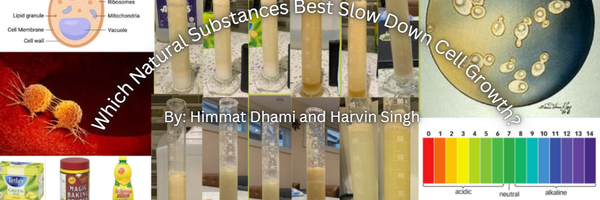
Which Natural Substance Best Slows Down Cell Growth?
Harvin Singh, Himmat Dhami
Khalsa School Calgary Educational Foundation
Grade 9
Presentation
Hypothesis
Hypothesis - If we test how different natural substances (such as green tea, vinegar, honey, lemon juice, and baking powder) affect the growth rate of yeast cells, as a model for how natural substances might affect cancer cells' growth. Then my partner and I hypothesize that vinegar will slow the growth of the yeast most effectively, followed by lemon juice, green tea, baking powder, and honey.
Hypothesis Support - Vinegar has acidic as well as antibacterial properties, which can stop the growth of yeast. Lemon juice is also acidic, and it may reduce the yeast growth by lowering the pH. This can cause the enzyme function to be broken, and yeast cells may struggle to perform metabolic activities. Green tea may have a slight effect in slowing down the growth of yeast because it has polyphenols and antioxidants that may stress the cell and have an effect on the reproduction of yeast. Honey can also decrease yeast growth at high levels because sugar in high concentrations will produce osmotic pressure that can take water out of the cells to make it difficult for the yeast to survive. However, in lower concentrations, honey can supply sugar to help the growth of yeast. Baking powder may affect yeast growth by increasing pH and creating a less favorable environment, but it is expected to be of lower significance than vinegar. In general, vinegar is expected to have the greatest effect in reducing the yeast growth of all the substances.
Research
Similarities between cancer and yeast cells:
Yeast cells and cancer cells are similar in many ways because they both grow and develop, and divide very quickly. Scientists often use yeast to study due to the fact that it is extremely safe to work with, easy to test, and shares many similar parts of human cells, like DNA and a nucleus. By studying yeast, researchers can learn more about uncontrolled cell growth, which also happens in cancer. Even though cancer sometimes runs in families, less than 5% of cancers are inherited from past family members. Most cancers come from genetic mutations that happen during a person's lifetime. These mutations affect the DNA in body cells and cause them to lose control of their ordinary growth. In the 1960s, scientists began to understand that cancer is a genetic disease caused by mutations during a person's lifetime. A biologist named Leland H.Hartwell studied baker’s yeast, also known as Saccharomyces cerevisiae, to learn how cells control when they grow and divide. He discovered more than 100 genes called CDC (cell division cycle) genes that help control the cell cycle. Many of these genes are similar to the ones in humans. The cell cycle is a chain of events that happens when a cell grows and divides. In regular cells, these genes act like traffic lights telling the cell when to divide and when to stop. But in cancer cells, mutations can make certain genes act like stuck accelerators that force cells to divide very fast, or like broken brakes that can’t stop the cell from dividing. If there’s damage, the cell is meant to stop dividing until it is fully repaired. But when checkpoint genes are mutated, the cell doesn’t stop; something is wrong, leading to rapid tumor growth.
 After Hartwell’s discovery, another scientist named Paul Nurse made a key advancement in understanding the cell cycle. Using a different species of yeast, known as the Schizosaccharomyces pombe, Paul Nurse identified the gene CDC2, which plays a central role in regulating progression through the cell cycle and is comparable to the CDC28 gene originally described by Hartwell in his research following the discovery of the CDC gene. In 1987, Paul Nurse and his colleagues isolated the human version of this gene, known as CDK1(cyclin-dependent kinase 1). This showed that yeast and human cell division control occur in similar ways.
 How yeast grows
Yeast is a form of single-celled fungus that grows and reproduces by using sugars as a source of energy. Yeast cells grow in a process that is dependent on metabolism, enzyme activity, and environmental conditions such as temperature, pH, and nutrient availability. When yeast is placed in an environment that contains sugar and water, it becomes active and starts converting sugar into usable energy. Yeast uses the sugars mainly glucose, fructose, and sucrose by a process of cellular respiration or fermentation, in the presence or absence of oxygen. Sugar molecules pass into the yeast cell through the cell membrane and are broken down by enzymes in a pathway known as glycolysis. During glycolysis, the glucose is broken down into pyruvate, releasing energy that is used to form ATP ( adenosine triphosphate ), which the yeast uses to perform cellular processes such as growth, repair, and reproduction. As yeast gains energy from sugar metabolism, it reproduces mainly through budding, a form of asexual reproduction. In the process of budding, a daughter cell is formed on the surface of the parent cell of yeast. The nucleus replicates, and one of them is transferred into the bud, which develops until it ultimately splits into an independent cell. This process has an increasing effect on the yeast population and activity. The environmental conditions are very important in yeast growth. The optimal environment of yeast is approximately ( 25 - 30 degrees celsius), slightly acidic (4-6pH), and rich in all essential nutrients. If the environment becomes unfavourable, enzyme action slows down or halts the growth of the yeast. Therefore, yeast growth can be demoted by substances that disrupt pH or make other environmental conditions unfavourable. Overall, yeast grows by breaking down sugars to obtain energy and then using that energy to carry out cellular processes and reproduce.
 Natural substances and yeast
Vinegar is a substance that is highly acidic due to the acetic acid it contains, and therefore, it has a very low pH. Since vinegar creates a much more acidic environment than yeast likes to operate in, it is able to disrupt the metabolism of yeast, enzyme activity, and slow down or even cause the death of yeast cells. Although certain species of yeast can withstand low levels of acidity, the high level of vinegar usually suppresses the growth of yeast because of its acidic and antimicrobial effects. This makes vinegar an important material in investigating the effects of changes in environmental factors on reducing or stopping cell growth.
 Green tea contains natural compounds known as polyphenols, in particular, one type of them is called epigallocatechin gallate (EGCG), which is the most active component biologically. Even though EGCG is considered to be an antioxidant when conditions are quite specific, it leads to the production of reactive molecules such as hydrogen peroxide. This stress triggers certain proteins in response to the stress in the yeast, which means that the green tea polyphenols have the potential to influence cellular processes and growth of the yeast.
 Honey can affect yeast growth because of its high concentration of sugar and natural antimicrobial compounds. High concentrations of sugar in honey create a high level of osmotic pressure, which takes water out of the yeast cells, making it difficult for them to survive and reproduce. This can slow or stop the growth of yeast. However, when honey is added in low concentrations, the honey could contain sugar that can be used by yeast as a source of energy and food, which may result in some growth rather than the yeast growth slowing.
 Lemon juice can impact the growth of the yeast mainly due to its acidity. The yeast is most likely to grow in an acidic environment, and lemon juice has a significantly lower pH, which will be able to disrupt enzyme functioning and disrupt the normal metabolism of the yeast cells. This acidic condition makes it harder for yeast to produce energy and reproduce efficiently, which can slow or reduce growth. Moreover, lemon juice has natural antimicrobial compounds that have the capacity to further demote yeast growth in large concentrations.
 Baking powder and baking powder also contains sodium bicarbonate, which is a basic (alkaline) compound that can raise the pH of a solution when dissolved in water. Yeast such as Saccharomyces cerevisiae grows best in a somewhat acidic to neutral pH range (around 4.5 - 6.5), and shifting the environment too much toward the alkaline pH side may secondarily affect yeast metabolism and fermentation. When the pH outside this optimum range is increased by baking powder, the biochemical pathways that yeast uses to go through the process of breaking down and making carbon dioxide can be slowed down, making the yeast slower to work and produce growth in the mass. High pH can also stress the yeast cells through interfering with the internal pH balance and the function of enzymes, which may further inhibit growth.

Variables
Variables
Controlled - Our controlled variables for this experiment include: the type of yeast we use (Red Star Active Yeast), the graduated cylinders we use, the same environment for the growth to occur, water temperature, oxygen exposure, amount of natural substance added, the time for the yeast to grow, amount of sugar that was added for each trial 5g (this is just how much sugar we added to each graduated cylinder not the amount of sugar in each natural substance), light exposure, and the same mixing methods.
Manipulated- The manipulated variables in this experiment include: the type of natural substance added. For example, yeast growth was tested with the addition of substances like green tea, vinegar, honey, lemon juice, and baking powder. By changing only the identity of the substances while keeping all other conditions the same, the experiment will be able to show the noticeable effect that each substance has on yeast growth.
Responding - The responding variables in this experiment include: how much the yeast grows/ foams. Firstly, we will measure the vertical growth of the yeast to find the amount of growth in height. Secondly, we will also find the mass of the yeast by weighing the final weight of the yeast in the graduated cylinder after each trial.
Uncontrolled - Our uncontrolled variables for this experiment include: small changes in the room temperature, the fact that one of the natural substances was a different state of matter and that it was a solid (baking powder) slight differences in air circulation, measurement errors when pouring liquids in the graduated cylinders alongside yeast, as there is no way to get perfect measurements, minor differences in yeast activity between samples, and the evaporation of liquid over time (the 60 minutes we took to do our trial). We tried our best to reduce the impact of these uncontrollable circumstances and their impact on our results.
Procedure
Procedure
- Label all graduated cylinders with the respective natural substances (3 each). Include 3 separate natural substances at all.
- Get the liquids and natural substances that you need: warm water (35 degrees Celsius), brew green tea, and prepare the control sample, which will just have yeast, sugar, and water. (35 degrees Celsius), Measure vinegar, lemon juice, baking powder, and honey (try to keep the temperature consistent).
- Pour 50 ml of warm water into each graduated cylinder, including the control graduated cylinders, to give all the yeast the same conditions to start.
- Add 5g of sugar to each graduated cylinder and stir gently. (Sugar provides energy for the yeast to grow and produce foam).
- Add the natural substances to each of the respective labeled graduated cylinders. Do not add anything to the control graduated cylinders. (Add 15 ml of each natural substance.)
- Place all the graduated cylinders in the same warm location (30-35 degrees Celsius) to ensure the yeast grows at a similar rate under the same conditions
- Add 1 gram of yeast to every graduated cylinder and stir gently. Start your stopwatch for the test.
- Perform 3 trials for each natural substance, and try to keep conditions the same for each trial. These conditions include the temperature of the water, the location of the graduated cylinders during testing, and the amount of substance added.
- Measure the foam height for each of the natural substances at 0, 5, 10, 15, 30, 45, and 60 minutes using the built-in measurements on the graduated cylinder.
- Record observations for each of the graduated cylinders, such as foam height, bubbles, colour, smell, and any contamination or formation of bacteria. Take photos if possible.
- At 60 minutes, record the final foam height for each of the individual trials.
- Calculate the average foam height for each natural substance by adding the results of each of the three trials and dividing by three. Also, do this for the control graduated cylinders
- Measure and record the mass of each of the graduated cylinders and note it down, as well as the average.

Observations
Observations
Our observations were done in two parts Part 1 included baking powder, honey, and control. Part 2 included lemon juice, vinegar, and green tea
Trial 1 part 1
- When we added the baking powder to its respective graduated cylinder we already noticed that the baking powder had already reacted with the water and sugar producing foam and bubbles.
-
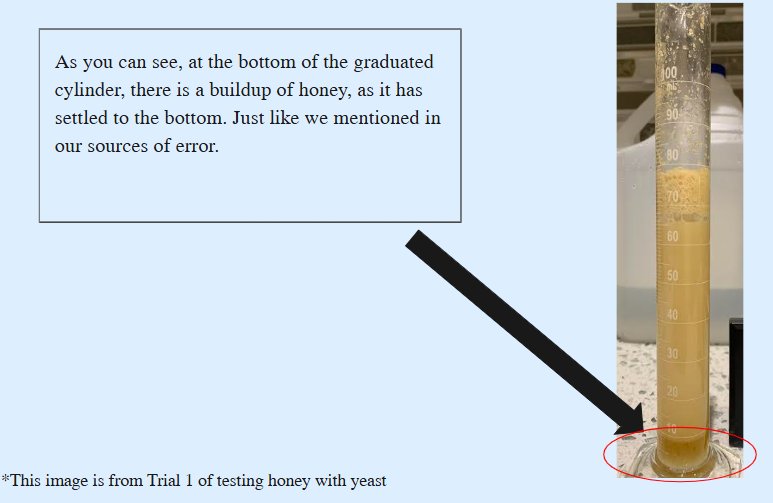
When we added the honey to its respective graduated cylinder some of the honey stuck to the side of the glass and the rest of the honey rested at the bottom of the graduated cylinder.
-
To measure the weight of the yeast we took a piece of paper that weighed 0.23 grams and then added yeast until the weight was shown as 1.23 grams to measure the yeast.
0 minutes
- The height of the yeast when added to the baking powder solution rose to 59 ml at 0 minutes. ( the yeast powder mixed with the water and the solutions colour changed to light brown)
- The height of the yeast when added to the control solution rose to 53 ml at 0 minutes. ( the yeast powder mixed with the water and the solutions colour changed to light brown)
- The height of the yeast when added to the honey solution was 67 ml at 0 minutes. ( the yeast powder mixed with the water and the solutions colour changed to light brown)
5 minutes
- The height of the yeast after being added to the baking powder solution rose to 60 ml in 5 minutes. ( Bubble formation occurred and the top of the solution started to form a light brown substance)
- The height of the yeast after being added to the control solution rose to 54 ml in 5 minutes. ( The top of the solution started to form a light brown substance.)
- The height of the yeast after being added to the honey solution was 68 ml in 5 minutes. ( the yeast and water mixed together and most of the honey was still sitting at the bottom and the top of the solution started to form a light brown substance.)
10 minutes
- The height of the yeast after being added to the baking powder solution rose to 64 ml in 10 minutes. ( More bubbles formed)
- The height of the yeast after being added to the control solution rose to 54 ml in 10 minutes ( small amounts of bubbles started to form)
- The height of the yeast after being added to the honey solution was 68 ml in 10 minutes. ( The honey started to mix with the yeast and water and the colour started to become darker.)
(For all of the trials, they began to give a distinct odor that was like bread.) 15 minutes
- The height of the yeast after being added to the baking powder solution rose to 69 ml in 15 minutes. ( at the bottom of the graduated cylinder there was baking powder and at the top the yeast had started to grow and foam to create a semi-solid substance at the top.)
- The height of the yeast after being added to the control solution rose to 57 ml in 15 minutes. ( more bubble formation started to occur and the substance started to rise.)
- The height of the yeast after being added to the honey solution was 68 ml in 15 minutes. ( The honey started to mix with the yeast and water and the colour started to become darker.)
30 minutes
- The height of the yeast after being added to the baking powder solution rose to 71.5 ml in 30 minutes. ( The foam started to expand more)
- The height of the yeast after being added to the control solution rose to 62 ml in 30 minutes. ( more bubble formation started to occur and on the side of the graduated cylinder bubbles were forming)
- The height of the yeast after being added to the honey solution was 68 ml in 30 minutes. ( The honey was still sitting at the bottom and the dark brown yeast solution was on top.)
45 minutes
- The height of the yeast after being added to the baking powder solution rose to 72 ml in 45 minutes. ( More layers of foam began to form )
- The height of the yeast after being added to the control solution rose to 71 ml in 45 minutes. ( foam started to form)
- The height of the yeast after being added to the honey solution was 72 ml in 45 minutes. ( At the top the yeast had started to grow and foam to create a semi-solid substance at the top. )
60 minutes
- The height of the yeast after being added to the baking powder solution rose to 78 ml in 60 minutes. ( the foaming continued until the solution rose to 78ml )
- The height of the yeast after being added to the control solution rose to 71.5 ml in 60 minutes. ( foam gradually increased)
- The height of the yeast after being added to the honey solution was 79 ml in 60 minutes. ( Intense foaming for the honey solution and dark brown colour for the final result)
Final mass of baking powder - 194.50 grams
Final mass of controlled - 186.38 grams
Final mass of honey - 196.37


 Trial 2 part 1
0 minutes
- The height of the yeast when added to the baking powder solution rose to 60 ml at 0 minutes. ( the yeast powder mixed with the water and the solutions colour changed to
- light brown)
- The height of the yeast when added to the control solution rose to 54 ml at 0 minutes. ( the yeast powder mixed with the water and the solutions colour changed to light brown)
- The height of the yeast when added to the honey solution was 66 ml at 0 minutes. ( the yeast powder mixed with the water and the solutions colour changed to light brown)’
5 minutes
- The height of the yeast after being added to the baking powder solution rose to 62 ml in 5 minutes. (Visible bubble formation began to occur near the surface)
- The height of the yeast after being added to the control solution rose to 55 ml in 5 minutes. (A thin light brown layer started to form on the top.)
- The height of the yeast after being added to the honey solution was 67 ml in 5 minutes. ( the yeast and water mixed together and most of the honey was still sitting at the bottom and the colour started to become darker in shade.)
- (For all of the trials, they began to give a distinct odor that was like bread.)
10 minutes
- The height of the yeast after being added to the baking powder solution rose to 65 ml in 10 minutes. ( More bubbles formed)
- The height of the yeast after being added to the control solution rose to 56 ml in 10 minutes ( bubbles began to rise through the solution)
- The height of the yeast after being added to the honey solution was 67 ml in 10 minutes. ( The honey still was at the bottom and the yeast started to mix with the honey)
15 minutes
- The height of the yeast after being added to the baking powder solution rose to 65 ml in 15 minutes. ( A thin layer of foam became visible at the top.)
- The height of the yeast after being added to the control solution rose to 56 ml in 15 minutes. ( more bubbles began to form throughout the solution)
- The height of the yeast after being added to the honey solution was 67 ml in 15 minutes. ( most of the honey still settled at the bottom as it was slowly mixing with the yeast.)
30 minutes
- The height of the yeast after being added to the baking powder solution rose to 68 ml in 30 minutes. ( visible foam expansion occured)
- The height of the yeast after being added to the control solution rose to 59 ml in 30 minutes. ( foaming began to occur at the top of the solution)
- The height of the yeast after being added to the honey solution was 69 ml in 30 minutes. (the honey started mixing more thoroughly with the solution.)
45 minutes
- The height of the yeast after being added to the baking powder solution rose to 70 ml in 45 minutes. ( uneven layers of foam were beginning to be produced.)
- The height of the yeast after being added to the control solution rose to 63 ml in 45 minutes. ( small layers of foam began to start forming on the top)
- The height of the yeast after being added to the honey solution was 73 ml in 45 minutes. ( the honey started to form foam exponentially creating a thick layer at the top.)
60 minutes
- The height of the yeast after being added to the baking powder solution rose to 74 ml in 60 minutes. ( large amount of foam growth and rise in height )
- The height of the yeast after being added to the control solution rose to 66 ml in 60 minutes. ( foam slowly increased)
- The height of the yeast after being added to the honey solution was 81 ml in 60 minutes. ( Intense foaming for the honey solution and dark brown colour for the final result)
Final mass of baking powder - 192.84 grams
Final mass of controlled - 184.92 grams
Final mass of honey - 198.05 grams


Trial 3 part 1 0 minutes
- The height of the yeast when added to the baking powder solution rose to 56 ml at 0 minutes. ( The solution seemed more opaque compared to previous trials and turned into a light brown colour)
- The height of the yeast when added to the control solution rose to 55 ml at 0 minutes. (The yeast mixed with the water and turned the solution into a light brown colour)
- The height of the yeast when added to the honey solution was 63 ml at 0 minutes. ( the yeast powder mixed with the water and the solution's colour changed to light brown and the honey instantly settled at the bottom.)
5 minutes
- The height of the yeast after being added to the baking powder solution rose to 56 ml in 5 minutes. (No visible change in the solution)
- The height of the yeast after being added to the control solution rose to 56 ml in 5 minutes. ( A few small bubbles started to cling to the side)
- The height of the yeast after being added to the honey solution was 64 ml in 5 minutes. ( Thin layers of foam began to form on top of the surface.)
10 minutes
- The height of the yeast after being added to the baking powder solution rose to 58 ml in 10 minutes. ( slowly bubbles were forming)
- The height of the yeast after being added to the control solution rose to 56 ml in 10 minutes ( more bubbles were being formed)
- The height of the yeast after being added to the honey solution was 66 ml in 10 minutes. (The solution started to mix with the honey and foam was settling on the surface)
15 minutes
- The height of the yeast after being added to the baking powder solution rose to 60 ml in 15 minutes. ( bubbles and foam started to gather at the top)
- The height of the yeast after being added to the control solution rose to 57 ml in 15 minutes. ( Thin layers of foam were being noticed)
- The height of the yeast after being added to the honey solution was 70 ml in 15 minutes. ( The foam rose up to 70 ml and then settled down at 68ml)
30 minutes
- The height of the yeast after being added to the baking powder solution rose to 63 ml in 30 minutes. (weak patches of foam started to form)
- The height of the yeast after being added to the control solution rose to 50 ml in 30 minutes. ( there was steady but slow foam formation)
- The height of the yeast after being added to the honey solution was 68 ml in 30 minutes. ( the foam collapsed but the foam was still growing)
45 minutes
- The height of the yeast after being added to the baking powder solution rose to 69 ml in 45 minutes. ( sudden foam expansion was happening)
- The height of the yeast after being added to the control solution rose to 64 ml in 45 minutes. ( more foam was forming)
- The height of the yeast after being added to the honey solution was 72 ml in 45 minutes. ( more dense foam was starting to form at the surface)
60 minutes
- The height of the yeast after being added to the baking powder solution rose to 73 ml in 60 minutes. ( moderate but uneven foam growth in the last 15 minutes )
- The height of the yeast after being added to the control solution rose to 67ml in 60 minutes. (foam was slowly increasing in very small amounts)
- The height of the yeast after being added to the honey solution was 77 ml in 60 minutes. ( thick foam formation in the last 15 minutes )
Final mass of baking powder - 191.66 grams
Final mass of controlled - 185.21 grams
Final mass of honey - 195.48 grams


- When we added the lemon juice to its respective graduated cylinder we already observed the substance became opaque and blurry.
- When we added the vinegar to its respective graduated cylinder we did not notice any visible change in appearance but the vinegar substance gave off an odour.
- When we added the green tea to its respective graduated cylinder the green tea substance mixed with the solution to create a yellow substance.
Trial 1 Part 2 0 minutes
- The height of the yeast when added to the lemon juice solution rose to 65 ml at 0 minutes. ( The lemon juice solution was blurry and half of the yeast floated at the surface and half of it settles at the bottom)
- The height of the yeast when added to the vinegar solution rose to 65 ml at 0 minutes. ( The yeast powder mixed with the vinegar and changed to a more cloudy substance while half the yeast floated at the top and half of it settled at the bottom.)
- The height of the yeast when added to the green tea solution was 65 ml at 0 minutes. ( The yeast mixed with the green tea evenly but no other visible difference was noted.)
5 minutes
- The height of the yeast when added to the lemon juice solution rose to 66 ml in 5 minutes. ( More of the yeast powder was rising to the top)
- The height of the yeast when added to the vinegar solution rose to 66 ml in 5 minutes. ( More of the yeast powder was rising to the top)
- The height of the yeast when added to the green tea solution was 67 ml at 5 minutes. (More of the yeast powder was rising to the top and a white substance started to form on the top. )
10 minutes
- The height of the yeast after being added to the lemon juice solution rose to 67 ml in 10 minutes.( patches of of white started to become visible on the top of the substance)
- The height of the yeast after being added to the vinegar solution rose to 67 ml in 10 minutes. ( The yeast started to rise and float at the top)
- The height of the yeast after being added to the green tea solution was 68 ml in 10 minutes. ( A thin layer of foam began to form)
15 minutes
- The height of the yeast after being added to the lemon juice solution rose to 68.5 ml in 15 minutes. ( Thin layers of foam began to form)
- The height of the yeast after being added to the vinegar solution rose to 67 ml in 15 minutes. (small very thin patches of foam formed on the top )
- The height of the yeast after being added to the green tea solution was 69 ml in 15 minutes. ( More thin layers of foam began to form on the top)
30 minutes
- The height of the yeast after being added to the lemon juice solution rose to 69 ml in 30 minutes. ( Thin layers of foam began to form)
- The height of the yeast after being added to the vinegar solution rose to 69 ml in 30 minutes. ( a thin layer of foam started forming)
- The height of the yeast after being added to the green tea solution was 73 ml in 30 minutes. (Large amounts of foam began to form)
45 minutes
- The height of the yeast after being added to the lemon juice solution rose to 70 ml in 45 minutes. ( some more thin layers of yeast began to form)
- The height of the yeast after being added to the vinegar solution rose to 70 ml in 45 minutes. ( thin layers of yeast formed )
- The height of the yeast after being added to the green tea solution was 76 ml in 45 minutes. ( Intense foaming and the formation of a semi-solid substance)
60 minutes
- The height of the yeast after being added to the lemon juice solution rose to 70 ml in 60 minutes. (no change)
- The height of the yeast after being added to the vinegar solution rose to 71 ml in 60 minutes. ( More thin layers of foam formed but no major changes)
- The height of the yeast after being added to the green tea solution was 78 ml in 60 minutes. ( Major foam formation occurred and the foam was intensely growing)
Final mass of lemon juice - 188.42 grams
Final mass of vinegar - 189.76 grams
Final mass of green tea- 191.83 grams


 Trial 2 Part 2
0 minutes
Trial 2 Part 2
0 minutes
- The height of the yeast when added to the lemon juice solution rose to 65 ml at 0 minutes. ( The solution appeared cloudy and most of the yeast settled quickly at the bottom.)
- The height of the yeast when added to the vinegar solution rose to 65 ml at 0 minutes. ( The yeast unevenly moved through the solution forming a few clumps and the substance became cloudy )
- The height of the yeast when added to the green tea solution was 65 ml at 0 minutes. ( The yeast mixed evenly throughout and the solution was yellow )
5 minutes
- The height of the yeast when added to the lemon juice solution rose to 65 ml in 5 minutes. ( No visible change in the solution )
- The height of the yeast when added to the vinegar solution rose to 66 ml in 5 minutes. ( A few bubbles started to cling to the side of the cylinder)
- The height of the yeast when added to the green tea solution was 66 ml in 5 minutes. ( The yeast started to slowly rise towards the surface )
10 minutes
- The height of the yeast after being added to the lemon juice solution rose to 66 ml in 10 minutes.( Faint white specks began to form on the surface)
- The height of the yeast after being added to the vinegar solution rose to 66 ml in 10 minutes. (small bubbles began to form)
- The height of the yeast after being added to the green tea solution was 67 ml in 10 minutes. (thin, uneven foam began to form)
15 minutes
- The height of the yeast after being added to the lemon juice solution rose to 67 ml in 15 minutes. ( Very thin layer of foam began to form)
- The height of the yeast after being added to the vinegar solution rose to 67 ml in 15 minutes. ( Thin layer of foam began to form )
- The height of the yeast after being added to the green tea solution was 72 ml in 15 minutes. ( Consistent foam began to form with a few layers)
30 minutes
- The height of the yeast after being added to the lemon juice solution rose to 67 ml in 30 minutes. (Thin layers of foam formed but collapsed)
- The height of the yeast after being added to the vinegar solution rose to 68 ml in 30 minutes. ( More bubbles began to form at the top)
- The height of the yeast after being added to the green tea solution was 73 ml in 30 minutes. (Solution colour became darker and foam growth slowed)
45 minutes
- The height of the yeast after being added to the lemon juice solution rose to 67 ml in 45 minutes. (Minimal change and no significant foam formation)
- The height of the yeast after being added to the vinegar solution rose to 69 ml in 45 minutes. ( Thin layers were still forming )
- The height of the yeast after being added to the green tea solution was 74 ml in 45 minutes. (Thicker foam began to form)
60 minutes
- The height of the yeast after being added to the lemon juice solution rose to 68 ml in 60 minutes. (Foam was present but only in a few thin layers)
- The height of the yeast after being added to the vinegar solution rose to 70 ml in 60 minutes. (Thin layers of even foam were formed)
- The height of the yeast after being added to the green tea solution was 76 ml in 60 minutes. ( Thick layers of foam with a semi-solid substance formed at the top)
Final mass of lemon juice - 187.90 grams
Final mass of vinegar - 188.60 grams
Final mass of green tea- 190.80 grams


Trial 3 Part 2 0 minutes
- The height of the yeast when added to the lemon juice solution rose to 65 ml at 0 minutes. ( The solution seemed very cloudy and the yeast instantly settled at the bottom )
- The height of the yeast when added to the vinegar solution rose to 65 ml at 0 minutes. ( The yeast separated in multiple different clumps around the solution and the solution became more blurry and cloudy. )
- The height of the yeast when added to the green tea solution was 65 ml at 0 minutes. ( The yeast evenly mixed but the solution became visibility darker)
5 minutes
- The height of the yeast when added to the lemon juice solution rose to 65 ml in 5 minutes. ( No visible change )
- The height of the yeast when added to the vinegar solution rose to 65 ml in 5 minutes. ( Only a few bubbles had formed at the surface of the solution )
- The height of the yeast when added to the green tea solution was 66 ml in 5 minutes. ( The bubbles started forming on the top of the solution )
10 minutes
- The height of the yeast after being added to the lemon juice solution rose to 65.5 ml in 10 minutes.( Bubbles began to form on the top )
- The height of the yeast after being added to the vinegar solution rose to 67 ml in 10 minutes. ( A thin layer of foam began to form )
- The height of the yeast after being added to the green tea solution was 70 ml in 10 minutes. ( A thin layer of foam began to form)
15 minutes
- The height of the yeast after being added to the lemon juice solution rose to 67 ml in 15 minutes. ( A few patches of foam were forming at the sides)
- The height of the yeast after being added to the vinegar solution rose to 68 ml in 15 minutes. ( More thin layers were forming )
- The height of the yeast after being added to the green tea solution was 71 ml in 15 minutes. ( More thin layers were forming )
30 minutes
- The height of the yeast after being added to the lemon juice solution rose to 66 ml in 30 minutes. ( No major change and a few patches of foam were still attached to the side )
- The height of the yeast after being added to the vinegar solution rose to 69 ml in 30 minutes. ( Foam growth remained consistent )
- The height of the yeast after being added to the green tea solution was 73 ml in 30 minutes. ( Thick foam formation in a steady, even pattern )
45 minutes
- The height of the yeast after being added to the lemon juice solution rose to 66 ml in 45 minutes. ( No visible change)
- The height of the yeast after being added to the vinegar solution rose to 70 ml in 45 minutes. ( Foam was expanding and sticking to the side of the cylinder)
- The height of the yeast after being added to the green tea solution was 76 ml in 45 minutes. (Thicker foam and the formation of a semi-solid substance occured)
60 minutes
- The height of the yeast after being added to the lemon juice solution rose to 66.5 ml in 60 minutes. ( No foam formation except for a few patches on the side )
- The height of the yeast after being added to the vinegar solution rose to 73 ml in 60 minutes. ( In the end, there were thin but sturdy layers of foam )
- The height of the yeast after being added to the green tea solution was 79 ml in 60 minutes. ( Intense foam formation and a dark colour in the solution )
Final mass of lemon juice - 189.67 grams
Final mass of vinegar - 187.98 grams
Final mass of green tea - 192.53 grams


Analysis
Data Graphs/Tables:
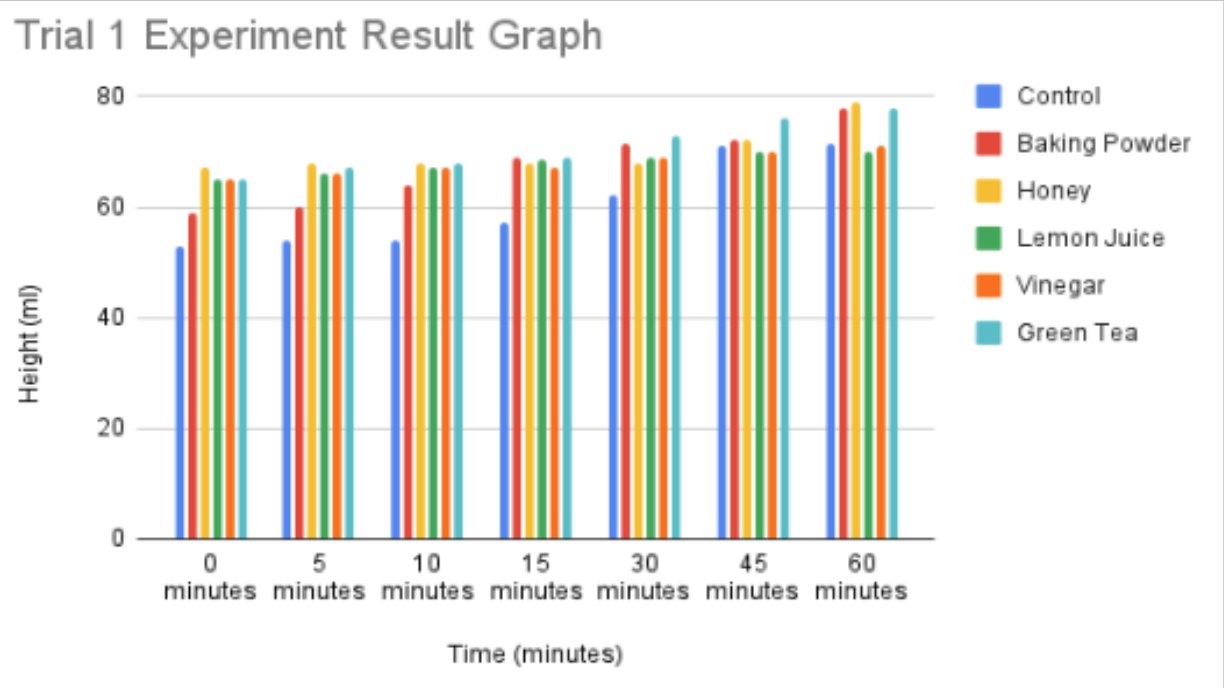
| Trial 1 Experiment Result Table | Control (ml) | Baking Powder (ml) | Honey (ml) | Lemon Juice (ml) | Vinegar (ml) | Green Tea (ml) |
|---|---|---|---|---|---|---|
| 0 minutes | 53 | 59 | 67 | 65 | 65 | 65 |
| 5 minutes | 54 | 60 | 68 | 66 | 66 | 67 |
| 10 minutes | 54 | 64 | 68 | 67 | 67 | 68 |
| 15 minutes | 57 | 69 | 68 | 68.5 | 67 | 69 |
| 30 minutes | 62 | 71.5 | 68 | 69 | 69 | 73 |
| 45 minutes | 71 | 72 | 72 | 70 | 70 | 76 |
| 60 minutes | 71.5 | 78 | 79 | 70 | 71 | 78 |
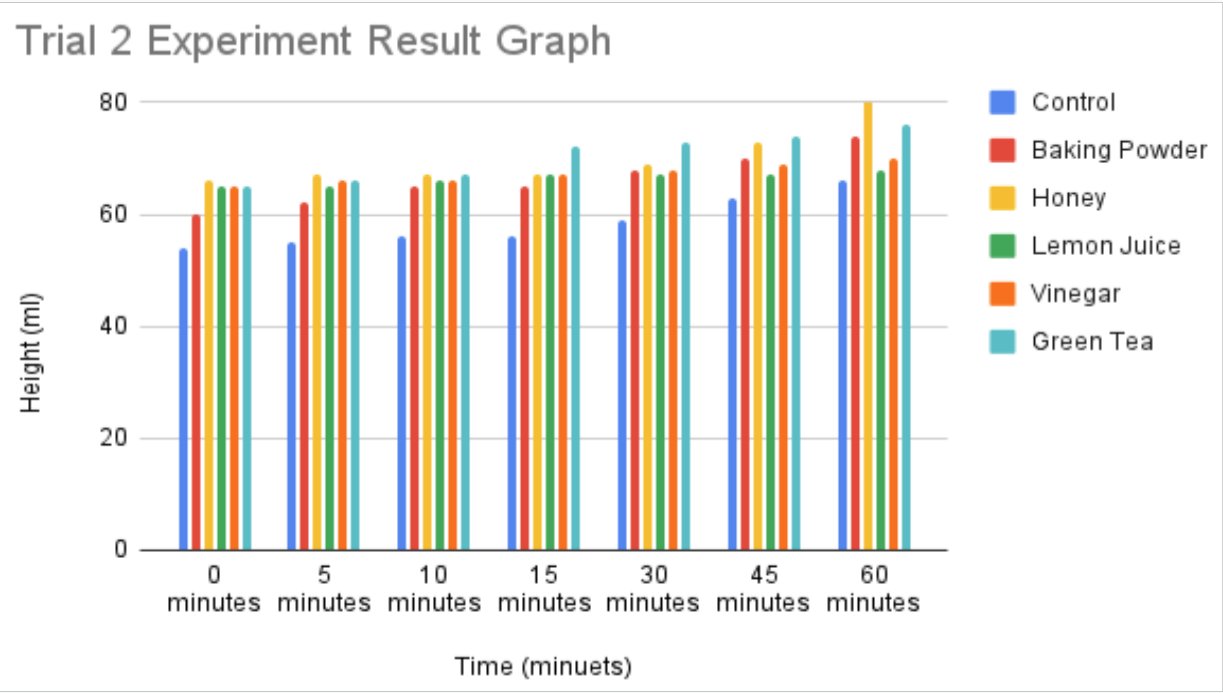
| Trial 2 Experiment Result Table | Control (ml) | Baking Powder (ml) | Honey (ml) | Lemon Juice (ml) | Vinegar (ml) | Green Tea (ml) |
|---|---|---|---|---|---|---|
| 0 minutes | 54 | 60 | 66 | 65 | 65 | 65 |
| 5 minutes | 55 | 62 | 67 | 65 | 66 | 66 |
| 10 minutes | 56 | 65 | 67 | 66 | 66 | 67 |
| 15 minutes | 56 | 65 | 67 | 67 | 67 | 72 |
| 30 minutes | 59 | 68 | 69 | 67 | 68 | 73 |
| 45 minutes | 63 | 70 | 73 | 67 | 69 | 74 |
| 60 minutes | 66 | 74 | 81 | 68 | 70 | 76 |
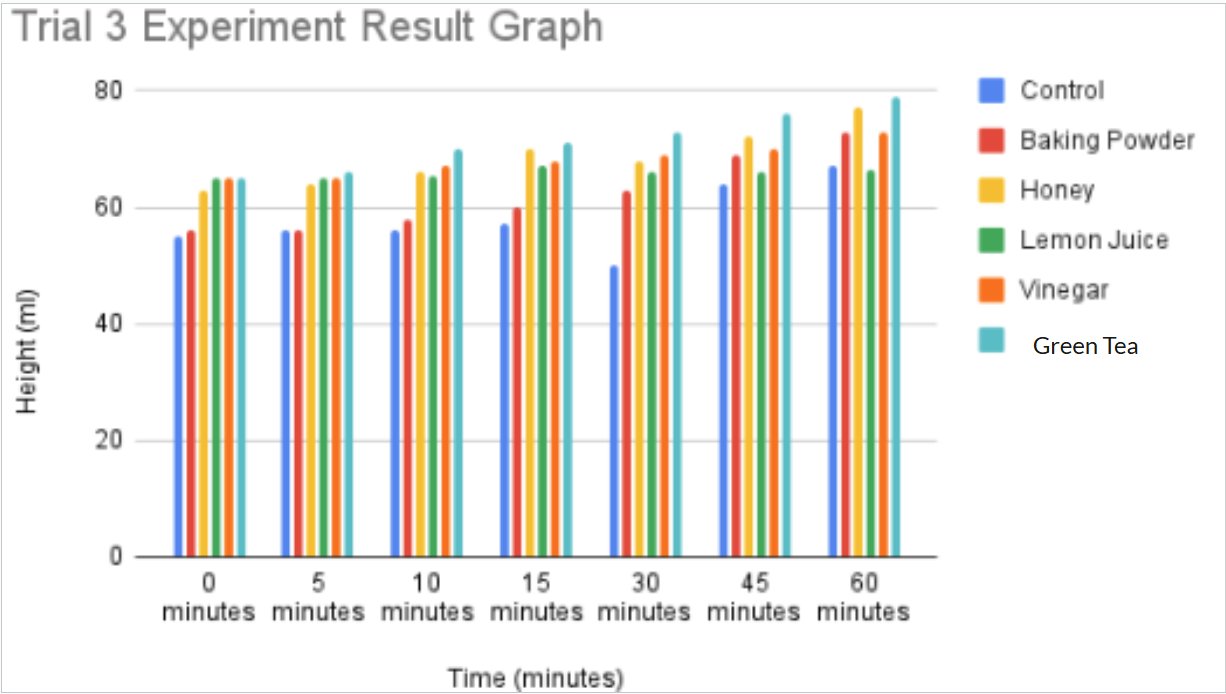
| Trial 3 Experiment Result Table | Control (ml) | Baking Powder (ml) | Honey (ml) | Lemon Juice (ml) | Vinegar (ml) | Green Tea (ml) |
|---|---|---|---|---|---|---|
| 0 minutes | 55 | 56 | 63 | 65 | 65 | 65 |
| 5 minutes | 56 | 56 | 64 | 65 | 65 | 66 |
| 10 minutes | 56 | 58 | 66 | 65.5 | 67 | 70 |
| 15 minutes | 57 | 60 | 70 | 67 | 68 | 71 |
| 30 minutes | 50 | 63 | 68 | 66 | 69 | 73 |
| 45 minutes | 64 | 69 | 72 | 66 | 70 | 76 |
| 60 minutes | 67 | 73 | 77 | 66.5 | 73 | 79 |
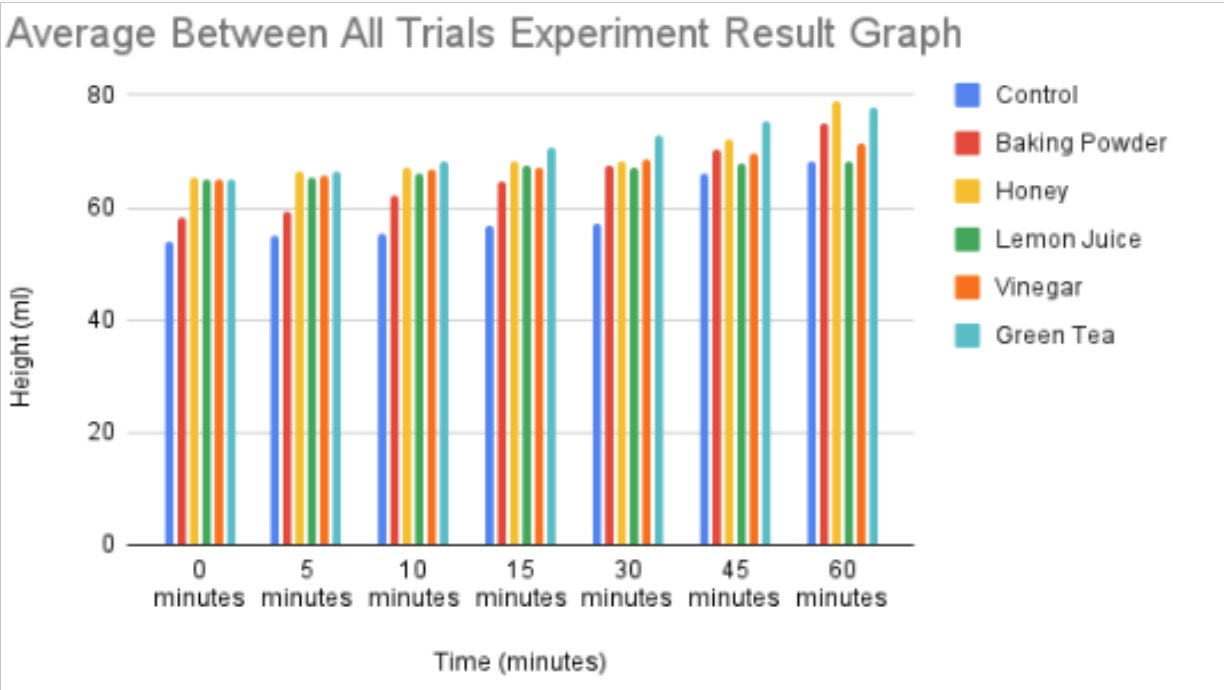
| Trial Experiment Average Result Table | Control (ml) | Baking Powder (ml) | Honey (ml) | Lemon Juice (ml) | Vinegar (ml) | Green Tea (ml) |
|---|---|---|---|---|---|---|
| 0 minutes | 54 | 58.3 | 65.3 | 65 | 65 | 65 |
| 5 minutes | 55 | 59.3 | 66.3 | 65.3 | 65.7 | 66.3 |
| 10 minutes | 55.3 | 62.3 | 67 | 66.2 | 66.7 | 68.3 |
| 15 minutes | 56.7 | 64.7 | 68.3 | 67.5 | 67.3 | 70.7 |
| 30 minutes | 57 | 67.5 | 68.3 | 67.3 | 68.7 | 73 |
| 45 minutes | 66 | 70.3 | 72.3 | 67.7 | 69.7 | 75.3 |
| 60 minutes | 68.2 | 75 | 79 | 68.2 | 71.3 | 77.7 |
 Final mass of the graduated cylinders :
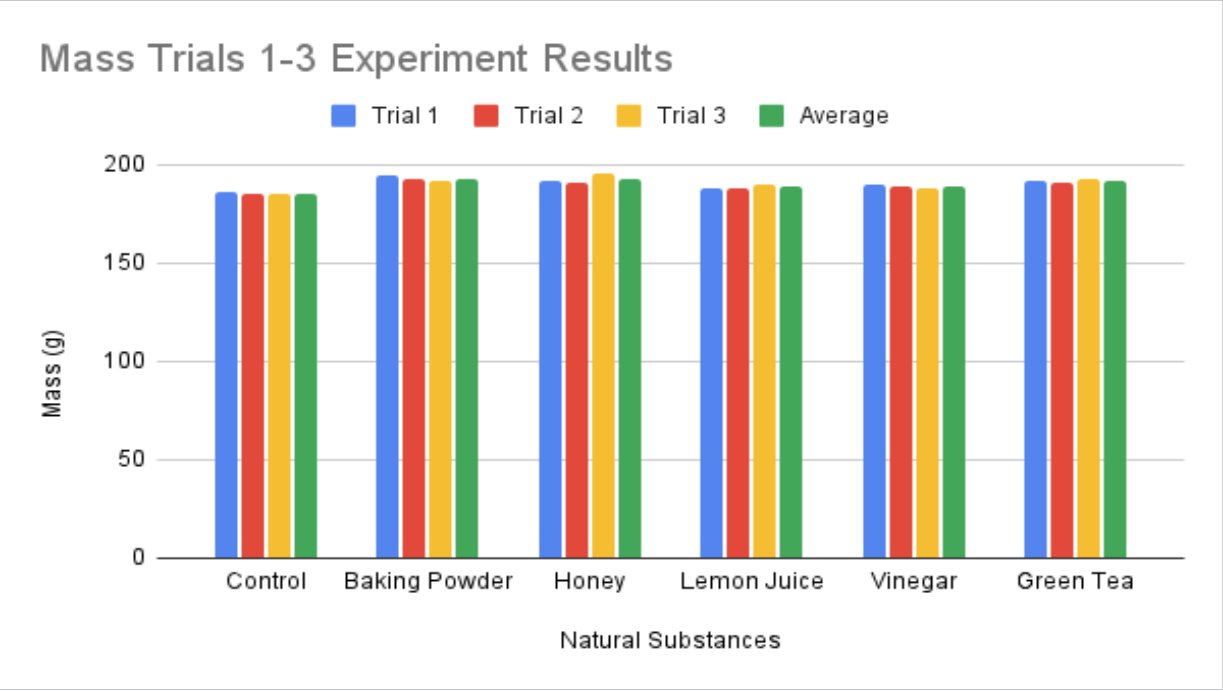
| Substance | Trial 1 (g) | Trial 2 (g) | Trial 3 (g) | Average Mass (g) |
|---|---|---|---|---|
| Lemon juice | 188.42 grams | 187.90 grams | 189.67 grams | 188.66 grams |
| Green Tea | 191.83 grams | 190.80 grams | 192.53 grams | 191.72 grams |
| Vinegar | 189.76 grams | 188.60 grams | 187.98 grams | 188.78 grams |
| Honey | 191.83 grams | 190.80 grams | 195.48 grams | 192.70 grams |
| Baking Powder | 194.50 grams | 192.84 grams | 191.66 grams | 192.33 grams |
| Control | 186.38 grams | 184.92 grams | 185.21 grams | 185.50 grams |
Analysis of results:
The data from our experiment revealed that each material had a different effect on yeast and its growth rate. Lemon juice and vinegar slowed down the yeast growth substantially, while green tea and honey accelerated it substantially. Honey produced the most foam, which means it had produced the most carbon dioxide and active yeast activity. Yet, even though green tea produced more foam, the baking powder mixture had a greater total mass at the end of the experiment of all of our trials. This shows that mass and foam height did not have corresponding results that were similar. This inconsistency in mass and foam data indicates that the two measurements are not closely related to one another. Foam measures carbon dioxide production and cell growth, relating to the yeast activity. Mass, on the other hand, measures the total weight of the mixture, which can be influenced by other factors like the liquid itself or how much solution was left. This is why we believe baking powder can have more mass, even though green tea has more activity in the mixture.
Conclusion
Conclusion
The result of this experiment showed that each natural substance affected yeast growth in a different way. Lemon juice slowed yeast growth the most. Followed by vinegar, because both substances are highly acidic and lower the pH of the yeast's environment. Yeast grows best in slightly acidic conditions with sugar, so when the pH became too low, the yeast’s normal processes were disrupted, causing slower chemical reactions rather than actual yeast growth. Green tea and honey increase yeast growth, with honey producing the most foam because it's high in sugar content, which provides extra energy for the yeast to use to grow and divide. Honey produced a greater amount of yeast, followed by green tea, even though the mass of the baking powder was greater than the mass of the green tea. Although the mass of the baking powder was greater than the mass of green tea, the green tea produced a greater yield of yeast compared to the baking powder.
The hypothesis predicted that vinegar would show yeast growth the most, but the results showed that lemon juice was more effective, making the hypothesis partially incorrect. Overall, this experiment showed that pH had a stronger effect on yeast growth than sugar, and very acidic conditions were the most effective at slowing down growth. Due to the fact that yeast and cancer cells share similar ways of growing and dividing. These results help show that changes in the environment, such as acidity and available nutrients, may also influence cancer cell growth, even though yeast is only a model and not cancer itself.
Application
Application
One of the ways these experimental results can be used is in cancer research and health science. They can help researchers figure out the impact of conditions like acidity and the availability of nutrients in a cell environment on cell growth. Cancer cells and yeast cells are very similar in the way they grow and divide. This experiment demonstrates that highly acidic conditions can almost completely inhibit cell activity. Besides that, these results are even more relevant to food science and fermentation, which relies on the regulation of pH and sugar levels to control yeast growth. Studying the effect of natural compounds on cell growth will perhaps provide clues to researchers in their fight for the development of drugs that can effectively slow down the uncontrolled division of cells.
Sources Of Error
Sources of error
One of the errors among us was inconsistent mixing, when we were doing the honey in particular, where the honey sometimes would settle at the bottom even before dissolving totally. Such inconsistency might have caused uneven sugar distribution and thus affected yeast growth. Another mistake was made when the temperature in the room varied, which might have influenced yeast activity, as yeast prefers warm and stable temperatures for growth. Furthermore, foam height may not be a completely accurate measure of yeast growth because some foaming, especially with baking powder, is a result of chemical reactions rather than biological activity. Thereby, even a slight error in measurements when reading foam height could affect the results. Lastly, the use of natural substances may have been combined with extra ingredients or preservatives that were not controlled and, therefore, might have affected yeast grow
Citations
References
- Maeta, K., Nomura, W., Takatsume, Y., Izawa, S., & Inoue, Y. (2006). Green tea polyphenols function as prooxidants to activate Oxidative-Stress-Responsive transcription factors in yeasts. Applied and Environmental Microbiology, 73(2), 572–580. https://doi.org/10.1128/aem.01963-06
- Bryce, N. (2025, May 19). Can yeast grow in vinegar? Understanding the complex relationship between yeast and acidic environments. TableAndSpoon. https://tableandspoon.com/can-yeast-grow-in-vinegar/
- Yeast as a model organism for studying cancer | Learn Science at Scitable. (n.d.). https://www.nature.com/scitable/topicpage/l-h-hartwell-s-yeast-a-model-808/
- Cancer Research UK. (n.d.). How does cancer start? | Cancer Research UK. https://www.cancerresearchuk.org/about-cancer/what-is-cancer/how-cancer-start-grow-spread/how-cancer-starts
- Uk, C. R. (2024, January 4). Sugar and cancer – what you need to know. Cancer Research UK - Cancer News. https://news.cancerresearchuk.org/2023/08/16/sugar-and-cancer-what-you-need-to-know/
- Cell cycle. (n.d.). Genome.gov. https://www.genome.gov/genetics-glossary/Cell-Cycle
- Pomelo. (2025\, July 30). How does pH affect fermentation? | Atlas Scientific. Atlas Scientific. https://atlas-scientific.com/blog/how-does-ph-affect-fermentation/
- Miłek, Michał, et al. “The Comparison of Honey Enriched with Laboratory Fermented Pollen vs. Natural Bee Bread in Terms of Nutritional and Antioxidant Properties, Protein in Vitro Bioaccessibility, and Its Genoprotective Effect in Yeast Cells.” MDPI, publisher, 3 Aug. 2023, www.mdpi.com/1420-3049/28/15/5851.
- Lee, S. (n.d.). The science behind yeast and baking soda. https://www.numberanalytics.com/blog/science-behind-yeast-baking-soda-interaction?utm
- Maicas, Sergi. “The Role of Yeasts in Fermentation Processes.” MDPI, publisher, 28 July 2020, www.mdpi.com/2076-2607/8/8/1142?utm.
- Glucose-Sensing and -Signalling Mechanisms in Yeast | FEMS Yeast Research | Oxford Academic\, academic.oup.com/femsyr/article/2/2/183/536213 . Accessed 17 Jan. 2026.
- Zhang, Yanfei, and Matteo Barberis. “Exploring Cell Cycle-Mediated Regulations of Glycolysis in Budding Yeast.” Frontiers in Microbiology, U.S. National Library of Medicine, 11 Oct. 2023, pmc.ncbi.nlm.nih.gov/articles/PMC10598772/ .
- Yeast | the Canadian Encyclopedia\, www.thecanadianencyclopedia. ca/en/article/yeast. Accessed 17 Jan. 2026.
Acknowledgement
Acknowledgemnts
My partner and I wish to acknowledge Prabhjeet Aulakh, our grade 9 homeroom teacher, as well as our science fair conductor. She was a great help; she reviewed our work and told us in what areas we could improve throughout our project. We also like to acknowledge our parents, as they were very helpful when it came to helping us make crucial decisions about our project, and finally my partner and I would like to acknowledge all the resources we used. They were key to all of our research and were the backbone of our project. We could not have done so well if it weren't for the amazing resources we had available.