
Making it clear
Mila Jankovic
Ecole St. Pius X School
Grade 6
Presentation
No video provided
Hypothesis
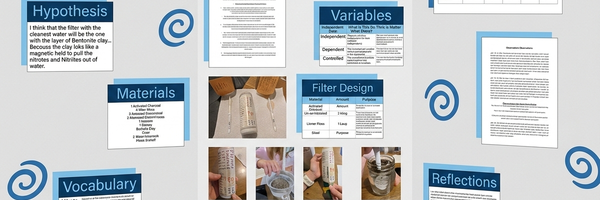
I think that the filter with the cleanest water will be the one with the layer of Bentonite clay, because the clay acts like a magnetic field to pull the Nitrates and Nitrites out of water.
Research
Variables
| Independent | The order of material in filter A and B Clay layers
| Because in filter A there is no clay and in filter B there is clay so we want to see if the clay makes a difference. |
|---|
| Dependent |
| Controlled |
Procedure
- Test the river water and tap water for Nitrates and Nitrites
Steps: Simulated runoff preparation
- Crush one miracle grow fertilizer spike into a fine powder using a ziploc bag and a mallet
- Measure exactly ¼ of fertilizer powder using a measuring spoon
- Dissolve the powder into 1 litre of Bow River water, and stir for sixty seconds
- Test the “spiked water” with a water test strips to confirm a Nitrate and Nitrite for at least 25 to 50 ppm
- This is now ready to put into the filter and do the baseline tests
2.Prepare the clay (it comes in powder).
3.Build filter A: Cut bottom of water bottle and flip over. Layer filter with cotton balls first,then add the 2 inches of activated charcoal and then the three inches of sand.
4.Build filter B: Layer filter with cotton balls first,then add the three inches of sand then add the layer of clay and on top of that the activated charcoal.
5.Filter Placement: Place both of the filters over a clean jar so that when you pour the water through the filter it will end up in those clean jars where you can test it easily.
6.Pour: Pour the same amount of water through the filter at exactly the same time, as soon as the first drop of water enters the filter A or B (make sure you start 2 different timers for A and B) start the stopwatch.
7. The Final Step: Now to test the water. Using the test strips on the water that came out of filter A and B\,check specifically for the nitrates and nitrites to compare to the test you made before the filter.
8. The Clarity Check: Hold both jars up to the light. On a scale of 1 to 10 (1 being muddy\, 10 being crystal clear) give the sample a “clarity score.”
Observations
Jan 23, 2026: There was about the same amount of water hardness and carbonate in both the jar of river water and tap water.I was really surprised that there wasn't any Nitrates and Nitrites in the water.I now had a problem.I had to solve this problem with a little help from plant fertilizer. I now had to make a simulated runoff sample by adding plant fertilizer to The Bow River water. I didn’t do one for the tap water because my main project is just about the river after a big rain on a farm when all the Nitrates and Nitrites flow into the water.
Jan 23, 2026: Today I was working on making a simulated filter, by adding fertilizer but I came to a problem when I did the test and it said that there were no Nitrates or Nitrites. I needed to add soil to create water that did have Nitrates or Nitrates. I retested the water and I was surprised that still no trace of Nitrates or Nitrates could be detected. I then added more soil to the powdered fertilizer solution, but this time from a houseplant. Finally, success! I got a reading of 50ppms of Nitrates. Still 0 for Nitrites. I’m now ready to make my filters!
Pouring the water through the filters: Time Filter A: 4:30 seconds (slow drip). ½ cup took approximately 6:05 to filter through. Time Filter B: Same amount of time for this one (slow drip)
More Nitrate water added. 3 plastic cups per filter were added. THis is the equivalent to: 600ml altogether
I am watching the water and right now and at 11 minute filter A is at a consistent drip and Filter B is just a stream of water. At 12 min Filter B is now at the point of dripping. At 13 minutes filter B bottom part is covered in water .Filter B and filter A are at the same amount of water. Stopped at 16 minutes. I noticed no difference in the flow rate.
Analysis
I compared the results of the baseline tests to the results of filter B. I also compared the results of filter B to the results to filter A. The bentonite clay played a big role in the comparison because it sucked most of the chemicals out of the water.
Conclusion
My question was whether the layer of Bentonite clay in my filter would catch the Nitrates and Nitrites before they enter the drinking water. I did my simulated runoff and there were 50 ppm’s of Nitrates placed in the Bow River water (with the housplant soil). I then did my filtered test and discovered that Filter A, the one with no clay, had the same result as the baseline tests. I was very happy when I tested filter B, the one with clay, and I found that the Nitrate level had gone down to 25 ppms. My hypothesis was confirmed when I did my experiment because the levels of ppms went down in Filter B which was the one with clay like my hypothesis said.The Bentonite clay in my experiment could be a solution to help filter pollutants near farms so that we can keep The Bow River water clean from fertilizers for everyone after a big rain.
Application
For real life the city of Calgary. The filter that the city of Calgary has that they run the water in Alberta through does not have bentonite clay. My filter proves that the bentonite clay has its uses for getting rid of chemicals in the water.
Sources Of Error
I think for my experiment I should have done more research about Nitrates and Nitrites because I didn't do much research about when the Nitrates and Nitrites are more likely to be in the water.Before this experiment I didn't know anything about Nitrates and Nitrites, I didn't even know they exist.The most challenging part of this experiment was when I tested the Bow river water and it came back with no sign of Nitrates or Nitrites in the water,which I handled by creating a simulated runoff.The most interesting part of this experiment was watching the water traveling through the Filter. A skill a learned during this experiment is being able to improvise when things don't go the way we wanted it to.
Citations
| The Pennsylvania State UniversityThe Pennsylvania State University
| The Pennsylvania State university.(2023). Water Filter. Science - U @ Home. https://science-u.org/experiments/water-filter.html |
|---|
University of Alberta. (Year Unknown). Build Your Own Water Filter.
https://www.futureenergysystems.ca/public/download/files/276574 |
|
Generation Genius. (2025).Water Quality & Distribution Activity for Kids.
https://www.generationgenius.com/activities/water-quality-and-distribution-activity-for-kids/
|
| National Geographic Kids. (Year unknown). Make a water filter.
https://kids.nationalgeographic.com/books/article/water-wonders
| | P.Mitchell and D. Trew. (Year Unknown). Agriculturarl Runoff and Lake Water quality.https://open.alberta.ca/dataset/044998b8-d9a0-4d5c-af97-a2629dbd32d1/resource/7600a142-b142-43fc-a15a-cef7db24c20c/download/7965.pdf |
Acknowledgement
I would like to thank my parents for helping me get all of my materials and helping me along the way. Without them I could definitely not reached the point I'm at right now. I would also like to thank my teachers for giving me inspiration. I would also like to thank my older brother for giving me tips about what to write and how to show my work. Thank you as well to: Build your own water filter Generation Genius National Geographic Article on runoff of fertilizer in rivers in Alberta Specific Bow River Data Science-U @ Home / Water Filter Experiment
Because without these sources I could not have learned what I needed for my project.