

The effect of breathing techniques on lowering heart beat rate after exercise .
Parth Sharma
West Island College
Grade 9
Presentation
No video provided
Hypothesis
High Heart rate-160 BPM- I think that Oral breathing will result in the quickest HR recovery. At that high of a heart rate the body requires higher amounts of oxygen. The VO2 max is higher when breathing through your mouth, which will allow for greater amounts of Oxygen to enter the bloodstream.
Low Heart rate-120 BPM- At this heart rate the body does not need a considerably high amount of oxygen to sustain and recover. That's why I believe that Nasal breathing will be most beneficial for recovery. Nasal breathing naturally adds Nitric Oxide to the bloodstream which allows oxygen absorption to be better in the blood stream. It also allows for more controlled and slow breath's which help bring heart rate down.
Research
Through my research I have learned a lot about my project. To begin lets talk about breathing and how it affects HR. When your heart rates becomes high, its a sign your body needs more Oxygen. But its important to lower your heart rate especially post exercise to recover. When taking deep controlled breaths you HR decreases rapidly. When your breaths are slow and controlled it sends signals to the brain telling it to calm down . Not only that deep controlled breaths help get oxygen to the body more efficiently. The reason deep controlled breaths are better then short quicks ones are due to Diaphragm usage. Your Diaphragm helps your lungs expand and contract, when you take long deep breaths the Diaphragm can be used to its full extent, allowing more oxygen to enter the bloodstream. In the contrary short breaths don't utilise the Diaphragm as much which results in less oxygen. Now lets actually talk about my two breathing technique's I tested: Nasal and Oral breathing. Oral breathing supplies more volume of air to the body. Your body naturally switches to Oral breathing in intense exercise as the body requires more oxygen to sustain itself. When performing Oral breathing it dries the throat causing discomfort not only that it may lead to shallow breathing and according to my research that is not optimal for HR recovery and effective oxygen absorption. Nasal breathing takes in less oxygen per breath then Oral breathing but it has many more benefits. Nasal breathing produces Nitric Oxide which helps with Oxygen absorption and widens the Blood vessels, to add on the air taken in through the nose is filtered and warmed up before entering the body this prevents dryness and reduces infection risks and improves air quality. After all this air goes into our body it should be clean. Last thing that I want to mention about breathing is that you can train Nasal breathing. In a study involving runners concluded that after months of performing Nasal breathing they could hit the same running pace while using 22% less air. This basically means that the body adapted to using oxygen more efficiently, even though they took in less air the air they did take in was used better. You can train your body to be more efficient. In theory that means you can use Nasal breathing for higher intensity exercises, as long as you train Nasal breathing you can utilise it more and more. After all Nasal breathing is better then Oral breathing in every way except for super high intensity exercises. That's all about breathing. Next quick research about everything else relevant in this project. First of all why would you want your HR to be lower? Studies show that high Heart Rates lower tactical decision making. So if you can lower your heart rate your decision making would be better which is what you want for many instances. In a game your HR gets really high its important that during breaks you can lower it efficiently. Next at really high HRs your Lactate acid build up. The Lactate threshold is the point in which Lactate acid can build up in the muscles without it being able to be removed. 85% of your max HR is the LIP(Lactate inflection point). Once you reach above the LIP it basically means your body tires out way quicker, meaning you want to make sure you don't get to that point. If you do or get close then its important to recover and lower your heart rate. Next what exactly is high HR? lets quickly discuss what is high HR, there's 5 zones of HR, 4 and 5 are 80 to 100%of your maximum HR. At that point you are reaching your limit and the body requires a lot of oxygen which is why your HR increases. 220 minus your age is approximately your max HR. Final thing that is important is to realize that breathing technique helps with your input but not output. A study involving Nasal and Oral breathing conducted a test to see if power output was affected depending on breathing technique and the answer was no. Breathing technique can be effective in recovery and some performance aspects but in pure power output it is irrelevant. If you breathe through your nose its not going to magically increase your strength by 10 instead it will help with more oxygen intake and throat moisture which will help your endurance .That is all.
Variables
Manipulated variable - Breathing exercise (Nasal, Oral,). Responding variable - Most effective Breathing exercise for recovery (Heart rate) post exercise. Controlled variable- Amount of time breathing exercise performed, pre test warm up.
Procedure
Before testing make sure that participant involved are capable of increasing heart rate through the jog/run. Blow nose to ensure Nasal breathing technique can be performed effectively. Dynamic Stretching before the jog/running to mitigate injury risk. Finally ensure the participant knows how to do the breathing technique properly . For the actual testing: Step 1: jog or run at a comfortable pace to increase heart rate to 120 or 160 depending on which test they are performing, during running breathe how you would normally. Step 2: after heart rate 160 or 120 is achieved, make them stop the exercise and perform the breathing exercise while standing for a total of 2 minutes. Step 3: After 2 minutes of performing the exercise write down the HR . Acquire and write down all this information. Repeat the test and with the following arrangements (160 HR starting- Oral breathing), (160 HR starting- Nasal breathing), (120 HR starting- Oral breathing), (120 HR starting- Nasal breathing).
Observations
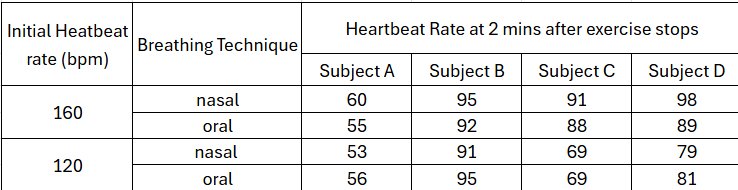
Participant 1: High HR -Nasal- after 2 minutes: 60 BPM . High HR- Oral- after 2 minutes: 55 BPM . Low HR-Nasal after 2 minutes: 53 BPM . Low HR-Oral- after 2 minutes: 56 BPM.
Participant 2: High HR-Nasal- after 2 minutes: 95 BPM . High HR- Oral- after 2 minutes: 92 BPM . Low HR-Oral- after 2 minutes: 91 BPM. Low HR-oral- after 2 minutes: 95 BPM .
Participant 3: High HR-nasal- after 2 minutes: 91 BPM . High HR- Oral- after 2 minutes: 88 BPM . Low HR- Oral- after 2 minutes: 69 BPM. Low HR- Nasal- after 2 minutes: 69 BPM .
Participant 3: High HR-nasal- after 2 minutes: 98 BPM . High HR-Oral- after 2 minutes: 89 BPM . Low HR-Oral- after 2 minutes: 79 BPM. Low HR-Nasal- after 2 minutes: 81 BPM .
High HR test refers to original heart rate achieved of 160 BPM and Low HR refers to original heart rate achieved of 120 BPM.
Analysis
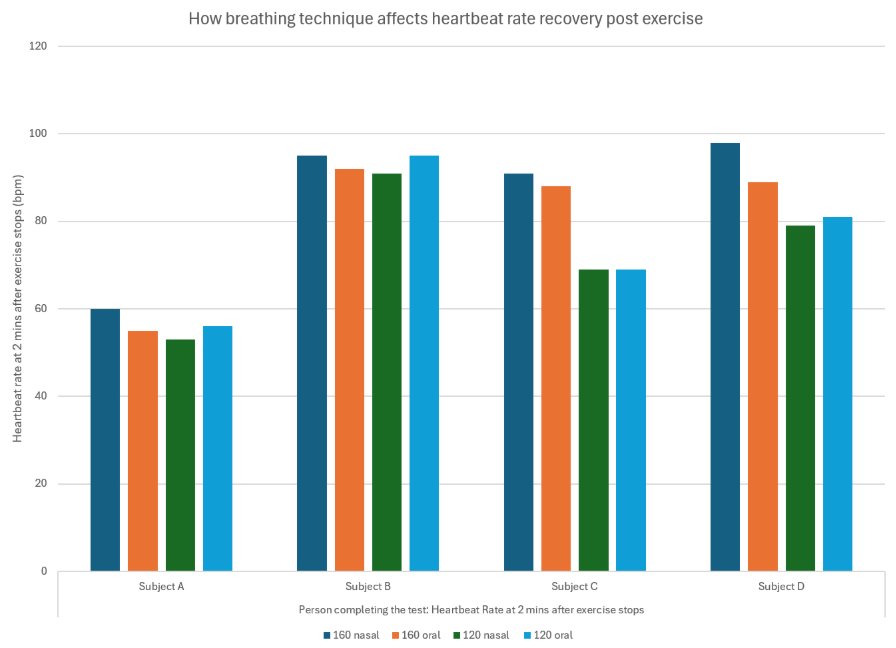
High HR- Through my results it can be confirmed that Oral breathing does help lower heart rate more than Nasal breathing post exercise. Though it only helps a small amount. I can confirm that my hypothesis for the High HR was correct. As I suspected when performing breathing through your mouth it allows for more amounts of oxygen to enter the bloodstream. At a heart rate of 160, you are reaching zone 4 to 5 for the average human and the body requires a higher dose of oxygen to sustain itself. That would explain why Nasal breathing resulted in a higher HR as less oxygen was supplied to the body resulting in post HR recovery to be slower. To finalize Oral breathing is better for post exercise HR recovery at high heart rates.
Low HR- Through my results it can be decided that at a lower heart rate Nasal and Oral breathing lead to a similar HR recovery rate. This means that neither Oral nor Nasal breathing is better then the other at lowering heart rate at lower HR. My Hypothesis was proven Incorrect. I believed that Nasal breathing would result in a lower heart rate due to the fact that the starting HR was 120 which required considerably less oxygen in comparison to high heart rates. Due to the fact Nasal breathing allowed Nitric Oxide in the bloodstream to help with oxygen intake would greatly help Nasal win. Considering the fact that Oral breathing still supplied more oxygen to the bloodstream also helped oral breathing resulting in a lower heart rate. To finalize Oral and Nasal breathing are equally as effective for post exercise HR recovery at high heart rates.
Conclusion
To conclude, Oral breathing is more beneficial when it comes to post exercise HR recovery for high heart rates. For lower heart rates there's no best breathing technique to lower HR after exercise, both Oral and Nasal are similarly effective. Though there are many more factors that must be considered before confirming which is better Oral or Nasal breathing for lower heart rates. Oral breathing may provide a higher VO2 max at the moment which is essential for high HR scenarios but when you utilize this technique at lower heart rates its actually less beneficial then Nasal breathing. Lets discuss all the benefits of Nasal breathing. To begin, Nasal breathing humidifies and warms the air we inhale which prevents dryness. If you breathe for extended periods of time Orally your throat dries up causing discomfort. Not only that, Nasal breathing filters the air we breathe which makes the air inhaled cleaner. We breathe everywhere and typically places that may have dust, dirt or other harmful things in the air, Nasal breathing ensures that the air is clean before entering our body. Oral breathing does not help with cleaning the air, which basically implies that you are breathing dirtier air though your mouth. Nasal breathing provides Nitric Oxide into the blood stream which helps with Oxygen absorption in the blood stream. Another benefit of Nasal breathing is that it allows for more controlled breaths, this allows for the Diaphragm to be used fully, meaning more air. To summarize, the point I am trying to prove is that Oral breathing is better at higher BPM, its hard to breathe through your nose and and your body requires a tremendous amount of oxygen, but at heart rates that are lower, Nasal breathing is better in every single way. If both Nasal and Oral breathing result in similar post exercise HR recover then its better to utilise Nasal breathing as it provides better air. Nasal breathing is quality, you get better quality of air, and Oral breathing is quantity, you get more quantity of air. To summarize, Oral breathing should be utilised in high HR environments. The body requires high amounts or oxygen and through Oral breathing you can achieve that, Nasal breathing would prove to be less effective in getting oxygen to the body. Oral breathing is better for high HR. For HRs that are on the lower side it is way more beneficial to breath through your nose. If you are wondering what high vs low heart rates are. It is controversial. For each person it may be different, depending on many factors it may be affected. The main point is when possible breathe through your nose, since when you reach high HRs your body naturally starts breathing though the mouth. Nasal breathing has more benefits so when capable of using it, use it.
Application
Now I have explained how to use each breathing technique, but when will this actually be effective? The answer is always. To begin for athletes this is very important. I play many sports but majorly basketball. Basketball, Soccer, Football, Volleyball and many more sports are very intense but more importantly the input of power isn't consentient. Meaning that one minute you are running top speed and the next you are standing still resting. In sports like this my research can prove to be extremely beneficial. In game its important that you breathe through your mouth most of the time as your body requires a high amount of oxygen. Though in times you are resting and your HR is lower breathing through your nose should be your goal. I used this information my self during practice. While doing cardio we had 4 sets of running. During the running I used to breathe through my mouth as it gave more oxygen but since we weren't sprinting instead running I tried nasal breathing. Oral breathing did make my throat really dry, that was a major thing I noticed. Nasal breathing prevented the super dry feeling and even though I got less air it was fine since I didn't need as much due to the lower intensity of exercise. Athletes can use this information to benefit themselves with post exercise recovery or during breaks . Though in sports that require constant movement with no stop such as track or swimming this wont be as helpful, as there's no stopping. During extremely intense exercise with no breaks this data will be non beneficial as well.
Sources Of Error
To begin the smart watch I used didn't work on 2 participants, and because they didn't work I could gather no information from them. I could have used more participants to make the data more accurate. I should have used a more accurate HR measuring tool to get more specific details. I could have used more people and made them do the tests multiple times for more accurate results. The test may have been slightly rigged due to the fact you can train your Nasal breathing, but prior to testing I asked if they had regularly practiced any nasal breathing, and none of them had. This made it more fair. Though the results may have been different if the participants did have prior experience. In the end Nasal breathing still would be less effective then Oral breathing in extremely high HRs (Zone 5), but may have caused a slight difference in experiments with heart rate zones of 3 or 4. I am not 100% sure but I would assume the difference would be small. This is the main source of error.
Citations
Cited by BibGuru: References Breathing and athletic performance: The oxygen advantage. (n.d.). Nasaleve.com. Retrieved March 4, 2026, from https://nasaleve.com/post/nasal-breathing-athletic-performance Breathing techniques to lower heart rate work wonders. (2025, May 7). Green Juice Life. https://greenjuicelife.com/2025/05/07/breathing-techniques-to-lower-heart-rate/ Clinic, C. (2025, October 6). What to know about exercise and heart rate zones. Cleveland Clinic. https://health.clevelandclinic.org/exercise-heart-rate-zones-explained Dack, D. (2025, July 17). Nose vs. Mouth breathing while running: A coach’s guide to breathing right. Runner’s Blueprint. https://www.runnersblueprint.com/nose-vs-mouth-breathing-while-running-a-coachs-guide-to-breathing-right/ Lörinczi, F., Vanderka, M., Lörincziová, D., & Kushkestani, M. (2024). Nose vs. mouth breathing- acute effect of different breathing regimens on muscular endurance. BMC Sports Science, Medicine and Rehabilitation, 16(1), 42. https://doi.org/10.1186/s13102-024-00840-6 Mobility Athlete. (2021, November 9). 10 benefits of nasal breathing athletes may be missing out on. Mobility Athlete. https://mobilityathlete.com/10-benefits-of-nasal-breathing-athletes-may-be-missing-out-on/ Nose breathers: Benefits of nasal breathing. (2025, July 28). Biology Insights. https://biologyinsights.com/nose-breathers-benefits-of-nasal-breathing/ Qiao, W., Hua, K., Zhang, J., Song, D., Li, J., Chen, X., & Liang, D. (2025). Higher heart rate intensity can negatively impact tactical decision-making and technical accuracy in small-sided games: A study on the effects of field size and scoring method manipulation. Journal of Sports Science & Medicine, 24(3), 522–531. https://doi.org/10.52082/jssm.2025.522 Recinto, C., Efthemeou, T., Boffelli, P. T., & Navalta, J. W. (2017). Effects of nasal or oral breathing on anaerobic power output and metabolic responses. International Journal of Exercise Science, 10(4), 506–514. https://doi.org/10.70252/EHDR7442 Wikipedia contributors. (2026, February 25). Lactate threshold. Wikipedia, The Free Encyclopedia. https://en.wikipedia.org/w/index.php?title=Lactate_threshold&oldid=1340414398 (N.d.-a). Integratingpulse.com. Retrieved March 4, 2026, from https://integratingpulse.com/articles/breathing-techniques-lower-heart-rate/ (N.d.-b). Insightcla.com. Retrieved March 4, 2026, from https://insightcla.com/blog/zone-5-heart-rate/ (N.d.-c). Mdpi.com. Retrieved March 4, 2026, from https://www.mdpi.com/2075-4663/13/10/368 (N.d.-d). Researchgate.net. Retrieved March 4, 2026, from https://www.researchgate.net/publication/325521734_Effect_of_Nasal_Versus_Oral_Breathing_on_Vo2max_and_Physiological_Economy_in_Recreational_Runners_Following_an_Extended_Period_Spent_Using_Nasally_Restricted_Breathing
Acknowledgement
I would like to thank Dr. Sumner for her great assistance and help. My Mom and Dad for pushing me and helping me in my project. All my participants for performing the tests.