
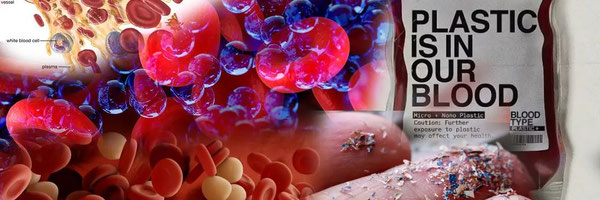
The Hidden Plastic Problem
Navnir Gill, Tanveer Brar
Annie Gale School
Grade 9
Presentation
No video provided
Hypothesis
MAIN QUESTION (s):
Are Single Use Plastic Water Bottles actually SAFE?
- Is it safe to drink from single use plastic bottles until the posted date?
- Does sunlight / UV rays affect the amount of microplastic (if any) in the water?
- What are its effects on the human body?
- What are the effects of this plastic on the environment and ecosystems?
- Can a different type of plastic be made to prevent contamination of these microplastic?
- Can a device be made to prevent the intake of microplastics?
Can a Biodegradable Plastic be made to prevent this issue?
- What are the different types of biodegradable plastics that exist today?
- Are any of these resilient to UV rays?
- How are Biodegradable Plastics made?
HYPOTHESESE:
Information for the Hypotheses - Single-use plastic water bottles have been used all across the planet for decades. But, recent studies have proven that plastic water bottles contain a certain amount of microplastics, and this has been affecting humans and the environment in countless ways. Millions of people all across the globe are unaware of this and continue to intake microplastics by drinking from plastic water bottles. Additionally, UV rays melt the POLYETHYLENE TEREPHTHALATE (the type of plastic in a majority of plastic water bottles), which cause extremely tiny plastic pieces to get mixed within the water.
Navnir:
If we test single-use plastic water bottles, then all of them will contain some amount of nano plastics or microplastics. This is because the plastic used (PET) is known to degrade under UV exposure and release plastic particles, and past studies have consistently shown that bottled water samples contain measurable amounts of microplastics. Overall, with all of these factors contributing, I feel that overall, no plastic water bottle is completely safe, and will contain some microplastic.
In terms of creating a biodegradable plastic, if we create a bioplastic using algae based polymers and starch based biopolymers, then the plastic will have better resistance against UV rays and sunlight, and a better degradation rate. This will result in little to no amount of microplastics within the test water. This is because this bioplastic will use bio polymers from biomass, rather than using traditional petroleum polymers to create strength and flexibility. This will result in close to no microplastics in the water.
Tanveer:
If traditional plastic water bottles are exposed to UV rays, and are kept in a humid and warm environment, and other water bottles of the same type kept in an environment where there is no UV radiation or hot temperatures. Then the water inside all will contain some levels of microplastics, but the ones under UV rays will have a significantly higher concentration of microplastic. This happens because of the UV radiation that accelerates the degradation of the polymer (substance where molecules are chemically bonded to give plastic strength and flexibility) mix found in these water bottles known as PET leading to higher levels of plastic in the water. While there still will be microplastic present in the water bottles with no UV rays but there will be no heat to increase the degradation of PET.
If we create a biodegradable plastic using a combination of algae-based polymers and starch-based biopolymers. Then the material will have improved UV resistance and biodegradation rates, and no microplastics in the water compared to traditional based plastics. This is because this would use bio polymers from biomass, rather than petroleum polymers to create the flexibility and strength resulting in little to none microplastics in water. In fact this plastic will be completely safe for marine life, which none of the Bioplastics right now are able to do.
Research
The Big Problem:
Throughout recent years, tiny pieces of plastic have been found everywhere on the planet. From interweaving within our environment to occurring in our food, microplastics are a rising concern.
Research from Columbia University shows that a majority of the reason why humans are being contaminated by plastic is because of single-use plastic water bottles. On average, a litre of bottled water contains roughly 240000 pieces of microplastic, and this number is expected to rise within the coming years. Not only do they affect us humans, but entire ecosystems, which is why it is crucial for humans to be aware of this crisis, and that we take action to protect ourselves and the environment around us.

What are Biodigardable Plastics?
Biodigradable plastic is plastic material that can be broken down by microorganisms into natural substances (water, carbon dioxide and biomass). They are specifically designed to decompose in a rational timeframe under specific conditions (moisture, microbial activity, temperature).

Different types of Bioplastics:
| TYPE | MATERIALS | CHARACTERISTICS | EXAMPLES | DECOMPOSITION |
|---|---|---|---|---|
| Polylactic Acid (PLA) | Corn starch, sugar cane | Rigid, transparent, industrially compostable and brittle | food containers, disposable utensils and 3D printing | 3-6 months (industrial composting) |
| Polyhydroxyalkanoates (PHAs) | Bacterial fermentation of plant oils and sugars | Flexible, biodegradable in soil and water | packaging, agriculture films and medical implants | 2-6 months (soil and marine) |
| Starch-Based Plastics | Corn, potato | brittle, moisture- sensitive | Compastable bags and food service items | 1-4 months (home compostable) |
| Cellulose-Based Plastics | Wood pulp and cotton fibers | transparent breathable | cellphone, films and textiles | 1-3 months (compost or soil) |
| Polybutylene Adipate Terephthalate (PBAT) | Fossil fuels and biodegradable additives | flexible tear-resistant compostable in industry | bags, packaging film | 3-6 months (industrial composting) |
| Polybutylene Succinate | ||||
| Heat-resistant and durable | food packaging | 3-6 months (industrial composting or soil) | ||
| Polycaprolactone (PCL) | Fossil fuels (can be bio-synthesized) | not heat resistant and elastic | medical devices, drug delivery | 6 months - 2 years (soil or compost) |
| Oxo-Degradable Plastics | Conventional plastics and metal salts | Not fully biodegradable, degrades into fragments | plastic bags and agriculture films | Unknown (leaves microplastics) |
Biodegradable VS. Compostable
| Feature | Biodegradable Plastics | Compostable Plastics |
|---|---|---|
| Meaning | Break down naturally overtime through microorganisms | Breaks down into non-toxic components ( CO2, water or biomass) under specific composting conditions |
| Time for Breakdown | can take months to years ( no time limit) | Decomposes in a specific time frame (2-6 months under industrial composting) |
| Environmental conditions | May degrade in soil, marine or landfills (often very slowly) | Needs controlled conditions (heat, moisture and microbes) |
| Examples | PHAs, PBS, PCL and some starch based blends | PLA, PBAT, and plastics that have certifications |
How are bioplastics made?
- Choosing a Raw material:
Bioplastics are made from biomass, including:
- Sugar cane
- Potatoes
- Cellulose/plant waste
- Algae
-
Agricultural by-products
-
Sugar Extraction
Then the sugar (glucose, sucrose) is extracted from the biomass. This involves
- Grinding the biomass
-
Using enzymes or acids to break down starch into sugars
-
Fermentation or Polymerziation
This step depends on Bioplastics you are creating
-
For PLA (Polylactic Acid):
-
Microorganisms ferment the sugars into lactic acid
-
Lactic acid Molecules are chemically bonded (polymerized) to make PLA, a biodegradable plastic
-
For PHA(polyhydroxyalkanoates)
-
Bacteria are fed plant sugars or oils
- They produce PHA granules inside their cells
- The PHA is then harvested and turned into plastic
4, Processing into Products The biopolymer is dried, melted or moulded into films, bottles, packaging and more. This is done similarly to how petroleum plastics are processed.
How can we create Bioplastics using household materials?
There are many different ways we can create Bioplastics at home
- Starch-based Bioplastic- Using starch as the base polymer, mixing it with water, acid (Vinager) and glycerin and heating it up.
- Gelatin-based bioplastic- Gelatin can also be used as a polymer, dissolving it into hot water and adding glycerin results in a flexible plastic.
- Milk plastic- Heating milk and adding an acid (vinegar) causes it to curdle and form casein (a natural polymer). When this is dried it turns into a plastic like material
- Banana peel plastic- When banana peels are boiled blender and mixed with acid (vinegar) and glycerin also makes a flexible plastic
- Algae-based plastic- Using algae biomass you can get polysaccharide (natural polymer), when mixed with glycerin and heated result in a thin plastic film
For our experiment, I have concluded that the ‘best’ type of plastic would be one that mixes the different types of Bioplastics materials together. My research has also told me that every plastic except Algae based plastic has been said to be not suitable for use due to weak properties, poor water resistance, low heat resistance and most importantly the food safety concerns. The Algae based plastic is still under research and looking for improvement.
Algae based plastic Algae based Bioplastics are made from Algae biomass, specifically the polymers extracted from the algae. It has many advantages: being sustainable, biodegradable, safe for marine environments, can capture Co2, and having a lower carbon footprint. On the other hand, some limitations are the cost, durability and scalability.
How is it made? (Industrial)
- Algae cultivation- Algae is grown in controlled environments
- Harvesting- The algae is collected and made into biomass (grinding and drying)
- Blending or Direct use- Some use biomass as main polymer or it’s blended with other polymers
- Polymerization- turning the collected polymers into usable plastic forms
Research being done on Algae-based plastic
There is a lot of active research being done in the field of algae-based plastics. These are the main ideas of the research done and being done:
- Extraction of Algae-
Scientists and researchers are looking at suitable algae species to optimize cultivation and extraction of polymers like alginate, carrageenan, agar, cellulose and PHAs.
- Seaweed as Basis of Eco-sustainable plastic materials: Focus Alginate- By MDPI- This paper focuses on Macroalgae being used as the fees stock for Bioplastics, with information on polysaccharide Alginate (Alginate is a natural polysaccharide, mainly found in the cell walls of brown seaweeds) deprived from brown seaweeds.
What are Microplastics?
Microplastics are microscopic pieces of plastic debris, they come from the breakdown of larger plastic. They are environmental pollutants that are present nearly everywhere from the depths of the oceans to the air we breathe and the water and food we consume. They are non-biodegradable and stay in the environment making them a global health and global concern. One thing to keep in mind, is that the tinier the microplastic, the more toxic.
One of the most disturbing things about this issue is that countless are intaking millions of pieces of microplastics daily. This is done when people drink out of single use plastic water bottles which have been sitting in the sun for many hours. Sunlight and UV rays melt the plastic resulting in the water getting contaminated.


How do Microplastics impact humans?
Humans are exposed to microplastics in various different ways. Overall, humans are uncovered to microplastic in these 3 ways - direct ingestion, direct contact, or inhalation. This can include food packaged in plastic packaging, personal hygiene products, etc. Some exposure can also come from our household environment -including paint fragments. The toxicity of inhaling these microplastics present in our atmosphere can result in very serious health issues. This may include chronic diseases, such as respiratory and cardiovascular illness. To add on, other variants of microplastics may cause differences in antioxidant genes and enzymes involved in generating active oxygen and oxidative stress. Furthermore, microplastics can impact various human systems, including the digestive system - when microplastics are ingested, causing irritation to gastrointestinal line, resulting in inflammation, etc- , respiratory system - causing coughing, inflammation in lungs, low O2 in lungs, etc. Microplastics can affect the endocrine system as well, affecting metabolism, hormones, development disorders and reproductive disorders.
Because microplastic intake can disrupt the natural balance of the human body, it is important that we are aware of this rising issue and how we can prevent it.

How do Microplastics impact the environment and ecosystems?
Microplastics-especially in bodies of water affect the environment and wildlife significantly. Similar to humans, microplastics enter the system mainly through direct ingestion. They block the gastrointestinal tract of wildlife, causing inflammation and irritation. Additionally, they can also leave the animal feeling full, resulting in a loss of appetite, and physical decline.
In terms of the environment, microplastics play a crucial role in plastic pollution, not only on land but also the sea. The chemical compounds and heavy metals found in plastics can be transferred into the environment, eventually affecting organisms as well. This can cause biomagnification of the toxins, eventually affecting the entire food chain.
EVIDENCE OF MICROPLASTICS ACCUMULATING ON OUR PLANET:

- This article is from THE GUARDIAN, showing how much humans inhale microplastics daily.


- This article is from the CNN, taking about how plastic food packaging is contaminating our food with microplastics

- This article is from THE BBC
One thing that we want to emphasize about these breaking news articles is that all of them are very recent. This illustrates how much of a problem microplastic pollution/contamination have become in these recent years. If you compare breaking news articles to a few years ago, there are little to no articles on microplastic pollution, but in recent years, the number has gone up. This symbolizes how microplastic contamination has spiked and is affecting us and our planet more than ever.
Overall, there are countless other recent news articles explaining this microplastic crisis. But we just wanted to share and emphasize that microplastics are a significant problem, and now it is about time that we start raising awareness and take matters into our own hands and start to come up with a long lasting solution.
Chemical Composition and Additives in Microplastics:
Microplastics have a wide range in sizes - 1mm to 5mm. While the size is tiny, they can contain a large amount of different additives and polymers. Because of this variety, visual inspection to identify the different plastics is a very poor method. Instead, using a variety of identification tools helps.
Different chemicals in Microplastics………….
|||
| --- | --- |
| Polyethylene (PE)
||
| Polypropylene (PP) ||
| Polystyrene (PS)
||
| Polystyrene (PS) ||
| Polyethylene terephthalate (PET)
||
| Polyethylene terephthalate (PET)
 ||
| Polyvinyl chloride (PVC)
||
| Polyvinyl chloride (PVC) ||
| Polyamide (PA, aka Nylon)
||
| Polyamide (PA, aka Nylon) ||
| Acrylics (PMMA, etc.)
||
| Acrylics (PMMA, etc.)
|| | Polycarbonate (PC) ||

The different polymer types help with thermal properties. For example, different plastics react differently and degrade at different temperatures.
Additives include………..
- Plasticizers (helps with elasticity)
- Stabilizers (prevents breakdown through heat/UV)
- Flame retardants (Reduces flammability)
- Colourants/pigments(Gives colour)
- Antioxidants(Prevents degradation)
There also can be various amounts of contaminants that plastics get from factories, the environment, etc. This can include heavy metals, organic pollutants, and more.
Methods to detect Microplastics:
In today’s world, the majority of microplastics are found in water. There are three main microplastics identification methods used to find microplastics in water;FTIR SPECTROSCOPY, py-GC/MS, and Raman Spectroscopy. FTIR and Raman are used to determine the number of microplastic particles. They do this by identifying the plastic type and size range. py-GC/MS Quantifies concentrations of a specific type of microplastics in milligrams per liter.
These detection methods help environmentalists to not only identify but also understand the health of the ecosystem and understand the severity of plastic pollution in a specific area. Overall these methods help enhance scientists' understanding of micro plastic pollution. Over time this will help mitigate and reduce this issue, in turn helping ecosystems and the environment thrive.
Raman:

py-GC/MS:

Technologies to Prevent Microplastics:
Throughout the years, Scientists have been working together and developing new ways and Technologies to prevent the contamination of microplastics in our environment.
Some of the most popular methods include filtration systems like membrane bioreactors and ultrafiltration. These systems physically trap microplastics, similar to sieves. Another method is physical separation methods such as hydrocyclones and whirlpools. These methods physically separate the microplastics from contaminated bodies such as water and soil. Lastly, nature-based solutions like rain gardens and bioretention systems. These methods use technologies which are integrated within infrastructure, such as sewers, gardens, drains, etc.
Impact of UV radiation on Microplastics:
The impact of UV rays and thermal energy on plastics is very significant. Past studies have tested this out and have found immense data showing how heat and sunlight contribute to the degradation of plastics.
On average, popular plastics such as Polystyrene & Polypropylene, tend to begin degrading under high temperatures - usually over 37 degrees celsius. Additionally, the environment for this to happen also needs to be exposed to moderate levels of UV rays (sunlight).
Typically, the amount of nanoplastics released by these plastics varies. But all plastics usually release up to 10⁸–10⁹ particles/mL of nanoplastics after 18 weeks in this environment.
Even though the plastics remained in this environment for a very long time, the chemical structure and properties of the released particles were the exact same as before. This proves that the nonplasticity came from the plastic itself and was not sourced from any other external source.
Additionally, knowing this information has allowed environmentalists to study the areas that nanoplastics might be contaminating and take action because if microplastics have the same chemical structure as before, then the toxicity will remain the same as well.

Laura M. Hernandez a , Joel Grant a , Parvin Shakeri Fard a , Jeffrey M. Farner a b , Nathalie Tufenkji. “Analysis of ultraviolet and thermal degradations of four common microplastics and evidence of nanoparticle release.” ScienceDirect, https://www.sciencedirect.com/science/article/pii/S2666911023000047. Accessed 9 10 2025.
Regulations existing on Microplastics and Plastics to prevent contamination in Environment:
In Canada and many other countries around the globe, there are countless policies put in place to prevent the contamination of microplastics in the environment and ecosystems. For example, many countries in North America have banned certain single-use plastic items and have banned plastic microbeads. In Canada specifically, the regulations have banned the manufacture, imports and sale of certain single use plastics. An example of this is that many grocery stores don't have the plastic bags that they used to have a few years ago, instead they have reusable ones that you can buy and use over and over again. This helps limit not only the production of plastics but it also helps limit the plastic waste that Canada has as a whole. These rules and regulations are a part of Canada's plan to address the plastic pollution problem and meet 0 plastic waste Target by 2030. This will not only help reduce greenhouse gas emissions, but it will also decrease Canada's contribution to climate change. in time, these changes and our society will help save many ecosystems and save the habitats of many Innocents organisms

Variables
Variables for experiment:
Controlled Variables:
- The type of water bottle (brand)
Manipulated Variables:
- The environment that the tests were put into: - Control - Hot - Cold
Responding Variables:
- Does the temperature/environment effect the amount of microplastics a plastic releases?
Variables for making the biodegradable plastic:
Manipulated Variables:
- Bioplastics/ Bioplastic mixture
- Number, type and amount of polymers (cornstarch, algae powder, agar powder)
- Amount of glycerin
- Amount of water
- Use or removal of vinegar
- Changes made in between each trial to improve their strengths, clarity, and overall quality of plastic
- Heating Conditions
- Amount of heat applied
- Duration of heating time
Controlled Variables:
- Testing Methods-
- Same strength testing(strength, bag/cup, coins)
- Same bending method and angle for flexibility test
- Same water submersion method for water resistance test
- Materials used for testing-
- Same type of coin (two-dollar coin)
- Same string, tape, and plastic bag
- Environmental Conditions-
- Room temperature during drying and testing
- Air drying time(24-48 hours)
- Water Resistance Test Conditions-
- Same bowl
- Same amount of water
- Water at room temperature
Responding Variables:
- Strength of the Bioplastic-
- Number of 2-dollar coins held
- Flexibility of Bioplastic-
- Number of 180-degree bends before cracking or breaking
- Water Resistance-
- changes in texture, shape, strength after being submerged in water for 48< hours
- Physical properties of Bioplastic
- Clarity
- Color
- Presence of lumps
- Firmness after drying
- Malleability
Procedure
MATERIALS:
MATERIALS NEEDED FOR THE EXPERIMENT:
- 3 plastic water bottles [one control and two manipulating]
- UV light [ can be a UV light or can be the sun]
- Warm and moist environment
- Control environment [What the storage advice is on the water bottle packaging]
- Cool environment (ex. Freezer)
- Microscope
- Includes all the small parts necessary for viewing the samples Ex. The slide, the dye, etc
PROCEDURE(s):
PROCEDURE(s) FOR THE EXPERIMENT:
- Gather all three of your water bottles and place them into the three different environments.
- Wait approx. 2-3 weeks before checking on them again
- After, take a sample of each and drop 1-2 drops into the microscope slide.
- Look at the sample through the microscope (MICROSCOPE MUST BE SET AT 400X!)
- Record your observations
PROCEDURE FOR EACH TEST RAN ON TRIALS:
Trial #1 STRENGTH TEST Materials:
- Bioplastic created
- Coins
- String
- Small plastic bag or cup
- Tape
Procedure
- Cut or tear Bioplastic into equal shapes
- Tape one end of the Bioplastic to a table edge
- Create a small hole in the other end of the Bioplastic using a pencil or small nail
- Tie string into the hole
- Add coins one at a time
- Record the number of coins when it tears
FLEXIBILITY TEST
Materials
- Bioplastic
Procedure
- Take one piece of the Bioplastic
- Bend it 180 degrees back and forth
- Count how many 180 degrees bends before it cracks or breaks
WATER RESISTANCE
Materials
- Bioplastic created
- Water
- Small bowl
Procedure
- Place one piece of Bioplastic into a bowl submerged with water at room temperature
- Observe texture, shape and strength of plastic after day 1, day 2, day 3 and so forth
DISCLAIMER- ALL PROCEDURES, AND MATERIALS FOR ALL TRIALS ARE IN ATTACHMENT UNDER “MATERIALS, PROCEDURE, AND RESULTS FOR BIOPLASTICS AND PHYSICAL LOGBOOK”⚠️⚠️
Observations
OBSERVATIONS OF THE EXPERIMENT:
INTRODUCTION:
The primary focus of this experiment was to observe how different environments affect the release of microplastics into bottled water over time. Three plastic water bottles (from the same brand/type) were placed in different environments: a control environment following the storage instructions on the bottle, a cold environment (freezer), and a warm, moist environment exposed to UV light. After 2–3 weeks, samples from each bottle were examined under a microscope at 400x magnification to observe any differences in microplastic amounts/structures. WHEN WE TOOK THE SAMPLES FROM THE TESTS, WE TOOK A LARGE AMOUNT. THEN WE LOOKED AT EACH TEST MULTIPLE TIMES (5 different times using different samples) UNDER THE MICROSCOPE TO INSURE OUR RESULTS WERE ACCURATE!!!
OBSERVATIONS:
Control Sample (Stored as Recommended on Packaging)
Under 400x magnification, the control sample appeared mostly clear with a small number of scattered particles. Several small circular, ring-like structures of varying sizes were observed (most likely gas bubbles). A few thin, fiber-like structures and a rectangular dark particle were also present. These are most likely the microplastic particles, larger the size, larger the particle of the plastic. The particles were evenly distributed and no clustering or dense groupings were observed.
Cold Environment Sample (Freezer)
The cold sample also appeared clear under the microscope. Several circular ring-like structures were visible (again, most likely air bubbles), similar to the control sample, but fewer particles overall were observed. One larger, irregularly shaped dark particle was present. These are most likely microplastics, seeing that there is a very less quantity of them in this sample. The particles were widely spaced and were not clustered in any way.

Warm Environment Sample (Warm, Moist, UV Exposure)
The warm environment sample showed a high concentration of particles. Under 400x magnification, many darkly stained particles of various shapes were observed, including rectangular, triangular, and irregular forms. Numerous elongated, rod-like and fiber-like structures crossed the field of view. Small dark dots were densely scattered, with noticeable clustering and overlapping of particles. This sample appeared significantly more crowded and complex than the control and cold samples.
COMPARISON OF THE RESULTS:
When comparing the three samples, the warm environment showed the greatest number and variety of particles, while the cold environment showed the least. The control sample was in-between. The warm, moist conditions combined with UV exposure likely promoted changes in the water, such as increased particle formation or contamination, due to the thermal energy increasing chemical reactions. On the other hand, the cold environment likely slowed down these processes, resulting in fewer observable particles. The control environment maintained relatively stable conditions, leading to minimal changes over time. IMPORTANT DISCALMER: While some particles may be microplastics, microscopy alone cannot confirm their composition. Additional tests (such as spectroscopy) would be required to definitively identify plastic particles.
A GRAPH(s) SHOWCASING OUR EXPERIMENTAL RESULTS:
 The table shows the average number of particles observed per microscope field of view at 400x magnification for each environmental condition
DISCLAIMER- ALL OBSERVATIONS, RESULTS, PROCEDURES AND MATERIALS FOR THE 4 DIFFERENT TRIALS ARE IN ATTACHMENTS LABELLED “MATERIALS, PROCEDURE, AND RESULTS FOR BIOPLASTICS AND PHYSICAL LOGBOOK” (Because the platform was not letting all of the information save)⚠️⚠️
Analysis
ANALYSIS OF THE EXPERIMENT:
TRENDS AND OBSERVATIONS:
- Control Environment: The control sample - which was stored according to the original manufacturer instructions - showed a low number of particles (about 5–10 per microscope field of view). The particles were evenly distributed, mostly small fiber-like or rectangular shapes. This indicates minimal microplastic release under recommended storage conditions.
- Cold Environment: The cold sample displayed the fewest particles (about 3-5 per field), widely spaced out, with only a few larger particles here and there. This proves/suggests that low temperatures slow down and/or obstruct microplastic formation by slowing chemical and mechanical degradation of the plastic.
- Warm & UV-Exposed Environment: This sample showcased the highest particle count (about 20–30 per field) and the highest variety of different shapes, including fibers, rods, irregular shapes, etc. There was dense clustering and heavy overlapping of the particles, indicating that heat, moisture, and UV exposure significantly accelerate/increase microplastic release.
Quantitative and Visual Evidence:
The particle counts were visualized in bar graphs and scatter plots, showing a clear gradient: cold < control < warm. Additionally, the microscopic images confirm these trends, with the most cluster and the most amount of shapes in the warm environment.
This bar graph visually displays the AVERAGE number of particles in every test per field of view.
........................................................................................................................................................................................................................................
| Field | Control | Cold | Warm |
|---|---|---|---|
| 1 | 14 | 5 | 38 |
| 2 | 16 | 8 | 42 |
| 3 | 17 | 11 | 32 |
| 4 | 21 | 10 | 52 |
| 5 | 7 | 6 | 36 |
 This chart/table shows the original data that was collect when we averaged the amount.
Further Explanations:
The results of our study align fairly well with existing data collected/known about the processes of plastic degradation. To elaborate, the exposure of UV rays can cause photodegradation (a process where materials breakdown due to the exposure of light), alongside the increase in temperatures, which accelerates chemical reactions. Combined, the moisture and thermal energy from this environment promotes a process similar to hydrolysis - a process where water is used to break bonds.
These factors combined weaken the plastic structure and lead to the formation and release of microplastic particles.
In contrast, cold conditions slow these chemical and physical processes, resulting in fewer particles being released into the water.
ANALYSIS FOR CREATING THE BIODEGRADABLE PLASTIC:
ANALYSIS
 This graph tracks the performance of four experimental trials against how many coins each one of them could uphold. Similar to the mass measurements, there is a consistent upward trend across the trials, with the number of coins supported rising from roughly 13 in Trial #1 to nearly 50 by Trial #4. However, the petroleum-based plastic still demonstrates superior strength, withstanding 100 coins, which is exactly double the capacity of the final experimental trial.

This compares the durability of four experimental trials against a petroleum-based plastic benchmark. The data shows a clear improvement across the experimental phase, with the mass supported increasing steadily from approximately 100g in Trial #1 to 325g by Trial #4. Despite this progress, the petroleum-based plastic remains significantly stronger, withstanding roughly 700g, which is more than double the capacity of the most successful experimental trial.
Strength Test
| Trial | Coins Held | Mass (g) |
|---|---|---|
| Trial 1 | 16 coins | 111.84 g |
| Trial 2 | 31 coins | 216.6 g |
| Trial 3 | 35 coins | 244.65 g |
| Trial 4 | 46 coins | 321.54 g |
Strength improved in each trial. Trial 4 was the strongest. Flexibility Test
| Trial | 180° Bends Before Damage |
|---|---|
| Trial 1 | 50 bends |
| Trial 2 | 100 bends |
| Trial 3 | 60 bends |
| Trial 4 | 100 bends |
Flexibility improved when more glycerin was added. Trial 2 and Trial 4 showed the best results.
Water Resistance Test
 SCORE SCALE
4-fully intact, firm, no changes
3- Soft, flexible, weaker
2- Very weak breaking
1- decomposed
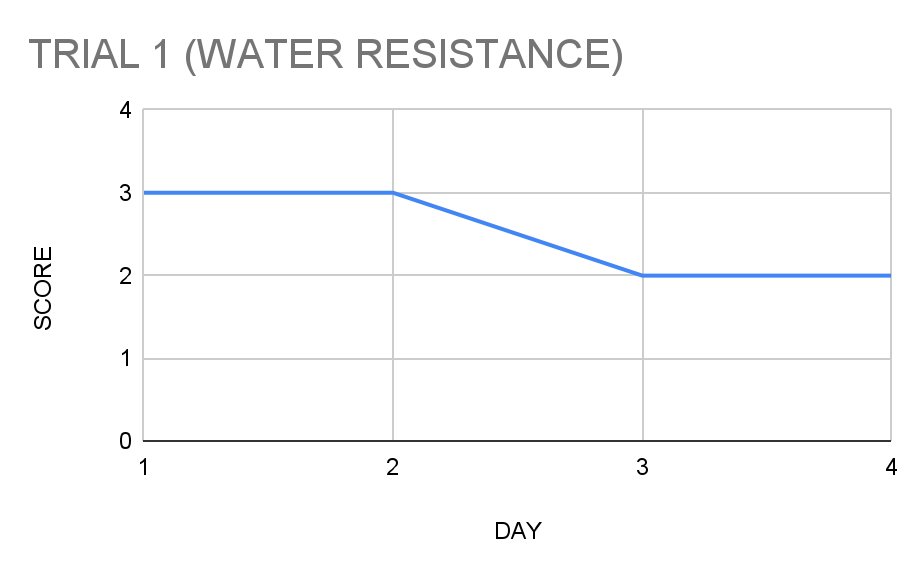
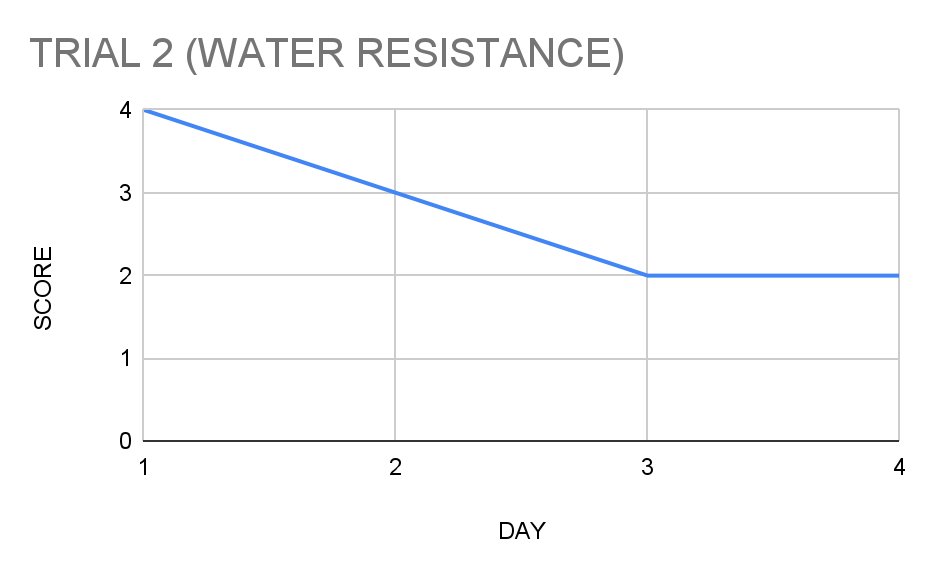
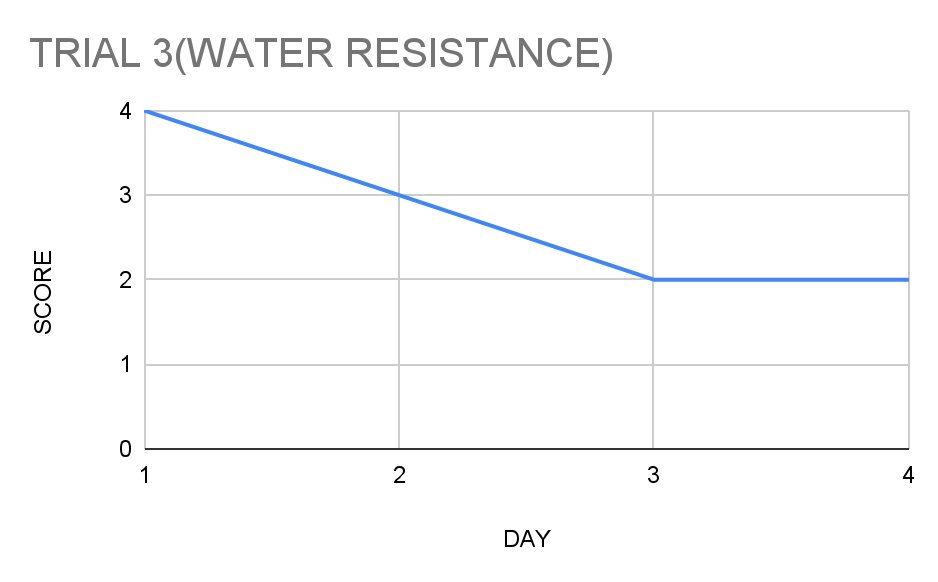
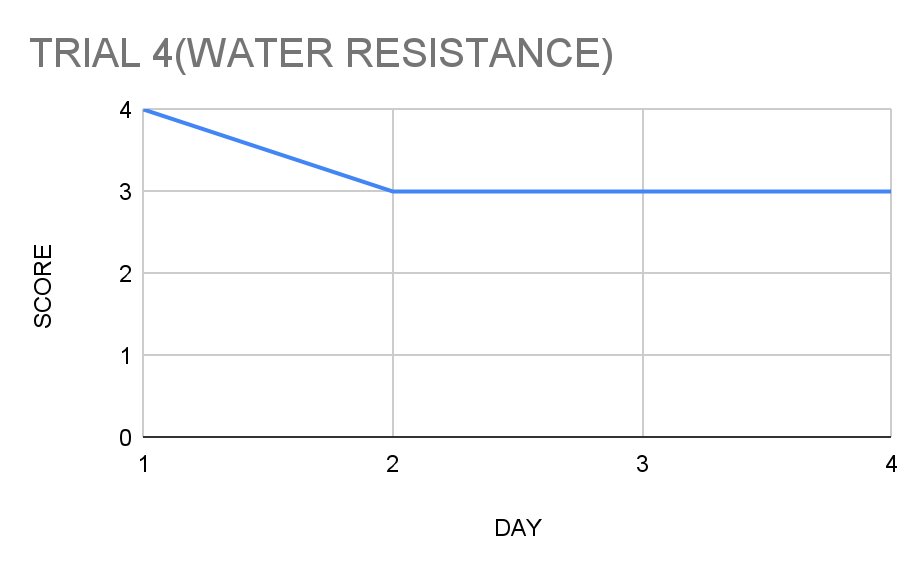
These graphs show the score of the degradation of the trials in water throughout 4 days, using the score scale above. Trial 1 has the worst results, starting at a score of 3 (soft, flexible, weaker) for the first 2 days and 2 (very weak and breaking) at the last 2 days. Trial 2 has better progress starting at 4 (fully intact, no changes) but quickly making its way down to 2 (very weak breaking). Trial 3 has the exact same results as Trial 2, starting at 4 and making its way down to 2 (very weak, breaking). Trial 4 has the best results, starting at 4 (fully intact, no changes) and then keeping at a steady 3 (soft, flexible, weaker
SCORE SCALE
4-fully intact, firm, no changes
3- Soft, flexible, weaker
2- Very weak breaking
1- decomposed
These graphs show the score of the degradation of the trials in water throughout 4 days, using the score scale above. Trial 1 has the worst results, starting at a score of 3 (soft, flexible, weaker) for the first 2 days and 2 (very weak and breaking) at the last 2 days. Trial 2 has better progress starting at 4 (fully intact, no changes) but quickly making its way down to 2 (very weak breaking). Trial 3 has the exact same results as Trial 2, starting at 4 and making its way down to 2 (very weak, breaking). Trial 4 has the best results, starting at 4 (fully intact, no changes) and then keeping at a steady 3 (soft, flexible, weaker
Overall Analysis:
The results show that increasing polymer content improved strength. Trial 4 had the most cornstarch and agar, which created stronger bonding between polymer chains. Adding more glycerin improves flexibility because glycerin acts as a plasticizer. It allows polymer chains to move without breaking. Algae powder did not improve strength and made the plastic darker and less clear. Removing it improved clarity. The plastics dissolved in water because starch and agar absorb water easily. Water breaks the hydrogen bonds holding the polymer chains together. Compared to PET plastic (which can hold 50–150+ coins), even the strongest bioplastic was weaker. However, the bioplastic is biodegradable, which is better for the environment.
Conclusion
CONLUSIONS FOR THE EXPERIMENT:
This experiment examined how different environmental conditions (control, warm, and cold), effect the release of microplastic particles from single-use plastic water bottles - which is a growing global health and environmental concern. By exposing identical bottles to three controlled environments—recommended storage conditions, cold temperatures, and warm, moist conditions with UV exposure—our experiment clearly concluded how UV rays and warmer conditions result in a higher amount of plastic particles released.
The results strongly supported the our hypotheses that warmer environments increase microplastic contamination in bottled water. This is because the samples that were exposed to heat, moisture, and UV radiation consistently showed the highest average particle counts (20–30 particles per field of view), as well as the greatest diversity in particle shapes, including fibers, rods, and irregular fragments. Compared to the cold environment, which released the lowest amount of particles (3–5 per field), suggesting that low temperatures significantly slow plastic degradation. The control environment produced intermediate results, confirming that even properly stored plastic bottles can release microplastics over time, although at a reduced rate.
Too add on, both of our original hypotheses were proven correct. As we predicted, microplastic particles were observed in all water bottle samples, confirming that no single-use plastic water bottle is completely "safe" of microplastic contamination. This supports the both of our hypotheses that polyethylene terephthalate (PET) naturally degrades over time, even under recommended storage conditions. Furthermore, bottles exposed to UV radiation and warm, humid environments released significantly higher concentrations of microplastics, once again proving our hypotheses correct. These findings align with established scientific research on plastic photodegradation, hydrolysis, and thermal degradation. UV radiation weakens polymer bonds, heat accelerates chemical reactions, and moisture promotes structural breakdown, collectively increasing the fragmentation of plastics into micro- and nano plastics.
While light microscopy allowed for the visualization and comparison of particle quantity and morphology, it could not definitively identify chemical composition. As such, some observed particles may not have been plastic. In the future, studies might want to use advanced techniques/technologies to identify nano plastics, such as FTIR or Raman to enhance visibility, results, and limit and uncertainty.
The future applications of this experiment are highly significant. This is because bottled water is increasingly becoming a major source of microplastic exposure for humans. Our experiment/project highlights this issue.
In conclusion, our experiment goes to show that environmental factors—especially heat and UV exposure—play a critical role in accelerating micro plastic release from plastic water bottles. Addressing microplastic pollution will require a combination of scientific innovation, informed consumer choices, stronger regulations, and the development of sustainable materials. By increasing awareness and advancing biodegradable plastic technologies, meaningful progress can be made toward protecting human health and preserving ecosystems.\
CONLUSIONS FOR CREATING THE BIODEGRADABLE PLASTIC:
This experiment showed how changing natural and renewable resources can be used to create a strong Bioplastic that can replace petroleum-based plastics. From the four trials of the biodegradable plastics, improvements were made by changing the ratios, composition of materials and the method to create Bioplastic.
The results showed the improvements and changes made from each trial made the final product stronger, firm, and flexible. Trial 1 was the weakest Bioplastic from all the plastics, it had low tensile strength (90.87g), low flexibility and poor water resistance. Trial 2 was a major improvement, without the use of algae powder, an addition of polymers and plasticizers, and more heating. I created a plastic that had more tensile strength (216.69g), flexibility (no damage after 100-180degree bends). Trial 3 slightly increased the strength, while the flexibility detracted and the water resistance was increased, indicating adding algae powder did not improve molecular structure and reduced flexibility. Trial 4 was the most successful. Removing the algae powder, adding concentration of polymers, plasticizer and heating, the final Bioplastic withstood 321.54g of mass, 100-180degree bends and had the best water resistance. This shows that stronger intermolecular interactions between polymer chains, combined with effective plasticization, created a tougher and more flexible material. Although the final product still does not match the strength and durability of petroleum-based plastics like PET, it demonstrated significant improvement from the original design.
Our hypotheses were partially supported. We predicted that bioplastics created from a combination of algae and starch-based polymers could exhibit enhanced UV resistance, faster biodegradation, and minimal microplastic formation in water. The experimental results suggest that using naturally derived polymers instead of petroleum-based materials allows the bioplastic to maintain moderate flexibility and strength while reducing environmental harm, particularly to marine ecosystems. These findings highlight a promising pathway for developing environmentally friendly bioplastics that degrade safely in aquatic environments, an improvement that many current bioplastics have yet to fully achieve.
Overall, our project demonstrates that bioplastics can be optimized through careful manipulation of polymer chemistry and composition. While water resistance remains a limitation, the final trial shows promising potential for creating stronger, flexible, and more sustainable plastic alternatives.
Application
APPLICATION OF EXPERIMENT:
This experiment has very important applications to our world. Especially in today society where plastic production is increasing, and people are using plastic more than ever. Since bottled water is a major source of human exposure to microplastic, our experiment shows how common everyday storage conditions (such as how people tend to keep plastic water bottles in their cars in the summer) can increase contamination. It showcases that leaving plastic water bottles in warm places, such as cars or direct sunlight, can significantly increase the amount of microplastics released into the water. This information can help consumers make safer choices, such as avoiding heat and UV exposure or choosing reusable alternatives. The findings also support the development of safer packaging materials, including bioplastics like algae-based plastics, which may reduce long-term environmental and health risks. Additionally, our project was done in the intent to raise awareness about microplastics and how millions all across the globe are unknowingly consuming microplastic particles daily - just by drinking water! Overall, this experiment provides useful evidence that can inform public awareness, consumer habits, and future material design.\
APPLICATION FOR CREATING THE BIODEGRADABLE PLASTIC:
This experiment has very important applications to our world. Especially in today society where plastic production is increasing, and people are using plastic more than ever. Since bottled water is a major source of human exposure to microplastic, our experiment shows how common everyday storage conditions (such as how people tend to keep plastic water bottles in their cars in the summer) can increase contamination. It showcases that leaving plastic water bottles in warm places, such as cars or direct sunlight, can significantly increase the amount of microplastics released into the water. This information can help consumers make safer choices, such as avoiding heat and UV exposure or choosing reusable alternatives. The findings also support the development of safer packaging materials, including bioplastics like algae-based plastics, which may reduce long-term environmental and health risks. Additionally, our project was done in the intent to raise awareness about microplastics and how millions all across the globe are unknowingly consuming microplastic particles daily - just by drinking water! Overall, this experiment provides useful evidence that can inform public awareness, consumer habits, and future material design.
To add on, one of the biggest environmental problems we are currently facing is microplastic pollution. Traditional plastics do not fully biodegrade; instead, they break down into tiny plastic particles called microplastics. These particles accumulate in oceans, rivers, soil, drinking water, and even inside animals and humans. Microplastics can harm marine life when ingested and can move through the food chain, creating long-term ecological and health concerns. Plastic pollution is a major global problem due to the wide-spread of petroleum-based plastics that are strong and persist in the environment. These plastics are useful, but also cause environmental harm and the accumulation of microplastic in ecosystems, food, and human beings. This project investigates a bioplastic created from algae powder, agar powder, cornstarch and vegetable glycerin, and evaluates its strength, flexibility and water resistance. The project can help teach polymer chemistry, the connection of molecular structure to material properties and how plastizers affect polymer behaviour. The final plastic, can be easily industrially produced with modification to form an even stronger Bioplastic and be used as single use packaging for dry foods, snacks (chips bag) and produce products. The plastic can also have agricultural uses; seed coatings or plant started films. Overall, this bioplastic can be used for lightweight packaging, agricultural films, and it offers an alternative to petroleum plastics while reducing microplastic pollution.

Sources Of Error
EXPERIMENTAL SOURCES OF ERROR:
- Microscope Limitations
- Using light microscopy at 400x magnification allows you to see small particles, but it cannot confirm chemical composition. Some of the observed particles might be air bubbles, dust, or other debris, not microplastics.
- Sampling Errors
- When taking water samples from the bottles, it’s possible that the sample wasn’t perfectly mixed, so some fields of view could have more or fewer particles than average.
- Dropping water on the microscope slide could introduce contamination from the slide, pipette, or environment.
- Environmental Contamination
- Microplastics are everywhere in the air, so dust or fibers in the room could accidentally get into the samples.
- Handling bottles or slides without gloves or clean equipment could add extra particles.
- Uneven Exposure Conditions
- The warm, humid, and UV-exposed bottles might have had slightly different amounts of sunlight or heat depending on their placement.
- The cold environment (freezer) might have temperature fluctuations that slightly slowed or accelerated microplastic release.
- Variability in Bottles
- Even though all bottles were the same brand, slight differences in manufacturing or plastic thickness could affect how many particles were released.
- Human Observation Error
- Counting particles under the microscope by eye can be subjective, especially when particles overlap or are very small.
- Time Frame
- The experiment ran for 2–3 weeks. If the experiment were longer, more particles might have formed, meaning the results are only a snapshot in time.
SOURCES OF ERROR FOR CREATING THE BIODEGRADABLE PLASTIC:
- Uneven Thickness of Plastic Some sheets of bioplastic were thicker in certain areas and thinner in others. This could have affected the strength test results, since thinner sections would tear more easily.
- Inconsistent Heating The mixture was heated on a stove without measuring the exact temperature. If the temperature changed or the mixture was heated for slightly different times, polymer bonding may not have been consistent between trials.
- Measurement Inaccuracies Ingredients such as cornstarch, agar, and glycerin were measured using spoons, which may not be perfectly precise. Small differences in amounts could change the final properties of the plastic.
- Drying Conditions The plastic was air-dried at room temperature. Humidity and air circulation may have varied, affecting how evenly or completely the plastic dried.
- Manual Testing Method The strength test relied on adding coins manually, and the flexibility test involved bending by hand. Differences in speed, force, or angle could have influenced when the plastic broke.
- Water Test Was Observational The water resistance test was mostly qualitative (based on observation and touch). No measurements of mass loss or exact degradation rate were taken, which reduces accuracy.
- Material Sticking to Foil Some plastic stuck to the aluminum foil and tore during removal, which may have weakened the samples before testing.
Citations
- Harvard Medicine Magazine. (n.d.). Microplastics everywhere. Harvard Medical School. Retrieved September 29, 2025, from https://hms.harvard.edu/magazine/microplastics-everywhere
-
Food and Agriculture Organization. (n.d.). Microplastics: A real global threat for environment and food safety. Retrieved September 29, 2025, from Microplastics: A Real Global Threat for Environment and Food Safety.
-
European Parliament. (n.d.). Microplastics: Sources, effects and solutions. Retrieved September 29, 2025, from Microplastics: sources, effects and solutions - European Parliament.
-
National Institutes of Health. (n.d.). Plastic particles in bottled water. NIH Research Matters. Retrieved September 29, 2025, from https://www.nih.gov/news-events/nih-research-matters/plastic-particles-bottled-water
- Columbia Climate School. (2024, January 8). Bottled water can contain hundreds of thousands of previously uncounted tiny plastic bits, study finds. Retrieved September 29, 2025, from https://news.climate.columbia.edu/2024/01/08/bottled-water-can-contain-hundreds-of-thousands-of-previously-uncounted-tiny-plastic-bits-study-finds/
- Canadian Wildlife Health Cooperative. (n.d.). Wildlife ingestion of microplastics [PDF]. Retrieved September 29, 2025, from https://www.cwhc-rcsf.ca/docs/fact_sheets/Wildlife%20ingestion%20of%20microplastics.pdf
- The Guardian. (2025, August 28). Microplastics in hair study. Retrieved September 29, 2025, from https://www.theguardian.com/environment/2025/aug/28/microplastics-in-hair-study
- CNN. (2025, June 24). Microplastics in food packaging study. Retrieved September, 30, 2025 from https://www.cnn.com/2025/06/24/health/microplastics-food-packaging-study-wellness
- BBC Future. (2025, July 23). How do the microplastics in our bodies affect our health? Retrieved September, 30, 2025, from https://www.bbc.com/future/article/20250723-how-do-the-microplastics-in-our-bodies-affect-our-health
- Allen, S., Allen, D., Phoenix, V., Le Roux, G., Durántez Jiménez, P., Simonneau, A., … & Galop, D. (2021). Atmospheric transport and deposition of microplastics in remote areas. ACS Chemical Reviews, 121(15), 11954–12020. https://doi.org/10.1021/acs.chemrev.1c00178
- MeasurLabs. (n.d.). Microplastics in water: Methods of detection. Retrieved September, 30, 2025, from https://measurlabs.com/blog/microplastics-in-water/#:~:text=The%20three%20main%20methods%20for,in%20sludge%20and%20soil%20samples.
- ScienceDirect. (2024). [Article on microplastics research]. Retrieved September, 30, 2025 from https://www.sciencedirect.com/science/article/pii/S2666765724000978
- ScienceDirect. (2024). Wet oxidation technology for microplastics and nanoplastics removal. Retrieved September, 30, 2025, from https://www.sciencedirect.com/science/article/abs/pii/S0043135424010765#:~:text=Wet%20oxidation%20technology%20can%20significantly%20reduce%20both%20microplastics%20and%20nanoplastics,-Author%20links%20open
- ScienceDirect. (2022). Membrane filtration technologies in drinking water treatment. Retrieved October, 8, 2025 from https://www.sciencedirect.com/science/article/pii/S2772577422000404
- ScienceDirect. (2024). Membrane bioreactor (MBR) technology for micropollutant removal. RetrievedOctober, 8, 2025, from https://www.sciencedirect.com/science/article/pii/S2405844024019145#:~:text=Membrane%20bioreactor%20(MBR)%20technology%20has,%2C%20pharmaceuticals%2C%20and%20so%20on.
- ScienceDirect. (2023). [Article on microplastics environmental impact]. Retrieved October, 8, 2025 from https://www.sciencedirect.com/science/article/pii/S2666911023000047
- Government of Canada. (n.d.). Single-use plastics overview. Environment and Climate Change Canada. Retrieved October, 9, 2025, from https://www.canada.ca/en/environment-climate-change/services/managing-reducing-waste/reduce-plastic-waste/single-use-plastic-overview.html
- [Author Unknown]. (n.d.). Poly(lactic acid) (PLA) and polyhydroxyalkanoates (PHAs). [Source unknown].
Acknowledgement
- We would like to acknowledge Mr. Chiu, our CYSF coordinator, for guiding us through our projects, and reminding us of key deadlines and due dates.
- We would like to acknowledge our families for supporting us throughout our project, and providing us with any material needed for our project.