
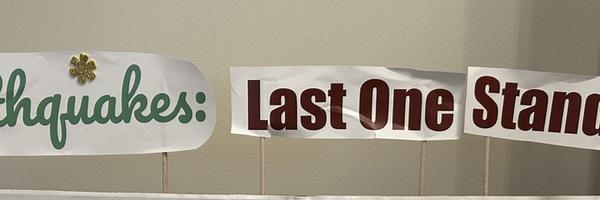
Earthquakes - Last one standing
Leen Al-Sayed
Horizon Leadership Academy
Grade 9
Presentation
Hypothesis
I expect the square pyramid design to be the most effective because it uses the triangle shape design which resists the shearing forces of an earthquake.
Research
The First important aspect that we need to note is the difference between earthquake RESISTANT buildings and earthquake PROOF buildings. Earthquake resistant buildings are buildings that are designed to withstand the impact of an earthquake long enough for people to evacuate safely and to prevent total collapse, some examples of buildings that fit this criteria are apartment buildings, business offices, recreational buildings etc. Earthquake proof buildings however, are buildings that need to stay functional during and after an earthquake, these buildings would be essential buildings to keep the society stable, for example, hospitals, firestations, important government buildings etc. These buildings need to have little to no damage and stay safe for use throughout the earthquake. In the case of this experiment we only need to find the best design of an earthquake resistant building. Earthquakes produce lateral loads on buildings on the contrary to vertical loads which can be caused by snow piling on the roof.
Methods used to in earthquake resistant buildings:
- Symmetry: Making a building symmetrical helps distribute the lateral forces of an earthquake evenly across the building. It is especially important for the lower floors to keep the building standing.
- Flexibility: One ancient method used by the Greeks in building their earthquake resistant buildings was to add clamps between the building blocks made of iron or wood and covered in lead which made the joints flexible enough to absorb the forces of the earthquake, leaving the building with minimal damage to the building. This method was also used in the legendary columns in which they joined together using wooden pegs and wedges known as polo and empolia.
- Diaphragms and Shear walls: Shear walls are reinforced walls in an earthquake resistant building, they can be reinforced with materials such as steel or concrete, they are designed to withstand the shear forces of an earthquake and prevent the roof from falling. Diaphragms are like shear walls but for floors and roofs because that is where the mass of the building is concentrated.
- Tuned mass Damping: A tuned mass damper is a mechanism used in tall skyscrapers that experience high wind speeds and are prone to unnatural shaking. Dampers are materials that absorb kinetic energy and reduce vibration effects. Dampers can have many forms and in this case it is a mass damper meaning that it uses the force of gravity (mass) to absorb the kinetic energy, in this case caused by the shear forces of an earthquake, and minimize the shaking of the building. An excellent example of a tuned mass damper is the one in the TAIPEI 101 in Taiwan, this tuned mass damper weights 728 tons and is suspended in between the 87 floor and the 92 floor. The TAIPEI 101 is the tallest green building in the world and survived an earthquake with the magnitude of 6.8 Richter without any damage.
- Floating Foundations: The idea of a floating foundation is that the foundation of the building or the base of the building is flexible so that in the event of an earthquake the forces are absorbed at the bottom of the building and do not reach the upper floors. This method is especially useful for mass production of stable buildings because it is cost effective and not labor intensive.
Variables
Manipulated variable: Strength of earthquake simulated by shaking of shaker table. And building designs. Responding variable: The amount of damage the buildings will face after experiencing the shearing/lateral forces of the earthquake.
Procedure
To conduct this experiment I first decided on the purpose of the building that I will be designing, for this specific building it will be a hotel (this hotel will be located in an earthquake zone), so it needs to be aesthetically pleasing and at the same time stable to keep the customers safe and give them a chance to evacuate in case of an earthquake. Then I decided on four main structure designs to test, the first one being a regular rectangular prism as is seen in most buildings, second will be a cube design, as for the third one it will be a cone shape, and lastly, the fourth one will be a square-based pyramid. To test these designs I will build a shaker table using two pieces of cardboard/plywood attached by springs or small balls in cylinders; Then using the shaker table I will lightly fasten each building design to it using tape and push the top slab to simulate the shaking of an earthquake, I will measure how far I push it in centimeters. I will do the same to each design five times and measure the damage caused to each design, the building that has the most damage will be eliminated. In the next round I will use the same procedure but push farther this time and each time the building with the most damage will be eliminated. Once I am left with only one building design I will use different techniques on it to see which methods of building earthquake resistant buildings is the most useful and makes the biggest difference. In the end I will have the best design to build earthquake resistant buildings.
Observations
Round 1: Description and Observations: Description: Buildings stabled by tape and stuck in to board. Shaker table pulled by 1 inch and released 5 times per building. Pulled at x axis.
Building #1: 4 foundations Observations: Considerable amount of shaking at foundation causing upper floors to shake. Damage caused the building to lean toward the right.
Building #2: 4 foundations (foundations much longer than other buildings) Observations: Shaking mostly took place at the joints, minimal damage.
Building #3: 3 foundations (foundations much smaller than other buildings) Observations: Not much shaking only at the top, foundations stayed stable, no considerable damage.
Round 2: Description and Observations: Description: No changes to building designs or foundations. Shaker table pulled by 2 inches and released 5 times per building. Pulled at x axis.
Building #1: Observations: point of weakness in joint near foundation causing shaking at the top floors also causing permanent leaning toward the right.
Building #2: Observations: more shaking at joins, foundations began to come loose. One foundation almost failed.
Building #3: Observations: Minimal shaking, similar to round 1. Did not continue to shake after release, no damage.
Round 3: Description and Observations: Description: Continuous, random aptitude until failure of building (could be caused by loss of foundation or collapse) measuring how long the building will last.
Building #1: Time it took to fail: 11 seconds. Observations: Failure caused by loss of foundation, building rotated clockwise during shaking.
Building #2: Time it took to fail: 7 seconds. Observations: Failure caused by loss of foundation similar to building #1, shaking strongly at joints, other pillars came loose.
Building #3: Time it took to fail: 1 minute and 24 seconds Observations: During shaking one pillar began to come loose and when it failed it pulled the other pillar, causing it to fail as well, the building rotated counterclockwise.
Analysis
| From this expiriment I can conclude that building number three, the triangle based pyramid, is the most effective in earthquake risitance |
|---|
| ------------------------------------------------------------------------------------------------------------------------------------------ |
Conclusion
Based on the observations of this experiment I can conclude that between these building designs the most effective in earthquake resistance between these basic building designs was the triangle based pyramid which I hypothesized previously. Earthquake resistant buildings are becoming more and more important in order to mitigate losses from earthquakes, as technology continues to advance it is always important to not just make scientific discoveries but also make a way for these discoveries to make a positive impact on people’s lives.
Application
This experiment focuses on earthquake zones and geological areas that have a higher likelihood of experiencing an earthquake. this experiment shows that triangular shapes are more efficient in resisting lateral forces such as those produced by an earthquake. this could be used in the bracing of earthquake resistant buildings and even the pyramid shape overall could be used in the designing of new earthquake resistant buildings.
Sources Of Error
In a real life building the weight of the building will be a factor in resisting the shearing forces due to gravity which could not be replicated in this experiment due to presentational reasons. Additionally the joints of buildings overall are commonly much more secure and stable than the one that was built for the purpose of this experiment.Furthermore, there are many more methods that assist in resisting earthquakes which were not included in this project. Lastly, there are many factors in building a real building that affect the design such as cost and purpose.
Citations
| https://science.howstuffworks.com/engineering/structural/earthquake-resistant-buildings.htm
https://blog.ringfeder.com/compelling-reasons-for-earthquake-resistant-construction
https://dozr.com/blog/5-astonishing-earthquake-resistant-buildings-around-the-world
https://youtu.be/xvhfLmA6gVk?si=wf8M3QwB8lktYLPo
https://www.theacropolismuseum.gr/en/parthenon-empolia-and-polos
https://info.fbibuildings.com/blog/diaphragm-design
| https://practical.engineering/blog/2016/2/14/tuned-mass-dampers-in-skyscrapers |
https://miyamotointernational.com/what-are-tuned-mass-dampers/
https://www.foxblocks.com/blog/earthquake-resistant-construction-techniques
https://eppconcrete.com/floating-slab-foundation-pros-and-cons/
|
Acknowledgement
I would like to acknowledge my father who is a seismic engineer and helped me greatly in this project and sparked my curiosity for seismic studies. Additionally I would like to thank my brother for assisting me and giving me a different point of view and great ideas.