
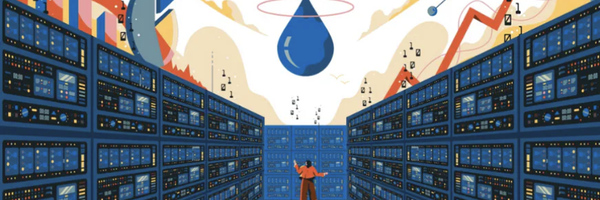
The Energy Cost and Environmental Effects of Artificial Intelligence
Ailin Guo, Arabella Doetzel
John G. Diefenbaker High School
Grade 10
Presentation
No video provided
Problem
Project Overview
This research project examines the energy consumption and environmental impacts of artificial intelligence (AI) systems in data centers. As the use of AI models continues to increase, concerns have emerged regarding the large amounts of electricity and water required for model training, daily operation, and data-center maintenance and the increased green house gas emissions associated with it. This investigation uses a research-based approach by reviewing scientific studies, government reports, and industry sustainability data in order to explore just how much AI impacts the planet’s health. The goal of the project is to evaluate whether the current growth of artificial intelligence is environmentally sustainable by identifying the key factors contributing to its environmental footprint and exploring how AI affects the different components of our planet’s health.
Research Question:
In what ways does the increasing use of artificial intelligence effect the environment?
Problem
Artificial intelligence systems require extremely high computational power for both training and everyday use. This leads to high electricity demand, significant carbon emissions due to high demand making fossil fuels the best energy source, as well as the large amount of water required for water based cooling systems. As AI becomes more widely adopted, its total energy consumption is increasing rapidly, but the full environmental impact remains poorly understood and documented. This creates uncertainty about whether current AI technology and systems are truly sustainable and healthy for the environment.
Purpose
Because the environmental impacts of artificial intelligence remains poorly understood and lacks the proper precautions of sustainability measures, we build our project for the purpose of properly studying this missing information. Through researching and analyzing scientific studies and industry data, this project aims to assess whether the current growth of AI technologies is environmentally sustainable and to identify the key factors contributing to its environmental footprint.
Hypothesis:
If the usage of AI models continues to expand rapidly without proper sustainability measures, then consumption of energy and energy as well as greenhouse gas emissions will continue to exponentially increase past sustainable levels, resulting in significant negative and irreversible impacts on the environment, because at our current development and understanding AI's consumption of resources and the waste AI data centers produce create massive strain on the environment's ability to maintain itself and it's inhabitants.
Method
This research project was completed by reviewing existing scientific studies, official AI company reports and data graphs, and public legal documents, and backed articles on the sustainability of AI. These online resources were collected from reliable articles published by university studies and reports done by news organizations. The following information obtained on electricity consumption, carbon emissions, pollution of water sources/nearby environments, harmful impacts on nearby human populations, and data-center energy use was identified and organized, before being compared the reported statistics and values of AI companies, AI model, and data centers. The cross-checked information was then analyzed to assess and determine the trend of AI’s energy demand and environmental impact. No experiments were performed. All conclusions were drawn from existing and official published data, statistics, measurements and studies.
Research
Generative AI LLMs how they work (Training) and use of data centers
(https://www.climateimpact.com/news-insights/insights/carbon-footprint-of-ai/): -algorithm complexity because AI training involves more computing than conventional methods. More energy, servers, and cycles may result from a more complicated algorithm. -Training time and energy consumption are directly impacted by the amount of the dataset and the number of model parameters. For instance, compared to models from a few years ago, GPT-5 is orders of magnitude larger. -"Specialized chips like TPUs are designed to accelerate AI training more efficiently than general-purpose hardware. As hardware improves, the energy cost per calculation drops—but overall demand keeps rising." (the mining of these materials can also damage the environment) -LLM’s are powerful learning systems trained to understand and respond to human-like text (https://news.climate.columbia.edu/2023/06/09/ais-growing-carbon-footprint/)
- Training: Exposing the ai model to huge amounts of data with billions of words (can come from the internet such as articles, books, social media and etc)
- AI eventually learns how to identify patterns and relationships in the given data and weighs the different features in the data to accomplish the given task
- Parameters: internal settings that it learns from the data which represent the relationships between different words and are used to make predictions
- To process and analyze the vast amounts of data, large language models need tens of thousands of advanced high-performance chips for training and, once trained, for making predictions about new data and responding to queries
- Graphics processing units (GPUs), specialized electronic circuits, are typically used because they can execute many calculations or processes simultaneously; they also consume more power than many other kinds of chips.
- AI mostly takes place in the cloud—servers, databases, and software that are accessible over the internet via remote data centers. The cloud can store the vast amounts of data AI needs for training and provide a platform to deploy the trained AI models.
- -Data center efficiency: A data center powered by Icelandic geothermal energy has a much smaller footprint than one powered by coal in West Virginia. Cooling systems and energy efficiency make a difference too. https://www.climateimpact.com/news-insights/insights/carbon-footprint-of-ai/
Entry points for pollutants into environment from data centers
- Electronic waste: AI relies on specialized hardware with relatively short lifespans like GPUs, TPUs, and high-performance servers; Frequent upgrades and disposal of these devices create large amounts of e-waste; difficult to recycle and may release harmful chemicals into the environment
- Extraction of materials used to build data centers: The mining of these rare metals can
- Noise: AI data centers that use HVAC fan cooling system mainly/only produce large amounts of noise. The noise leaks out of the building into the surrounding area as noise pollution. Majority of data centers do not use noise depressors causing a large percentage of noise to escape.
- Energy Generation: AI data centers frequently use backup power generators do better meet their high energy consumption needs which power grids are unable to meet. Well these generators are meant to only serve as back up many AI based data center operators end up using them outside of regulated use. These generators generally produce lots of noise and CO2. However, alternatives to fossil fuel generators are being researched such as SMRs.
Effects on soil toxicity and water contaminants
1. Water Evaporation: When water for data centers must be extracted from the natural environment in the data centers surrounding area. The extracted water is then used in water based cooling systems, which causes the water to evaporated. Well some data centers have system in place to reuse the evaporated water through closed system, many do not causing the water to escape into the atmosphere. The evaporated water now in the atmosphere travels away from the surrounding environment and then precipitates else where. This extraction and evaporation of water causes the nearby pollutant concentration in water and soil to increase due to the water in the area being decreased. This effect can be observed most severely in dry places with large agriculture, such as grasslands.
-Manufacturing AI hardware requires mining metals such as: lithium, cobalt, and rare earth elements; extracting these can cause soil degradation (https://www.climateimpact.com/news-insights/insights/carbon-footprint-of-ai/) -When e-waste ends up in landfills, toxic substances like lead, mercury, and flame retardants can leach into the soil and groundwater, eventually contaminating rivers and local drinking water. (https://www.vancouverislandwaterwatchcoalition.ca/artificial-intelligence-ai-infrastructure-particularly-the-data-centres-required-to-power-it-poses-several-contamination-risks-in-canada-through-its-intense-use-of-water-massive-energy-consumptio/?utm_source=chatgpt.com) -Manufacturing AI hardware requires mining metals such as: lithium, cobalt, and rare earth elements; extracting these can cause water pollution (https://www.climateimpact.com/news-insights/insights/carbon-footprint-of-ai/) -“Contaminated wastewater: A significant portion of this water is used for evaporative cooling towers. At the end of the cooling cycle, the water is contaminated with chemical coolants, minerals, and heavy metals. This wastewater is then discarded, potentially contaminating local waterways." https://www.vancouverislandwaterwatchcoalition.ca/artificial-intelligence-ai-infrastructure-particularly-the-data-centres-required-to-power-it-poses-several-contamination-risks-in-canada-through-its-intense-use-of-water-massive-energy-consumptio/-"
Effects on Ecosystems
- Pollutants and high toxcitiy cause health complications for flora and fauna leading to strain on the ecosystem. The build up of toxin in the food chain could even lead to endangerment of species in the environment.
- Noise pollution from data centers interfere well migration patterns, which can drastically transform ecosystems.
- Water basin drainage can changes the humidity and water layout of the ecosystem effecting the habitat's weather and range of fauna and flora.
- -the mining and reliance on water can cause local strains of regions already material scarce -energy demand and water demand goes up faster than supply can accommodate -resource extraction for the manufacturing of GPU's and machine materials for data centers can cause significant impact on land
Effects on human health nearby
- The higher toxin to water concentration causes many rural wells near data centers to become more contaminated or to dry up, effecting many people who rely on them as a fresh water source.
- Noise pollution can cause major health issue for nearby human populations when exceeding about 90 decimals.
- No exacatly health, but nearby data centers often cause demand for water and energy in the area to increase prices for these services for everyday consumers.
Solutions
-we can use AI for good by: (https://news.climate.columbia.edu/2023/06/09/ais-growing-carbon-footprint/)
- "AI is being used to optimize power grids for renewable energy, predict wildfires, monitor deforestation, and model future climate change scenarios. It’s even helping design new materials for batteries and carbon capture. In this sense, AI is both part of the problem and part of the solution." (https://www.climateimpact.com/news-insights/insights/carbon-footprint-of-ai/)
- Can narrow down and predict uncertainties in the climate systems
- Improve climate models
- Help businesses anticipate disruptions due to climate change
- Can use ai to develop stronger/lighter materials
- Making wind turbines/aircrafts more efficient = consuming less energy
- can design new materials that use less resources, enhance battery storage, or improve carbon capture
- manage electricity from a variety of renewable energy sources
- monitor energy consumption
- identify opportunities for increased efficiency in smart grids, power plants, supply chains, and manufacturing
- AI systems can detect and predict methane leaks from pipelines
- monitor floods, deforestation, and illegal fishing in almost real time
- agriculture more sustainable by analyzing images of crops to determine where there might be nutrition, pest, or disease problems
- AI robots have been used to collect data in the Arctic when it is too cold for humans or conduct research in the oceans
-Efficient algorithms that can achieve the same performance but less energy use -Better hardware -Efficient data centers--more green -Delivering incentives for giant tech companies to go green: EX: Google has committed to running entirely on carbon-free energy by 2030. Microsoft has pledged to become carbon negative by 2030. Amazon is investing billions in renewable projects
-More efficient cooling systems; hybrid systems, closed systems, non-conductive coolants.
-energy alternatives to fossil fuels to fufill increased demand for energy
-imprical research to expand understanding on AI data center impacts
-More talk about regulation on AI based date centers and what the operators are allowed to do with proffesional and public consultation taken into serious account
Data
WATER CONSUMPTION
Larger data centers can each “drink” up to 5 million gallons per day, or about 1.8 billion annually, usage equivalent to a town of 10,000 to 50,000 people. (https://www.washingtonpost.com/climate-environment/2023/04/25/data-centers-drought-water-use/)
According to scientists at the University of California, Riverside, each 100-word AI prompt is estimated to use roughly one bottle of water (or 519 milliliters). (https://www.washingtonpost.com/technology/2024/09/18/energy-ai-use-electricity-water-data-centers/)
Approximately 80% of the water (typically freshwater) withdrawn by data centers evaporates (https://arxiv.org/pdf/2304.03271) "about 17.5 billion gallons of fresh water was consumed directly by U.S. data centers in 2023. This is approximately equivalent to 26,500 Olympic-size swimming pools, or the annual water use of a mid-sized American city such as South Bend, Indiana or Fort Collins, Colorado" https://www.climateimpact.com/news-insights/insights/carbon-footprint-of-ai/
In certain areas, data centers consume up to 57% of cooling water from potable sources A typical hyperscale data center can use 3–7 million gallons of water per day for cooling purposes Peng Gao and Yu Tao. (5 July, 2025). Global data center expansion and human health: A call for empirical research. sciencedirect.com. https://www.sciencedirect.com/science/article/pii/S2772985025000262
evaporative room cooling is among the simplest and cheapest ways to keep the chips from getting overheated and damaged Data Drain: The Land and Water Impacts of the AI Boom
ENERGY CONSUMPTION
56% of the electricity used to power data centers nationwide comes from fossil fuels, a significant portion of data center water consumption is derived from steam-generating power plants (https://arxiv.org/pdf/2411.09786)
As data centers are expected to consume up to 1,050 TWh annually by 2030, water usage will increase in parallel. (https://www.eesi.org/articles/view/data-center-energy-needs-are-upending-power-grids-and-threatening-the-climate) Collectively, all data centers in Northern Virginia consumed close to 2 billion gallons of water in 2023, a 63% increase from 2019. Loudoun County, with approximately 200 operational data centers, used around 900 million gallons of water in 2023. (https://www.ft.com/content/1d468bd2-6712-4cdd-ac71-21e0ace2d048 and https://vcnva.org/agenda-item/responsible-data-center-development/) Data centers power usage grew from 2688 megawatts at the end of 2022 to 5341 megawatts at the end of 2023 Globally data centers power usage grew to 460 terawatt-hours in 2022 https://news.mit.edu/2025/explained-generative-ai-environmental-impact-0117 ChatGPT query consumes about five times more electricity than a simple web search. https://news.mit.edu/2025/explained-generative-ai-environmental-impact-0117 2021 research paper from google and University of California estimated AI training alone used 1287 megawatt hours of electricity -- enough to power 120 average US homes for a year --- and generated about 552 tons of carbon dioxide Training a single large model like GPT-3 can use over 1,200 MWh - enough electricity to power around 120 U.S. homes for a year. And that is just for training the model. More energy is consumed every time someone submits a query. https://www.climateimpact.com/news-insights/insights/carbon-footprint-of-ai/ "Researchers estimated that training GPT-3 emitted roughly 500 metric tons of carbon dioxide (CO₂)—the equivalent of driving a car from New York to San Francisco about 438 times." https://www.climateimpact.com/news-insights/insights/carbon-footprint-of-ai/ "Data centers currently consume about 1–2% of global electricity. Of that, AI is responsible for about 15%." https://www.climateimpact.com/news-insights/insights/carbon-footprint-of-ai/ "Once models are deployed, inference—the mode where the AI makes predictions about new data and responds to queries—may consume even more energy than training. Google estimated that of the energy used in AI for training and inference, 60 percent goes towards inference, and 40 percent for training. GPT-3’s daily carbon footprint was been estimated to be equivalent to 50 pounds of CO2 or 8.4 tons of CO2 in a year." (https://news.climate.columbia.edu/2023/06/09/ais-growing-carbon-footprint/) "training of GPT-3 with 175 billion parameters, which consumed 1287 MWh of electricity, and resulted in carbon emissions of 502 metric tons of carbon dioxide equivalent" ((https://news.climate.columbia.edu/2023/06/09/ais-growing-carbon-footprint/)
Data Centers consumed 1.5% of global electricity in 2024 and are expected to represent nearly 10% of the electricity demand growth from 2024 to 2030 Peng Gao and Yu Tao. (5 July, 2025). Global data center expansion and human health: A call for empirical research. sciencedirect.com. https://www.sciencedirect.com/science/article/pii/S2772985025000262
Early in the AI boom, in 2023, US data centers consumed 176 terawatt-hours of electricity, roughly as much as the entire nation of Ireland (whose electric grid is itself nearly maxed out, prompting data centers there to use polluting off-grid generators), and that’s expected to double or even triple as soon as 2028. Data Drain: The Land and Water Impacts of the AI Boom
Carbon Emissions
"training a single AI model can emit over 626,000 pounds of CO2, equivalent to the emissions of five cars over their lifetimes." (https://news.climate.columbia.edu/2023/06/09/ais-growing-carbon-footprint/)
"A more recent study reported that training GPT-3 with 175 billion parameters consumed 1287 MWh of electricity, and resulted in carbon emissions of 502 metric tons of carbon, equivalent to driving 112 gasoline powered cars for a year." ((https://news.climate.columbia.edu/2023/06/09/ais-growing-carbon-footprint/)
"Once models are deployed, inference—the mode where the AI makes predictions about new data and responds to queries—may consume even more energy than training. Google estimated that of the energy used in AI for training and inference, 60 percent goes towards inference, and 40 percent for training. GPT-3’s daily carbon footprint was been estimated to be equivalent to 50 pounds of CO2 or 8.4 tons of CO2 in a year." (https://news.climate.columbia.edu/2023/06/09/ais-growing-carbon-footprint/)
"training of GPT-3 with 175 billion parameters, which consumed 1287 MWh of electricity, and resulted in carbon emissions of 502 metric tons of carbon dioxide equivalent" ((https://news.climate.columbia.edu/2023/06/09/ais-growing-carbon-footprint/)
CO2 emissions from electricity generation for data centres peak around or before 2030. However, in the Lift-Off Case, which sees significantly higher levels of fossil fuel-based electricity generation, they continue to increase until the early 2030s, peaking at nearly 1.5 times the maximum emissions level of the Base Case. ”Global electricity generation to supply data centres is projected to grow from 460 TWh in 2024 to over 1 000 TWh in 2030 and 1 300 TWh in 2035 in the Base Case” -data centres predicted to rise from 1% of global electricity generation today to 3% in 2030, accounting for less than 1% of total global CO2 emissions. -US and China largest users of data centres by large, in both fossil fuels largest source of energy - US: 40% natural gas\, 24% renewable\, 20% nuclear\, 15% coal - China: 70% coal\, 20% renewable\, 10% nuclear\, natural gas < 1% - Europe renewables and nuclear are set to supply most of the additional electricity required\, with their combined share rising to 85% by 2030 -Japan and Korea together account for about 5% of global data centre electricity demand today -remainder Southeast asia and India -Co2 emissions from data center energy consumption projected to rise to 320 Mt CO2 by 2030, and decline to 300 Mt CO by 2035 International Energy Agency. (April, 2025). Energy supply for AI. iea.org. https://www.iea.org/reports/energy-and-ai/energy-supply-for-ai
-Small modular reactors (SMRs) are advanced nuclear reactors that have a power capacity of up to 300 MW(e) per unit -SMRs produce ⅓ of what traditional nuclear reactors can generate
-pros include: small size, easy modular production, easy transportation from factory to site, more possible sites due to small size, cheaper production, faster production, less customization needed so less time needed and specialization needed in production, -good for rural energy generation in places that struggle to get energy from faraway generations of power grid -micro ones are good as back up power generators in case of emergency -runs on more passive systems and inherent safety characteristics to operate and ensure safety of reactor, allowing for automatic shutdowns in emergency without external interference (which decreases radioactivity) -generally need less fuel than traditional Liou, Joanne. (13 Dec, 2023). What are Small Modular Reactors (SMRs)?. iaea.org. https://www.iaea.org/newscenter/news/what-are-small-modular-reactors-smrs
NOISE POLLUTION
Data centers generate significant noise pollution primarily from diesel generators and Heating, Ventilation, and Air Conditioning (HVAC) systems, with internal noise levels reaching up to 96 A-weighted decibels (dBA)—well above the 85 dBA threshold considered harmful to hearing Peng Gao and Yu Tao. (5 July, 2025). Global data center expansion and human health: A call for empirical research. sciencedirect.com. https://www.sciencedirect.com/science/article/pii/S2772985025000262
-Safe sound levels: 70 A-weighted decibels (dBA) or lower -Unsafe sound levels: 85 dBA and above is harmful to hearing -1 Small Diesel generator runs at about 85 dBA -1 large Diesel generator runs at about 100 dBA. -HVAC fans: generate 55 to 85 dBA -Noise inside date centers: can reach up to 96 dBA (according to C&C Technology Group) -Exposure to this level of sound can damage hearing within half an hour: Data center staff who experience prolonged exposure to high noise levels (at work) may suffer from hearing damage, decreased productivity and increased stress. -Natural gas generators: runs from under 50 to 100 dBA (sustainable substitute for diesel generators) Richardson, Kelly. (03 Dec, 2024). Understanding the impact of data center noise pollution. techtarget.com. https://www.techtarget.com/searchdatacenter/tip/Understanding-the-impact-of-data-center-noise-pollution
Impact on Human Health
A recent model indicates that the U.S. data centers in 2030 could contribute to nearly 1300 deaths annually, resulting in a public health burden of more than $20 billion Peng Gao and Yu Tao. (5 July, 2025). Global data center expansion and human health: A call for empirical research. sciencedirect.com. https://www.sciencedirect.com/science/article/pii/S2772985025000262
In 1992, the Oregon DEQ measured an average nitrate concentration of 9.2 ppm across a cluster of wells in the Lower Umatilla basin. - In 2015\, the average had risen 46 percent to 15.3 ppm. For some wells\, DEQ found nitrate levels nearly as high as 73 ppm\, more than 10 times the state limit of 7 ppm. Hanley, Steve. (2 Dec, 2025). Massive Data Centers May Make Groundwater Pollution Worse. cleantechnica.com. https://cleantechnica.com/2025/12/02/massive-data-centers-may-make-groundwater-pollution-worse/
Noise inside date centers: can reach up to 96 dBA (according to C&C Technology Group) -Exposure to this level of sound can damage hearing within half an hour: Data center staff who experience prolonged exposure to high noise levels (at work) may suffer from hearing damage, decreased productivity and increased stress. Safe sound levels: 70 A-weighted decibels (dBA) or lower -Unsafe sound levels: 85 dBA and above is harmful to hearing constant humming or buzzing noise from data centers causes some people (people living in communities nearby data centres) to experience headaches, stress and sleep disturbance. Lack of sleep and stress can result in anxiety, cognitive impairment and cardiovascular risks. In more extreme cases, noise pollution can cause tinnitus and hearing loss. Richardson, Kelly. (03 Dec, 2024). Understanding the impact of data center noise pollution. techtarget.com. https://www.techtarget.com/searchdatacenter/tip/Understanding-the-impact-of-data-center-noise-pollution
The facilities have also gotten “massive,” Bolthouse adds. “Each one of those buildings is using as much as a city’s worth of power, so that power infrastructure is having a huge impact on our communities. All the transmission lines that have to be built, the eminent domain used to get the land for those transmission lines, all of the energy infrastructure, gas plants, pipelines that deliver the gas, the air pollution associated with that, the climate impacts of all of that.” Across Northern Virginia, on-site diesel generators—thousands of them, each the size of a rail car—spew diesel fumes, creating air quality issues. “No other land use that I know of uses as many generators as a data center does,” Bolthouse says. And while such generators are officially classified as emergency backup power, data centers are permitted to run them for “demand response” for 50 hours at a time, she adds. “That’s a lot of air pollution locally. That’s particulate matter and NOx [nitrogen oxides], which impacts growing lungs of children, can add cases of asthma, and can exacerbate heart disease and other underlying diseases in the elderly.” Data Drain: The Land and Water Impacts of the AI Boom
Conclusion
In conclusion, the information obtained from our research indicates that artificial intelligence focused data centers are currently consuming electricity and water at levels that raise extreme concerns for environmental sustainability. As AI technologies continue to expand rapidly, the energy required for model training, daily operation, and cooling systems is increasing at a significant rate. Much of this energy is still supplied by fossil fuels, contributing to rising greenhouse gas emissions which intensifies climate change. In addition, the heavy reliance on water-based cooling systems places strain on local water supplies, potentially leading to huge chain reactions of the disruptions to ecosystems, and long-term environmental damage.
Our research supports the hypothesis that if AI usage continues to grow without more sustainable measures being implemented, its environmental footprint will surpass the limits of sustainability . This could result in irreversible consequences, including increased carbon dioxide emissions, public health risks, ecological disruption, and habitat loss.
However, it is not too late to fix this. We have identified several possible solutions to reduce the environmental impact of AI data centers. These include development of alternative power sources from fossil fuels and improvement of noise-reduction infrastructure to limit noise pollution. Additionally, the implementation of closed loop, non-conductive, hybrid systems that use both liquid and HVAC cooling systems to most efficiently cool data centres.
Finally, we recommend that more comprehensive research should be completed regarding the environmental costs of AI operations and related data centers. While certain aspects of AI development are widely studied and discussed, the environmental impact of data centers and infrastructure has not received the same level of attention. Greater regulation, improved efficiency standards, and continued innovation in sustainable technology will be critical in ensuring that artificial intelligence develops in a way that benefits society without causing long-term harm to the planet.
Overall, artificial intelligence has the potential to drive progress and innovation, but its growth must be balanced with responsible environmental stewardship. Sustainable development practices will determine whether AI becomes a tool for positive change or a significant environmental challenge for future generations.
Citations
BIBLIOGRAPHY
Adam Zewe (January 17, 2025) Explained: Generative AI’s environmental impact. news.mit.edu https://news.mit.edu/2025/explained-generative-ai-environmental-impact-0117
Climate impact partners (October 28, 2025) The Carbon Footprint of AI climateimpact.com https://www.climateimpact.com/news-insights/insights/carbon-footprint-of-ai/
contact@uasdf.org, U. S.-A. S. D. F., *1Cambridge, MA, USA*Corresponding author. Email:, & Tong, Y. (March 7,2025) White Paper on Global Artificial Intelligence Environmental Impact . AI and Sustainability. ai-sustainability.pubpub.org https://ai-sustainability.pubpub.org/pub/fz5j9nzu
Hanley, Steve (2 Dec, 2025) Massive Data Centers May Make Groundwater Pollution Worse. cleantechnica.com. https://cleantechnica.com/2025/12/02/massive-data-centers-may-make-groundwater-pollution-worse/
International Energy Agency (April 10, 2025) Energy and AI iea.org https://www.iea.org/reports/energy-and-ai/energy-supply-for-ai
International Energy Agency. (April, 2025) Energy supply for AI iea.org. https://www.iea.org/reports/energy-and-ai/energy-supply-for-ai
José Pablo Ortiz Partida (June 25, 2025) What Are the Environmental Impacts of Artificial Intelligence? blog.uscs.org https://blog.ucs.org/pablo-ortiz/what-are-the-environmental-impacts-of-artificial-intelligence/ https://news.cornell.edu/stories/2025/11/roadmap-shows-environmental-impact-ai-data-center-boom?utm_source=chatgpt.com
Liou, Joanne (13 Dec, 2023) What are Small Modular Reactors (SMRs)? iaea.org https://www.iaea.org/newscenter/news/what-are-small-modular-reactors-smrs
Miguel Yañez-Barnuevo (June 25, 2025) Data Centers and Water Consumption eesi.org https://www.eesi.org/articles/view/data-centers-and-water-consumption
Pengfei Li, Jianyi Yang, Mohammad A. Islam, Shaolei Ren (March 26, 2025) Making AI Less “Thirsty”: Uncovering and Addressing the Secret Water Footprint of AI Models arxiv.org https://arxiv.org/pdf/2304.03271
Peng Gao and Yu Tao (5 July, 2025) Global data center expansion and human health: A call for empirical research sciencedirect.com https://www.sciencedirect.com/science/article/pii/S2772985025000262
Renee Cho (June 9, 2023) AI’s Growing Carbon Footprint www.climate.columbia.edu https://news.climate.columbia.edu/2023/06/09/ais-growing-carbon-footprint/
Richardson, Kelly (3 Dec, 2024) Understanding the impact of data center noise pollution. techtarget.com. https://www.techtarget.com/searchdatacenter/tip/Understanding-the-impact-of-data-center-noise-pollution
Tianqi Xiao, Francesco Fuso Nerini, H. Damon Matthews, Massimo Tavoni & Fengqi You (November 10, 2025) Environmental impact and net-zero pathways for sustainable artificial intelligence servers in the USA nature.com https://www.nature.com/articles/s41893-025-01681-y
Vivian Liu and Yiqiao Yin (July 8, 2024) Green AI: exploring carbon footprints, mitigation strategies, and trade offs in large language model training hlink.springer.com https://link.springer.com/article/10.1007/s44163-024-00149-w
Vancouver Island Water Watch Coalition (November 4, 2025) Artificial intelligence (AI) infrastructure, particularly the data centres required to power it, poses several contamination risks in Canada through its intense use of water, massive energy consumption, and contribution to electronic waste vancouverislandwaterwatchcoalition.ca https://www.vancouverislandwaterwatchcoalition.ca/artificial-intelligence-ai-infrastructure-particularly-the-data-centres-required-to-power-it-poses-several-contamination-risks-in-canada-through-its-intense-use-of-water-massive-energy-consumptio/?utm_source=chatgpt.com
Acknowledgement
Thank you Ms. Mayer for providing us the opportunity to participate in the Calgary Youth Science Fair! And thank you science fair club president of Diefenbaker High school, Emelia Chong, for answering our numerous questions and motivating us to start this project!