
Filter Fanatics
Eleanor Farrow
R. T. Alderman School
Grade 5
Presentation
No video provided
Hypothesis
If four filters are used for oil and sawdust contaminated water then the fabric filter will remove the oil and sawdust most successfully because the contaminants and water will separate, with the oil and sawdust collecting on the fabric
Research
There are three main methods of filtration: mechanical - strains physical debris, chemical - traps contaminants with adsorption (particles stick to surface), absorption (particles pulled inside like a sponge) and chemical reactions, biological - breaks down contaminants with microorganisms. Oil has larger particle sizes compared to water. The right mechanical filter should allow water to pass through and collect oil and sawdust. This project will focus mainly on mechanical filters for filtering oil. Mechanical filters can be built with different materials because different materials will collect different amounts of oil depending on particle size. Sand and Gravel can physically strain debris from water. Fabric works as a filter because it traps solid particles. Charcoal can trap debris, chemicals, and odours. Mesh is a good filter because it can filter large debris from water and air.
Variables
Manipulated variable = The filter type.
Responding Variable = The temp of water,type of water,the size of container,the type of contaminants ,the state of the water and contaminants, and the amount of water and oil (mm) and sawdust( tsp), the pour rate, the filter design.
Controlled Variables = Removes the most contaminants from water.
Procedure
Step 1: Gather Materials Gather up and organize all of the materials listed on the materials list. Your filters for example. fabric, mesh,charcoal,and sand.
step 2: Build filter apparatus (x13) add filter materials, prepare the data table .To prepare the data table look at the “diagram of data table slide” , measure and mark pour bottle.
Step 3: Conduct Experiment (x13) In the mixing bottle add 100 ml of oil using the funnel. Add 300 ml of water using the funnel and 1 tbsp of sawdust using the funnel. Agitate oil and water mixture. Pour through filter apparatus keeping the same pour rate (keep slow) for each test. Repeat and pour liquid mixture a second time for a total of 200 ml of oil and 600 ml of water and 2 tbsp of sawdust in the filter apparatus.
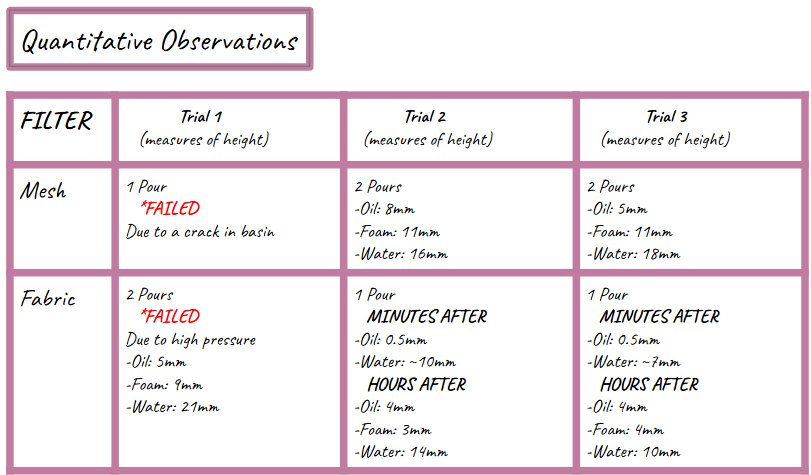
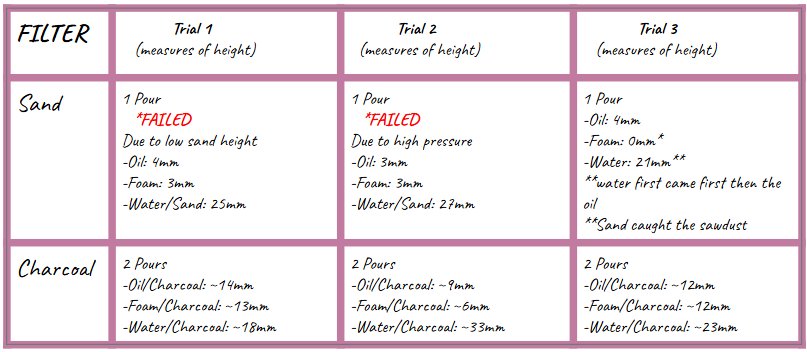
step 4: Observe and collect the data Make observations about the results, by measuring with a ruler the height of the oil in the filter tube (for sand and charcoal only ).Then look at the container to measure the oil (for fabric and mesh only). (1 mm = 3.3 ml). Fill out data sheet.
step 5: Analyze Look at the data to check for patterns and differences in the amount of oil in the Filter Tube.
step 6: Sources of Error Think about the control variables and think about the experiment. List those that couldn’t be controlled 100%.
step 7: Conclusions Draw conclusions about how the filters performed and whether the hypothesis was proven or disproven.
Observations
Analysis
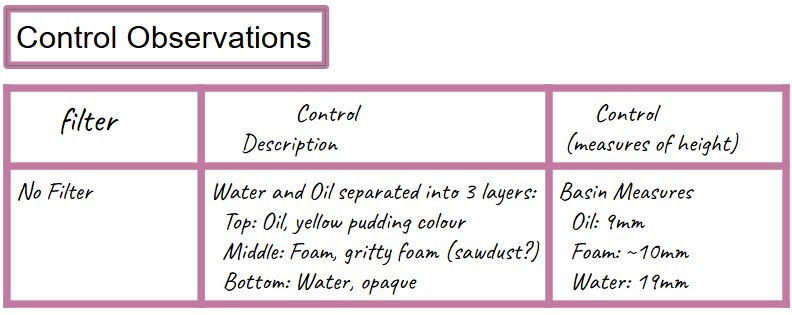
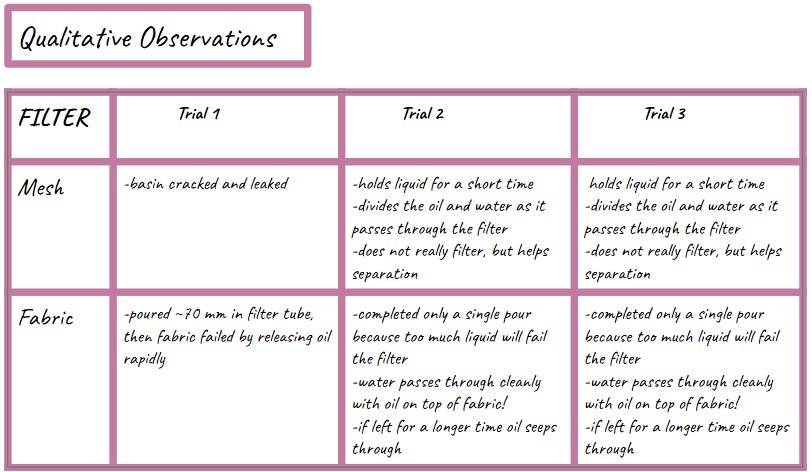
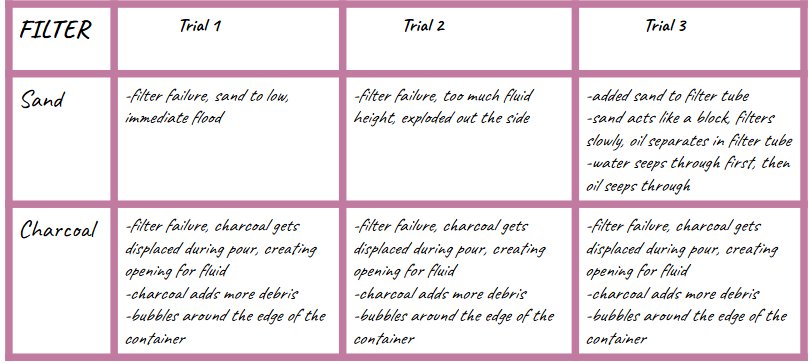
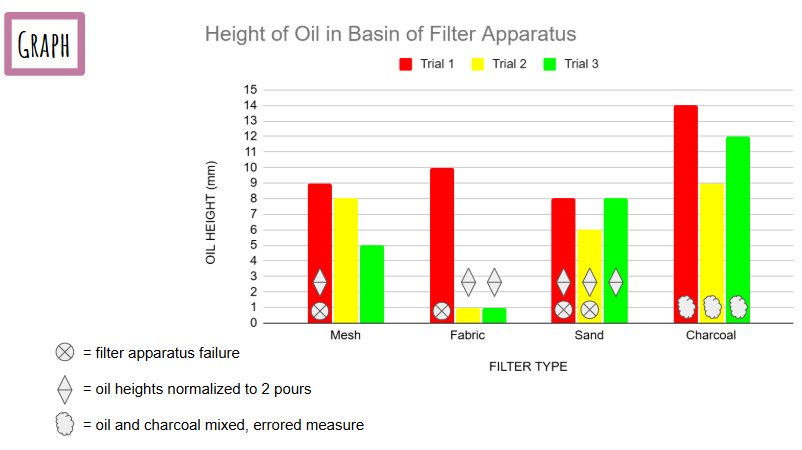
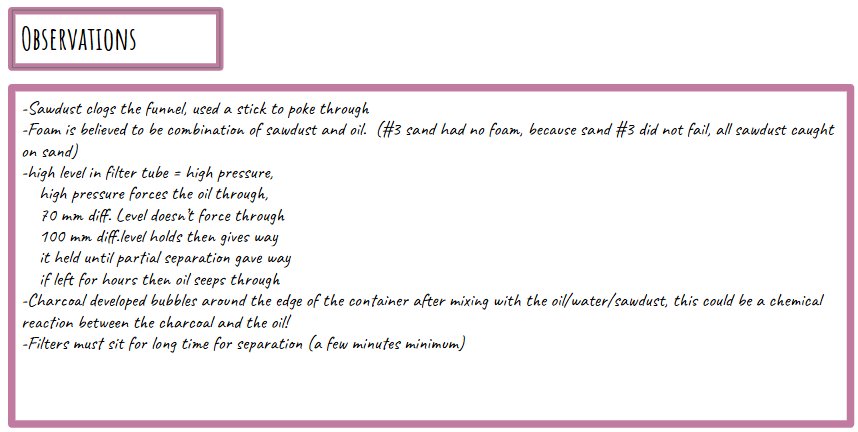
The data from the experiment shows that the fabric filter significantly reduced oil in the basin compared to the mesh, sand and charcoal filters. However it was also observed that the fabric filter let through the oil after sitting for a long time. Mesh and sand filters mostly show similar results in oil height, this is because the mesh and sand filters let through all the oil, but even though the mesh and sand filters let through the oil they did help the separation process. The charcoal filter was difficult to measure because the added contamination of the charcoal being agitated by the water being poured through the filter. Charcoal performed poorly compared to the other 3 filter designs, as all oil passes through and the fluid did not separate well in the basin. The sawdust was caught by the fabric, mesh and sand filters, while the charcoal filter let through all contaminants including sawdust. In my background research I found out that my filter apparatus is a mechanical filtration design. From the fabric filter experiment I learned that higher pressure in the filter tube decreases filter performance by forcing the oil through faster. Well doing the fabric filter experiment, I noticed that a 70 mm difference in level in height, didn’t force oil through, it would separate in the filter tube, and then the filter would pass the water slowly, beading into the basin. It was noted that a 100 mm level would hold briefly before rapidly being pushed through filter. It is probably, that the filter held until the water because the oil had only partially separated, allowing the water on the bottom ( which has a smaller particle size ), to be rapidly released through the filtered followed closely by the oil.
Conclusion
In conclusion the hypothesis was proven correct, the fabric filter worked best. As the oil and water got poured into the filter tube they separated and since the water has smaller particle sizes and is more dense than the oil, the water was pushed through the fabric filter. Even though the fabric filter worked well, if it was left for a long period of time, the oil would eventually seep through. These results Prove the fabric filter worked well, but is not a filter to be left for long periods of time. One of the things I learned through this experiment is that one of the best methods of separation is time, if you let it sit for long enough, even if it’s agitated, it will still separate.
Application
If I were to apply my filter in real life, I would use it in places where oil is present with water. For example, in a car wash, in a garage, or used when environmental cleanup is needed. The filter could be used for cleaning oily, dirty water from garages before it goes into a city water treatment plant. If I were to redesign my filter based on my learnings from this experiment, I would first use a bigger holding container to allow the liquid to separate from its agitated state. The next stage would be for the water to travel through a mechanical filter, making sure there isn’t too much pressure on the liquid, which could force oil through.
Sources Of Error
| Source of Error
| Result of Error |
|---|
| --------------- |
| Inconsistent measurement of the height of the oil within the basin. |
| Inaccurate data.
| | Inconsistent amount of time agitating the oil, water, sawdust mixture.
| Different separation qualities. Different times for separation.
| | Inconsistent time between pouring the liquid into the filter, and height measurement of the oil.
| Allowed different amounts of oil in the filter to enter the basin which resulted in an inaccurate measurement.
| | Apparatus failures in some trials
| Apparatus failures resulting in not getting the full results of a set of tests.
| | Some of the trials only had 1 pour to avoid filter failure (even though they were meant to have 2 pours), so the data was normalized to 2 pours (doubled single pour numbers)
| Doubles the errors.
| | | |
Citations
“Three Main Categories of Filtration.” Safe Air, www.safeair.com.tr/three-main-categories-of-filtration
“How Do Sand Filters Work?” Shaw Resources, 1 Dec. 2020, shawresources.ca/blog/2020/12/01/sand-filters-work/#:~:text=Sand%20filtration%20works%20by%20using,aquaculture%20seawater
“Why Is Charcoal a Good Filter? The Science Explained.” Biology Insights, 10 Jan. 2026, biologyinsights.com/why-is-charcoal-a-good-filter-the-science-explained/
“What Cloths Are Used for Filtration?” CITIUS, 14 July 2025, en.citius-filter.com/newsdetail/1944440632972275712.html
“Why Is Oil Less Dense than Water?” TutorChase, www.tutorchase.com/answers/igcse/physics/why-is-oil-less-dense-than-water
Acknowledgement
My acknowledgements are for my dad, for getting materials and for finding time to help me. My mom, for encouraging me and always being there for me, and my teachers, for helping me when I got stuck.