

Getting Greywater Smart
Arya Shetye
Louis Riel School
Grade 9
Presentation
No video provided
Problem
Adjusting the ratio of greywater production to potable water consumption (referred to variable in this research) within the Greywater Equation enables a more accurate differentiation between - low, average and high - greywater-producing households. This differentiation provides a quantitative basis for selecting appropriate household greywater recycling technologies and supports data-driven decisions aimed at reducing overall municipal water demand.
OBJECTIVE
The purpose of this project is to help households understand how much greywater they produce to encourage efficient reuse, supporting long-term potable water conservation Greywater is a valuable resource and one of the easiest types of wastewater to treat. Every day, household activities such as using bathroom sinks, taking showers, and running laundry machines generate greywater as a byproduct. Typically, this water flows into the main sewer system for treatment, but with the right approach, it can be conveniently reused at home instead of being discarded.
My project, “Getting Greywater Smart,” focuses on quantifying the amount of greywater produced by a household through a specialized equation. This equation further serves as a diagnostic tool to classify homes as low, average, or high greywater producers. By identifying their category, households can make informed decisions on how to reuse greywater more efficiently. For instance, high-producing households may benefit from investing in advanced filtration systems such as the BioBarrier, while average or low-producing households could use simpler methods like manual collection (bucketing) or compact filtration units. Ultimately, this self-assessing tool has the potential to advance efforts in sustainable water management and conservation which is an essential step as fresh water becomes more of an uncertain resource.
Method
To research “Getting Greywater Smart”, I used tools such as Google Scholar to narrow down more research-based studies. To find company articles/ products, I used targeted searches with keywords such as “greywater reuse technology/ Canadian companies, wastewater conservation, greywater volumes, etc.”
At the start of my project, I emailed multiple experts in different areas of wastewater management. Dwelling towards the academic/ research sector, I contacted hydrologists and their students at University of Calgary and University of Alberta. In the commercial sector, reaching out to greywater reuse companies such as BioMicrobics and the YMCA aided me in finding specific greywater reuse technologies! Here are the steps I used to rapid-review search:
- Use keywords tailored to what I am looking for (ex. If I were looking for a statistic related to potable water consumption, I would use keywords like “Calgary open data portal” or “EPCOR water stats”)
- Read article, study, or data set headline and subtitle
- Add relevant links to citation list
- Read “abstract” or “summary” first to see if the source is what I need
- Read entire source material
Research
What is greywater, and why is that the focus of this research project?
Greywater can be defined as wastewater free from fecal matter, excessive pathogens, oils, and human waste. It can be classified on a scale from light to dark, with light only containing trace contamination and dark bordering blackwater (sewage). Greywater is the byproduct of water-spending appliances such as a shower, bathroom sink, laundry machine, and bathtub. Kitchen sinks and toilets do not produce greywater as their uses create bacterial strains, foster pathogens, and contain heavy iodine.
Across the world, many countries are taking initiatives to reuse greywater, recognizing that access to fresh water is not always guaranteed. Because there is no fecal coliform in greywater, it is easier to treat without heavy chemicals, thus making it the simplest to treat and reuse at home. In Australia, greywater filtration systems are a part of many homes. For example, the city of Perth has specific guidelines in action for the quality of greywater reuse, taking more sanitary measures. It is also a predominant wastewater. According to studies an average \~ 65% percent of the water we consume is being turned into greywater. Because it is the least contaminated of the three main types of wastewater as well as the most abundant, greywater has what is called "greywater use potential". It is the safest to treat at home and is always being produced by appliances.
If we can reuse this resource on a large scale, Calgary’s wastewater treatment plants, such as the Bonnybrook, will be put under less strain, using less energy for cleansing wastewater. Additionally, reused greywater is acceptable to replace the potable water spent on non-human consumption uses. (For example, flushing the toilet.)
Potable water and Calgary:
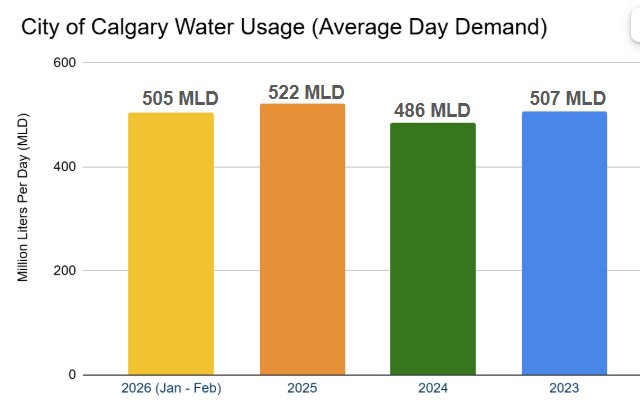
The average Calgarian (per capita), according to Green Calgary's water conservation tip sheet. consumes 231 liters of potable water a day. This water is directed to appliances such as sinks, showers, and laundry machines and contaminated, forming the byproduct, greywater. During summer, Calgary sees an increase in freshwater usage for recreational outdoor activities and watering lawns. Fresh water is abundant in Calgary as we are situated on the Bow River, fed from the Bow and Rae glaciers. However, glaciologists have begun measuring the increasing meltwater due to increasing temperatures and heat-dome events, showing that our fresh water will not always be present. For example, in 2021, the July heatwave caused the Bow Glacier’s meltwater to surge areas of the river, eroding banks and flooding small dams. If Calgary faces a similar heat-dome event again, the Bow Glacier will diminish severely, thus cutting off our main source of potable water.
Wastewater treatment in Calgary, including greywater:
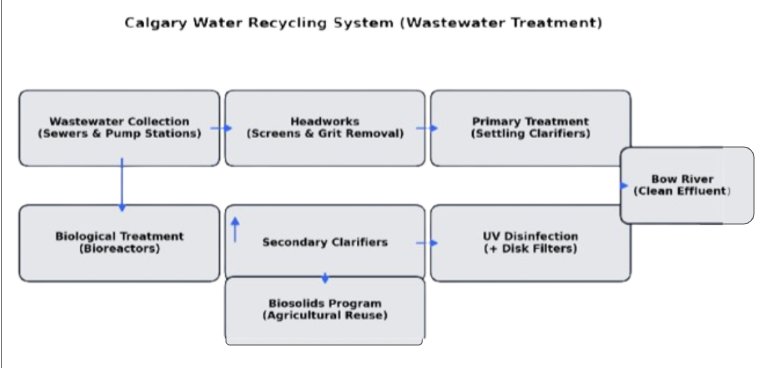
The Fish Creek, Pine Creek, and Bonnybrook wastewater treatment plants help treat wastewater in Calgary from all four quadrants. Pine Creek can support the wastewater demands of 1.75 million people, while Bonnybrook and Fish Creek can support 1.37 million. After water from drainage/ sewage pipes are sent to a collection site, they are redirected to the plants for the removal of pathogens, physical contaminants, and other harmful residue. Settlement tanks with paddles attached skim physical contaminants in a tank before sending the water to an aeration filter, bioreactor, secondary clarifier, and more means of chemical/ biological disinfection. The plants take care to not use excessive amounts of cleaning agents such as chlorine, as water will be sent back into the Bow River as “effluent”. Greywater, blackwater, and yellow water (urine contaminated) are not treated separately.
Real World - Bearspaw Feeder Main Breaks in 2024 and 2025
Calgary has faced water main breaks at the south feeder main of the Bearspaw Reservoir two years in a row. In June of 2024, the water main of the Bearspaw cracked due to corrosion and internal concrete damage. This event left thousands to depend on freshwater trucks, property damage in communities including Montgomery and Bowness, and the entire city to rely on the potable water from the Glenmore Reservoir. Although the infrastructure panel promised to improve the standards of inspections, the breakage in December of 2025 says otherwise. On December 31, the same south feeder main that carries 60% of Calgary’s water ruptured. While repairs were underway, stage 4 water restrictions were implemented once again. The target of 486 million liters of water used per day for the city had not been met - the daily usage was closer to 501 million liters.
Greywater, while not safe for human consumption, would have reduced stress on the wastewater treatment plants in times of crisis. Reusing it ensures that you have water, regardless of the quality, for appliances such as the toilet, sprinkler, and others that do not involve ingestion/ direct human contact. By reducing the demand on potable water for appliances where it is not always required, we consume less of the resource that is running out.
Data
PROPOSED GREYWATER EQUATION
Can be used by households to calculate daily G value
G = Daily greywater production in avg. household (byproduct contributed by everyone) P = Daily avg. of potable water consumption (per person) R = Ratio of greywater to potable water consumption (interchangeable ratio, not set at fixed value) H = Household population
“G= (PxR) (H)”
EX => There are 4 people in a household. On average, each person consumes 230 L of potable water every day. The ratio of greywater produced for every liter of potable water used is 70:100, meaning 70% of all water consumed has turned into greywater. Let us plug these values into the greywater equation: G = 230 (0.70)(4) G =644 L of greywater total
What is variable R, and why is it a significant factor in the greywater equation?
Variable ‘R’ is the ratio of greywater production to potable water consumption. On average, studies estimate 65% of all potable water consumed daily, per capita, becomes greywater. However, this percentage is not an accurate representation of every person, as water-spending habits, appliance types and other factors vary from household to household.
How do water spending habits and other factors change the outcome of variable R?
In relation to variable R, the more frequent and more length of time a person uses a greywater-spending appliance, the more greywater they will produce. This is not a negative outcome as it increases greywater reuse potential with a larger filtration system.
Factors to determine R variable:
- Flow rate of appliances
High flow and low flow appliances impact variable R.

- Frequency of Showering and Bathing
- Frequency of Using Bathroom Sinks
- Frequency of using Laundry machines
- "Warming Up" Water
- Greywater sources
In this project, I have proposed a questionnaire designed to show the relationship between appliance flow rates, household water-use habits, and the quantity of greywater produced. The questionnaire includes both quantitative and qualitative questions. It can be adapted for either household surveys or controlled water-use studies.
Questionnaire: Factors Affecting Greywater Production
Section 1: Respondent and Household Information
- Number of people living in the household: ____
- Number of bathrooms: ____
- Type of water supply: ☐ Municipal ☐ Groundwater ☐ Other: ______
Section 2: Water-Using Appliances and Fixtures
A. Showers
- Type of showerhead installed: ☐ Standard (high flow, >9 L/min) ☐ Low flow (≤9 L/min) ☐ Unknown
- Average shower duration per person: ____ minutes
- Frequency of showers per person per week: ____ times
B. Bathtubs (if applicable) 4. How often are baths taken (per person per week)? ____ 5. Average bathtub water depth or estimated volume used: ____ L
C. Bathroom and Handwashing Sinks 6. Sink faucet type: ☐ Standard ☐ Low flow ☐ Sensor/automatic ☐ Unknown 7. Average sink use per person per day (minutes): ____ 8. Typical use per activity (tick all that apply): ☐ Face washing ☐ Tooth brushing ☐ Shaving ☐ Handwashing
D. Laundry 9. Washing machine type: ☐ Top-load (older model) ☐ Front-load (high efficiency) ☐ Commercial/shared machine ☐ Manual washing 10. Average loads per week: ____ 11. Estimated water used per load (if known): ____ L 12. Do you reuse rinse or wash water for other purposes? ☐ Yes ☐ No
Section 3: Behavioral and Awareness Factors
- Are you aware of the difference between high flow and low flow appliances? ☐ Yes ☐ No
- Have you replaced any fixtures with water-saving types in the past two years? ☐ Yes ☐ No
- If yes, which ones? __________
- Do you consciously try to reduce water use during daily routines? ☐ Yes ☐ No
- If yes, please describe how: ___________________________
- Are you interested in using or recycling greywater for non-potable uses (e.g., irrigation, toilet flushing)? ☐ Yes ☐ No
Section 4: Estimated Greywater Sources
(Respondent can estimate volume or frequency if meters are unavailable.)

Section 5: Observations and Comments
- Any additional comments on water use habits, appliances, or greywater awareness:
Analysis:
1: Identify and Quantify Greywater Sources
From each completed questionnaire, I’d calculate the estimated greywater volume per day or per week using these sources:


If data is weekly, convert to daily by dividing by 7.
Step 2: Define Greywater Production Ranges
Once "V TOTAL" is calculated for all respondents, find summary statistics (mean, median, standard deviation) across the sample.
How to classify:
 (Adjust thresholds to match local data or reference studies.)
Step 3: Include Key Behavioral and Appliance Indicators
You can use both quantitative volumes and qualitative responses for cross-validation:
 This qualitative categorization helps to confirm whether estimated greywater volumes align with behavioral patterns.
Step 4: Compute Variable R (Greywater Ratio)
 Classify using:
- R<0.33 -> Low
- 0.33≤R 0.67 -> Medium
- R≥0.67 -> High
STEP 5 (Optional): Calculating potable water savings using greywater technology
Potable water = P Greywater = G Water Reuse Rate using greywater technology = RR Water savings % = (G*RR)/P
This means if an average household’s potable water use is 1200 liters/d and it produces average 600 liters/d of greywater, then given a greywater reuse rate of 0.8 (actual will depend on technology used/building limitations), the total water savings will be 40% Water savings = (600*0.8)/1200 = 40%
APPLICATION OF GREYWATER FINDINGS:
Separate studies have supported the idea of categorizing greywater producers. According to a case study by Craig-Madeline Jean (2025, Toronto Metropolitan University), greywater reuse systems were installed in 23 homes in the southern cities/ townships of Ontario.
Types of greywater reuse systems and the climates where they are best fit:
Calgary has seen reuse of greywater on a commercial scale but not much is known in terms of residential reuse. For example, the YMCAs in Calgary have implemented LEED Gold certified water reuse systems where the pool backwash and shower drainage water are filtered and redirected towards flushing locker room toilets. After contacting, I received a response from Nick Wiggins, VP Operations at YMCA. He states that a number of facilities (Saddletowne, Remington, Shane Homes and Brookfield Residential) started water reuse between 2012-2019. He explained that the water reuse systems were installed as the facilities themselves were being built. Encouraged by the City of Calgary’s environmental team, the YMCA has shown that they can reuse greywater on a large scale. There has been much advocacy in Alberta when it comes to reusing the water we have. For instance, Watersmart Alberta published a study in to determine how greywater reuse reduces water demands in households across Alberta. They caution that our fresh water is not unlimited, and that we need to invest in environmentally-friendly methods of greywater reuse and reclamation.
The growing need for water conservation and more efficient use of water resources in Alberta has resulted in the development of guidance for small water reuse. Water reuse consists of wastewater which has been treated to a quality suitable for a specific end-use. These systems may require an approved alternative solution as defined by the National Plumbing Code as referenced in the Plumbing Code Regulation.
At home greywater reuse systems can be as simple as a DIY setup, or as complex as a separate plumbing system for greywater. The type of system best fit is dependent on the type of household it is serving, low, average, or high. It is also important to consider climate when installing a greywater reuse system. Cold climates can face problems related to pipes freezing/ frost - wedging as well as water leaking and freezing inside other areas near pipes in the winter.
I have researched the greywater systems that are best fit for each type of household.
1. The simplest method of greywater reuse is called “bucketing”. You collect the greywater from an appliance and directly reuse it. Some ways you can use the collected greywater are for watering plants and flushing toilets (pour into bowl and flush). It is recommended that you do not keep the greywater contained for more than 24 hours\, as any pathogens or buildup will settle to the bottom\, causing odors and permeating waves of harmful bacteria into the air where it is stored around. Bucketing is a quick solution for when you have minimal amounts of greywater to reuse\, suitable for households falling under the low - average category. It is also suitable for any climate\, so long as the bucket is not stored outside in below 0 degrees Celsius.
2. This is an image of a diversion system for greywater.
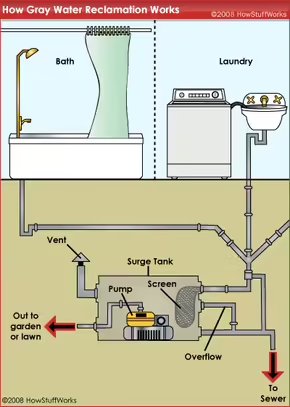 Image credits: HowStuffWorks.com, article "How Greywater Reclamation Works", Robert Lamb, 2008
There are many variants of it depending on the model and size you purchase, but most are used with manual switches. First, the person uses the diverter switch to decide from where the greywater is coming, be it the sink, bath, or laundry machine. They can then choose whether to send the greywater into the surge tank for quick, physical filtration (mesh screen) and directly to the irrigation area, or to the sewer. If a large amount (L) of greywater is directed to the surge tank, the overflow will be sent to the sewer so as not to have water back up the pipes or settle in the tank. Surge tanks are sterile and do not keep greywater sitting for long periods of time, as that can lead to buildup and the creation of blackwater.
Diversion systems are quite simple and are common in homes in temperate - hot climates. For example, the city of Perth (AUS) recommends keeping the systems running throughout summer to keep lawns healthy and water in supply. The pipes for diversion systems can be thin, not allowing bathtubs full of greywater down at a time. This sets back the time it takes water to get to the garden. Climate - wise, the diversion system is not as suitable for Calgary. The thin pipes are susceptible to frost-wedging if not properly maintained, and the water diversion to the lawn is not desirable in winter. However, homes falling under any category (low, average, high) may find this reuse system worthy of their wastewater needs depending on how frequently they water lawns in the summer.
3. This is a dual- plumbing system\, operating by having two separate pipelines for greywater and for blackwater.
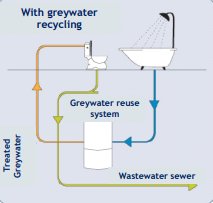 Image credits: Interreg Central Europe, PowerPoint titled "Greywater", unknown date
Greywater-producing appliances, such as the bathtub seen in the diagram, have a pipe that directly flows into the filtration barrel. Depending on the model, the greywater could be filtered by adding chemical agents (chlorine, activated carbon, hydrogen peroxide, etc.) or through a mesh membrane. The membranes separate physical contaminants, resulting in cleaner greywater. Water from the filtration system is constantly backed into appliances that use water but can run on water that is not potable. In the diagram, the yellow arrow shows the redirection of the treated greywater, it goes into the toilet’s tank. Blackwater or excess greywater is sent directly to the main sewer feed.
Dual plumbing is suitable for both hot and cold climates, as it is indoors and should not encounter external sources unless the pipe is redirected to a garden/ outdoor greenhouse. The installation process should be done carefully, so as not to coincide with the normal sewage pipelines of the house. This method of greywater reuse is suitable for households that fall under the average/ high category, as they produce enough greywater to continuously fill the surge tank.
4. This image is the BioBarrier\, a membrane bioreactor that removes particles and pathogens with an ultrafine membrane.
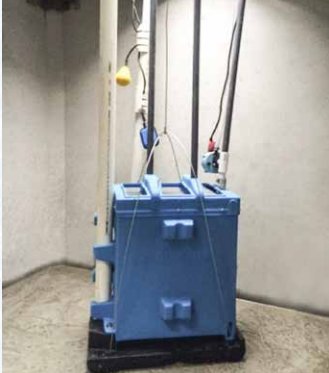 Image credits: BioMicrobics-- BioBarrier Information Brochure, no date
It is a long-term greywater investment, and the treated water can be used for flushing toilets, lawn irrigation, and washing outdoor surfaces. After water travels from a greywater pipeline into the tank, aeration is used to settle heavy particles and further extract anything that floats to the surface. The vacuum pump then draws water into the ultrafine membrane to purge all remaining particles. Inside, the membranes and oxygen hose are self cleaning, making it easy to maintain.
Because of its size, the BioBarrier is suitable for households that fall under the high greywater-producing category. It is suitable for cold climates and can be shut down in winters as the system is installed inside or below the house rather than outside. It is recommended for larger houses such as a duplex, 3-story, or mansion. High greywater producers may opt to invest in the BioBarrier.
Conclusion
CONCLUSION:
Compared with centralized wastewater systems, building-level greywater treatment faces technical (limited expertise) and operational (variable influent quality) challenges. Yet, greywater offers strong potential for reuse to address urban water scarcity. Reusing water at the building scale improves system flexibility, reduces transport energy, and enhances city resilience. Cities worldwide, including Calgary, face severe freshwater shortages. Understanding how reuse contributes to conservation, is essential. While technologies exist, mass adoption requires data showing the benefits and ensuring treated greywater is safe. For instance, if Calgary consumes about half a million liters daily, even reusing a quarter could substantially reduce future infrastructure stress. Using my testing tool, I can derive a reuse variable for households based on water use and behavior, then scale it citywide with a greywater equation. Estimating enables decisions on treatment methods and supports strategies that could save millions of liters of potable water each day.
EXTENSION:
Beyond the Ontario case study (CMJ), I found few scientific sources that quantify greywater reuse or examine how water usage habits influence greywater production and overall reuse potential. Gathering my own dataset through the testing tool would allow me to analyze how different households use water compared to the averages I calculated. For instance, while I hypothesized that high-producing households have an R value greater than 0.67, collecting data from 20–40 relevant households could reveal that this value changes significantly.
During my research, I discovered that Calgary’s wastewater data is either not measured or not publicly available. Building my own dataset would therefore help overcome this limitation by providing direct measurements of household wastewater and reuse patterns.
Extending Getting Greywater Smart would involve:
- Distributing the testing tool to real households to collect detailed data on greywater production\, consumption\, collection\, and reuse — helping to fill a major gap in localized water-use research.
- Computation of greywater reuse rates depending on technology used and building restrictions\, to arrive at average water savings rate.
- At a household\, city\, provincial or national scale\, this can be foundation of the cost benefit ratio. The cost–benefit ratio is calculated by multiplying the household’s total daily potable water use by the greywater savings rate (example 40%)\, then multiplying that result by the water price and by 365 days in a year and finally dividing the annual monetary savings by the total cost of the greywater system. Of course\, this is just when measuring benefits in monetary terms. The economic benefits of addressing water scarcity concerns and\, for a modern city like Calgary facing massive water infrastructure challenges\, the gains would go well beyond the monetary.
Citations
Water reuse and recycling in Canada — history, current situation and future perspectives Tony Van Rossum July 22, 2020 https://iwaponline.com/wqrj/article/55/3/213/85138/Water-reuse-and-recycling-in-Canada-history-current
SEASONAL VARIATION IN GREYWATER QUALITY FOR A REAL LIFE SYSTEM Maitreyee M. Tilve May, 2014 https://www.researchgate.net/publication/262535562_Seasonal_variation_in_greywater_quality_for_a_real_life_system
How Greywater Systems Work, The black and white about greywater GroundStone, BC Publication date not specified https://groundstone.ca/how-greywater-systems-work-the-black-and-white-about-greywater/
Saving water in your home City of Calgary water services Publication date not specified https://www.calgary.ca/ues/water/education/water-conservation/saving-water-in-your-home.html
Water Reuse and Recycling in Canada: A Status and Needs Assessment Kirsten Exall September 2004 https://www.ec.gc.ca/water/en/manage/wateruse/e_reuse.htm Reuse of Grey Wastewater in Multi-Story Buildings Authors not listed Building (4Science Journals) Publication date not specified https://journals.4science.ge/index.php/building/article/view/3275/3269
Greywater Treatment and Reuse in Northern Buildings and Communities: Results from a Demonstration Project N. A. Poirier, R. Pristavita 2019 https://www.canada.ca/content/dam/polar-polaire/documents/publications/aqhaliat/volume-2/greywater-treatment.pdf
Greywater Systems Green Building Alliance Publication date not specified https://www.gba.org/resources/green-building-methods/interior-solutions/greywater-systems/
City of Calgary Open Data Portal – Environment City of Calgary Continuously updated https://data.calgary.ca/browse?category=Environment&sortBy=relevance&pageSize=20&page=7
Water Single-Family Consumption City of Calgary Publication date not specified https://data.calgary.ca/Government/Water-Single-Family-Consumption/j7mp-h975/data_preview
Types of Homes in Calgary: Condos, Houses, and Other Housing Types Anastasia Dvorak Publication date not specified https://calgarylifestyleguide.com/types-of-homes-condos-houses-in-calgary-types-of-houses-with-pictures-and-definition/
Towards Development of a Standard Methodology for Testing Field Performance of Residential Greywater Reuse Systems Madeleine Craig, Russell Richman 2018 https://iwaponline.com/jwrd/article/8/2/135/38022/Towards-development-of-a-standard-methodology-for
Feeder Main Repair (City of Calgary) City of Calgary Publication date not specified https://www.calgary.ca/emergencies/feeder-main-repair.html
Bonnybrook Wastewater Treatment Plant Upgrade and Expansions City of Calgary Publication date not specified https://www.calgary.ca/planning/water/bonnybrook-wastewaste-treatment-plant-upgrade-and-expansions.html
History of Flooding in Calgary City of Calgary Publication date not specified https://www.calgary.ca/water/flooding/history-calgary.html
Housing in Canada: Statistical Overview Canada Mortgage and Housing Corporation (CMHC) 2015 https://publications.gc.ca/collections/collection_2016/schl-cmhc/NH18-24-3-2015-eng.pdf
Glacier Melt and Alberta Heat CBC News Published date: not fully clear but article link references mid-2021 coverage (likely June 2021) https://www.cbc.ca/news/canada/calgary/jeffrey-kavanaugh-glacier-melt-retreat-rockies-heat-wave-1.6091949
HE Washing Machine Water Usage Whirlpool Canada (blog) Publication date not specified https://www.whirlpool.ca/en_ca/blog/washers-and-dryers/he-washing-machine-water-usage.html
Residential Greywater Solutions Greyter Water Systems (corporate web page) Publication date not specified https://greyter.com/products-solutions/residential/
Different Types of Greywater The Greywater Project Publication date not specified https://www.thegreywaterproject.org/differenttypesofgreywater
City of Edmonton Green Guide — Water Consumption City of Edmonton Publication date not specified https://www.edmonton.ca/public-files/assets/document?path=PDF/GreenGuide-WaterConsumption.pdf
How to Read Your Water Bill City of Calgary Publication date not specified https://www.calgary.ca/water/customer-service/how-to-read-your-water-bill.html
Greywater Recycling and Reuse in Alberta (2011) Publication date: 2011 Watersmart Solutions / water utility report (likely authorship by project group but not explicitly listed) https://watersmartsolutions.ca/wp-content/uploads/2018/08/Greywater-Recycling-and-Reuse-in-Alberta-2011.pdf
Acknowledgement
I would like to acknowledge a few people who were the biggest supports I had while researching "Getting Greywater Smart"! I am very thankful for my experts, Nick Wiggins (VP of Operations at Calgary YMCA) and Mike from Move Water company in Edmonton. I would also love to thank my mom for helping me understand more about how reusing greywater can benefit us cost-wise.