
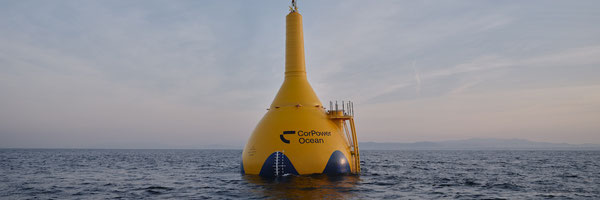
Wave energy for electricity generation
Anvay Shidhaye
STEM Innovation Academy Jr. High SW
Grade 7
Presentation
No video provided
Problem
What is wave energy and how can we use it to power our world in a clean way?
d
Method
I searched the internet for all the information
d
Research
Ocean waves enter a WEC (Wave Energy Converters), which then drives a power take off system. WECs turn the wave energy into mechanical energy as the waves interact with the device (ex. The surging of a flap or rising and falling of a buoy). It is converted into mechanical energy through a power take-off system such as an air turbine. The power take-off system (PTO) is attached to a generator that converts mechanical to electrical energy, which is then transferred onshore through wires. Here, you can see the types of WECs in more detail. •Wave Profile Devices include Point Absorbers, which are shorter than the wavelength, and attenuators, which are longer than the wavelength. Both rise and fall because of the wave, pushing a hydraulic pump. This is known as a hydraulic power take-off system (PTO). This pump pressurizes the liquid, which spins a turbine to generate electricity. •Oscillating Water Columns are positioned on deep shorelines. They block off water that will come to the shoreline but leave a gap at the bottom. The water fills the gap, pushing air inside the machine to spin a turbine. When the water come out, air is sucked in, spinning the turbine for the second time. Oscillating water columns are a type of terminators, which “terminate” the wave. •Wave Capture Devices are floating devices which have ramps that water climbs up. The wave crashes into the ramp and falls into the main compartment, the “reservoir.” This water pool which falls into the second compartment and spins a turbine. It falls out of the device, back to the ocean. They are also called overtopping devices. •Submerged Pressure Differential wave energy converters use the fluctuating of the surface from waves to generate electricity. There are two types: One uses a turbine at the seabed, which is connected to a heavy floating device. When the waves push is up, the floating device moves up, pulling air to spin the turbine. When it falls back down, the air inside the pipe connecting the turbine and the floating device is compressed, pushing the turbine for the second time. The generator inside the turbine creates electricity. The other one is like a point absorber. It uses the heave motion of a submerged buoy. Waves move the buoy in a reciprocal motion, which is converted to electricity through another power take-off. The Rotating Mass type of PTO uses an internal weight rotating about a fixed point to change the center of gravity when waves hit the device. Since the internal weight is always trying to move to its new center of gravity, electricity is generated because of it spinning. To summarize, there are multiple different types of getting energy from waves. These machines use different systems and locations, but all of them use turbines and generators. All these systems are Power Take-Off systems, the heart of the WEC. There are many projects around the world dedicated to generating electricity through wave power. UK The UK is one of the world's largest wave energy generators. Scotland alone has fifteen gigawatts of electricity. Multiple companies have made innovative wave energy converters to harness this giant source of electricity. Ireland Ireland’s 1,448 kilometers of shoreline can be used to convert the strong ocean waves into usable electricity. The Saoirse project is Ireland’s biggest wave energy project, made by ESB, Ireland’s biggest ocean energy company. The EU funds this project. Ireland is evaluating its wave energy infrastructure, as wave energy could fully provide Ireland’s energy. France France’s Atlantic coast offers high potential to generate electricity through wave power. Multiple sites across the coast have been set up to test and develop wave energy infrastructure. The French government continues to promote wave energy production, as they are trying to use less non-renewable energy sources. Australia •Strong Southern Ocean winds generate huge waves that continuously battle the coast of Australia, where wave energy may produce enough energy to power more than 10% of the country. CSIRO says that there are two hundred wave energy devices across Australia that are in the testing and developing stages. The Perth Wave Energy Project was the first in the world to produce electricity connected to a grid, plus it produces desalinated water. South Korea •The South Korean government has invested in multiple sites across the coast, where there is potential for wave energy generation. Jeju Island, a South Korean state, has lots of wave activity, so South Korea has set up many testing sites there. Portugal •A pioneer in wave energy generation, Portugal continues to invest in wave power. Portugal’s Agucadora Wave farm was the first commercial wave farm in the world. Many projects are underway, and wave energy could make up 30% of Portugal’s GDP. China China’s long coastline of 14.5 thousand kilometres means there is potential for many wave energy projects. Theoretically, China could generate 1/10th of its electricity through wave power. China’s first project, Nankun, is an oscillating water device and was connected to the grid in November 2023. China continues to invest in wave power generation and is a potential leading wave energy provider. Chile Chile is the leading wave power generator in South America. South America’s first proven and tested WEC was developed by Chile, in the Pacific Ocean. United States The US has a coastline of 19,924 kilometres, meaning there is potential for developing and generating wave energy. Research on wave power generation has been made by the US, mostly through organizations such as the US Department of Energy. Places such as California, New Jersey, Oregon, and Hawaii have all been hotspots for WEC testing. India Bharat Petroleum Corporation Limited (BPCL) has decided to supply India’s largest wave energy project at the Mumbai Oil Terminal. Eco Wave Power has collaborated with BPCL, and the collaboration is supported by India’s Minister of Petroleum and Natural Gas. New Zealand New Zealand has potential for wave energy generation, considering the south coast where waves could generate sixty kilowatts/meter. It is possible that New Zealand could produce five thousand terawatts of electricity a year, which is well over its current electricity consumption. Norway Having the longest coastline in Europe, Norway has great potential for wave energy generation. Since Norway is a smaller country, it takes less time and money to reach the coast, making it ideal for wave energy generation testing. Norway has started construction on the Norwegian Ocean Technology Centre, a laboratory where ocean technologies will be researched and developed. Israel Opened in 2024, Israel’s EWP-EDF One project at Jaffa Port was Israel’s first WEC connected to the grid. Israel has enough infrastructure on the coast to potentially produce 250 MW of electricity in the future. Canada While Canada may not have any ongoing wave energy production, Natural Resources Canada’s experts are developing advanced WECs and technologies. Canada has huge potential because it is surrounded by three oceans: The Arctic, Atlantic, and Pacific oceans. This makes Canada have the world’s longest coastline of 243,042 kilometers. Summary
Multiple countries around the world have tested, advanced, developed, and evaluated wave power generators. Countries such as Israel, the US, China, the UK, and Portugal already have generated electricity, while other countries are still in the developing stage. Canada has huge potential since it is surrounded by three oceans. In Canada’s Pacific and Atlantic oceans, multiple projects are being tested. The pacific coast has a theoretical capacity of 42,000 megawatts, which covers 60% of Canada’s energy consumption, while the Atlantic has even more, at 146,500 megawatts. Many devices are still in the prototype stage, while some are being tested. British Columbia has organized two wave energy projects: SyncWave Energy Systems and the Pacific Coastal Wave Energy Corp, both right next to Vancouver Island. If wave energy in Canada is used, then it can help local economies develop and help the country overall by helping transition from fossil fuels to renewable energy. Canada could build wave energy machines near existing technology, such as near a wind farm in the ocean. This way, all you need to do is send the WEC and connect it with a wire to the existing technology. Canada’s companies could also partner with other countries to provide fuel or WEC equipment.
Data
 All my other info is in "research"
All my re
All my other info is in "research"
All my re
Conclusion
In conclusion, my study has revealed the following information about wave energy: •Wave energy uses Wave Energy Converters (WECs) •WECs use a power take-off system to generate electricity (ex. The rising of a buoy) •There are multiple types of WECs including wave capture devices, oscillating water columns, and submerged pressure differential •There is also Tidal energy, which use TECs and the motion of tides
Citations
Introduction: https://seagrant.oregonstate.edu/ocean-renewable-energy/marine-energy/waveenergy#:~:text=Wave%20energy%20is%20a%20type,eventually%20grow%20into%20larger%20waves. How it works: https://marinerenewables.ca/facts/wave-energy/#:~:text=Oscillating%20Water%20Column:%20Water%20enters%20through%20a,connected%20to%20a%20turbine%20to%20generate%20power. Machines involved: https://www.alternative-energy-tutorials.com/wave-energy/wave-energydevices.html#:~:text=Capture%20Wav e%20Energy%20Devices,Turbine%20generating%20electricity%20as%20shown, https://theliquidgrid.com/marine-clean-tech-briefs/wave-energy-converters/submerged-pressure-differential/. Ongoing Projects: https://natural-resources.canada.ca/energy-sources/renewable-energy/ocean-energy , https://www.ecowavepower.com/eco-wave-power-reports-h1-2025-results-showcasing-breakthroughs-in-u-s-europe-asia-and-africa-as-global-wave-energy-demand-accelerates/ , https://wedusea.eu/wave-energy-around-the-world/ Wave vs. Tidal Energy: https://www.emec.org.uk/marine-energy/tidal-devices/ Advantage and Disadvantages: https://evidencenetwork.ca/wave-energy-what-it-is-how-it-works-types-examples-advantages-and-disadvantages/ , https://earth.org/the-pros-and-cons-of-wave-energy/ What can Canada do with this: https://thestarfish.ca/journal/2025/03/movement-of-the-ocean-is-wave-power-the-future-of-sustainable-energy, https://marinerenewables.ca/facts/wave-energy/. The Future: https://www.cnbc.com/2022/09/07/why-wave-power-could-complement-solar-and-wind.html.
Acknowledgement
Thank you for my parents for guiding me through my project, giving me feedback for my project and letting me use their printer for my information.
d