

Running Tuned In
Abigail Iwaniuk
R. T. Alderman School
Grade 9
Presentation
Hypothesis
If music of one's liking is listened to when running, then the rate of perceived exertion will be lower, and the pace of the run will match the bpm of the music. This is because listening to music of liking provides a distraction from fatigue, and can increase serotonin levels making the run seem easier; as well as because people tend to match their step to the beat of a song. It is a prediction that heart rate will be higher after listening to higher bpm music when running.
Research
Introduction Running is an important function that greatly benefits the health of humans. Any way to make people more interested in running is something to look into, for example music. This experiment will be testing how music affects the human body's ability to run in many ways. First, it will be testing how bpm affects the distance you can run in a certain time(5 minutes), along with the pace you are running at. Additionally, the rate of perceived exertion will be tested. The control experiment in the project will be running without any music. This topic is relevant to humanity because especially right now, there is an influx in interest in running. Many of these people have a newfound interest in running, but don’t know where to start regarding many factors of running, including music. This project aims to bring some answers to questions runners may have as well as add to the growing knowledge of running.
Past Research
Overall this topic has been researched quite a bit before. There are many papers that go into depth about different factors in how music affects the brain; for example “The Influence of Music Preferences on Exercise and Performance: A Review” published by Christopher G. Ballmann, Department of Kinesiology at Samford University. This article goes into some of the specifics about the psychological, physiopsychological, and physiological effects music has on exercise. Another article of note is “The effect of music type on running perseverance and coping with effort sensations” written by G Tenenbaum, R Lidor, N Lavyan, K Morrow, S Tonnel, A Gershgoren, J Meis, and M Johnson. What makes this article fascinating is its results when compared to other research findings. Results of which showed that music did not influence rate of perceived exertion, heart rate, and sensation of exertion, however the music was perceived as a positive by the participants. The broad conclusion is that there are many papers done that show how music can have many effects, but there are still some that show no effects or very little; this encourages further inquirement into the topic.
Basics in BPM BPM is the amount of beats per minute that a song or instrumental piece has. Also known as the heartbeat of music, depending on the amount of beats the person listening to the song may feel a variety of things. For example low BPM(normally 40-60) typically has a calming or sad effect, contrasted with high BPM(normally 140+) which tends to elicit excitement. Moderate BPM is a nice in between and favors a relaxed and happy mood. In running BPM can be used to set a pace for the run as people often move with the beat. If one is looking for a high intensity run they can put on songs with a higher BPM and vice versa with a low intensity run. All in all BPM is a simple thing that can be used if need be.
Psychological Components of how music effects running Music is unique, as it activates so many different parts of the brain all at once. Not only does it activate many areas of the brain, but depending on the genre of music certain parts of the brain have more or less activation. Regarding running, the turning on of these parts will affect how you run, and how you feel while running. Some parts of the brain that experience neural activation to note are the left inferior frontal gyrus, and the insular cortex. The former plays a part in response inhibition, and the latter plays a part in interoception, pain perception, and regulating the autonomic functions. The activation of these suggests an increase in cognitive processing speed, and movement organization, which is a great optimization for running.
Listening to music before has been shown to increase motivation, effort, and can help distract from fatigue, which can help push through exhaustion while running. Not only that, but a reduction in fatigue perception through dissociation and distraction is another possible effect from listening to music. A person's overall view of their run can be changed by music as well, because of an increase in serotonin levels.
Physiological Components of how music affects running Within the context of listening to music someone prefers, it has been shown that music, even when doing high intensity exercises, improves a person's mood, no matter the level or how trained that person is. Not only that but it has been shown to increase a person's vigor while doing physical activity. Music also has the ability to reduce the rate of perceived exertion through dissociation and distraction. Things like muscle activation and catecholamines have displayed alterations by the presence of music while exercising. Specifically adrenaline levels, stress levels and heart rate have also been shown to be affected by music. High energy music can increase adrenaline and heart rate. While low energy music can do the opposite; decrease adrenaline, and lower heart rate. This is particularly good for after a run when you want to cool down. However, the majority of this has been shown to only happen when the person is listening to their preferred taste; when otherwise, the results that music has on you while doing things like running doesn’t affect you, or even worsens your performance. Another possible downside is that the tempo of a song can affect your breathing patterns, which has a chance to worsen your endurance during running. Overall music can have some unique effects on various factors of running.
How music affects the brain Humans developed a keen sense of hearing way back in the earlier days in order to survive, and now that evolution serves as the reason why music has such an effect on the brain. Music lights up almost all of the brain, including the limbic system(in charge of pleasure, motivation, body’s motor system), amygdala and hippocampus(both in charge of emotional responses through memory). Due to so many brain systems firing off at once is why music can be such a rich experience. When music goes through the temporal lobe it can influence the autonomic nervous system, which is why listening to suspenseful or calming music can alter the heart rate. It is also important to note that the positivity or valence of the song can influence the ANS as well.
Music has been shown to reduce stress and anxiety, regulate mood, and facilitate emotional processing, and that is just regarding some of the emotional effects of music. Focus and efficiency have displayed an increase when there is rapid modulation; activation in the prefrontal cortex and frontal lobe(control judgment and reasoning) are the cause for this, explaining why listening to background music can be a task or easily unmotivated. Additionally, cognitive processing also has some improvements such as reduction in reaction time, better focus, well-preserved memory, enhanced creativity, and increased spatial awareness. High energy music can also increase motivation. All in all, music has many effects on how the brain functions, and processes different things.
How genre affects the brain and possibly running ability
Various genres affect the brain differently due to separate sensitivities the frontal lobe has to different music, and how the auditory cortex processes pitch, melody, rhythm and timbre. To start, classical music has enhanced attention, activity in prefrontal cortex (due to complex structure), working memory, and self referential processing; as well as being associated with relaxation, focus, and better cognitive process. While EDM shows more activation in motor regions, engagement with the motor cortex, increased dopamine in the nucleus accumbens, reduced self-awareness and increased sensory output(affected by changes in default mode network). Rock shares some connection with EDM as it also engages with the motor and auditory cortices, however it is more emotion driven with activation in the amygdala and hippocampus. Something to remark is that listening to non-preffered music/genres when running can increase RPE and decrease the ability to dissociate to the music, beyond that of no music. Overall, different genres of music have varying effects on neural activation.
Concluding
The main focus of all this research is learning how music could possibly affect one running, and how it is possible to use this information to one's benefit. Music affects running both regarding the brain, and things it controls like emotion and motivation; as well as physically with things like motor control, adrenaline, and heart rate. In general music has a big effect on the brain because it activates so many parts of it, and it is to be noted that the genre of the music can affect said activation. The popularity of running is seeming to increase, and with that comes wanting to learn more about the subject. People may also want to know how to optimize their running to make it both easier and more enjoyable. This is where this project comes in; by testing how components like(but not solely) rate of perceived exertion are affected by music, people may become better informed of how they can change or add simple things to their running routine to improve the overall experience.
Variables
Manipulative: Bpm, and music vs no music Responding: Rate of perceived exertion, and pace Controlled: Liked music chosen, running for 5 minutes, track does not change, rest time, questions asked
Procedure
- For the first round of testing do not do step number 4, the first test should be done without music for a control test
- Put heart rate and distance measuring wrist band on the test subject
- Record in data table the heart rate of the test subject
- Get headphones on, and start the prepared music with low bpm to start
- Get timer ready, and approach the start of the track(or area of running)
- Count down from 3, and start the timer once test subject begins
- The runner will run for 5 minutes, once the 5 minutes is over stop the timer
- Check the distance that the test subject has run and record in data table
- Figure out the average pace of the test subject(Time/Distance= Pace), and record in data table
- Check the heart rate of the runner at different points of the test(begining and end), and record in data table
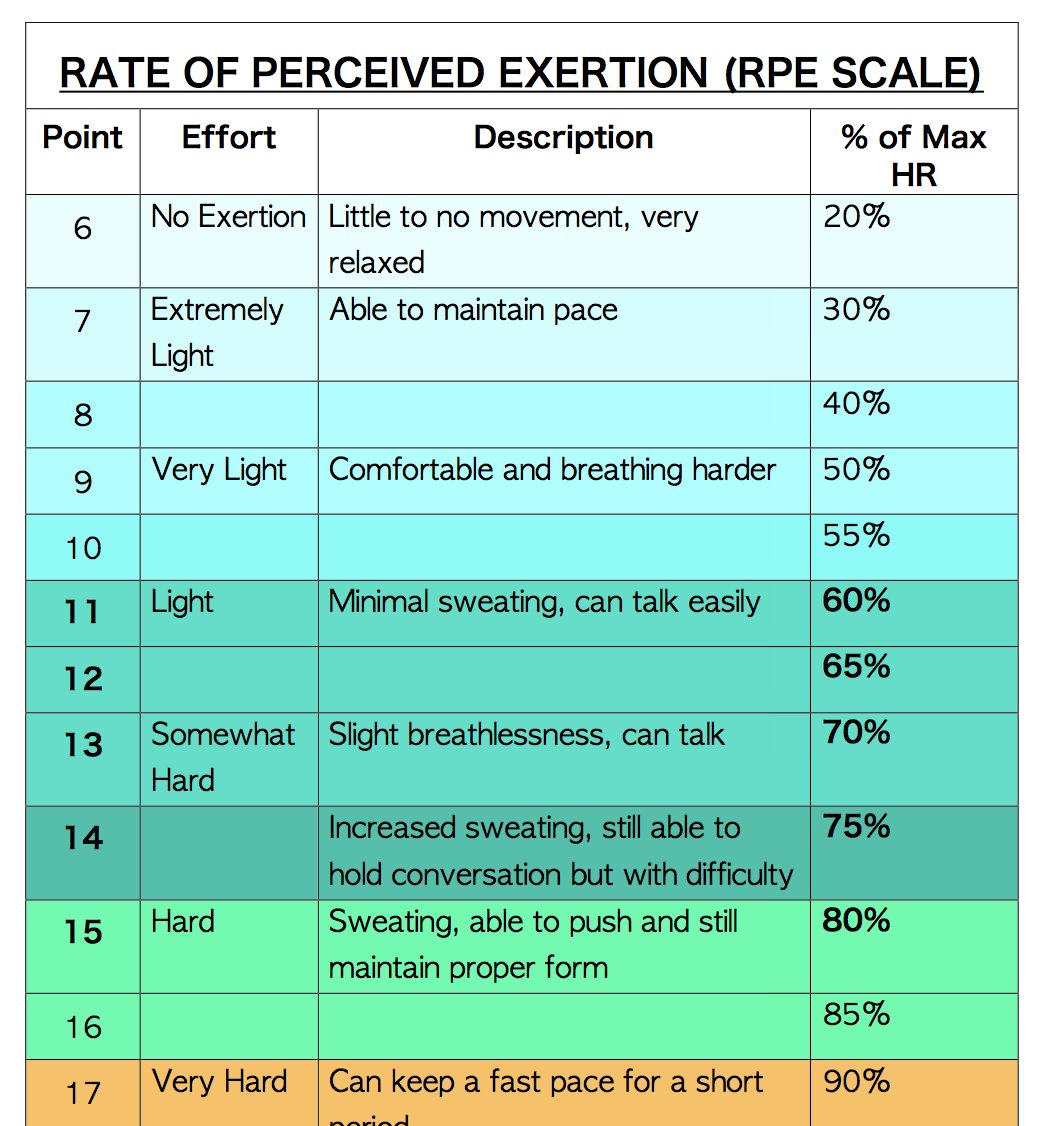
- Ask the test subject to answer their rate of perceived exertion based off of the Borge RPE scale, and record in data table
- Ask the test subject how the run felt(were certain parts harder, did they go faster or slower)
- Give the test subject a 20 minute break
- Repeat steps 1-12 to get a total of 4 trials per test subject, 3 with music 1 without, making sure to change the bpm each time, first test low, second test moderate; third test high
*Before the experiment begins, ask the test subject to send a list(10 or so) of moderate to high energy songs that they like, and then determine which songs are in the bpm range needed(130-145 for this group). Create a playlist that you will play for the test subject(the playlist will change with each test subject)
Observations
| Data Collection |
|---|
| Test | Test Subject | Heart Rate before | Heart rate after | RPE(6-20) | Distance Ran | Time | Average Pace | Qualitative | BPM(average) |
|---|---|---|---|---|---|---|---|---|---|
| Control | 1 | (not accurate)57 | 102 | 12 | 1 | 5 | 8.695652174 | N/A | 0 |
| 1(low) | |||||||||
| 120 | 168 | 12 | 0.7 | 5 | 7.142857143 | ||||
| 85 | |||||||||
| 2(moderate) | |||||||||
| 90 | 150 | 14 | 0.9 | 5 | 5.555555556 | ||||
| 135 | |||||||||
| 3(high) | |||||||||
| 102 | 180 | 15 | 0.92 | 5 | 5.434782609 | ||||
| 155 | |||||||||
| Control | 2 | 73 | 140 | 10 | 0.805 | 5 | 6.211180124 | N/A | 0 |
| 1(low) | |||||||||
| 84 | 192 | 12 | 0.9 | 5 | 5.555555556 | distraction | 90 | ||
| 2(moderate) | |||||||||
| 96 | 204 | 14 | 1 | 5 | 5 | Distraction | 126 | ||
| 3(high) | |||||||||
| 102 | 180 | 15 | 1.24 | 5 | 4.032258065 | motivation | 167 | ||
| Control | 3 | 78 | 132 | 13 | 1 | 5 | 5 | N/A | 0 |
| 1(low) | |||||||||
| 90 | 144 | 12 | 0.805 | 5 | 6.211180124 | ||||
| 102 | |||||||||
| 2(moderate) | |||||||||
| 96 | 126 | 15 | 1 | 5 | 5 | ||||
| 130 | |||||||||
| 3(high) | |||||||||
| 114 | 168 | 16 | 1.15 | 5 | 4.347826087 | ||||
| 170 | |||||||||
| Control | 4 | 84 | 138 | 11 | 0.7 | 5 | 7.142857143 | The very last hundred meters. | 0 |
| 1(low) | |||||||||
| 78 | 156 | 12 | 0.83 | 5 | 6.024096386 | The middle-ish when “don't dream it’s over” was ending- I think I picked up parser when tinnitus started playing- distraction | 95 | ||
| 2(moderate) | |||||||||
| 84 | 162 | 13 | 0.96 | 5 | 5.208333333 | Getting going was hard with the song “wildflower” playing, very end with Takedown playing was easier- slower at the end of wildflower that got faster at the start of takedown- distraction | 144 | ||
| 3(high) | |||||||||
| 96 | 162 | 14 | 1.02 | 5 | 4.901960784 | was pretty good, at the end I was getting tired because of the such high energy, American idiot was playing- whole thing was pretty consistent- motivation | 183 | ||
| Control | 5 | 102 | 120 | 13 | 0.7 | 5 | 7.142857143 | the whole 5min felt long as you didn't really know when it would end and it was kinda boring, | 0 |
| 1(low) | |||||||||
| 96 | 180 | 9 | 0.93 | 5 | 5.376344086 | Slightly less hard but made it feel really long because the music was slow, but laps were easier because of the music | 110 | ||
| 2(moderate) | |||||||||
| 78 | 186 | 12 | 0.82 | 5 | 6.097560976 | I think the last minute felt really hard because I was running a little faster because of the faster pace music, the music provided a distraction-made it easier | 143 | ||
| 3(high) | |||||||||
| 84 | 168 | 14 | 1 | 5 | 5 | This one didn't feel hard, the music made time go by faster, it felt fun | 110 | ||
| Control | 6 | 138 | 174 | 12 | 0.862 | 5 | 5.800464037 | the last quarter was pretty difficult- same all around otherwise, consistent pace during run | 0 |
| 1(low) | |||||||||
| 120 | 150 | 13 | 0.69 | 5 | 7.246376812 | halfway through it got difficult, got easier after that(not related to the song) focusing on the song, consistent pace all around | 105 | ||
| 2(moderate) | |||||||||
| 114 | 206 | 15 | 0.8 | 5 | 6.25 | when ever the beat was not interesting they slowed down, last stretch was easier because the music was hitting just right and they wanted to get it over with, 4 times pace was picked up, motivation through the music | 133 | ||
| 3(high) | |||||||||
| 120 | 160 | 18 | 0.91 | 5 | 5.494505495 | all around more difficult due to muscle fatigue, but was better because of the music, slower around the mid part but pace returned to normal afterwards(1 minute), distraction through music | 185 | ||
| Control | 7 | 126 | 192 | 16 | 0.7 | 5 | 7.142857143 | N/A | |
| 1(low) | |||||||||
| 126 | 180 | 18 | 0.69 | 5 | 7.246376812 | 75% of the way through form started to worsen, first lap was the easiest, speed started faster and then got slower, and last lap increased again | 109 | ||
| 2(moderate) | |||||||||
| 120 | 150 | 17 | 0.7 | 5 | 7.142857143 | the slow part of the second song was harder, music did help through motivation and distraction, beginning was easier the song was motivating, slowed down towards the middle- not music related | 146 | ||
| 3(high) | |||||||||
| 114 | 168 | 17 | 0.6 | 5 | 8.333333333 | harder towards because of exhaustion, keep pace with the songs, chorus made running easier, consistent pace with the songs, motivation | 153 | ||
| RPE Table | 1 | 2 | 3 | 4 | 5 | 6 | 8 | |
|---|---|---|---|---|---|---|---|---|
| Control | 12 | 10 | 13 | 11 | 13 | 12 | 16 | |
| Low | 12 | 12 | 12 | 12 | 9 | 13 | 18 | |
| Moderate | 14 | 14 | 15 | 13 | 12 | 15 | 17 | |
| High | 15 | 15 | 16 | 14 | 14 | 18 | 17 |
| BPM | Av heart rate before | Av heart rate after |
|---|---|---|
| Control | 100 | 142 |
| Low | 102 | 167 |
| Moderate | 96 | 169 |
| High | 104 | 169 |
| Test | Average pace(P=T/D |
|---|---|
| Low | 6.4 |
| Moderate | 5.9 |
| High | 5.3 |
| Test | Average distance ran in each test |
|---|---|
| Control | 0.823857142857 |
| Low | 0.7921428571 |
| Moderate | 0.855 |
| High | 0.9771428571 |
| How did music help? | Distraction | Dissociation | Motivation | Did not help |
|---|---|---|---|---|
| Low | 3/5 | 0/5 | 0/5 | 2/5 |
| Moderate | 2.5/5 | 0/5 | 2.5/5 | 0/5 |
| High | 1/5 | 0/5 | 4/5 | 0/5 |
Graphed Versions of Data | 


    |
|---|
Analysis
Analysis and Discussion The data from this experiment shows that music can have an effect on the mental challenge of running. Furthermore an increase in bpm does increase the amount that one can run in a set period of time. For the low bpms tests the music had little effect on the real portion of running, and in one trial it even had a negative effect: making the run feel drawn out and harder due to the slow pace of the music. Heart rate in the low bpm tests did average lower than higher bpm rates with an average of 167 however, it was greater than the average heart rate for the control test which was 142. The difference between the average heart rate of the music test was only by a few, with moderate and high bpm having the same average of 169 beats per minute. Along with this, the control test’s average distance was similar to that of the moderate tests. This may imply that when running without any external influence one might naturally flow into a moderate tempo; as well as their heart rate may not increase as much. Regarding the increase in heart rate being at least 20 less than the rest of the tests, this could be due to the fact that it was the first test, or possibly because music can raise your heart rate faster than without. In order to get a clearer answer more testing should be done. As the bpm increases to moderate and high, the difficulty changes with moderate being easier than low, but high being more difficult than moderate but easier than low. For one test subject the high bpm test was the easiest because the music pushed them through it. The rest of the test subjects thought it was harder due to fatigue. This fatigue may have been caused by the fast pace of the music, making the muscles exhaust faster. However, it also could have been caused by overall fatigue from having to run multiple times, and every person's body having a different time requirement for rest(all test subjects were given the same amount of rest time). It is certainly something to take note of, and possibly a source of error. If this test was done in a way that ensured that the participants got fully rested in between tests, the outcomes may change. The upbeat Moderate though, no one seemed to suffer through fatigue, and the music did help. In the end this test seemed to be the easiest for most participants. Most likely because the music was still engaging while also having a pace that wouldn't push the body to an above average speed. In each of the tests the amount of subjects that said motivation through music helped varied, but one thing all tests had in common was no one found that music helped through dissociation. This could be because music engages with so many parts of the brain, as well as the exercise adding an additional barrier to get through in order to dissociate. It is hard to focus on just the mind and the imagination when there are multiple outside stimuli. For the low bpm test, music either didn’t help at all or helped through distraction. This is contrary to the high bpm test where most participants answered that music helped through motivation. Distraction may have been more prominent on the low bpm test because the pace of the song was causing the person to perceive their fatigue or exhaustion easier, and in order to counteract that they focused on the music. Lower bpm music also tends to have emotional lyrics that could make the test subject think about the song therefore, causing them to focus more on the music. The moderate bpm test had pretty mixed responses between both motivation and distraction. High bpm songs most likely had the opposite reaction because you can passively listen to them easier, but also they tend to be more upbeat and energetic. Which has been shown to increase catecholamine levels(adrenaline, dopamine, epinephrine) From the tests it is proven that bpm does in fact impact the amount of your run, with the relationship being the higher the bpm the longer the distance. The average distance for each test is low: 0.79 km, moderate 0.85 km, and finally high with an average of 0.97 km(P=T/D). This also goes hand in hand with how the pace decreases which is directly affected by distance. Even if the average is not looked at, and instead it is looked at case by case all of the people's distance and pace increase with the increase of bpm except for test subject 5 in moderate test and subject 7 in the high test. With the overwhelming majority though these tests results can be ruled as an outlier in the data. The motor cortex is a very important part of the brain for this specific data point because the reason for you matching a pace or increasing pace with different bpms is due to the activation of this area. The rate of perceived exertion typically increased along with the bpm, with the last test being the hardest. This does make sense with all of the other data points that show that the run did become harder like increase in heart rate, and running a longer distance as the bpm changed. Nevertheless, the RPE staying consistent with these factors suggest that music, while it may have made the run easier mentally, did not take away the physical strain that people felt while running. An explanation for this could be that since music has been shown to increase adrenaline levels, while on the run adrenaline levels were higher and the music was helping. After the music stopped though and the adrenaline levels inevitably went down, and the exhaustion set in, thinking back on how the run felt in this state may have increased the RPE. The only way to truly test this is to take adrenaline levels which is not something for the level of this experiment. There is the other thought that the music just didn’t do anything to help with the RPE as it is a more physically driven factor.
Conclusion
In conclusion my hypothesis was partially correct. The pace of the person did go up along with the increase in bpm, but the RPE was affected very little by the music or at least the music did not decrease the rate of perceived exertion. This experiment had many qualities that could be improved upon. First of all the organization of the testing, specifically the timing of it all was not thought through as well as it should have been. With this leading to the qualitative questions having to be asked not immediately after the run due to time restraints. As well as not even getting the qualitative results for some participants. This could be fixed with planning out a larger time period for each test, or taking smaller groups of participants at a time. Another weakness of this experiment is the small test group. While this was mostly not something that
Application
Significance Around 20% of people in Canada, and around 15% of Americans participate in some form of running or jogging. That's around 51 million people combined. After Covid-19 the interest in running increased greatly with one source saying that since 2020, 20 million people have started running, and 7 million have returned to running. That is only with data from the USA, worldwide there is even more. With this newfound interest in running, information about running becomes a lot more applicable to people, leading into why this experiment is significant. When people run they often listen to music for many reasons; it helps them run more, it makes the experience more enjoyable, some have said it even makes running easier, etc. This project is testing how music affects running, whether you can use it to better control your running, and how music actually helps make the experience more enjoyable, or easy as some have said. There have been many papers done that show that music has a generally good impact on running, and that it can be used to your advantage. However, there are some papers that resulted in music having little to no impact on one's running. This experiment will expand the understanding of music and running by adding more evidence to the previous knowledge. Many people may benefit from this project, especially the one who does run. Simply because they can use the finding of this experiment to their advantage, and it also teaches them more about… Although not only the people who currently run will benefit from this because many love music, and knowing how it can be used in running may motivate them to start participating. And of course doing more activity when one may not do a lot is good for both their physical and mental health. If the results of this experiment favour listening to music then music may become a more in practice thing than it already is, and a more decisive choice than just randomly picking a song or playlist and using that for running.
Sources Of Error
Source of Error
- During the first round of testing(5 participants) in order to make sure people get the set amount of time resting, as well as start the next person running, the qualitative questions were not asked. A form was set out afterwards to remedy this but some of the participants never answered
- During the first test of the day instead of using the manual of getting heartbeat a watch was used that clearly did not accurately measure heart rate, after this was when it was switched to manual measuring
- Test subject got more rest in their before their low bpm test
- For a few tests the track had to be switched to one of the more inner tracks due to other people using the facilities at the time. This did not change things like the distance calculations, but it did mean that the track was shorter, which could have some effect mentally
Citations
Ballmann, C. G. (2021). The Influence of Music Preference on Exercise Responses and Performance: A Review. Journal of Functional Morphology and Kinesiology, 6(2), 33. https://doi.org/10.3390/jfmk6020033 Clinic, C. (2025, August). Your Brain on Music: How Tunes Can Impact Your Mind. Cleveland Clinic. https://health.clevelandclinic.org/how-does-music-affect-the-brain
Eck, A. (2024, March). How Music Resonates in the Brain. Magazine.hms.harvard.edu; Harvard Medicine. https://magazine.hms.harvard.edu/articles/how-music-resonates-brain
Galic, B. (2021). 126 Running Statistics You Should Know. EverydayHealth.com. https://www.everydayhealth.com/workouts-activities/running-statistics/
Government of Canada, S. C. (2023, August 16). More Canadians are getting active outside. Www.statcan.gc.ca. https://www.statcan.gc.ca/o1/en/plus/4316-more-canadians-getting-active-outside
ReferencesSports and Family Medicine, P.C.: Sports Medicine. (2025). Princetonmedicine.com.https://www.princetonmedicine.com/blog/the-impact-of-listening-to-music-while-running-a-sports-medicine-perspective
team, C. (2024, October 9). How do different genres of music affect the brain? - California Learning Resource Network. California Learning Resource Network. https://www.clrn.org/how-do-different-genres-of-music-affect-the-brain/
Tenenbaum, G., Lidor, R., Lavyan, N., Morrow, K., Tonnel, S., Gershgoren, A., Meis, J., & Johnson, M. (2004). The effect of music type on running perseverance and coping with effort sensations. Psychology of Sport and Exercise, 5(2), 89–109. https://doi.org/10.1016/S1469-0292(02)00041-9
Toader, C., Tataru, C. P., Florian, I.-A., Covache-Busuioc, R.-A., Bratu, B.-G., Glavan, L. A., Bordeianu, A., Dumitrascu, D.-I., & Ciurea, A. V. (2023). Cognitive crescendo: How music shapes the brain’s structure and function. Brain Sciences, 13(10), 1390. https://doi.org/10.3390/brainsci13101390 Tobias, D. (2025, May 23). Running’s Boom: Fad or Future? The Runner Journal. https://www.therunnerjournal.org/post/running-s-boom-fad-or-future Watson, T. (2020, October 4). Music And Running: Can Running With Music Make You Faster?Marathonhandbook.com.https://marathonhandbook.com/can-running-with-music-make-you-faster/
Acknowledgement
I would like to acknowledge the participants, my teachers, my sister and all those who have supported me through this project. I would also like to thank the people who volunteered to coordinate this CYSF event.