

Does screen size and distance affect the level of visual fatigue and eye blink rate?
Angie Zhang, Isabella Luong
West Island College
Grade 8
Presentation
No video provided
Hypothesis
Smaller screen size and closer viewing distances are expected to decrease blink rate, potentially increasing the risk of dry eye and digital eye strain.
Research
- Since the pandemic has started, surveys have shown increased in screen time use, especially in children. This includes TVs, tablets, computers, smart phones and gaming consoles.
- Children in U.S.A. use screen of an average of 3 hours on weekdays, and 6 hours on weekend days.
- 41 % of American teens report >8 h/day on screens.
- Research shows that when looking at a screen, adults and college students tend to blink 50% less compared to doing a daily activity.
- Reduced blinking will result in dry, red, tired and/or burning eyes. It can also cause fluctuating or blurry vision. This is known as Dry Eye Syndrome or DigitalEye Strain (Figure 1).
- Many people report using smartphones for tasks that include homework,communication, research, and productivity, but laptops/desktops are still often the primary tools for structured academic or professional work.
- Young people hold phones much closer (\~20cm) than traditional near-vision reading distances (\~40 cm) when using them for typical tasks like texting or web browsing, and when lying down.
- There are limited studies on whether blink rate in children reduces with screen use, and whether viewing habits (screen size and distance) influence its effect.
- In our experiment, we are measuring spontaneous blink rate (SBR), which means how many times you naturally blink in a minute without conscious effort.
Variables
Manipulated variable: Device's size and screen distance Responding variable: Spontaneous blink rate Controlled variable: Same location, same time, same lighting of the room, same screen brightness, same task, same duration of activity Control: UNO online card game
Procedure
Experiment 1 Computer
- Choose subjects of the age range of 8-13 years old
- Set up online UNO game on computer
- Have your subjects sit in the exact same spot where there is a consistent room lightening, and no glare on screen
- Demonstrate how to play UNO
- Measure the viewing distance (40-50cm)
- Start the timer and have subjects complete the task for a 1 minute
- Count and record how many times the participant blinks
Experiment 2 Phone
- Choose subjects of the age range of 8-13 years old
- Set up online UNO game on phone
- Have your subjects sit in the exact same spot where there is a consistent room lightening, and no glare on screen
- Measure the viewing distance (40-50cm)
- Start the timer and have subjects complete the task for a 1 minute
- Count and record how many times the participant blinks
Experiment 3 Phone personal choice
- Choose subjects of the age range of 8-13 years old
- Set up online UNO game on phone
- Have your subjects sit in the exact same spot where there is a consistent room lightening, and no glare on screen
- Measure the viewing distance (40-50cm)
- Start the timer and have subjects complete the task for 1 minute
- Count and record how many times the participant blinks
Observations
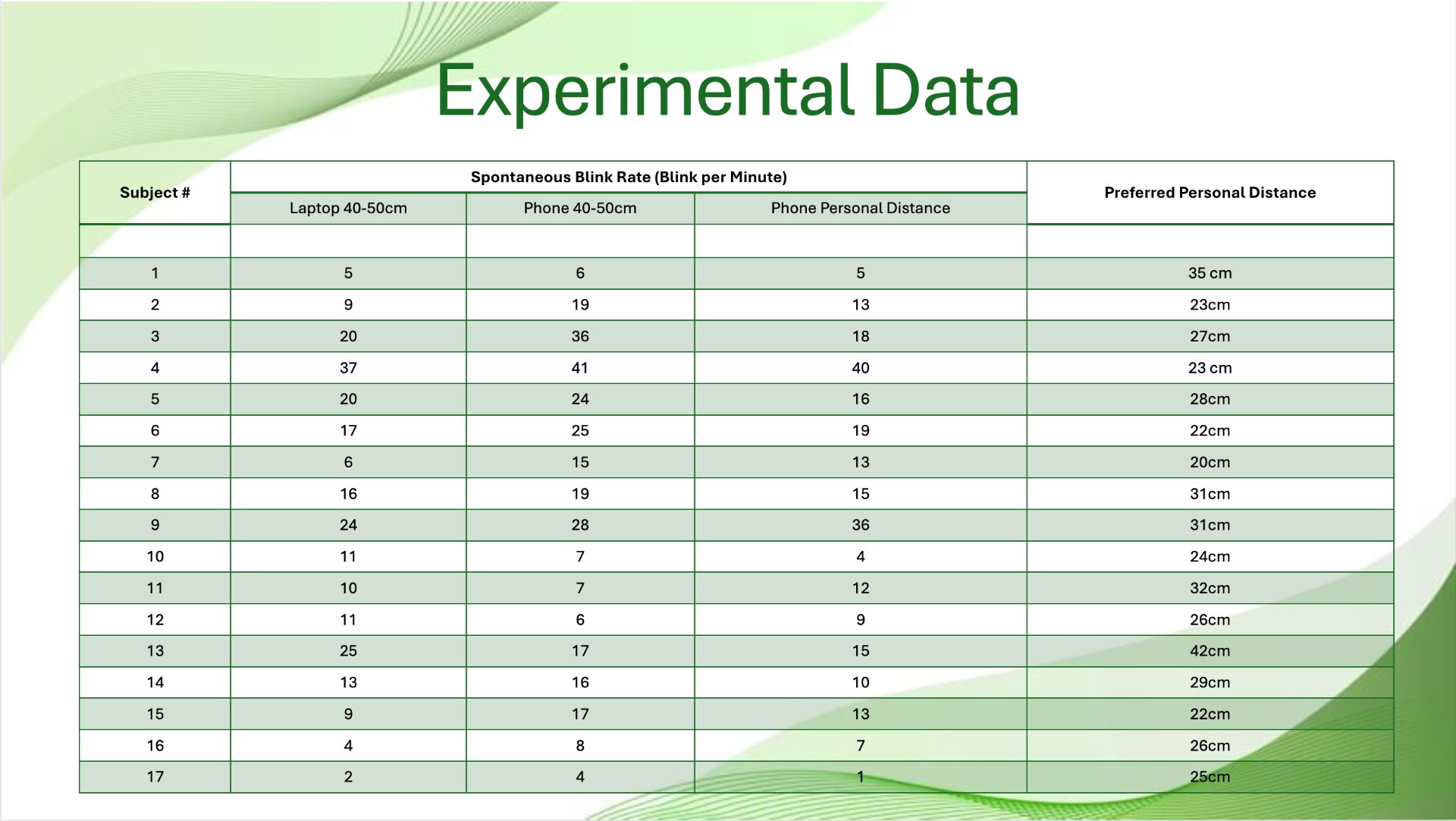
- There's an average reduction in blink rate by 33% when using a phone at 40-50cm compared to a computer screen at the same distance
- There's an average reduction blink rate of 28% when using a phone at 20-30cm compared to a phone at 40-50cm
- We can extrapolate that blink rate decreases 60% when switching from laptop at40-50 cm to holding a phone close to the eyes
-
Analysis
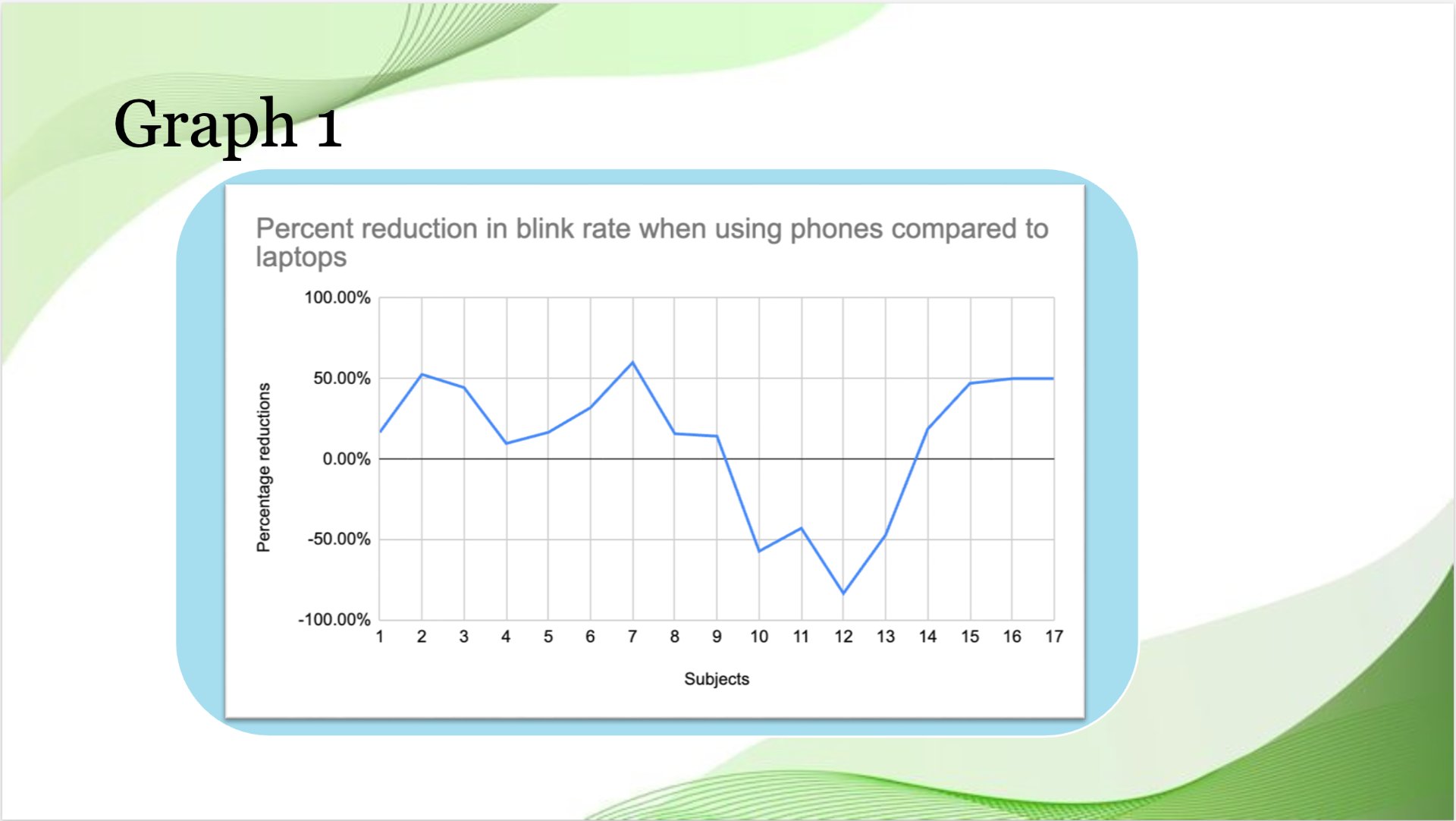
- There's an average reduction in blink rate by 33% when using a phone at 40-50cm compared to a computer screen at the same distance (Graph 1)
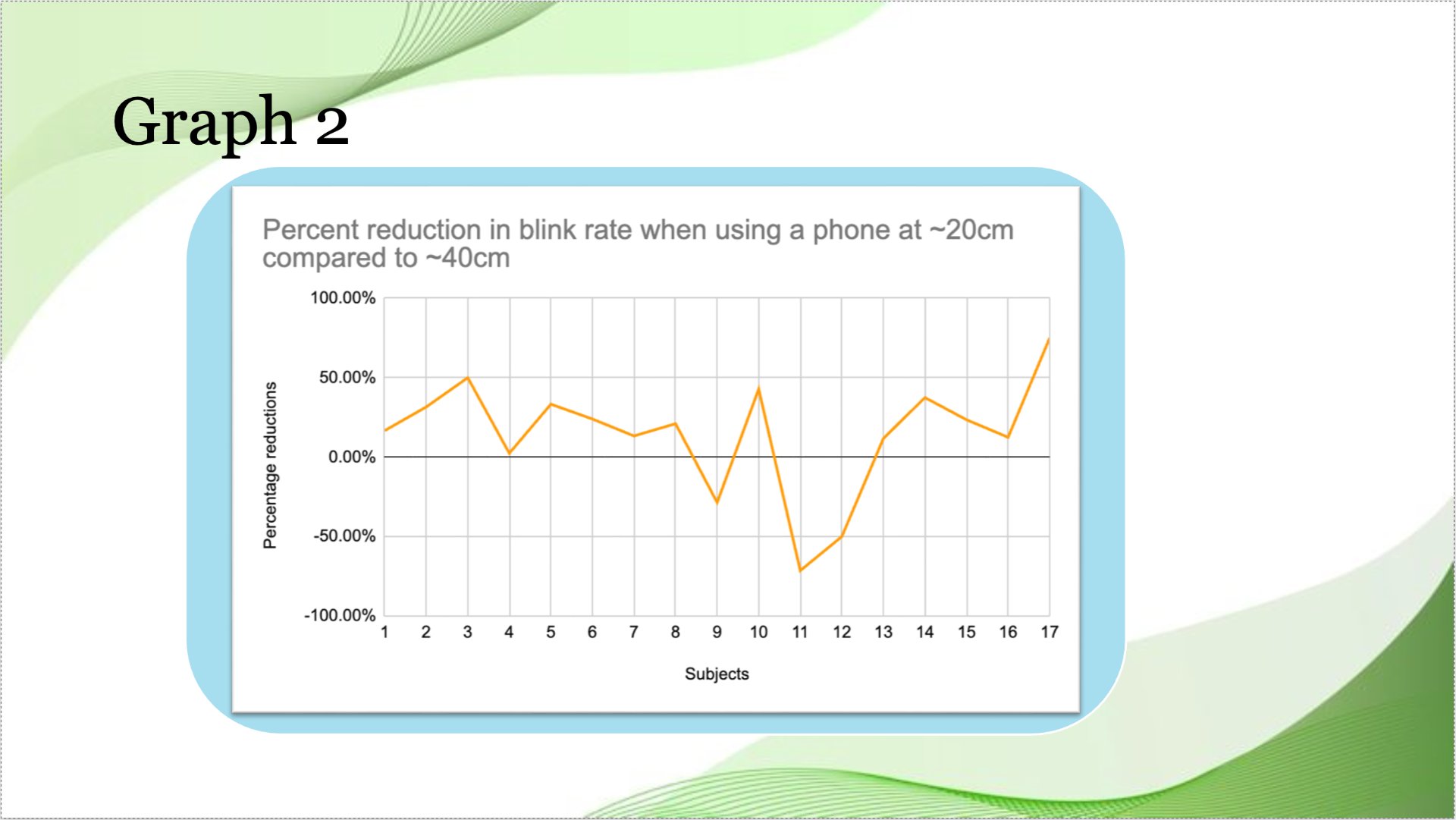
- There's an average reduction blink rate of 28% when using a phone at 20-30cm compared to a phone at 40-50cm (Graph 2)
- We can extrapolate that blink rate decreases 60% when switching from laptop at 40-50cm to holding a phone close to the eyes
Conclusion
- Research has shown that smaller screen size requires more cognitive attention
- Phones have smaller screen size compared to laptop, making it harder to focus and see clearly, hence requiring more cognitive attention.
- When you hold a screen closer to your eyes it increase the amount of accommodative (eye focusing) demand.
- When possible, students should limit amount of screen time.
- Even short duration has an immediate effect on blink rate and possible dry eyes.
- Screen distance
- Screen size
- Given the ubiquitous use of smartphones by children, future work shouldexamine whether effects persist over a longer term causing cumulative damage to the ocular surface.
Application
Effects of Dry Eye Syndrome
- Physical: Dry Eyes can cause Physical, Mental &Financial Burden (Corneal Ulcer, Contact lens intolerance, Chronic Pain Syndrome, Blurry vision and Blindness)
- Mental: Poor Concentration, Poor Grades 2-3x, Risk of Depression, Low Quality of Life (even worse than glaucoma, macular degeneration and retinal detachment)
- Financial: Treatment cost to patients $750-2500/yr, Cost to insurance $25 billion/yr, Cost to society $55 billion/yr
How can we help others reduce the effects of Dry Eye Syndrome from Screen Use
- Use the 20-20-20 rule
- Blink more often when using screens
- Sit at a proper distance from screens
- Use larger screens when possible
- Take regular breaks
Future Experimental Considerations
- Add more subjects to the experiment
- Measure the effect of working distance and blink rate
- Determine if reading text on a screen vs paper will change the of spontaneous blink rate
- Determine if viewing a static versus a moving object will change the of spontaneous blinkrate
- Determine the difference between blink rate for a long time of period compared to a shorteramount of time
Sources Of Error
- Small sample size
- Subjects got distracted while doing their tasks
- Human counting error of blinks
- Human variability
- Short testing time
- Measurement error
Citations
Al-Mohtaseb, Zaina, et al. “The Relationship between Dry Eye Disease and Digital Screen Use.” Clinical Ophthalmology, vol. 15, 2021, pp. 3811–3820. https://doi.org/10.2147/OPTH.S321591. Alnahdi, W., et al. “Relationship Between Screen Time and Dry Eye Symptoms During the COVID-19 Pandemic in the Pediatric Population of the Western Region of Saudi Arabia.” Cureus, vol. 14, no. 11, 2022, e31015. https://doi.org/10.7759/cureus.31015. American Academy of Child and Adolescent Psychiatry. “Screen Time and Children.” Feb. 2020, www.aacap.org/AACAP/Families_and_Youth/Facts_for_Families/FFF-Guide/Children-And-Watching-TV-054.aspx. Bowling, Ernie. “Dry Eye in the Digital Age.” Optometry Times, 15 Apr. 2020, www.optometrytimes.com/view/dry-eye-digital-age. Chidi-Egboka, Ngozi Charity, et al. “Smartphone Gaming Induces Dry Eye Symptoms and Reduces Blinking in School-Aged Children.” Eye, vol. 37, no. 7, 2023, pp. 1342–1349. https://doi.org/10.1038/s41433-022-02122-2. Clarke EyeCare. “The Impact of Screen Time on Dry Eye: Tips for Digital Eye Strain.” www.clarkeeye.com/the-impact-of-screen-time-on-dry-eye-tips-for-digital-eye-strain. Accessed 26 Jan. 2026. Elhusseiny, A. M., et al. “Relationship between Screen Time and Dry Eye Symptoms in Pediatric Population During the COVID-19 Pandemic.” The Ocular Surface, vol. 22, 2021, pp. 117–119. https://doi.org/10.1016/j.jtos.2021.08.002. Grand View Research. Dry Eye Syndrome Treatment Market Size, Share & Trends Analysis Report, 2022–2030. www.grandviewresearch.com/industry-analysis/dry-eye-syndrome-treatment-market. Kamøy, B., et al. “Video Display Terminal Use and Dry Eye: Preventive Measures and Future Perspectives.” Acta Ophthalmologica, vol. 100, no. 7, 2022, pp. 723–739. https://doi.org/10.1111/aos.15105. Kharel Sitaula, R., and A. Khatri. “Knowledge, Attitude and Practice of Computer Vision Syndrome among Medical Students and Its Impact on Ocular Morbidity.” Journal of Nepal Health Research Council, vol. 16, no. 3, 2018, pp. 291–296. Lu, Z. “Computer Screen Time Is Damaging Eyes—Especially for Children.” The Washington Post, 23 Apr. 2021. Malik, A. “How Too Much Screen Time Affects Kids’ Eyes: Tips to Prevent Eye Strain.” Children’s Hospital of Philadelphia, 21 Dec. 2021. Mishal, Anu, Umesh Giri, and Aparna Rizyal. “Effect of Mobile Phone Use on Blink Rate among MBBS Students in Kathmandu.” Nepal Medical College Journal, vol. 23, no. 1, 2021, pp. 11–15. https://doi.org/10.3126/nmcj.v23i1.36220. Pang, Y., et al. “Effect of Screen Time on Dry Eye Symptoms in Young Adults.” Investigative Ophthalmology & Visual Science, vol. 61, June 2020. Porter, P. “Digital Devices and Your Eyes.” American Academy of Ophthalmology, www.aao.org/eye-health/tips-prevention/digital-devices-your-eyes. Accessed 16 Feb. 2025. Schuchardt, Madeleine. “Screen Time and Dry Eyes: What You Need to Know.” Winnipeg Dry Eye Spa, www.winnipegdryeye.com/screen-time-and-dry-eyes-what-you-need-to-know. Accessed 26 Jan. 2026. ScreenBlink. “Complete Guide to Digital Eye Strain & Dry Eyes.” www.screenblink.org/eye-strain-guide. Accessed 26 Jan. 2026. Sharifah-Aimi SI, Saliman NH, Buari NH. Comparative Analysis of Blink Rates During Printed and On-Screen Reading Across Varying Screen Sizes. J Health Sci Med Res [internet]. 2024 Nov. 7 [cited 2026 Feb. 25];42(6):e20241097. available from: https://he01.tci-thaijo.org/index.php/jhsmr/article/view/275054 Sumitra, L. K., & Aniruddha, G. (n.d.). Effect of screen time on visual accommodation and eye fatigue. https://doi.org/10.47009/jamp.2025.7.5.164
Acknowledgement
- We would like to thank our science teachers, Ms. Krause and Dr. Sumners, for their guidance, support, and valuable feedback throughout this project.
- We would also like to thank our school West Island College for this opportunity