
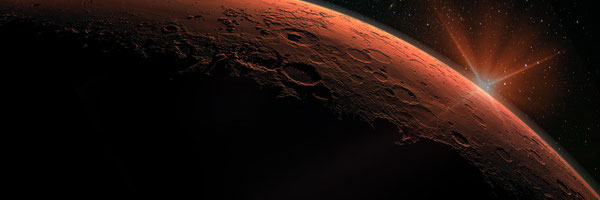
Is Terraforming Mars Scientifically Feasible? An Analysis of Physical, Chemical, and Biological Constraints.
Het Patel
Ernest Manning High School
Grade 11
Presentation
Problem
Terraforming Mars is the idea of changing Mars to make it more like Earth and is often discussed in science, and media as a possible future goal for humanity. However, Mars is very different from Earth. It has a thin atmosphere, extremely low air pressure, no global magnetic field, colder temperatures, and higher levels of radiation. These conditions make long term human survival difficult.
The problem this project investigates is whether it is scientifically possible to terraform Mars based on what we currently understand about physics, chemistry, biology, and planetary science. Specifically, this research examines the major scientific limitations that could prevent Mars from becoming Earth-like. In addition, this project explores whether it would be more realistic to change the planet itself or instead adapt humans and technology to survive in the existing Martian environment.
Method
I am going to be dividing and organizing my research into key scientific categories:
- Planetary Physics – gravity, atmospheric escape, magnetic field absence, and radiation exposure.
- Atmospheric and Climate Science – greenhouse effects, temperature regulation, atmospheric pressure, and climate feedback systems.
- Chemistry – availability of carbon dioxide, water ice, and potential methods of oxygen production.
- Biology – limits of human survivability, extremophiles, and ecological development requirements.
- Engineering and Technology – proposed terraforming methods and habitat-based survival systems.
Research
1. Core Foundations:
-
What is terraforming?
- A theoretical process of long term engineering to transform/alter a planet, moon, or other celestial object’s atmosphere, surface, and temperature to make it habitable for humans.
- Also known as Planetary Ecosynthesis
-
Why Mars is considered a candidate for terraforming:
- Presence of polar ice caps and subsurface water for potential resource use.
- Evidence of past liquid water indicates possible climate and atmospheric adjustment.
- Relatively close proximity to Earth for transport and communication.
- Rocky planet with similar day length and seasonal cycles.
- Thin atmosphere makes initial modification feasible compared to gas giants.
2. Mars as a Planet:
-
Size and mass of Mars:
- Radius of 3390 kilometers
- Half the size of earth
- The mass of mars is approximately 7.1 x 10²⁰ tons (6.4 x 10^23 kg or 11 x Earth mass)
-
Surface gravity compared to Earth:
- Approximately 3.69m/s^2
- Earth's Gravity is 9.81 m/s^2
- 62.5% less gravity than Earth
- If you weighed 100 pounds on Earth, you would only weight 38 pounds on mars
-
Distance from the Sun:
- 1.5 astronomical units away from the sun (approximately 224,396,806.5 km)
- Astronomical Unit: The distance from the Sun to the Earth, and is a unit of measurement used to define distances from planets, asteroids, comets, or spacecrafts because our solar system is so limitless
- The precise distance of an astronomical unit is 149,597,871 km
-
Length of day and year:
- completes one whole rotation every 24.6 hours
- Days on mars are called sols(short for solar day)
- One year (a full orbit around the sun) consists of 669.6 sols (equivalent to 687 earth days)
-
Axial tilt and seasons:
- Mars' axis of rotation is tilted 25 degrees with respect to the plane of its orbit around the Sun (similar to Earth with an axial tilt of 23.4 degrees)
- Like how on Earth the seasons are evenly spread over the year (around 3 months at a time), the seasons on Mars vary in length because of Mars' elliptical, egg-shaped orbit around the Sun
- Spring in the northern hemisphere (autumn in the southern) is the longest season at 194 sols
- Autumn in the northern hemisphere (spring in the southern) is the shortest at 142 days.
- Northern winter/southern summer is 154 sols
- Northern summer/southern winter is 178 sols
-
Seasonal Air Pressure Changes on Mars:
- Mars experiences seasonal pressure changes (Earth does not).
- Caused by carbon dioxide (CO₂) freezing and melting.
- During the southern winter:Temperatures drop below –123°C (–189°F), CO₂ freezes into frost, snow, or ice, air pressure drops by 25–30%.
- CO₂ moves between the polar caps with the seasons.
-
Surface temperature ranges:
- Temperatures can be as high as 20 degrees celsius, or as low as -153 degrees celsius
- Because the atmosphere is so thin heat easily escapes from the planet
-
Geological history of Mars:
- Formation of Mars (≈ 4.6 billion years ago):
- Mars formed from dust and gas in the early solar nebula.
- Heat from impacts and radioactive decay caused the planet to partially melt.
- Dense materials (like iron and nickel) sank to form a core, while lighter materials formed the mantle and crust.
- Early Mars experienced heavy asteroid bombardment, creating many impact craters.
- Noachian Period (≈ 4.1–3.7 billion years ago):
- This is the oldest geological period on Mars.
- The surface became heavily cratered from frequent impacts.
- Evidence shows that liquid water flowed on the surface, forming: Valley networks, River channels, Possible lakes and shallow seas
- Clay minerals formed, indicating long-term water-rock interaction.
- Mars likely had a thicker atmosphere and warmer climate during this time.
- Hesperian Period (≈ 3.7–3.0 billion years ago):
- Major volcanic activity reshaped large areas of the planet.
- Massive lava flows covered older cratered terrain.
- Large volcanic regions developed, including the Tharsis volcanic plateau.
- Water became less stable on the surface(Catastrophic floods occurred, long-term rivers and lakes became rare.)
- Sulfate minerals formed, suggesting more acidic water conditions.
- The atmosphere began to thin, and the climate cooled.
- Amazonian Period (≈ 3.0 billion years ago–Present):
- Mars became cold and dry, similar to today.
- Geological activity slowed significantly.
- Few new craters formed compared to earlier periods.
- Water is mostly frozen(polar ice caps, or underground ice (permafrost))
- Wind became the dominant surface process (sand dunes, dust storms, erosion features)
- Present-Day Mars:
- The surface shows evidence of craters, volcanoes, ancient rivers, and wind erosion.
- No stable liquid water exists on the surface today.
- Mars preserves geological evidence of a once warmer and wetter environment.
- Scientists study Mars to better understand planetary evolution and the possibility of ancient life.
-
Moons/Rings:
- Mars has two small moons (Phobos and Deimos)
- Potato shaped because they have too little mass for gravity to make the spherical
- Phobos, the innermost and larger moon, is heavily cratered, with deep grooves on its surface. It is slowly moving towards Mars and will crash into the planet or break apart in about 50 million years.
- Deimos is about half as big as Phobos and orbits two and a half times farther away from Mars. Oddly-shaped Deimos is covered in loose dirt that often fills the craters on its surface, making it appear smoother than pockmarked Phobos.
- As of right now Mars has no rings, but in 50 million years when Phobos is expected to crash, dusty rings will likely form.
3. Martian Atmosphere (Physics + Chemistry)
-
Current atmospheric composition:
- On Earth the the atmosphere is made up of 78% nitrogen, 21% oxygen, and 1% other (Aron, CO2, etc)
- On Mars, the atmosphere is made up of 96% CO2, <2%Argon, <2%Nitrogen, and <1% other(CO, H2O, etc)
-
Atmospheric pressure compared to Earth:
- Earth - Average sea-level air pressure: 1,013 millibars
- Mars - Average surface pressure: 6–7 millibars
- Less than 1% of Earth’s sea-level pressure
- Similar to being 45 km (28 miles) above Earth’s surface
- A space suit is required to survive
-
Sources of CO₂ on Mars (air, ice caps, soil):
- Atmosphere: Mars' thin atmosphere is 95% CO₂.
- Polar ice caps: Frozen CO₂ (“dry ice”) in polar regions can sublimate seasonally.
- Soil and rocks: Carbonates and adsorbed CO₂ in soil could release CO₂ when heated.
-
Escape velocity:
- Mars’ escape velocity is about 5.03 km/s, much lower than Earth’s (\~11.2 km/s).
- Low escape velocity allows lighter gases (like hydrogen and some water vapor) to escape into space more easily.
-
Solar wind interaction:
- Mars’ thin atmosphere offers minimal protection from solar wind.
- Charged particles strip away atmospheric ions, gradually thinning the atmosphere.
- Causes long-term loss of water and CO₂, weakening the greenhouse effect.
-
Role of Mars’ weak magnetic field:
- Without strong magnetic shielding, solar wind directly interacts with the atmosphere, accelerating atmospheric loss.
- Weak magnetosphere contributes significantly to Mars’ cold, thin atmosphere and low surface pressure.
-
Atmospheric Circulation:
- Mars’ Circulation
- Simpler than Earth’s because Mars has no oceans.
- Dominated by Hadley cell motion at low latitudes: warm air rises at the equator, moves toward 30° latitude, cools and sinks, flows back toward the equator.
- Winds:Blow from the northeast in the northern hemisphere/Blow from the southeast in the southern hemisphere.
- At higher latitudes:Polar air masses create high and low pressure systems, weather fronts and storms can form, storms are weaker than Earth’s due to: thin atmosphere, low temperatures, very little water vapor.
4. Climate & Heat Balance (Physics)
-
Energy received from the Sun:
- Solar Irradiance: The amount of energy that a surface receives from the Sun. Solar irradiance is measured in watts per square metre (W/m2).
- Max solar irradiance on Mars is 590 W/m2
- On Earth is it 1000 W/m2
-
Albedo (surface reflectivity):
- Albedo is the fraction of sunlight a planet’s surface reflects back into space.
- Mars has a higher albedo than Earth due to its dusty, bright surface and polar ice caps.
- High albedo causes more solar energy to be reflected, reducing surface warming.
- Lowers the effectiveness of the greenhouse effect, contributing to Mars’ cold temperatures.
-
Greenhouse effect on Mars:
- Greenhouse effect: Natural process that warms a planet’s surface by trapping infrared (heat) radiation.
- Mars has a very weak greenhouse effect compared to Earth.
- Its atmosphere is extremely thin (less than 1% of Earth’s surface pressure).
- The atmosphere is mostly carbon dioxide (CO₂), but it lacks sufficient density to trap much heat.
- It contains very small amounts of water vapor and methane, so additional heat trapping is minimal.
- Low gravity makes it difficult for Mars to retain a thick atmosphere.
- The absence of a strong global magnetic field allowed solar wind to strip away much of its past atmosphere.
- As a result, Mars remains very cold, with an average temperature around –60°C.
-
Heat retention vs heat loss:
- Heat Retention:The ability of a planet or atmosphere to trap and hold heat energy.
- Occurs when greenhouse gases absorb and re-radiate infrared radiation.
- Leads to warmer and more stable temperatures.
- Heat Loss: The process by which a planet loses heat to space.
- Happens when infrared radiation escapes without being trapped.
- Results in cooler temperatures and greater temperature fluctuations.
5. Chemistry of Terraforming
-
Carbon dioxide chemistry:
- CO₂ is a strong greenhouse gas that traps infrared radiation and increases planetary temperature.
- Can be released from polar ice caps or carbonate minerals through heating or chemical reactions.
- Can be chemically split into carbon monoxide (CO) and oxygen (O₂) using electrolysis.
- Reacts with water to form carbonic acid (H₂CO₃), influencing surface and soil chemistry.
-
Oxygen production pathways:
- Photosynthesis (plants, algae, engineered microbes) converts CO₂ + H₂O into O₂.
- Electrolysis of water splits H₂O into hydrogen (H₂) and oxygen (O₂).
- Solid oxide electrolysis can split CO₂ directly into CO + O₂.
- Oxygen buildup requires long-term carbon removal to prevent recombination into CO₂.
-
Water availability and state (ice vs liquid vs vapor):
- Water may exist as subsurface ice, polar ice caps, or atmospheric vapor.
- Increasing temperature and pressure allows ice to melt into liquid water.
- Low atmospheric pressure causes liquid water to evaporate or boil quickly.
- Stable liquid water requires sufficient greenhouse warming and atmospheric thickening.
-
Chemical reactions required for atmosphere change:
- Sublimation: Solid CO₂ → CO₂ gas (thickens atmosphere).
- Carbonate decomposition: CaCO₃ → CaO + CO₂ (releases trapped carbon dioxide).
- Ammonia breakdown: NH₃ → N₂ + H₂ (adds nitrogen to atmosphere).
- Industrial production of synthetic greenhouse gases for enhanced warming.
- Stability of gases over long timescales:
- Low gravity allows lighter gases (like H₂) to escape into space.
- Solar radiation can break apart molecules (photodissociation).
- Lack of magnetic field increases atmospheric stripping by solar wind.
- Long-term stability requires continuous replenishment or protective measures.
- Limits imposed by available materials:
- Limited accessible CO₂ and nitrogen reserves may restrict atmosphere buildup.
- Insufficient water reserves could limit oxygen production.
- Energy requirements for large-scale chemical processing are enormous.
- Planetary mass and gravity fundamentally limit how thick an atmosphere can remain.
6. Water & Hydrology (Earth Science)
- Evidence of past liquid water:
- Ancient valley networks, river channels, and delta formations show long-term surface water flow.
- Minerals like clays and hematite form in the presence of liquid water.
- Rover missions have found sedimentary rocks shaped by persistent water activity.
- Suggests early Mars had a thicker atmosphere and warmer climate.
- Polar ice caps:
- Mars has permanent north and south polar ice caps made of water ice and frozen CO₂ (dry ice).
- Seasonal CO₂ sublimation (the phase transition of a substance directly from a solid to a gas, completely bypassing the liquid state), thickens the atmosphere slightly during warmer months.
- Water ice in the caps could serve as a resource for drinking water, oxygen, and fuel.
- Melting polar ice would be key for warming and atmospheric thickening in terraforming scenarios.
- Subsurface ice:
- Large deposits of frozen water exist beneath the surface, especially at mid- to high latitudes.
- Radar data confirms thick underground ice sheets.
- Subsurface ice is more stable than surface ice under current conditions.
- Could be extracted to support human settlements and atmospheric modification.
- Water cycle comparison (Earth vs Mars):
- Earth has an active water cycle: evaporation, condensation, precipitation, and runoff.
- Mars has a very weak cycle, mostly involving sublimation and thin atmospheric vapor.
- Mars lacks stable rainfall due to low atmospheric pressure.
- Terraforming would require increasing pressure and temperature to create a stronger hydrological cycle.
- Role of liquid water in climate stability:
- Liquid water absorbs and stores heat, moderating temperature changes.
- Oceans help regulate atmospheric CO₂ through chemical weathering.
- A stable water cycle supports long-term climate balance.
- On Mars, sustained liquid water would be essential for climate regulation and habitability.
7. Biology & Life Science
- Conditions required for life:
- Stable liquid water sustained by higher atmospheric pressure and temperature.
- Thicker atmosphere to provide sufficient oxygen (or usable gases) and thermal insulation.
- Radiation protection through atmospheric thickening, magnetic shielding, or underground habitats.
- Essential elements (carbon, hydrogen, nitrogen, oxygen, phosphorus, sulfur) available in accessible forms.
- Long-term climate stability to prevent atmospheric collapse or freezing.
- Extremophiles and their environments:
- Extremophiles: an organism, usually a microorganism like bacteria or archaea, that thrives in physically or geochemically extreme conditions deadly to most life on Earth
- Certain Earth extremophiles survive in cold, dry, salty, or acidic conditions, similar to parts of Mars.
- Microbes in Antarctic ice or deep subsurface rocks model possible survival strategies.
- Some organisms tolerate low oxygen and high CO₂ environments.
- Engineered microbes could potentially assist in producing oxygen or modifying soil chemistry.
- Radiation effects on living organisms:
- Mars lacks a strong global magnetic field, exposing the surface to UV and cosmic radiation.
- Radiation damages DNA, increasing mutation and cell death rates.
- Long-term exposure raises risks of sterility and cancer in complex organisms.
- Protection would require underground habitats, thickened atmosphere, or artificial magnetic shielding.
- Low-pressure biological limits:
- Current Martian pressure (\~6 millibars) is too low for stable liquid water.
- Low pressure can cause rapid evaporation of bodily fluids and cellular damage.
- Many microbes cannot metabolize effectively under such thin atmospheric conditions.
- Terraforming would require significantly increasing atmospheric pressure for widespread surface life.
- Ecosystem development requirements:
- Primary producers (photosynthetic microbes or plants) must establish first.
- Soil must be chemically modified to reduce toxicity and support nutrient cycles.
- A functioning carbon and nitrogen cycle is essential for long-term sustainability.
- Biodiversity increases ecosystem resilience and climate regulation over time
8. Magnetic Field & Radiation
- Role of magnetic fields in habitability:
- Magnetic fields protect planetary atmospheres from charged solar and cosmic particles.
- They reduce surface radiation, making conditions safer for life.
- Aid in long-term retention of atmospheric gases, crucial for climate stability.
- Without a magnetic field, planets are more vulnerable to atmospheric stripping by solar wind.
- Mars’ magnetosphere:
- Present-day Mars lacks a global magnetic field; only small crustal remnants remain.
- Weak magnetosphere contributes to solar wind erosion of the atmosphere over billions of years.
- Loss of magnetic protection is a major reason for Mars’ thin, cold, and dry environment.
- Radiation sources in space:
- Solar wind: stream of charged particles from the Sun.
- Cosmic rays: high-energy particles from outside the solar system.
- UV radiation: harmful ultraviolet light from the Sun.
- On Mars, these reach the surface more easily due to the thin atmosphere and weak magnetic field.
- Atmospheric erosion due to radiation:
- Solar wind strips away lighter gases like hydrogen and oxygen over time.
- UV and cosmic radiation cause photodissociation(a physical and chemical process where a molecule or ion breaks apart into smaller fragments like atoms, radicals, or ions, after absorbing one or more photons of light), breaking molecules like H₂O into H and O.
- Loss of atmosphere reduces greenhouse effect and surface pressure, limiting habitability.
- Continuous atmospheric loss requires interventions for terraforming to maintain stability.
- Shielding concepts:
- Artificial magnetic fields could deflect charged particles and protect the atmosphere.
- Underground habitats or lava tubes provide natural shielding from radiation.
- Thickened atmosphere or reflective layers could absorb or scatter harmful radiation.
- Use of water or ice barriers as radiation shields for both microbes and humans.
9. Engineering & Technology
- Proposed terraforming methods:
- Atmospheric thickening by sublimating polar CO₂ ice or releasing greenhouse gases (CO₂, CH₄, or synthetic gases).
- Heating the surface with large mirrors, orbital reflectors, or nuclear devices to trigger CO₂ release.
- Introducing photosynthetic organisms or engineered microbes to produce oxygen over long timescales.
- Importing volatile-rich asteroids or comets to add water, nitrogen, or other gases.
- Energy requirements:
- Enormous energy needed to heat the planet and trigger atmospheric changes.
- Sublimating CO₂ ice caps or melting permafrost requires gigatons of energy over decades to centuries.
- Artificial magnetic shielding or large orbital mirrors would demand sustained, high-output energy sources.
- Resource limitations:
- Limited accessible CO₂, nitrogen, and water reserves on Mars.
- Availability of minerals for soil modification and chemical reactions is finite.
- Transporting materials from Earth is costly and technologically challenging.
- Feasibility with current technology:
- Small-scale experiments (greenhouse gas release, microbial growth) are possible.
- Full planetary-scale terraforming far exceeds current energy and engineering capabilities.
- Current technology allows partial atmospheric manipulation and localized habitable zones.
- Near-future vs far-future technologies:
- Near-future: habitat domes, underground settlements, small-scale greenhouse gas injection, solar mirrors, etc
- Far-future: planetary-scale atmospheric thickening, global warming via synthetic gases, artificial magnetospheres, large-scale biosphere engineering, etc
- Maintenance of terraformed conditions:
- Continuous monitoring to prevent atmospheric loss due to solar wind.
- Replenishment of gases as needed to maintain temperature and pressure.
- Management of water cycle and ecological balance for long-term habitability.
- Engineering safeguards against catastrophic climate events or chemical imbalances.
10. Partial Terraforming vs Full Terraforming
- Definitions and differences:
- Partial Terraforming: modifying specific conditions (temperature, pressure, or radiation) without fully transforming the planet’s environment.
- Full Terraforming: completely altering the planet’s atmosphere, temperature, hydrology, and ecology to be Earth-like and self-sustaining.
- Partial terraforming is less resource-intensive and faster, while full terraforming is complex and long-term.
- Artificial habitats vs planetary change:
- Artificial habitats: domes, underground colonies, or pressurized modules to protect against radiation and low pressure.
- Planetary change: modifying the atmosphere, pressure, and climate to make the surface naturally habitable.
- Habitats provide short- to medium-term solutions, while planetary change is long-term and large-scale.
11. Ethical & Environmental Considerations
- Long-term consequences:
- Changes to the atmosphere or climate could last thousands to millions of years.
- Unintended consequences may include runaway warming, toxic gases, or loss of water resources.
- Introduced ecosystems may fail or dominate, disrupting intended terraforming goals.
- Monitoring and maintenance would be required indefinitely to maintain habitability.
- Who decides planetary modification?
- Decisions involve international space agencies, scientists, and global policy bodies.
- Outer Space Treaty and UN guidelines regulate planetary protection and modification.
- Ethical, scientific, and political considerations must be weighed before large-scale interventions.
- Broad consensus is necessary for any irreversible planetary changes.
- Irreversibility of changes:
- Terraforming or contamination may be irreversible on human timescales.
- Once atmospheric or ecological systems are altered, restoring original conditions may be impossible.
- Irreversible changes increase ethical and environmental responsibility for future generations.
- Highlights the need for careful planning, risk assessment, and incremental approaches.
12. Limitations & Scientific Uncertainties
- Physical limits:
- Mars’low gravity (\~38% of Earth) limits the ability to retain a thick atmosphere over long periods.
- Thin atmosphere and distance from the Sun constrain achievable temperature and pressure.
- Planetary size and surface area limit the scale of hydrological and climate systems.
- Solar radiation and dust storms impose ongoing environmental stress on surface operations.
- Chemical limits:
- Availability of minerals for soil modification or chemical reactions is finite.
- Some desired reactions (e.g., CO₂ splitting or oxygen production) require massive energy input.
- Chemical equilibrium may prevent sustaining desired atmospheric composition.
- Biological limits:
- Earth life would struggle with low pressure, low temperatures, and high radiation.
- Microbial survival may be limited without engineered adaptations.
- Complex ecosystems require nutrient cycles and stable water availability.
- Unknown Martian pathogens or conditions could interfere with introduced life.
- Unknown variables:
- Exact subsurface water reserves and chemistry are not fully mapped.
- Long term effects of introducing life on native Mars chemistry are uncertain.
- Responses of Mars climate to artificial greenhouse gases are partially unknown.
- Potential geological or atmospheric response loops could alter terraforming outcomes unexpectedly.
Data
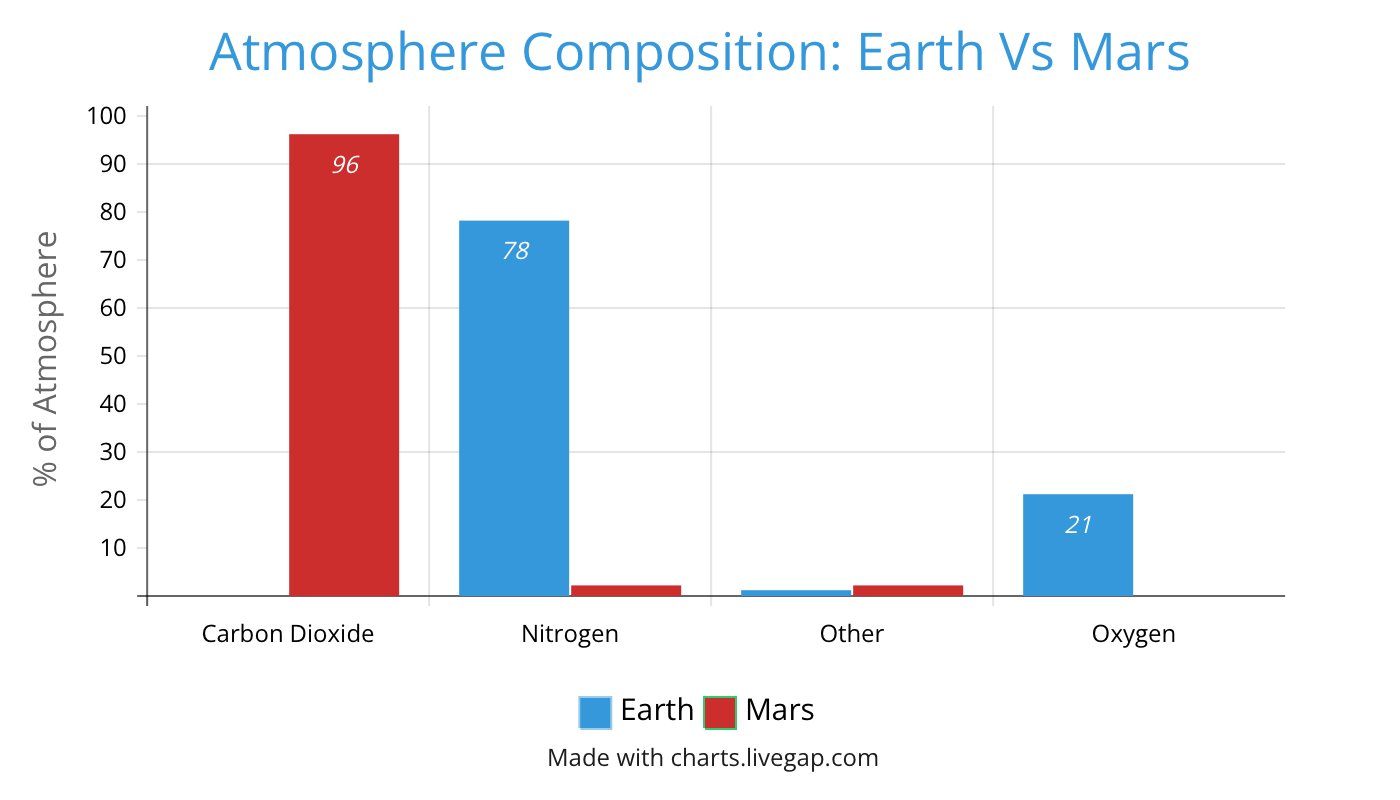 This graph compares the main gases that make up Earth’s and Mars’ atmospheres. Earth’s atmosphere is mostly nitrogen (78%) and oxygen (21%), which supports human life and protects the planet from harmful radiation. In contrast, Mars’ atmosphere is about 95% carbon dioxide, with very small amounts of oxygen and nitrogen. This shows that Mars does not currently have breathable air, and its atmospheric composition would need to be significantly changed for humans to survive without life-support systems.
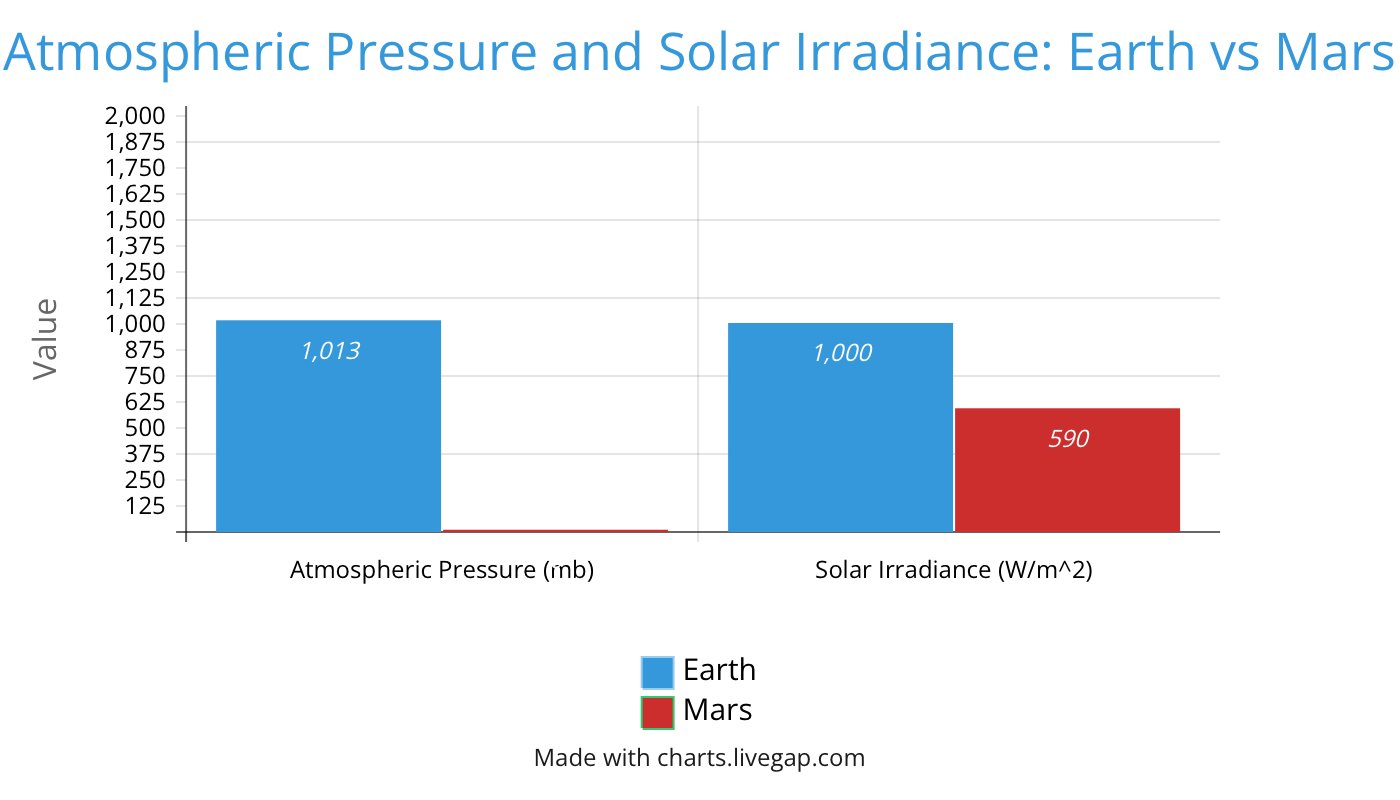 This graph shows that Earth has an average atmospheric pressure of about 1013 millibars, while Mars has only about 6 millibars, which is less than 1% of Earth’s pressure. Mars also receives much less solar energy (about 590 W/m² compared to Earth’s 1000 W/m²). The low pressure means liquid water cannot remain stable on the surface, and the lower solar energy makes warming the planet more difficult. Together, these factors show that creating a stable, warm, Earth-like environment on Mars would require large-scale atmospheric changes.
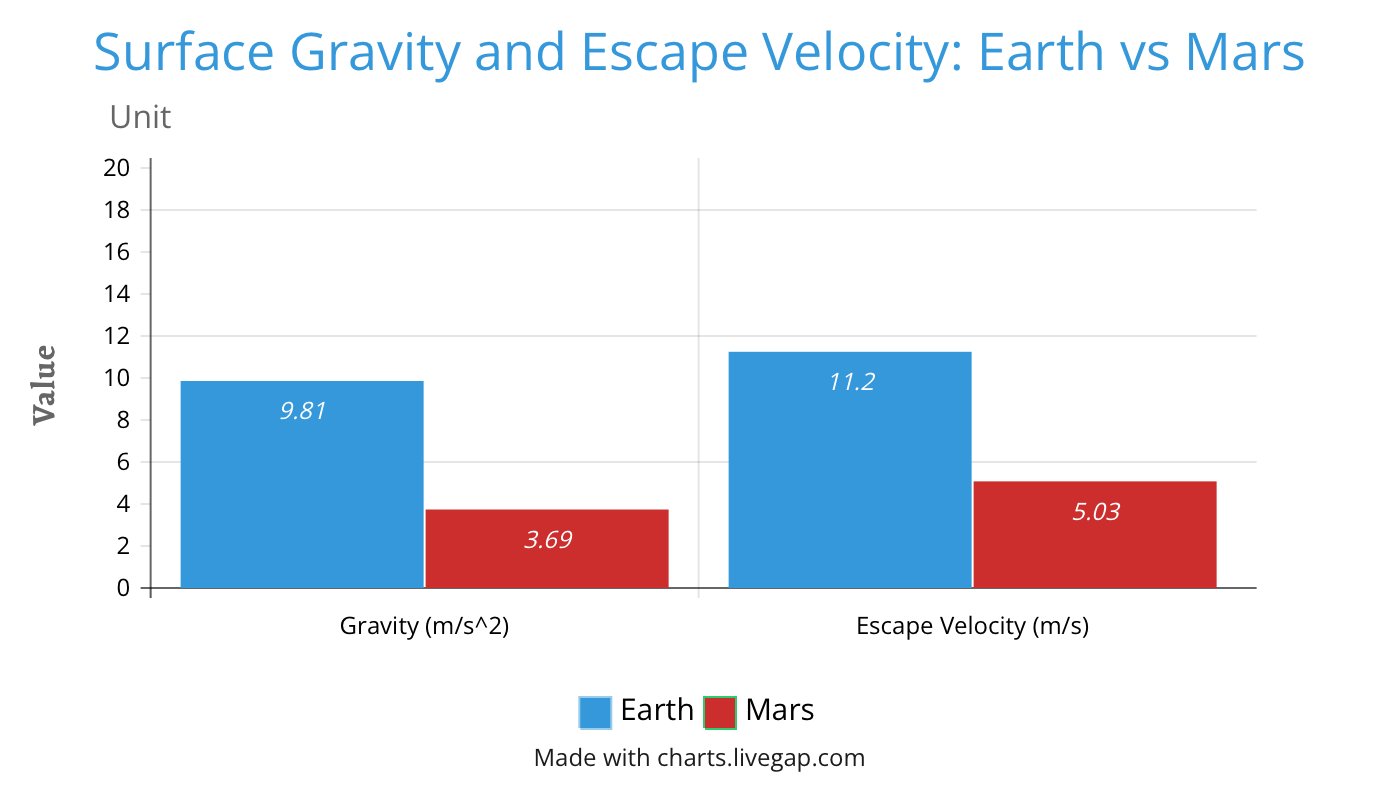 This graph compares the gravitational strength and escape velocity of Earth and Mars. Mars has only about 38% of Earth’s gravity and a much lower escape velocity (5.03 km/s compared to Earth’s 11.2 km/s). Lower gravity makes it harder for Mars to retain a thick atmosphere over long periods of time, since gases can escape more easily into space. This suggests that even if Mars were terraformed, maintaining a stable atmosphere could be a long-term challenge.
Conclusion
The data shows that full terraforming of Mars is not currently scientifically feasible. Mars’ low gravity, weak magnetic protection, thin atmosphere, and lower solar energy create major physical limits. Even if greenhouse gases were added, maintaining a thick, stable atmosphere would require continuous large-scale intervention.
In contrast, adapting humans to Mars through pressurized habitats, radiation shielding, and closed life-support systems is far more achievable with existing or near-future technology. While partial environmental modification may be possible, transforming Mars into a fully Earth-like planet faces fundamental planetary constraints.
Therefore, in conclusion based on current scientific evidence, human adaptation is more realistic than full terraforming.
Citations
Works Cited
Arizona State University. “Atmosphere.” Mars Education at Arizona State University, 2019, marsed.asu.edu/mep/atmosphere. Enes Yoldaş. “Cold Planet: Unraveling the Weak Greenhouse Effects on Mars.” Marsonearthproject.org, 2021, marsonearthproject.org/cold-planet-unraveling-the-weak-greenhouse-effects-on-mars. ESA. “Mars Express.” Www.esa.int, www.esa.int/Science_Exploration/Space_Science/Mars_Express. Johnson, Les, and Kenneth Roy. Interstellar Travel. Elsevier, 1 Feb. 2024. “Light on Mars.” Let’s Talk Science, Sept. 2024, letstalkscience.ca/educational-resources/backgrounders/light-on-mars. “Mars Orbiter Mission.” Www.isro.gov.in, www.isro.gov.in/MarsOrbiterMissionSpacecraft.html. mars.nasa.gov. “ESA’s 2016 ExoMars Orbiter.” Nasa.gov, 2016, mars.nasa.gov/esa-2016-exomars-trace-gas-orbiter/. Accessed 4 Mar. 2026. McClure\, Bruce. “What Is an Astronomical Unit? | Space | EarthSky.” Earthsky.org, 23 Oct. 2017, earthsky.org/space/what-is-the-astronomical-unit/. Morton, Erin. “NASA Resumes Efforts to Reestablish Contact with MAVEN.” NASA Science, 26 Jan. 2026, science.nasa.gov/blogs/maven/2026/01/26/nasa-resumes-efforts-to-reestablish-contact-with-maven/. NASA. “Curiosity (MSL) - NASA Science.” Science.nasa.gov, 31 Jan. 2025, science.nasa.gov/mission/msl-curiosity/. ---. “InSight - NASA Science.” Science.nasa.gov, 3 Nov. 2024, science.nasa.gov/mission/insight/. ---. “Mars 2020: Perseverance Rover - NASA Science.” Science.nasa.gov, NASA, 31 Jan. 2025, science.nasa.gov/mission/mars-2020-perseverance/. ---. “Mars: Facts - NASA Science.” Science.nasa.gov, NASA, 20 Nov. 2024, science.nasa.gov/mars/facts/. ---. “NASA Jet Propulsion Laboratory (JPL) - Space Mission and Science News\, Videos and Images.” NASA Jet Propulsion Laboratory (JPL), 2019, www.jpl.nasa.gov/.
Acknowledgement
I would like to thank my science fair coordinator for helping me throughout the whole process, as well as my parents for inspiring and motivating me to do science fair.