

Explaining a method of Co2 to O2 transformation
Abdulhayi Mohamed
Calgary Islamic School, Akram Jomaa Campus
Grade 6
Presentation
Hypothesis
If cotton is used as the filter material in the air-filter machine, then the air coming out will be cleaner because cotton can trap small particles from polluted air. Although sand could do the same thing, it makes sense because sand and cotton is a solid matter, but cotton has a stable, cellulose that prevents it from flowing like a liquid.
Research
Carbon dioxide (CO₂) is a gas in the air that contributes to climate change when levels get too high. Finding ways to remove CO₂ from the environment is important for improving air quality. Filters, such as activated carbon or other types, can trap pollutants and clean air or water. This science fair project investigates how different types of filters can reduce carbon dioxide or impurities in air or water. By comparing filter performance, the experiment shows how filtering can help make environments cleaner and healthier, indirectly supporting oxygen-rich conditions.
Variables
Independent Variable (what I change) Cotton Sand Dependent Variable (what I measure) Cleanliness of the air after filtering (observed by reduced smoke, clearer air, or indicator change) Controlled Variables (what stays the same) Same pipe structure Same motors and propeller Same batteries Same testing time Same container box
Procedure
The charcoal has been placed in its place and now it is ready to use. Using a lighter, I heated up the charcoal until Carbon Monoxide will rise from the charcoal. It will pass through 3 tubes into one box, which is sealed so all of the gas will get trapped. The next step is to clean. In the box, the dirty air will be cleaned by cotton strips. The cotton strips will trap the Carbon Monoxide and partially clean it. The remaining air will go through a tube.The long tube will elevate the dirty air to the final cotton. The last cotton helped a lot, filtering the rest of the dirty air.
Observations
How do I record air getting filtered?
By using a carbon monoxide monitor, I recorded it. My monitor has numbers and colours to record it. The brighter the red colour got, the more carbon monoxide was there.
Analysis
Tested multiple times - ran the experiment 4 times with two different filters (sand and cotton) and compared the results.
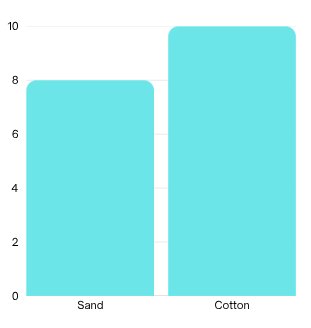 This graph shows how the cotton was more effective than the sand.
Conclusion
As a result, the cotton cleaned the carbon monoxide more than the sand cleaned it. Overall, I think my hypothesis was correct because the cotton cleaned the polluted air more.
Application
In the future, we can put this in fuel-burning appliances and engines, including furnaces, water heaters, stoves, fireplaces, grills, generators, vehicles and naturally-made things such as respiration, decomposition, volcanoes, and wildfires. And to make it more efficient, we can use both sand and cotton
Sources Of Error
I could use both sand and cotton because the structure will become stronger and sturdy. I can also use more materials such as polyester, activated carbon sheets and water pump motor.
Citations
ablung.ca ncbi.nlm.nih.gov myhealth.alberta.ca/ chatgpt.com ( to only give me references) mayoclinic.org cdc.gov youtube.com
1) YouTube ----- link above 2) The National Library of Medicine ----- link above 3) My Health Alberta ----- link above 4) ChatGPT ----- link above 5) Mayo Clinic ----- link above 6) Centers for Disease Control ----- link above 7) Alberta Lung ----- link above
Acknowledgement
I thank my whole family for buying me materials, helping me make it, and giving me ideas. And I also thank Mr.Farooq for helping me out and actually sending me to the CYSF. And lastly, I thank Ms.Atabayeva for also helping.