

To the moon and beyond
Reynah Opoku-Aniagyei
H. D. Cartwright School
Grade 8
Presentation
No video provided
Problem
In the coming years NASA,ESA, ISSO and JAXA are are planning and will continue to be sending more space craft into our solar system whether it be satellites, rovers,or spacecraft. The problem with is the impact its going to have onto the environment specifically the ozone layer. Since 2000 we have been working to rebuild it but with the new rush of space travel the one could be affected yet again.Scientists from the NOAA and The Aerospace Corp have modeled the climate responses of the stratosphere. Seeing that the space travel increase that will be coming in the next couple years will raise black carbon emissions as well as CO2 from Kerosene fuel. They suggested the ozone layer would be damaged and weakened.If this were to occur then skin cancer would become more common and humans immune systems would weaken.Along with this Agriculture and ecosystems would be disrupted.
The main cause of the ozone layer weakening is because of the green house gases and emission that come from our world and with rockets which mainly rely on kerosene engines to lift off and travel out and into the earth the carbon will course harm to the Ozone layer.
This got me thinking- "how can emissions of future space travel missions have a smaller effect not on the environment and ozone layer?"
Method
As I mentioned before Space travel is going to have a a new rise in the coming ye mars as NASA has announced.What comes with these new peaks in space missions,space tourism and launches is the impact it will have on the ozone layer,specifically the stratosphere. the area above the ozone layer. But its not only the stratosphere that will be damaged from kerosene fuel because wildlife and the environment are both highly impacted.
This got me thinking how I could lower those emissions and lessen the environmental impact of space travel in general. To do this I had to focus on where it all starts the the design process.
But first lets out line what we will cover:
- How Energy Will Be used
- Layout of the Ad Astra ship
- Each Stage + Needed Materials
- Comparison theo the SLS
- Engine types
- Fuels
- Engine Cyclle
What Energizes Will Be Used?
In the beginning and launch of the SLS model use of already charged and developed batteries and Energies will be used to power the ship with supply of air being pumped in from pre packed large lithium batteries.These then will help with he accent ;]launch and emergency conditions of the ship.
When making this model space ship I wanted to try and use renewable energy,some that we use basically every day . I looked at other space crafts from rovers to stations and found some energy sources and though so would work with many test I came to a decision on the three I would use for all the stages of the Ad Astra mission using the reference of the SLS (Space Launch System) knowing it would be launching around the time of the science fair.
- Bio energy
- Petroleum
- Solar Energy
Bio energy
Bio-energy is waste from organic material such as animals, plants,ect. When broken down the bio energy releases a bio gas called Methane which is commonly used in Rocket science - The SpaceX Starship Raptor engines. The best part is that if I got a manufacture to turn the waste into gas it would be even cheaper then it already is. This is when the Methane booster will drop and the kerosene engines will ignite as they start the TLI (Trans Lunar Interjection) which will give the rocket a gravitational boost to send it to the moon.
Petroleum
Kerosene the main fuel which will be used for the longest duration of the mission are harvested from petroleum then burned and refined in to Rocket grade Kerosene (RP-1) Kerosene is a historically reliable energy source and easy to sore since it can be stored around room temperature while other files like Liquid Hydrogen must be held at nearly absolute zero.
Solar Energy
Solar energy as we know is energy harvested from the sun and as the Environment America Research&Policy center say "Sunlight is transmitted through photons – mass less particles of electromagnetic radiation – which contain varying amounts of energy corresponding to their wavelengths. When this light hits certain materials, such as the silicon found in most solar panels, its energy and momentum can excite electrons present in the material, knocking them loose and creating a current of electrons (electricity)."In The Ad Astra mission during the duration of time that the Kerosene engines are thrusting us to the moon the solar panels will start taking energy from the sun and turning it in hydrogen via electrolysis which we will discuss later.
WHAT IS THE SLS
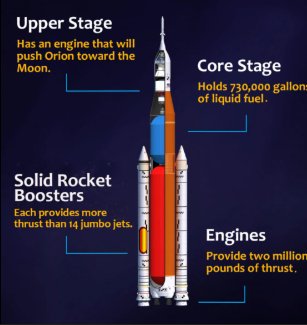
The SLS or Space Launch System Is the rocket used to propel the Orion spaceship to and around the moon in the coming Artemis mission.The first being in the end of 2022 and the Artemis ll being launched in the month of April if all systems operate well. With the Artemis ll missions engineers and scientist had to make it a livable condition for the astronauts who would be boarding the flight .This entitled adding life support,heat control and other removal of hazards that make the rocket substantial for life. The SLS will launch the astronauts on a flyby mission of the moon.
"The rocket itself though is heavy weight booster with only the small area at the top of the ship housing the astronauts. The crew will use Orion to practice multiple maneuvers in Earth orbit, including rendezvous with the interim cryogenic propulsion stage (ICPS) as practice for the mobility required for future exploration missions. Orion will perform a translunar injection (TLI) burn to put the ship on a lunar free return trajectory in which the astronauts aboard the Orion spacecraft will fly by the Moon and use the Moon’s gravity to slingshot around the lunar farside back to Earth. Like Artemis I, SLS will carry several small secondary payloads in its Orion stage adapter (OSA). These will be deployed after Orion completes the proximity operations demonstration and leaves the area."- George C. Marshall Space Flight Center
HOW DO ENGINES WORK IN ROCKETS
In rockets there are 4 main stages to the energy uses in a rocket
- The solid rocket boosters
- The core stage
- The upper stage
Staged Combustion Engines Majority of the fuel goes goes to the nozzle and then moves to the preburner. On the oxidizer side a small portion goes to the preburner while the rest is sent through the oxidizer contro valve and then to the main engine.The hot gas powers the turbines which are used for the fuel and oxidizer pumps After the hot gas moves to the main engine and combustion chamber.Joining the fuel and oxidizer.Staged combustion engines run the preburner with large amount of excess fuel and oxygen.The excess flow reduces the combustion temperature to needed variables. Hydrogen fueled engine like the SSME use fuel rich while kerosene engine like RD-RG run LOX-Rich.
Each part of the SLS includes different types of engines and each type of engine produces different thrust,speed,emissions and accuracy taday we will be comparing all three of the energies discussed before.This includes Kerosene which comes from Petroleum,Methane which comes from Biogas and finally Hydrogen which comes from Solar power.
METHANE ENGINE
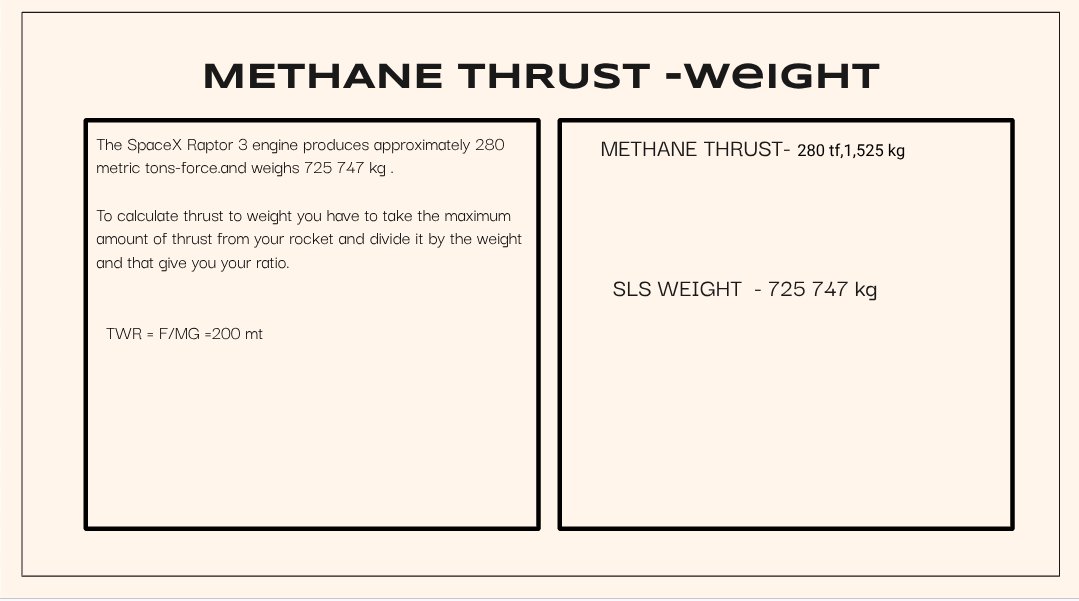
Methane engine work on a liquid fuel. The Raptor-3 is powered by subcooled liquid methane and subcooled liquid oxygen in a full-flow staged combustion cycle. This specific cycle allows the full flow of both propellants through the turbines. The Full-flow staged combustion has the advantage that the energy produced by the preburners, and by using that to power the propellant pumps. It is then spread through the entire fuel flow, meaning that the preburner exhaust driving the propellant turbopumps is as regulated as possible, even cooler than other closed engine cycles that only preburn one propellant. This then contributes to a long engine life.An oxygen-rich turbine powers an oxygen turbopump, and a fuel-rich turbine powers a methane turbopump. Both oxidizer and fuel streams are converted completely to the gas phase before they enter the combustion chamber. This speeds up mixing and combustion, reducing the size and mass of the required combustion chamber. Torch igniters are used in the preburners. Because of the high temperatures of the preburner exhaust.
Thrust to weight
 The principle is to convert thermochemical energy into exhaust jet kinetic energy.
Fuel and oxidizer are combined in the nozzle.The combustion chamber then forced out the nozzle.the high pressure forces the gas out causing acceleration.Using Newton's third law for each each action there is an equal opposite action/reaction.
Liquid propellant is better than solid rocket fuel motors because it has higher performance.Mono propellant- use straight gaseous propellant or use a catalyst to provide exothermic reaction.Only used for low thrust missions ie. satellites.
Bi propellant- uses hypergolic [propellants,are stable,can be sufficiently stable on normal conditions
In these engines the fuel and oxidizer are added at the higher pressures then to the combustion chamber. Pumps are ten used for high thrust engines such as ours. are necessary.
The principle is to convert thermochemical energy into exhaust jet kinetic energy.
Fuel and oxidizer are combined in the nozzle.The combustion chamber then forced out the nozzle.the high pressure forces the gas out causing acceleration.Using Newton's third law for each each action there is an equal opposite action/reaction.
Liquid propellant is better than solid rocket fuel motors because it has higher performance.Mono propellant- use straight gaseous propellant or use a catalyst to provide exothermic reaction.Only used for low thrust missions ie. satellites.
Bi propellant- uses hypergolic [propellants,are stable,can be sufficiently stable on normal conditions
In these engines the fuel and oxidizer are added at the higher pressures then to the combustion chamber. Pumps are ten used for high thrust engines such as ours. are necessary.
By igniting small portions of the fuel to burn and push them into the gas chamber.For the pump though though turbine drive are necessary.
Analysis
Kerosene engines, often used historically as dual-fuel petrol-paraffin engines or in modern industrial applications, run on refined kerosene (
 to
) due to its lower cost, higher flash point (
), and cold-weather reliability compared to diesel. While they can run on kerosene, they often require gasoline for starting.
to
) due to its lower cost, higher flash point (
), and cold-weather reliability compared to diesel. While they can run on kerosene, they often require gasoline for starting.
Conclusion
In my project I asked myself the question "how can emissions be reduced not the ozone layer?". Gladly I was able to find the answer to that question through the reduction of emissions from rocket fuels such as kerosene propellants. Kerosene has negative impact on the environment in the way that it releases excessive amount of carbon dioxide and black carbon which is what you see in the huge liftoff sand the cloud of combustion when the booster launch the spacecraft into space. That is what is rained back down into the planet and arms agriculture and the air itself. I studied different types of energy from geothermal to solar an I figured out that to create a strong but still environmentally cleaner rocket I had to use multiple types of fuel. Looking at the stages of space flight you see that it stats off on the launch pad then once it breaks through the atmosphere it takes a lap called the TLI which launches it into space with the help of Issac Newton's second law. After it drops the core stage and fully realize on the upper stage that send it to its target and back down to earth. In these last three stages I chose to use kerosene and hydrogen .Kerosene is one of the most powerful fuel types which is why its being used for The longest duration of the mission .While the solar energy is used. Solar power can turn into electricity but also fuel through the act of electrolysis where water separates the electrical currents int oxygen and hydrogen which is what Is needed for hydrogen engines. by using these energise emotions are reduced by 31.8 % .
So in conclusion I asked "how can emissions of future space travel missions have a smaller effect not on the environment and ozone layer?" and the answer isn't simple but if you change the fuel and the materials and experiment with different energy's we can maintain our ozone layer by lowering the amount of emmisons put in the air buy 31.8 %
Citations
https://gransystems.com/products/cubesat-structure/4UCubeStructure
https://www.o mnicalculator.com/physics/speed-of-light
https://www.nasa.gov/ames-engineering/spaceflight-division/biosentinel/
https://research.noaa.gov/projected-increase-in-space-travel-may-damage-ozone-layer/
https://science.nasa.gov/mission/dragonfly/
https://www.nasa.gov/image-article/sls-flight/ RS-25
https://www.nasa.gov/missions/the-people-bringing-orion-to-life-the-launch-abort-system/
https://www.lpi.usra.edu/lunar/artemis/orion/Launch_Abort_System_NASA_FS-2014_06_220_LaRC.pdf
https://www.nasa.gov/glenn/glenn-expertise-space-exploration/sls-usa/
https://ntrs.nasa.gov/api/citations/20160008869/downloads/20160008869.pdf
https://www.sciopen.com/article/10.7527/S1000-6893.2024.29690
https://www.nasa.gov/?search=methne+engine&content_type=post
https://ntrs.nasa.gov/api/citations/20160001041/downloads/20160001041.pdf
https://www1.grc.nasa.gov/beginners-guide-to-aeronautics/ideal-rocket-equation/
https://science.howstuffworks.com/math-concepts/velocity-formula.htm https://www.nasa.gov/wp-content/uploads/2018/06/fs-2018-02-250-ksc-ml_umbilical_fact_sheet.pdf?emrc=3f5e9f
https://science.nasa.gov/learn/basics-of-space-flight/chapter14-1/#:\~:text=Interplanetary%20mission%20operations%20may%20be,funding%2C%20the%20Extended%20Operations%20Phase. https://www.nasa.gov/reference/space-launch-system/
Acknowledgement
I would like to thank my teacher Ms.Offord who helped me get through all the work and understand what I needed to do.
To my parent thank you mom and dad for all the moral support.Thank you also to my brother who helped we with the physics side of all my work I meant a lot more than I let on and I am very grateful.