

Do Activities Before a Math Test Affect How Well Students Perform?
Dara Idowu, Gethyumi Wickrama Kaluthota Hewage
Fairview School
Grade 5
Presentation
Hypothesis
We hypothesized that if Grade 5 students perform 2 minutes of jumping jacks before taking a 5-minute math test, then they will score higher than students who rest quietly or listen to calm music, because short bursts of physical activity may increase blood flow to the brain and improve focus and working memory, which are important for solving math problems.
Research
Mathematics is an important subject used in many fields of study such as science, medicine, engineering, and technology. Doing well in math requires strong focus and clear thinking, yet many students feel nervous or unfocused before math tests.
Research shows that physical activity may increase blood flow to the brain and improve focus and working memory, which are important for math performance (Syväoja et al., 2021). Listening to calm music may also help students feel relaxed and concentrate better. Because focus plays an important role in math success, this project investigates whether different activities done before a math test affect student performance.
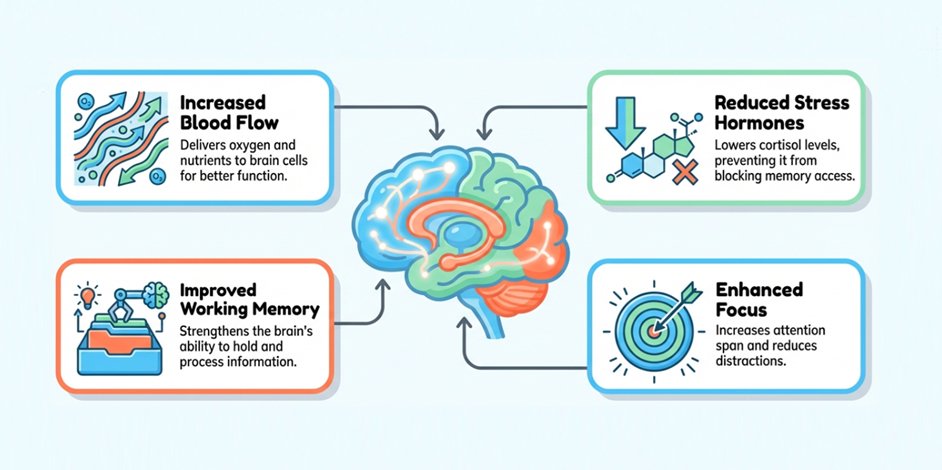
Figure 1: Brain Mechanisms Linking Exercise to Maths Performance
The figure 1 above illustrates the possible brain mechanisms that explain how exercise may improve maths grades. Physical activity increases blood flow to the brain, delivering more oxygen and nutrients that help brain cells function more effectively. Exercise also reduces stress hormones such as cortisol, which can interfere with memory and learning. In addition, physical activity strengthens working memory — the brain’s ability to hold and process information — and enhances focus by increasing attention span and reducing distractions. Together, these factors may help students concentrate better, remember mathematical procedures more easily, and perform better on maths tests.
Variables
Independent Variable (What was changed)
The type of activity performed before the math test (Jumping Jacks, Calm Music, or Quiet Rest).
Dependent Variable (What was measured)
The number of correct answers on the 5-minute math test.
Controlled Variables (What was kept the same)
- Duration of the pre-test activity (2 minutes)
- Duration of the math test (5 minutes)
- Grade level and difficulty of math questions
- Testing environment (same classroom setting)
- Instructions given to students
- Time of day the testing occurred
Procedure
The following procedures were followed:
- We collected signed consent forms from all participating students.
- We prepared three sets of math tests (Set A, Set B, and Set C), ensuring that all sets were of equal difficulty.
- We randomly divided the students into three groups: Quiet Rest, Calm Music, and Jumping Jacks.
- We instructed each group to perform their assigned activity simultaneously for 2 minutes.
- Immediately following the activity, we administered the corresponding math test to each group.
- We allowed 5 minutes for all students to complete their tests, timing the session precisely.
- We collected all completed tests after the time limit ended.
- We recorded the number of correct answers for each student for data analysis.
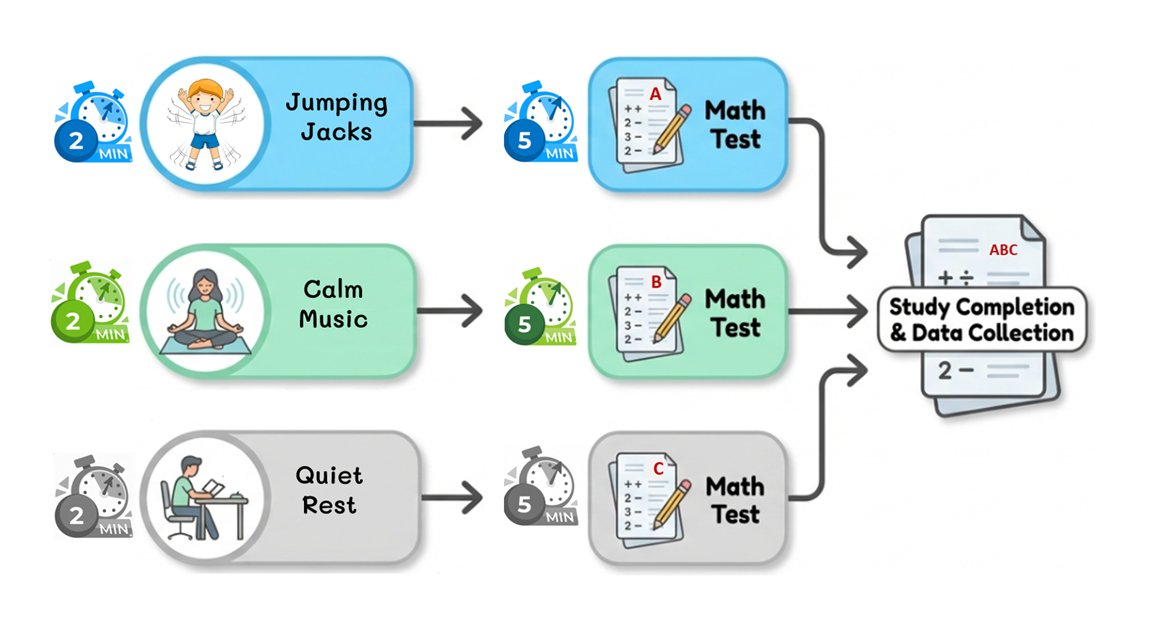 Figure 2 : Experimental Procedure for Pre-Test Activities and Math Assessment
From the figure 2 above, the procedure of the experiment is illustrated step by step. Students were divided into three different pre-test activity groups. The first group performed 2 minutes of jumping jacks (physical exercise), the second group listened to 2 minutes of calm music, and the third group had 2 minutes of quiet rest without any stimulation. Immediately after each activity, students completed a 5-minute math test. The scores from each group were then collected and recorded for comparison. This design allowed the researchers to determine whether short physical activity, calm music, or quiet rest had a greater effect on math test performance.
Observations
Our observations were analyzed using basic mathematical calculations, including averages and percentage scores, as shown below:
(1) Average = (Sum of student scores) / (Total student) ------------------------------ (Equation 1)
(2) % Average = (Average) / (Total Student) × 100 ------------------------------------- (Equation 2)
(3) % Average for Test A = (9 / 10) × 100 = 90% ----------------------------------------- (Equation 3)
(4) % Average for Test B = (8.6 / 10) × 100 = 86% --------------------------------------- (Equation 4)
(5) % Average for Test C = (8.1 / 10) × 100 = 81% --------------------------------------- (Equation 5)
Using Equations 1 and 2, we calculated the average score and converted it into a percentage. Equations 3, 4, and 5 show the percentage averages for Test A, Test B, and Test C, respectively.
Table 1: Student Math Test Scores Under Different Pre-Test Activities
| Student ID | Test A: Jumping Jacks | Test B: Calm Music | Test C: Quiet Rest (Control) |
|---|---|---|---|
| #001 | 9 | 9 | 8 |
| #002 | 10 | 9 | 9 |
| #003 | 9 | 8 | 6 |
| #004 | 8 | 8 | 7 |
| #005 | 9 | 8 | 8 |
| #006 | 10 | 10 | 10 |
| #007 | 9 | 9 | 8 |
| #008 | 9 | 8 | 9 |
| #009 | 8 | 8 | 8 |
| #010 | 9 | 9 | 8 |
| AVERAGE | 9 | 8.6 | 8.1 |
| % AVERAGE | 90 | 86 | 81 |
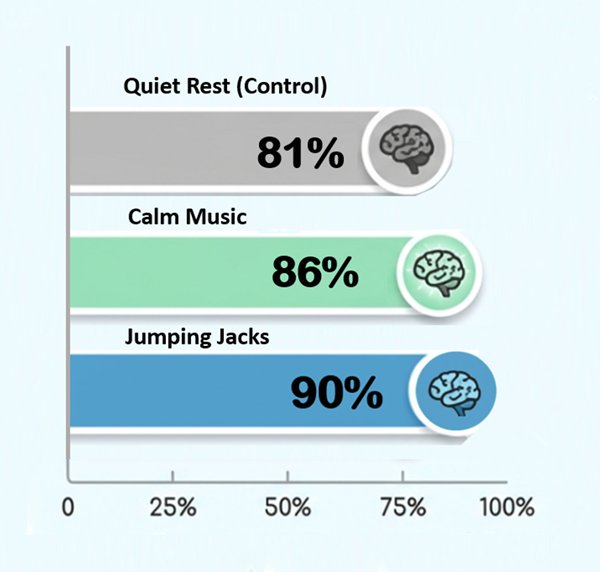
Figure 3: Percentage Average Math Scores by Pre-Test Activity
As shown in Table 1 and Figure 3, students achieved the highest scores after performing jumping jacks, with an average score of 9 out of 10 (90%). Students who listened to calm music had an average score of 8.6 out of 10 (86%), while students who rested quietly had the lowest average score of 8.1 out of 10 (81%).
We observed that students who performed jumping jacks before the test (Test A) achieved the highest average score of 90%. Students who listened to calm music (Test B) scored an average of 86%, while students who had quiet rest (Test C) scored the lowest average of 81%. These findings suggest that short physical exercise before a math test may improve math performance more than calm music or quiet rest. The higher scores in the exercise group may be explained by increased blood flow to the brain, improved working memory, and enhanced focus. Although calm music also showed positive effects compared to quiet rest, physical activity appeared to have the strongest impact in this study.
Analysis
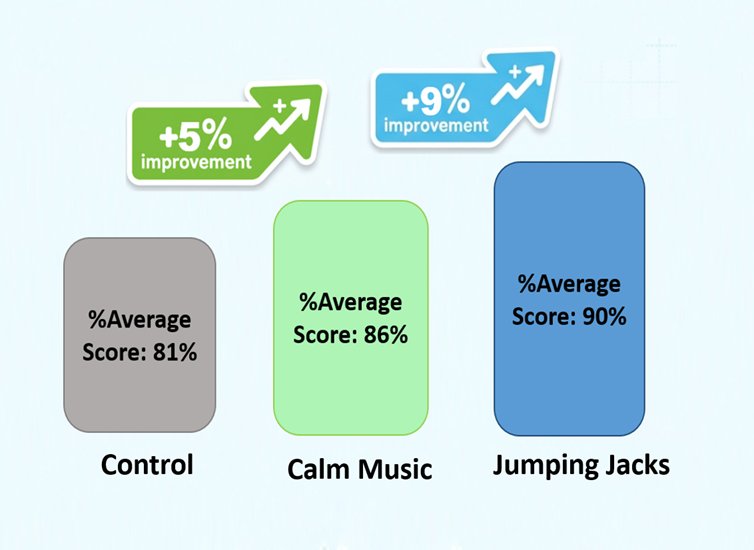
Figure 4. Comparison of percentage improvement in math test performance relative to the control condition, showing higher gains after physical activity and calm music.
From the figure 4 above, the data show that students who perform jumping jacks achieve the highest average score of 90%, which represents a 9% improvement compared to the quiet rest group. This suggests that physical activity may increase alertness and concentration before taking a math test. Exercise increases blood flow and oxygen to the brain, which may improve focus and problem-solving skills.
Students who listen to calm music also perform better than the control group, achieving an 86% average score, or a 5% improvement. Listening to music may reduce stress and create a relaxed mental state, which can support better thinking and concentration. The quiet rest group has the lowest average score at 81%, suggesting that sitting quietly may not stimulate the brain as effectively as movement or music. Overall, the results indicate that certain pre-test activities may positively influence academic performance. Short physical activity breaks or calming music sessions may help improve math performance.
Conclusion
The hypothesis is supported by the results of this investigation. The data show that students who perform activities before a math test achieve higher average scores compared to students who rest quietly. The Jumping Jacks group achieves the highest average score of 90%, representing a 9% improvement over the Quiet Rest group. These findings suggest that physical activity before a test may enhance focus and cognitive performance.
In future studies, additional types of physical activities, such as dancing or running, could be tested to determine whether they produce similar or greater improvements. Increasing the sample size to 50 or 100 students would improve the reliability of the results. It would also be valuable to investigate whether these activities improve performance in other subjects, such as spelling or reading comprehension.
Application
The results of this investigation can be applied in real classroom settings. Teachers may consider including short physical activity breaks, such as jumping jacks, before quizzes or tests to help improve student focus and performance. Even a brief two-minute exercise session could help students become more alert and mentally prepared. Students can also use this strategy at home by doing light exercise or listening to calm music before studying or taking practice tests. Parents may encourage these short activities to help their children prepare for homework or exams. Schools could explore adding structured movement breaks into the daily schedule to support both academic performance and overall well-being.
Sources Of Error
Several factors may have influenced the results of this investigation. First, the sample size was small, with only 10 students participating. A larger group may produce more reliable and generalizable results. Second, students have different natural math abilities, and some may have found certain math questions easier or more difficult than others. This could have affected their scores regardless of the activity performed. Additionally, not all students may have performed the jumping jacks with the same level of energy, and some students may have been more focused or more tired on certain days. Distractions may also have influenced the results. It was not always possible to keep the room completely quiet during the Quiet Rest phase, which may have affected students’ concentration. Finally, students may have become more familiar with the test format over time, which could have slightly improved their performance.
Citations
[1] Syväoja, H. J., Tammelin, T., Ahonen, T., & Kankaanpää, A. (2021). How physical activity, fitness, and motor skills contribute to math performance: Working memory as a mediating factor. Scandinavian Journal of Medicine & Science in Sports, 31(12), 2310–2321.
[2] Vorkapic, F. C., Bell, L., & Koutsandreou, F. (2021). Does physical activity improve cognition and academic performance in children? Neuropsychobiology, 80(6), 454–482.
[3] Quan, Y., Ma, W., Li, H., & Thompson, W. F. (2023). Slow tempo music preserves attentional efficiency in young children. Attention, Perception, & Psychophysics.
[4] Kasuya-Ueba, Y., Zhao, S., & Toichi, M. (2020). The effect of music intervention on attention in children. Frontiers in Neuroscience, 14, 757.
[5] Belligundu, E. (2025, October 8). How exercise helps students get better grades. Stanford Lifestyle Medicine.
[6] Batabyal, A. A. (2026, January 13). Does telling students to exercise help them academically? Rochester Beacon.
[7] Cappelen, A. W., Charness, G., Ekström, M., Gneezy, U., & Tungodden, B. (2026). Exercise improves academic performance. Journal of Political Economy, 134(1), 397–434.
Acknowledgement
We would like to give a huge thank you to everyone who helped make this project possible! To all the students who participated in our math tests, your time and effort were essential to our experiment — we couldn’t have done it without you. A special thanks to our families for helping us gather materials, organize our data, and keep everything running smoothly. We are especially grateful to our teacher for guiding us, answering our questions, and showing us how to do a fair and scientific experiment. Finally, thank you to everyone in the audience for taking the time to see our project and cheer us on — your support means a lot!