

Memory On Trial: Understanding Eyewitness Fail-ability
Mayokun Fafiolu
Bearspaw Christian School & College
Grade 8
Presentation
Hypothesis
Misleading questions and confirming feedback will reduce actual accuracy and increase false identifications, while increasing witnesses’ confidence in correct answers.
Research
Key Words:
Eyewitness - One who witnesses an occurrence. Testimony - A firsthand authentication of an event. Evidence. Manipulation - Influencing or controlling someone or something artfully or unfairly for personal advantage. Recall - To remember past events.
Overview:
An eyewitness testimony is an oral or written account given by someone who claims to have seen or experienced a particular event or crime. These statements are usually made under an oath and are often used as key evidence in legal cases. Although eyewitness testimony can help solve crimes, it often comes with serious disadvantages. Human memory is not perfect; it can change over time due to stress, fear, suggestion, or misinterpretation. When investigators use leading or manipulative questions, or when witnesses receive confirmation or feedback, their recollections can become distorted. This can lead to inaccurate testimonies and, in some cases, wrongful convictions.
What Are Some Real-World Connections?
On August 1, 1984, in North Carolina, a 22-year-old man named Ronald Cotton was arrested for the rape of a woman and the burglary of Jennifer Thompson-Cannino’s home. He was sentenced to 50 years in prison. After spending 10½ years behind bars, Cotton was proven innocent through DNA testing that was released on July 30, 1995. The eyewitness, Jennifer Thompson, had identified him in the police lineup, but later she discovered her decision was impacted by the way investigators handled the case.
A similar story in Chicago in 1983, Anthony Porter, age 27, was convicted of the double murder of Marilyn Green and Jerry Hillard. He was sentenced to death in prison, but after 16 years in prison, an investigation by journalism students and private investigators uncovered that another man was responsible for the murders. Porter’s conviction had been largely based on unreliable eyewitness accounts and pressured statements.
Both of these cases show that while eyewitness testimonies play a crucial role in investigations, they can be dangerously unreliable. According to the Innocence Project, a non-profit organization dedicated to freeing people who have been wrongfully convicted, about 70% of wrongful convictions later overturned by DNA evidence involved at least one mistaken eyewitness.
These examples show the importance of studying how memory, questioning, and feedback can alter what people believe they saw. Studying these physiological factors can help improve police procedures and prevent future injustices in the legal system.
What Is The Scientific Background Behind This?
Memory isn’t a perfect recording; rather, it is reconstructive and subject to distortion. Psychologists have identified several phenomena that show how memory can be changed after an event. Three especially relevant effects are the misinformation effect and the post-identification feedback event.
The Misinformation Effect. After witnessing an event, a person’s memory can be altered by exposure to misleading or incorrect information, a phenomenon known as the misinformation effect. Psychologist Elizabeth Loftus, widely recognized for her research on human memory, conducted a classic experiment that demonstrated this phenomenon. Participants were shown a short video of a car crash and later asked questions about what they had seen. Some were asked, “How fast were the cars when they hit each other?”, while others were asked the same question using the word “smashed” instead. This slight wording change caused participants to recall the event differently; many who heard "smashed" even remembered seeing broken glass when there was none.
Research shows that when misinformation is repeated, it can have a powerful and lasting impact on memory, often leading eyewitnesses to recall inaccurate details while testifying confidently. However, when false information is contradicted multiple times by multiple sources, witnesses may become more cautious and uncertain, making the misinformation effect somewhat unpredictable.
Memory errors caused by misinformation reflect two key psychological processes: suggestibility (being influenced by external information) and source misattribution (misremembering where the memory originally came from).
Post-Identification Feedback Effect. Another type of memory distortion occurs after a witness makes an identification, selecting someone from a lineup. Studies show that when investigators confirm feedback, for example, saying, “Good, you picked the suspect,” witnesses often become more confident in their choice, even if they are wrong. They may also later report being more certain, paying closer attention, or having a clearer view of the suspect than they actually did. In contrast, when witnesses receive disconfirming feedback (being told they made the wrong choice), the effect is weaker but can still cause stress or self-doubt. Dis-comfiring feedback tends to make witnesses feel cornered and uncertain, while confirming feedback falsely strengthens their confidence.
A meta-analysis of more than 20 experiments with 2,400+ participants, conducted by Amy Bradfield Douglass and colleagues, found strong evidence that confirming feedback significantly increases witness confidence, even when their identification is inaccurate. This is especially problematic in legal settings, where jurors and judges often use confidence as a key indicator of credibility.
Research Gaps
Most past research on eyewitness testimony has focused on either how the wording of questions affects memory or on how feedback after a lineup changes a witness’s confidence. However, there are barely any tests on how both of these factors might work together to influence memory accuracy and confidence at the same time. By combining both variables, my project aims to explore how these two sources of influence interact and how easily eyewitnesses can be misled even when they believe they are correct.
Variables
1. Manipulated (independent) variable.
- Type of question phrasing (neutral vs leading)
- Type of feedback after identification (none vs confirming)
2. Responding (dependant) variable.
- Accuracy of eyewitness memory
- Confidence level in answers
- Likelihood of identification error
3. Controlled variables.
- Same video shown to all participants
- Instructions and testing process
- Same questionnaire structure (only wording changes depending on group)
- Lineup photos
Procedure
Materials
Laptop - To display the Trunk Monkey video Internet access - For participants to complete the online test. 1 notebook - Take research notes during sessions. 200+ consent forms - Have to obtain permission from participants. Pens - For signatures on consent forms and taking notes. Information script - To inform participants what they’ll be doing. Instruction sheet - To tell participants when to start the test and to help guide them through it.
Google Form or a Physical Test Sheet containing:
- The group condition (A-D) was assigned to each participant.
- The ten eyewitness questions (neutral or leading).
- The identification lineup photo section consists of 6 photos.
- A question asking if the target is in the lineup.
- A confidence rating question (1-10 scale).
- Feedback statements (for Groups C & D)
Google Sheet containing:
- Participant ID
- Group
- Question type (neutral/leading)
- Feedback type (none vs confirming)
- Target Chosen Correctly (Y/N)
- Chosen photo (A-F and None)
- Age
- Gender
- Vision status (glasses, contacts, none)
- Seen clip before (Y/N)
- Accuracy (%)
- Confidence rating (1-10)
- Notes on participant
Preparation
1. Download the Test Video:
- Go to YouTube and download the video “Suburban Auto Group – Trunk Monkey Road Rage.” (https://www.youtube.com/watch?v=S5T03gNrWOk)
- Save the file as TrunkMonkey.mp4.
2. Extract and Prepare Lineup Images:
- Using the downloaded video, take 3 clear screenshots of the screaming man (the victim) and 3 clear screenshots of the person who caused the crash (the suspect).
- Edit 4 of the images slightly (adjust brightness, blur details) so they don’t look identical.
- Keep 2 unedited versions to serve as the real target photos.
- Save all images to a subfolder called “Lineup Images.”
3. Create a Google Sheet
- Open Google Sheets and title it Eyewitness Results Tracker.
- Add the following columns: - Participant ID - Group - Question type (neutral/leading) - Feedback type (none vs confirming) - Target Chosen Correctly (Y/N) - Chosen photo (A-F and None) - Age - Gender - Vision status (glasses\, contacts\, none) - Seen clip before (Y/N) - Accuracy (%) - Confidence rating (1-10) - Notes on participant
- You’ll fill this out after each participant completes their test
4. Create Four Tests in Google Forms
-
Test A (Neutral Questions) - Go to Google Forms\, click “+ Blank Form.” - Title it “A” - Add your questions: Click the “+” icon to add a Short Answer question: Age Repeat this for the following demographic questions: Gender Vision status (Glasses/Contacts/None) Have you seen this clip before?” (Yes/No) - Add neutral event questions\, such as (there should be 10 questions): “What colour was the car that hit the screaming man’s car?” “How many people appeared in the video, excluding the narrator?” “What kind of animal (if any) was in the video?” - Add the lineup identification question: Type: “Who caused the car crash? And if the man who caused it isn't present, choose no. Look closely, pictures are edited. ” Question type: Multiple Choice Click the image icon next to the question and upload your lineup image. Label each option A–F, and include “None of the above” as the last. - Add a confidence rating question: Question type: Multiple Choice Type: “Confidence (1-10)
-
Test B (Leading Questions) - In Google Forms\, click the three dots (⋮)\, then “Make a copy” of Test A. - Rename it “B.” - Change the neutral questions into leading ones\, for example (should be ten questions as well): Neutral: “How many people appear in the video?” (turn into) Leading: “How many people did you see getting out of the car?” Neutral: “Were there object(s) inside the trunk before the monkey appeared?” (turn into) Leading: “There were tools or weapons inside the trunk before the monkey appeared, correct?” - Keep the lineup and confidence rating the same.
-
Test C (Neutral, With Confirming Feedback) - Make a copy of Test A. - Rename it “C.” - After that\, go to a question and click the “Add section” icon (two rectangles) on the right. Write confirming feedback on the title line, like, “Yes, that’s right.” And under it type “This is where feedback will be located.” - You can add feedback on as many questions as you’d like\, by repeating the “Add section” step. - Keep everything else the same.
-
Test D (Leading, With Confirming Feedback) - Make a copy of Test B - Rename it “D.” - After that\, go to a question and click the “Add section” icon (two rectangles) on the right. Write the same confirming feedback you wrote on Test C. And under it type “This is where feedback will be located."
Setting Up Participants
1. Print Consent Forms
- Print at least 100 copies (or more) consent forms.
- Each form should explain the study and participation details.
- Keep all signed copies in a binder or folder.
2. Recruit Participants via Email (Online Method)
- Write the Invitation Email: - Example: “I’m conducting a small study on eyewitness memory for the upcoming science fair\, and I would like to invite you to participate. The study involves watching a short scenario and answering some questions about what you observed. Participation is completely voluntary\, and all responses will be kept confidential. You may request them if you wish to receive them back.
If you agree to participate, I will first need your signature on a consent form. Once that is received, I will send you a video and a multiple-choice test (with options A–D) via email. Along with the test link, you will also receive further instructions and additional information about the study. The goal of this study is to investigate how people recall details of events. Your participation would help me gather valuable insights for my project. If you’re interested, please reply to this email, and I will provide the consent form.
- Send Materials (if they agree): - Email them a PDF of the consent form to sign\, or give them the consent form in person. - Once signed\, email: - The video link (or downloaded file). - The Google Form link (matching their assigned test A–D). - Sample email when sending instructions: Watch the video once only. After you finish the video, do not rewatch or take notes. Then return to this form and answer the questions from memory. Do not discuss your answers with others. Complete the form in one sitting.
2.1. In-Person Participant Option
- Explain the experiment briefly.
- Give them a paper consent form to sign.
- Play the video once (projected or on a laptop).
- Hand out the paper test version (A, B, C, or D).
- After completion, collect all test sheets and record scores manually in your Eyewitness Results Tracker sheet.
Data Collection
1. Running The Experiment
- For both online and in-person participants - Make sure everyone only watches the video once. - Remind them not to share answers or rewatch the clip.
2. Collect Responses
- Online (Google Forms): - Open each form\, then click “Responses”. Then go to Google Sheets and open the spreadsheet “Eyewitness Results Tracker.” - Put all the results into the sheet.
- In-Person: - Manually enter each participant’s responses into the tracker sheet.
3. Record Lineup Accuracy
- Check who correctly identified the suspect.
- Mark “Yes” or “No” in the spreadsheet.
- Record each participant’s confidence rating (from the test)
Data Analysis
1. Organize Results
- Sort the tracker by Group (A–D) and calculate: - % of correct identifications - Average confidence levels - % of wrong identifications
2. Create Graphs
- Make two bar graphs in Google Sheets: - Accuracy (%) per Group (A–D) - Confidence Level (1–10) per Group
3. Interpret Findings
- Compare the results to answer: - Do leading questions reduce eyewitness accuracy? - Does confirming feedback increase confidence (even when wrong)?
Observations
Afterwards
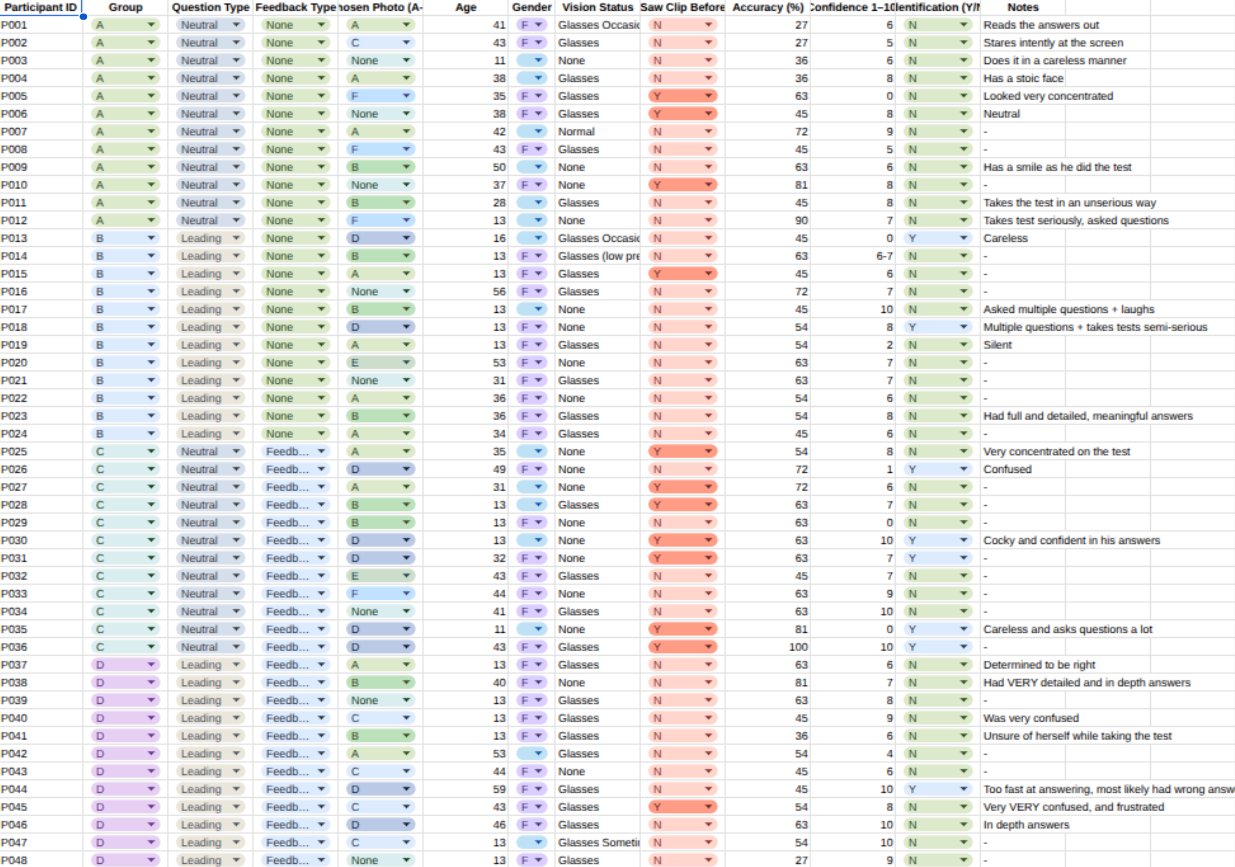
After viewing the same video stimulus and experiencing a short delay, participants completed an identification task and rated their confidence in their answers. The data were recorded in a spreadsheet and analyzed by calculating:
- Average confidence level (1–10)
- Percentage of correct vs. wrong answers
- Percentage of right identification (correctly identifying the actual target individual)
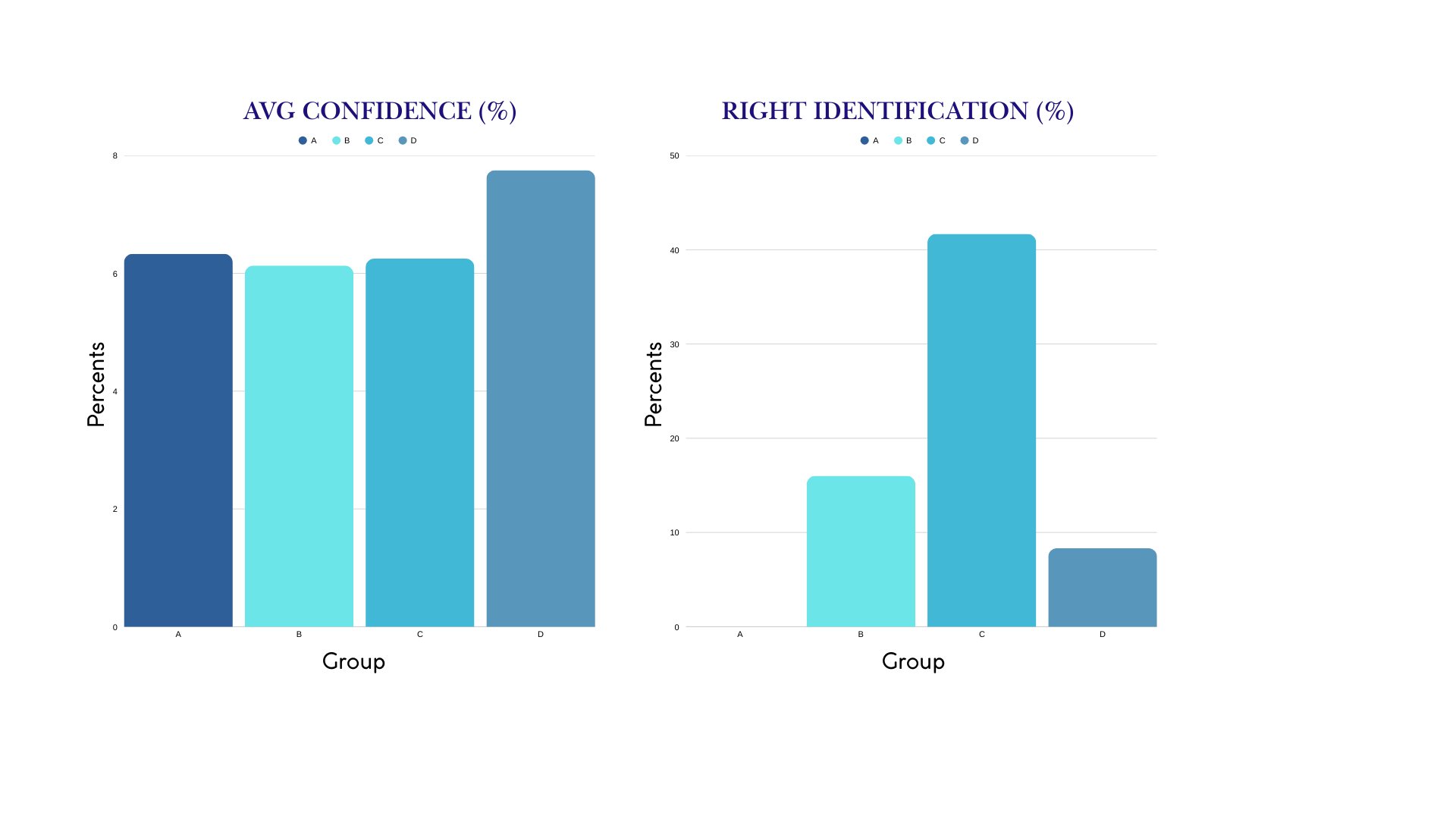
Two bar graphs were created to visually represent:
- Average confidence levels per group
- Right identification percentages per group
Observations from the Confidence Level Chart
From the Average Confidence (%) bar graph, several important trends were observed:
- Group D (Leading questions & confirming feedback) showed the highest average confidence, approximately 7.75.
- Group A (Neutral questions & no feedback) had a moderate confidence level, around 6.33.
- Groups B and C had similar confidence levels, slightly above 6.0, despite having different experimental conditions.
Participants who received confirming feedback (Groups C and D) tended to report higher confidence, even when their answers were not always correct. This suggests that feedback increases how confident participants feel, regardless of actual accuracy.
Observations from the Right Identification Chart
The Right Identification (%) bar graph revealed a much stronger contrast between groups:
- Group C (Neutral questions & confirming feedback) had the highest right identification rate at 41.67%.
- Group B (Leading questions & no feedback) followed with 16.66%.
- Group D (Leading questions & confirming feedback) had a much lower correct identification rate at 8.33%.
- Group A (Neutral questions & no feedback) had 0% right identification.
Although Group D showed the highest confidence, it did not show high accuracy. In contrast, Group C showed the highest accuracy, even though its confidence level was lower than Group D’s. This highlights a disconnect between confidence and correctness.
Comparison Between Confidence and Accuracy
| Avg Correct (%) | Avg Wrong (%) | Avg Confidence | Right Identification (%) | |
|---|---|---|---|---|
| Group A | 50% | 50% | 6.33% | 0% |
| Group B | 54.75% | 45.25% | 6.13% | 16.66% |
| Group C | 66.80% | 33.20% | 6.25% | 41.67% |
| Group D | 52.50% | 47.50% | 7.75% | 8.33% |
One of the most important findings of this experiment is that higher confidence did not always mean higher accuracy.
- Group D participants were the most confident, but they were often wrong.
- Group C participants were less confident than Group D, yet they were correct far more often.
- This pattern suggests that confirming feedback, especially when paired with leading questions, can inflate confidence without improving memory accuracy.
This is especially significant because eyewitness confidence is often used in real court cases to judge credibility. Neutral questions, used in Groups A and C, resulted in higher overall accuracy compared to leading questions, which were used in Groups B and D. Leading questions appeared to distort participants’ memories by subtly suggesting details that were not originally noticed in the video, increasing the likelihood of incorrect identifications. This finding supports existing psychological research showing that the wording of post‑event questions can alter memory recall and contribute to false identifications.
Confirming feedback also had a strong influence on participant responses, as it increased confidence levels, often created overconfidence, and reduced participants’ ability to accurately distinguish between correct and incorrect memories. Participants who were told they were “right” tended to report higher confidence even when their identification was incorrect, closely mirroring real interrogation and lineup procedures where subtle confirmation from investigators can unintentionally influence eyewitnesses. Several notable patterns emerged in the data, including cases where participants expressed very high confidence (ratings of 9–10) despite making incorrect identifications.
Groups that received feedback showed more extreme confidence levels overall, while participants who did not receive feedback tended to express more uncertainty, even when their answers were correct. These patterns suggest that external influences, such as question phrasing and feedback, play a larger role in eyewitness testimony than memory accuracy alone. Overall, the data strongly indicate that eyewitness memory is highly vulnerable to manipulation, confirming that feedback can create false confidence, leading questions increase the risk of wrongful identification, and confidence should not be considered a reliable indicator of accuracy.
Analysis
Throughout this experiment, I compared the effects of neutral versus leading questions and confirming feedback on eyewitness accuracy and confidence. All participants watched the same video, but each group received different types of questioning and feedback. Groups that received leading questions (B and D) generally showed lower correct identification rates compared to groups that received neutral questions (A and C). This suggests that leading wording may have influenced how participants remembered details from the video. I also observed that groups who received confirming feedback (C and D) reported higher confidence levels than groups without feedback. However, this increased confidence did not always match higher accuracy. For example, Group D had the highest confidence level but one of the lowest correct identification rates. Overall, the patterns in the data show that question wording and feedback changed how participants responded. Leading questions appeared to reduce accuracy, while confirming feedback increased confidence, even when answers were incorrect.
Conclusion
The results of this experiment support my hypothesis that both the phrasing of post‑event questions and the use of confirming feedback influence eyewitness memory accuracy, confidence, and identification errors. Participants who were asked leading questions were more likely to make incorrect identifications than those asked neutral questions, showing that suggestive wording can distort memory recall. In contrast, neutral questions generally resulted in higher identification accuracy, suggesting they are more effective for obtaining reliable eyewitness information. This demonstrates that the way questions are phrased plays a significant role in how accurately an event is remembered.
The experiment also showed that confirming feedback increased eyewitness confidence, but did not consistently improve accuracy. In some cases, participants who received confirming feedback were highly confident despite being incorrect. This indicates that confidence is not a reliable indicator of memory accuracy. Overall, the findings demonstrate that eyewitness memory is highly susceptible to external influences and that leading questions and confirming feedback can increase the risk of identification errors.
In conclusion, this investigation highlights the psychological vulnerability of eyewitness testimony and explains how memory can be unintentionally manipulated. The results emphasize the importance of using neutral questioning techniques and avoiding confirming feedback during eyewitness interviews and lineups. By applying psychological research to real‑world practices, especially in the justice system, the risk of false identifications and wrongful convictions can be reduced. This experiment shows that understanding how memory works is essential for making fair, accurate, and evidence‑based decisions.
Application
From a psychological perspective, this experiment demonstrates key concepts related to memory reconstruction, suggestibility, and cognitive bias. Psychological research shows that memory is not a perfect recording of events, but a reconstructive process that can be altered by external influences such as question wording and feedback. The results of this study support theories proposed by cognitive psychologists, including the idea that leading questions can introduce misinformation, causing individuals to remember details that were never actually present. Additionally, confirming feedback appears to increase confidence inflation, a psychological effect where individuals become more confident in their memories without a corresponding increase in accuracy. This disconnect between confidence and correctness highlights why eyewitness memory should be treated cautiously.
These psychological findings have important real‑world applications, especially within the criminal justice system. Police interrogations, eyewitness interviews, and lineups often rely on human memory, which this study shows is highly vulnerable to psychological influence. If investigators unintentionally use leading questions or provide confirming feedback, they may increase a witness’s confidence while simultaneously increasing the risk of false identification. This can contribute to wrongful convictions, where confident eyewitness testimony is mistaken for reliable evidence. Beyond the legal system, these results also apply to everyday situations such as school investigations, workplace disputes, and media interviews, where memory accuracy is often assumed.
Sources Of Error
Several sources of error may have influenced the results of this experiment. One major limitation was the need to switch between in‑person and online testing, as participants had different schedules and availability. This may have introduced variability in how instructions, feedback, and the testing environment were experienced. Additionally, the original goal was to have 100 participants per group (400 total); however, due to limited access to participants, the final sample size was reduced to 48 total participants, with approximately 12 participants per group. This smaller sample size reduces the generalizability of the results. To compensate, some participants completed more than one test; however, this was spaced out over a long period of time and involved different test versions, making it unlikely that participants remembered specific details from previous attempts. In fact, some participants performed worse on repeated tests, suggesting minimal learning or memory carryover effects. Another potential source of error was the difference in how confirming feedback was delivered: feedback in online tests (Groups C and D) was automated rather than verbally stated, which may have weakened its influence compared to in‑person testing. Despite these limitations, the experiment was carefully designed to maintain consistent procedures across groups, and the overall trends in the data remained clear and meaningful.
Citations
Testing the Accuracy of Eyewitness Testimony | Science Project. (n.d.). Science Buddies. https://www.sciencebuddies.org/science-fair-projects/project-ideas/HumBeh_p014/human-behavior/testing-accuracy-of-eyewitness-testimony
Science Buddies. (2004, September 14). The Case of Mistaken Identity. Science Buddies; Science Buddies. https://www.sciencebuddies.org/science-fair-projects/project-ideas/Soc_p006/sociology/mistaken-identity Eyewitness Testimony | Legal Dictionary. (n.d.). Clio. https://www.clio.com/resources/legal-dictionary/eyewitness-testimony/
Anthony Porter | National Registry of Exonerations. (2021). Exonerationregistry.org. https://exonerationregistry.org/cases/10767 Innocence Project. (2023). Ronald Cotton. Innocence Project. https://innocenceproject.org/cases/ronald-cotton/ Law, B. V. (2023, October 16). 3 ways police officers may manipulate people during questioning. Big Valley Law. https://www.bigvalleylaw.com/blog/2023/10/3-ways-police-officers-may-manipulate-people-during-questioning/
Cardozo, B. (n.d.). REEVALUATING LINEUPS: WHY WITNESSES MAKE MISTAKES AND HOW TO REDUCE THE CHANCE OF A MISIDENTIFICATION AN INNOCENCE PROJECT REPORT. https://www.innocenceproject.org/wp-content/uploads/2016/05/eyewitness_id_report-5.pdf
Zagorski, N. (2005). Profile of Elizabeth F. Loftus. Proceedings of the National Academy of Sciences, 102(39), 13721–13723. https://pmc.ncbi.nlm.nih.gov/articles/PMC1236565/#:~:text=Loftus%20never%20dropped%20out%20of,Oliver%20North%2C%20and%20Martha%20Stewart
Cherry, K. (2014, July 30). The Misinformation Effect and False Memories. Verywell Mind; Verywellmind. https://www.verywellmind.com/what-is-the-misinformation-effect-2795353 Kendra Cherry. (2023, August 17). A Biography of Memory Expert Elizabeth Loftus. Verywell Mind. https://www.verywellmind.com/elizabeth-loftus-biography-2795496
O’Donnell, R., Jason, Foster, J. L., & Garry, M. (2023). Experimental and meta-analytic evidence that source variability of misinformation does not increase eyewitness suggestibility independently of repetition of misinformation. Frontiers in Psychology, 14. https://pmc.ncbi.nlm.nih.gov/articles/PMC10492197/
Braithwaite, L. (n.d.). Suggestibility. The Decision Lab. https://thedecisionlab.com/biases/suggestibility Arndt, Jason. (2012). Misinformation Effect - an overview | ScienceDirect Topics. Www.sciencedirect.com. https://www.sciencedirect.com/topics/agricultural-and-biological-sciences/misinformation-effect Sharman, S. J., Danby, M. C., & Gray, A. (2023). Witnesses’ susceptibility to misleading post-event information delivered in a social media-style video. Memory, 32(1), 100–110. https://www.tandfonline.com/doi/full/10.1080/09658211.2023.2294692
Lacy, J. W., & Stark, C. E. L. (2013). The Neuroscience of memory: Implications for the Courtroom. Nature Reviews Neuroscience, 14(9), 649–658. https://pmc.ncbi.nlm.nih.gov/articles/PMC4183265/
Steblay, N. K., Wells, G. L., & Douglass, A. B. (2014). The eyewitness post identification feedback effect 15 years later: Theoretical and policy implications. Psychology, Public Policy, and Law, 20(1), 1–18. https://www.innocenceproject.org/wp-content/uploads/2016/04/Steblay_Wells_Douglass_2014_PPPL.pdf
Tassin, S. C. (2009). The relationship between eyewitness identification accuracy and memory for contextual details (Honors thesis). Louisiana State University. https://repository.lsu.edu/cgi/viewcontent.cgi?article=6031&context=gradschool_dissertations Random Stuff Inbox. (2012, January 3). Suburban Auto Group-Trunk Monkey Commercial. YouTube. https://www.youtube.com/watch?v=S5T03gNrWOk
Acknowledgement
Mr. Oostenbrink, a teacher at Bearspaw Christian School, thank you for your advice on what to do and for helping me understand how to approach my project.
Thank you to the participants for partaking in this study and providing me with the data needed.