
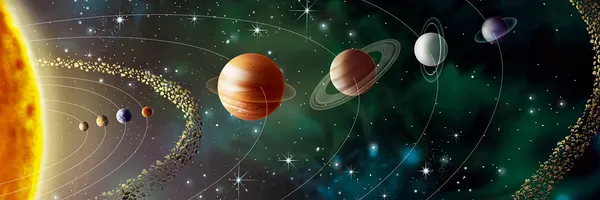
Out of this world! A study of the habitability of the planets.
Angeline Badilla
St. Rose of Lima Junior High School
Grade 8
Presentation
No video provided
Problem
Did you know that, at the time of writing this, doomsday clock is at 89 seconds until midnight? This is the closest it has ever been since its creation in 1947, and according to Wikipedia, this is the cause of climate change, COVID 19, and disruptive innovation (the newest being generative AI). Climate change is affecting us fast, and even more because of the new discovery of generative AI and its use of fossil fuels and water. There are also many conflicts within multiple countries relationships which is slowly affecting our trading of resources and knowledge. We need to rebrand -- to start over and start rebuilding the Earth to what we once knew it was, but what if by the time we do, it's too late?
I would like to discover a planet in our solar system that is next habitable to Earth. If anything happens to Earth, which is very plausible, we must find a planet B that can support some sort of life. My project is attempting to advance research in the field of astrobiology in hopes that it will be useful in the future. To further the chances of life on this new planet, I will make a prototype of a machine. This machine will have as many features as possible to bring life outside of earth and into this new planet.
Method
PART A :
HYPOTHOSIS :
I think that the planet next habitable to Earth is Mars. Before any studying, I think it’ll be Mars because of 3 key factors. Number 1 - Earth and Mars are directly next to each other in the solar system, and since earth is in the perfect spot and rotation in the solar system that Mars is close enough. Number 2 - Earth and Mars are similar sizes, and maybe if the sizes are similar then so are the planets. Number 3 - This reason is my weakest one, but I’ve heard that Scientists and Nasa once found traces of Liquid water on Mars. That is a big sign of habitability if it is true since water is one of the if not most required elements for the human body to survive. If my research does show that this rumor is true then Mars has lots of potential to be the next habitable planet.
COLLECTING INFORMATION :
Information about Earth :
- Earth's atmosphere is made of \~78% nitrogen, \~21% oxygen, \~1% argon, and \~0.04% carbon dioxide.
- Earth’s temperature is \~ 59 degrees fahrenheit (\~ 15 degrees celcius)
- Earth's center of gravity is in the center, and the atmosphere is pushing us so that we stand straight.
- The Earth is the right distance from the sun, it is protected from harmful solar rays because of its magnetic field, it is kept warm by an insulating atmosphere, and it has the right chemical ingredients for life, including water and carbon.
- It contains vital gasses such as carbon dioxide for photosynthesis and oxygen.
- It has liquid water
- It has a stable rotation and tilt.
- Earth's full day is 23.9 hours.
What makes a planet habitable? What are the requirements for transferring life from Earth to another planet?
- The standard definition of a “habitable zone/planet” is one that can support/sustain life for a significant period of time.
- It must have perfect conditions for life, not too hot or too cold.
- “Planets orbiting stars that produce high levels of X-ray and UV flux from flares and activity could end up stripped of their atmosphere, leading to a planet that may be warm but completely airless” - https://seec.gsfc.nasa.gov/what_makes_a_planet_habitable.html
- If there is a detection of free oxygen on one planet, that is strong evidence that there is some sort of presence of life on that planet. Oxygen is highly reactive, and would rapidly disappear when in contact with other elements unless it is continuously replenished from something like photosynthesis.
- Life has 3 main requirements, liquid water, certain chemical elements, and energy.
Little information about each planet (excluding earth since Earth is already habitable) :
Mercury :
 (An image of Planet mercury)
- Mercury is the closest planet to the sun.
- Smallest planet in the solar system, only slightly bigger than Earth's moon.
- Closest to the sun.
- Fastest planet, taking around 88 earth days to orbit around the sun
- Mercury is both extremely hot and excruciatingly cold, going from up to \~800 degrees fahrenheit (\~430 degrees celsius), and without an atmosphere, it can drop too \~-290 degrees fahrenheit (\~-180 degrees celsius).
- Mercury has no moons, nor rings.
- Mercury has a thin atmosphere consisting of oxygen, sodium, hydrogen, helium, and potassium.
- Mercury's magnetic field at the surface has only 1% of the strength of the earth's.
Venus
 (An image of planet Venus)
- Venus is the second planet in the solar system.
- It is the sixth largest planet, however earth is slightly bigger.
- Venus has no moons nor rings.
- Its atmosphere is mainly constructed of carbon dioxide, the gas that is putting a green house effect on earth and venus.
- Its temperature is \~464 degrees celsius (\~867 degrees fahrenheit).
- Its magnetosphere is induced, meaning it's weaker than earth's even though they have a similar size iron core.
Mars

(An image of planet mars)
- Around 3 billion years ago, Mars had a thicker atmosphere and was covered in liquid water in the past.
- Mars is about half the size of earth
- Mars completes one whole day at \~24.6 hours, very similar to earth's full day.
- Mars has two small moons, which aren't perfectly spherical due to their lack of mass.
- It has nearly the same area of dry land as earth.
- Mars has a very thin atmosphere consisting of carbon dioxide, nitrogen, and argon gases
- Mars does not have a magnetosphere
- Mars has a central core, a rocky mantle, and a solid crust.
- Temperature can range from \~70 Fahrenheit (\~20 celsius) to \~-225 Fahrenheit (\~-152 celsius) because of the thin atmosphere.
Jupiter
 (An image of planet Jupiter)
- Jupiter is the largest planet, if it was hollow it could fit 1000 earths.
- Jupiter has 4 large moons and 95 recognised smaller ones. Surprisingly one of its moons (Europa) is one of the most likely habitable planets (or moons) in the solar system. There is evidence of an ocean under its icy crust, which might be able to support life.
- Jupiters days are the shortest, only \~9.9 hours to rotate once. However, it takes 12 earth years for it to orbit the sun.
- Jupiter's composition is similar to the suns, made of hydrogen and helium. Once you go deeper into the atmosphere, the pressure and temperature increase, turning the hydrogen into a liquid. This gives it the title for biggest ocean in the solar system, but it is hydrogen instead of water.
- Jupiter surprisingly has rings, but they are hard to see.
- “The gas planet likely has three distinct cloud layers in its "skies" that, taken together, span about 44 miles (71 kilometers). The top cloud is probably made of ammonia ice, while the middle layer is likely made of ammonium hydrosulfide crystals. The innermost layer may be made of water ice and vapor.”
- Its temperature is \~-110 degrees celsius (\~-166 Fahrenheit), however its core is extremely hot.
Saturn
 (An image of planet saturn)\
- The farthest planet from earth.
- Saturn is 9 times wider than Earth.
- Saturn's days are \~10.7 hours long.
- As of June 2023, Saturn has 149 moons.
- Saturn has many rings; it is what makes it stand out.
- Similar to Jupiter, Saturn is mainly composed of hydrogen and helium, and it has a dense core made of iron and nickel.
- Saturn is the only planet in our solar system whose average density is less than water. According to NASA's website about Saturn, it could float in a bathtub if a bathtub so large existed.
- Saturn's atmosphere is mainly hydrogen and helium, but it does have other minor gases.
- Saturn's temperature is \~-178 degrees celsius (\~-288 fahrenheit)
Uranus

(An image of planet Uranus)
- Neptune is 4 times bigger than Earth.
- Uranus has 28 known moons.
- Surprisingly, Uranus has two sets of rings.
- Uranus is one of two ice giants, according to NASA’s facts Neptune is the second.
- Uranus gets its colour from all the methane gas.
- It does not have a surface, and is mainly just floating liquids like water, methane and ammonia.
- Uranus’ atmosphere is mainly hydrogen and helium, with little traces of water, methane, and ammonia.
- Its minimum temperature is “49K” ( according to NASA is \~-224.2 celsius)
- One day on Uranus is 17 earth hours, and a year (orbits the sun) is \~84 earth years.
Neptune
 (An image of the planet Neptune)
- It is the most distant planet in our solar system.
- Neptune is dark, cold, has super sonic winds, and like mentioned earlier is the second ice giant.
- Neptune is not visible to the human eye.
- Neptune has 16 known moons
- Neptune has at least 9 rings. 5 main ones and 4 prominent ones.
- It is the densest planet
- Its atmosphere consists mainly of hydrogen and helium, also having a little methane.
- This planet does not have a “real surface”.
- One day on Neptune is 16 earth hours, but a year is 165 earth years.
- Since it is a cold planet, its temperature is \~-361 degrees fahrenheit (\~-218 degrees celsius)
(EXTRA) : Europa
(An image of the moon Europa)
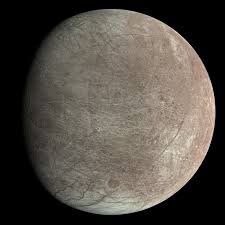
- Europa is Jupiter's fourth biggest moon.
- Europa is one of the most likely planets (or moons) to be able to sustain life.
- Even though Europa’s diameter is only ¼ of Earth's, its ocean could contain twice of earth's ocean.
- Europa’s ocean is covered by a huge ice wall.
- In 2019, one of NASA’s international teams discovered a water vapour above Europa's surface for the first time.
- According to NASA’s official page about Europa, it has the 2 out of the 3 key elements that are required for life. Europa has abundant liquid water, and all the chemicals that earth does. The third element however, energy, works a little differently for Europa. All life would have to be below the ice wall, where the sun cannot reach.
- This planet has a surprisingly smooth surface, even though it is an icy planet. It is also brighter than the moon.
- After a bit of research, scientists assume that the thick icy wall surrounding Europa is \~10-15 miles thick. The ice layer floats on an ocean \~40-100 miles deep.
- Its temperature is around -223 degrees celsius - -148 degrees celsius.
- It is possibly venting water into space, meaning that it could still be an active planet.
- A day on Europa is around 3.55 earth days (85 hours).
- Although Europa is continuously struck by Jupiter's radiation, this radiation hits the surface. As established earlier, life would have to happen beneath the icy surface and in the oceans. The radiation could possibly create energy for the ocean below. The radiation separates the water particles into oxygen and hydrogen, while the hydrogen floats into space, then the oxygen can bind with another element to create energy and fuel the ocean. If this energy could pass through the ice wall, then it can and will help with the habitability.
PART B
DISCLAIMER!: My machine will not include transportation to Europa, its use is simply to help with the habitability.
Hypothesis: I think the machine will require a warming system or a blade/saw to get through the ice and let the energy go to the ocean. I think it’ll also need a compartment that will hold micro bacteria and/or some sort of living organism that can survive in the conditions. It will need strong grippy winter tires and if possible a system where it can get its energy from the radiation of Jupiter. I think it should be around 7 inches. The machine should be controllable from Earth. I also want a camera on it. This machine will need to sustain very low temperatures, which is why I want the heating system.
Information about space crafts:
- A space craft is some sort of machine made to be sent into space.
- Because of the lack of air in space, the spacecraft's shape doesn't really matter, but its size does.
- Sizes can really range from 10 cm to over 109 m!
- There are eight types of space craft.
- SFlyby spacecraft
- Orbiter spacecraft
- Atmospheric spacecraft
- Lander spacecraft - the type of spacecraft I'm aiming to make
- Penetrator spacecraft
- Rover spacecraft
- Observatory spacecraft
- Communications & Navigation spacecraft
- The farthest a lander spacecraft has ever gone is Titan, a moon of saturn. By making an inference, that means it’s possible that my spacecraft could get to Europa.
- The space craft that went to Saturn was able to transfer information for about 4 hours, including its two hour and 27 minute descent and its 72 minute life on the moon.
- To send commands to a space craft, they are sent by radio waves. Radio waves can take 33-55 minutes to go from earth to Jupiter.
- Space crafts have antennas that receive and send information and signals to and from Earth.
More about lander space crafts:
- A lander space craft is a space craft designed to land, whether it is a planet, moon, asteroid, etc.
- There are two types of lander space crafts, soft landers and hard landers/impactors. I am focusing on soft landers in this project.
- Soft landers are landers that — like in their name, have softer landings. This is so they can continue to work after they have landed. They normally have two key factors, a solar generator or any type of energy generator, and something to slow impact.
- Impactors/hard landers are made to collide with these space objects at high speed.
- They do this to collect scientific data about the celestial body, and unlike soft landers they make their conclusions by hitting the planet, moon, or asteroid.
- To put it simply, landers need a shell, typically a heat shell that protects the body from extreme temperatures. It needs some sort of support for landing/touchdown, for more exact landing, they will need propulsion systems to help with landing, most common being retro rockets to counter the gravitational force of said body.
- It will need a power source, like a solar panel, and it will need antennas to receive radio waves from the huge antennas back at Earth.
- Lastly, instruments. Most common being cameras but there will be others. They will be used to support the space craft.
Information about the living organisms.
- After a quick Google search, there are intact multiple microorganisms that can survive in -200°C.
- Tardigrades can survive in mainly any condition because they ball up and go into an almost death like state, cryptobiosis.
- They eat algae and plants.
- Very fortunately, they can survive without oxygen.
Analysis
PART A:
After comparing all of the information I collected and comparing each celestial bodies traits, I decided that the best option out of the 8 was Europa. It has water, the proper chemical elements, and energy which comes from Jupiters radiation. The other candidates simply didnt have the traits, some not having surfaces, some being too hot or cold, etc.
PART B:
Requirements for Europa’s spacecraft:
- For spacecrafts, NASA usually uses Nickel-base superalloy for the shell/support/etc. which not only can stand over 1000°C, but also -300°C. This material is perfect because it can stand the temperature of Europa, but it can handle the high radiation of Jupiter.
- For the energy, NASA has in fact made solar panels specialized for high radiation, Extreme Environments Solar Power (EESP), in the article (listed in the resources and references), they stated that they started EESP for missions on planets like Jupiter.
- It’s landing support will be rods with curved circles at the bottom.
- There will be spots underneath the spacecraft for the rockets.
- There will be a compartment for the tardigrades.
- In the middle of the rockets, there will be a spot for a laser to try to make a hole to the ocean for the tardigrades to get through.
- On top there will be an antenna to receive the radio waves.
- Somewhere, there will have to be a camera.
- The tardigrades will launch from their compartment.
Materials needed:
- Cardboard
- Hot glue, glue
- Bamboo/barbecue sticks
- Tape
- Paper
- Sharpie
My rough sketch:
Conclusion
CONCLUSION FOR PART A:
I have decided to use Europa as the planet that I will make a machine about. I came to this conclusion because according to https://science.nasa.gov/jupiter/jupiter-moons/europa/, “Europa may be one of the most promising places in our solar system to find present-day environments suitable for some form of life beyond Earth.” It has multiple key elements for life and the potential is too grand to pass by. I believe that Europa is the moon next habitable to earth.
CONCLUSION FOR PART B :
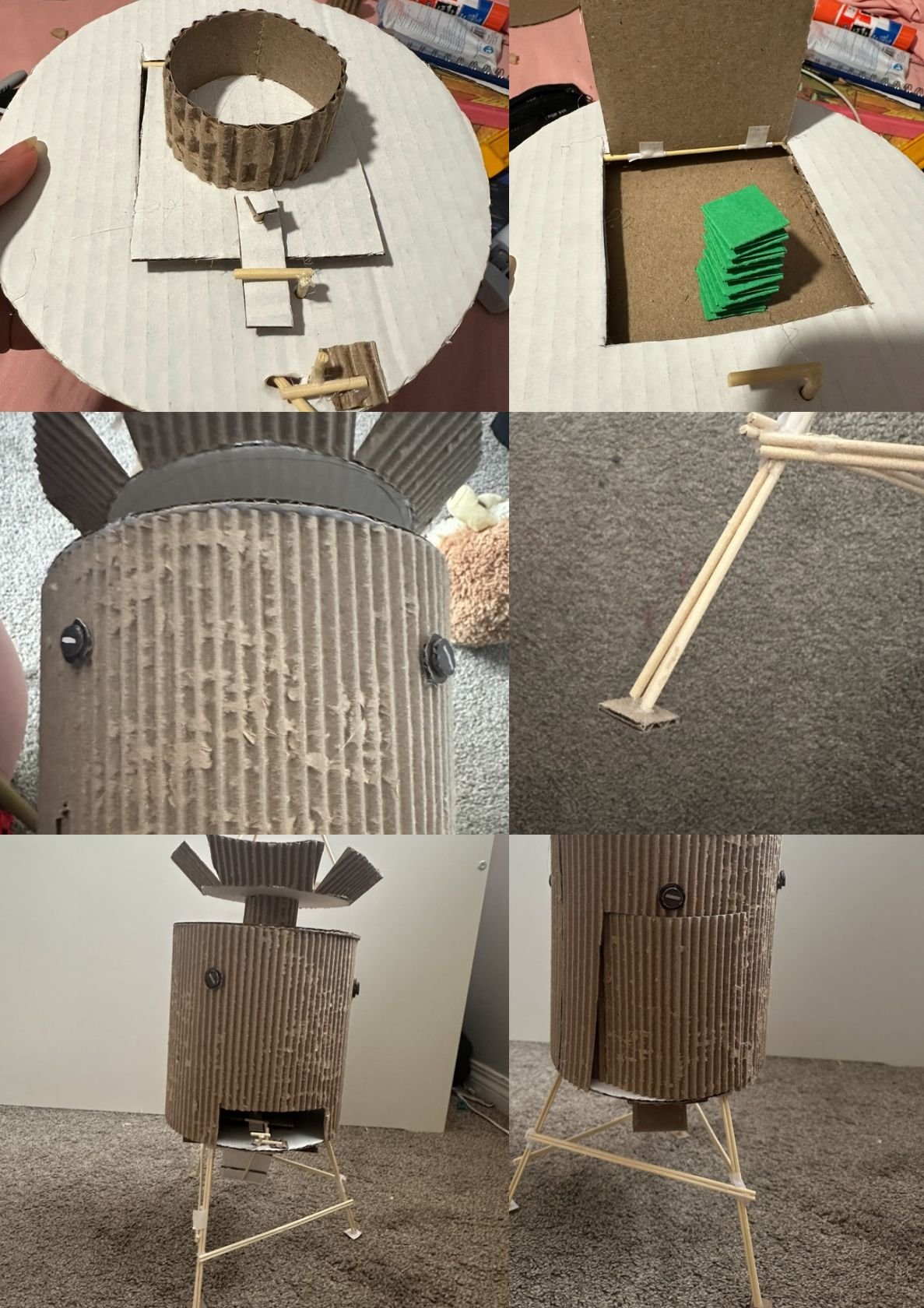
The final outcome: In the end, I made several changes from the original sketch. Firstly, the most major change I made was in the the tardigrade compartment and how they launched themselves. Originally, I had some sort of flap or hatch like thing that when released, would launch the tardigrades. However, after trying so, I realized the flap was too heavy and the taridigrades wouldn't have the time to launch. I ended up making a cardboard stick that held itself underneath a stick. when moved, it would jump up using the paper spring underneath it, and the same mechanism as a door.Then, I switched the bottom. Originally, the ends were curved, but that made it harder to stand and easier to push so I made them flat. I added sevral cameras all over, and made the walls curvy to represent the radiation pannels. Lastly, I made a laser on the bottom that would drill through the ice. When I added it, I wondered, "How would the tardigrades travel from their launch to the hole?" So, I added mirrors that could move and go back once the retro rockets finished their job.
And finally, the finished outcome.
Citations
https://www.amnh.org/exhibitions/permanent/planet-earth/why-is-the-earth-habitable https://seec.gsfc.nasa.gov/what_makes_a_planet_habitable.html https://pubmed.ncbi.nlm.nih.gov/11539468/ https://science.nasa.gov/mercury/ https://science.nasa.gov/venus/ https://science.nasa.gov/mars/facts/ https://science.nasa.gov/jupiter/jupiter-facts/ https://science.nasa.gov/saturn/facts/ https://science.nasa.gov/uranus/facts/ https://science.nasa.gov/neptune/neptune-facts/ Europa: Facts - NASA Science https://www.stateofglobalair.org/resources/report/state-global-air-report-2025#:~:text=world%20in%202023.-,The%20State%20of%20Global%20Air%202025%20report%20provides%20a%20comprehensive,of%2035%20%CE%BCg%2Fm3. https://en.wikipedia.org/wiki/Doomsday_Clock#:~:text=Other%20reasons%20cited%20included%20climate,since%20its%20inception%20in%201947. https://science.nasa.gov/mission/europa-clipper/why-europa-ingredients-for-life/#:~:text=But%20the%20type%20of%20life,the%20icy%20moon's%20interior%20flexes. https://www.nasa.gov/humans-in-space/spaceships-and-rockets/ https://www.esa.int/kids/en/learn/Technology/Spacecraft/All_shapes_and_sizes https://science.nasa.gov/learn/basics-of-space-flight/chapter9-1/ https://science.nasa.gov/mission/cassini/the-journey/timeline/#:~:text=The%20Huygens%20probe%20successfully%20landed,that%20a%20spacecraft%20has%20landed https://spaceplace.nasa.gov/dsn-antennas/en/#:~:text=dsn%2Dantennas,Spain;%20and%20Goldstone%2C%20California https://grokipedia.com/page/Lander_(spacecraft) https://www.nasa.gov/directorates/stmd/game-changing-development-program/extreme-environments-solar-power/ https://www.livescience.com/57985-tardigrade-facts.html https://www.space.com/space-exploration/new-laser-drill-could-help-scientists-explore-ice-covered-worlds-like-jupiters-ocean-moon-europa
Any AI use : The only ai used in this project was google’s ai Gemini. Although I did not ask the chatbot for help directly, when I googled for answers lots of the answers were responded to by Gemini. There was no other AI used in my project.
Acknowledgement
I would like to thank,
Mr Landa - Help throughout my projecty My parents - For support and materials Saint rose of Lima school - Supplying my trifold NASA's website - I used their website for mainly all of my information