

Slime Germs
Charlotte Rex, Neige Paton
Calgary Girls Charter School
Grade 6
Presentation
No video provided
Hypothesis
We believe Floam Slime will collect the least amount of bacteria because there is the least amount of slime and more floam therefor there is less density and motion.
We believe that Clear slime will collect the most amount of bacteria because it is sticky and therefore the stickiness will result in bacteria overload.
Research
We researched the types of slime and chose five types of slime we thought would harbour bacteria differently. The five types of slime we chose were: Water, Cloud, Clear, Floam, and Butter. We also researched the highest rated petri dishes. We did the experiment twice, using both homemade agar and commercial agar. No bacteria grew in either situation. We were going to research the types of bacteria that grew but there weren't any.
Variables
Dependent variable Our dependent variable is how much bacteria grows on each slime.
Control variable We are going to put a small potion of each slime aside to see how much germs it grows on its own.
Independent variable For our independent variable we changed the type of slime per day.
.
Procedure
Wash hand 30 sec. Under nail too rinse dry w/ paper towel Step 1 fridge door slide 4 sec each hand Light switches Bedroom door handles N & C Wipe hands on Main floor bathroom sink handle then sink bowl Toilet handle flusher and run hands down toilet lid Rub hands on bottom of shoes Then play with slime x3 min Rub slime over petri dish
Observations
Day #1 observations
- Clear and floam slime when warm get really sticky
- The cloud slime flaked whenever rubbed against the agar or our hands
- The agar broke/ripped easily
- The agar smelt bad
(This is the day that we actually put the agar in the petri dishes and rubbed the slime on them so there will be no observations about the bacteria for this day)
Analysis
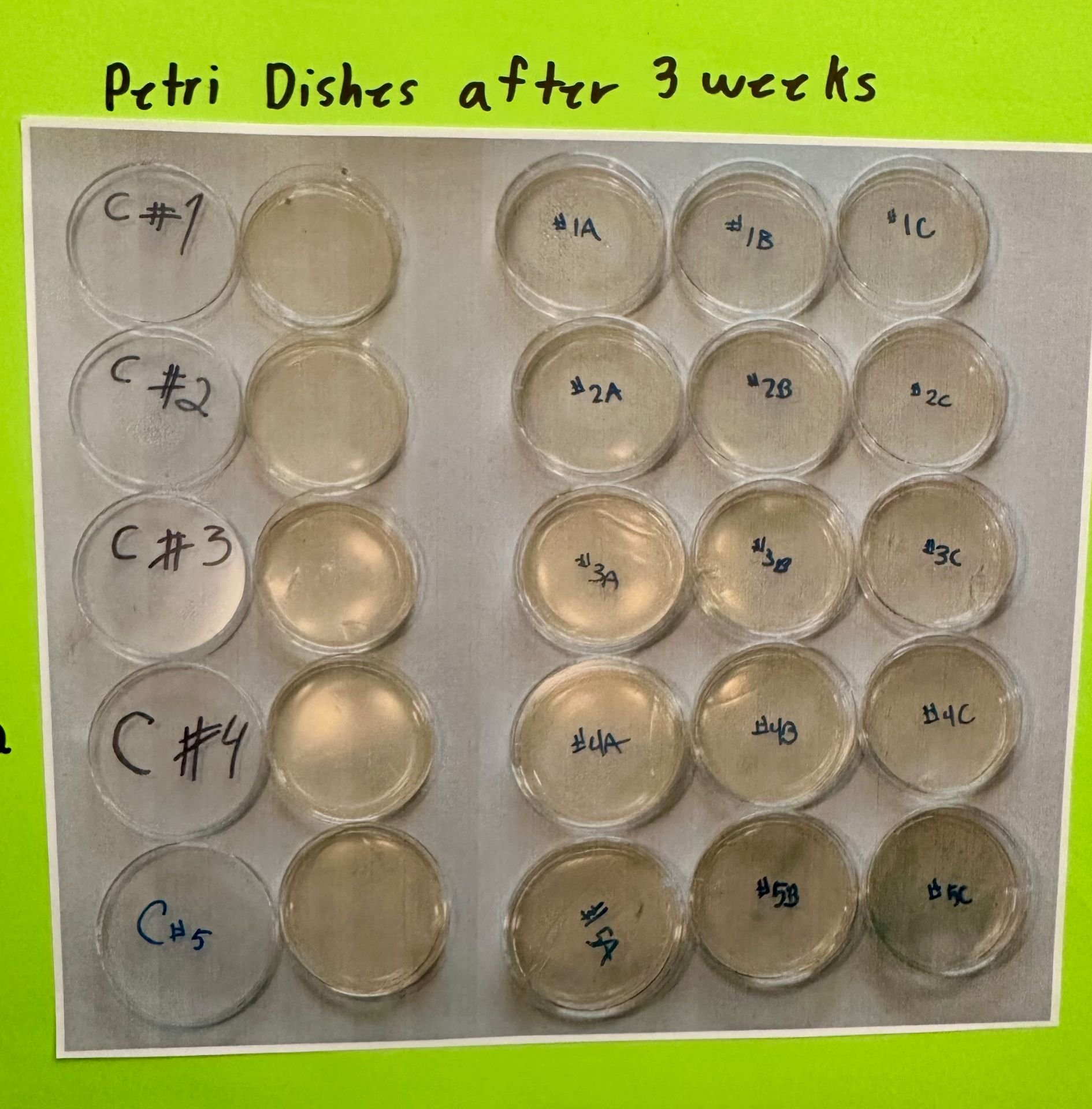 We observed the petri dishes for 3 weeks and found that no bacteria grew in any of them.
Conclusion
In conclusion, we found that none of our slimes grew any bacteria. This surprised us because we thought that the germs would grow due to all of the bacteria that was on our hands when we played with the slime. Why didn't it work? Some reasons why we think it didn't work include: the slime counteracts the agar mix, the slimes are anti-bacterial, there wasn't enough bacteria on our hands, the slime wasn't exposed to the agar long enough, and it was too cold for bacteria to grow.\ What could we try different next time? Next time we could: rub a finger on the agar to show how much bacteria we have on our hands, use different germ inducing items, leave a small piece on the petri dish to increase exposure time.
Application
If bacteria didn't transfer to the slime (as observed by no bacteria growing in the petri dish) then it's possible that smile is cleaner than we thought and that you can play with it multiple times without it being a bacterial playground.
This also applies to how parents sometimes won't get their kids slime because they think it will collect too many germs and that it will get their child sick. Perhaps we've shown that this is not the case and is false.
Sources Of Error
Clear pink slime sample 3 was opened by colleague may have cross contamination Floam slime preparation was inconsistent resulting in smaller samples. Sterilisation station may be partly ineffective Inoculation procedure may not be identical Color and scent of slimes
Citations
The agar recipe that we used was sourced from: https://www.umsl.edu/microbes/files/pdfs/homemademedia.pdf
The information about the slimes possibly being antibacterial was sourced from Google.
Acknowledgement
we acknowledge our teachers who provided information and a safe learning space. And our parents who helped order the resourses, provided a space to grow the bactiria, and helped to keep us on track.