
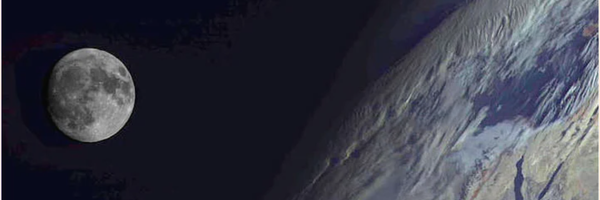
Earth-Moon system
Manmeet Kaur, Rajpreet k Shergill
Gobind Sarvar School Guru Nanak Gate Campus
Grade 11
Presentation
No video provided
Problem
How do tidal interactions between Earth and the Moon contribute to the current rate of lunar recession, and what do these interactions reveal about the future stability of the Earth–Moon system?
Method
This project was conducted as a theoretical research study. Scientific literature, peer-reviewed sources, and accepted astronomical data regarding tidal interactions in the Earth–Moon system were reviewed and analyzed. Key physical principles, including gravitational interaction, tidal friction, and angular momentum transfer, were examined to explain the mechanism behind lunar recession. Observed recession rates were interpreted in the context of long-term orbital evolution
Research
The Earth-Moon system forms a gravitational partnership where tidal forces transfer angular momentum from Earth to the Moon. Energy is gradually lost due to the movement of water and the deformation of the Earth's crust. The result follows: the moon's orbital distance slowly increases as Earth's rotational speed decreases. This makes days longer over geological time. Understanding these interactions is essential for analysing the long-term evolution of the Earth-Moon system.
As the Earth rotates, the gravitational pull of the Moon creates tidal bulges in the Earth's oceans. The Earth spins faster than the Moon orbits, which means that these bulges are not perfectly lined up with the Moon - they are slightly pulled ahead. This creates friction, also known as tidal dissipation. Tidal dissipation causes loss of Earth's rotational kinetic energy. That energy does not disappear - instead, it gets transferred to the moon's orbit. This can be expressed with the energy transfer relation: finding out how much energy is transferred or lost when something rotates under a twisting force.
ΔE=τ×Δθ
Data
Data from previous ranging experiments provide us with precise measurements of the Earth-moon dynamics. Current observations show that:
- Current Lunar recession rate: approximately 3.8cm per year
- Earth’s rotational slowdown: about 1.7 milliseconds per century
- Long-term predictions: 1 million years later
- The moon would migrate outward by 38 km
- The length of the Earth's day increases by 1.7 seconds
Conclusion
The Moon’s gravity causes tides in Earth’s oceans. Moving water creates friction and loses energy. Earth’s crust also bends slightly because of the Moon, which also uses energy. This loss of energy slows Earth’s rotation and makes the Moon slowly move farther away from Earth over time. Over millions and billions of years, this dynamic process will influence the Earths roation, moons orbit, and the delicate balance of our planet's relationship with it"s natural satellite.
Citations
NASA — Tides: How the Moon’s gravity affects Earth’s oceans (tides and bulges) NASA Science
NASA — 10 Things: What We Learn About Earth By Studying the Moon (axial stability, tides, rotation effects) NASA Science
Institute for Environmental Research and Education — Stabilization and climate effects of the Moon (axial tilt, long-term climate effects), Environmental Research Institute
NASA’s LRO findings — Earth’s pull influences geological features on the Moon (scientific measurement implications) NASA NASA’s LRO Discovers Earth’s Pull is ‘Massaging’ our Moon — https://www.nasa.gov/news-release/nasas-lro-discovers-earths-pull-is-massaging-our-moon/
The resonant tidal evolution of the Earth-Moon distance — https://www.aanda.org/10.1051/0004-6361/202243445
Lunar Ranging:
https://physicsworld.com/a/how-high-the-moon/?utm_source=chatgpt.com
🔗 Earth’s day is slowly getting longer and this is measured by scientists • ScienceDaily — Earth’s rotation is slowing, adding about 1.7 milliseconds per century because of tidal forces from the Moon. Why the day is 24 hours long: Astrophysicists reveal why Earth's day was a constant 19.5 hours for over a billion years (ScienceDaily) • Scientific American — Fossils and lasers show the day is lengthening and the Moon is receding about 3.8 cm per year. Fact or Fiction: The Days (and Nights) Are Getting Longer (Scientific American) • Space.com — The Moon drifts away at about 3.82 cm per year, slowing Earth’s rotation. Days on Earth Are Getting Longer, Thanks to the Moon (Space.com) • Wikipedia — Detailed explanation of tidal acceleration, the physics behind Earth’s slowdown, and the Moon’s recession. Tidal acceleration (Wikipedia) 🔗 Fossil records (like corals and shells) show how Earth’s days were shorter in the past • ScienceDaily — Fossil shells show Earth’s day was shorter (about 23½ hours) 70 million years ago. Ancient shell shows days were half-hour shorter 70 million years ago (ScienceDaily) • University of Texas Marine Science Institute — Fossil corals have daily and yearly rings that let scientists count how many days were in a year long ago. Coral Moon - Marine Science Institute (UT Austin) • EBSCO Research — Study of growth lines in ancient corals and shells shows Earth’s spin was faster in the past, with more days per year. Earth's Rotation | Research Starters (EBSCO Research) • ASA3.org — Coral and shell growth rings show more days per year in the past, which means shorter days long ago. Age of Coral Reefs (ASA3.org)
Britannica – Tides Overview Explains that tides are caused by the gravitational pull of the Moon and how tidal bulges form on Earth. Tide | Definition, Causes, Types, & Facts (Britannica) Time and Date – How the Moon Causes Tides Describes how the Moon’s gravitational variation creates bulges of water (high and low tides). The Moon Causes Tides on Earth (TimeandDate.com) Britannica – Moon and Sun’s Role in Tides Breaks down how the Moon’s gravity affects tides more than the Sun and why there are two high tides per day. What Causes Tides in the Ocean? (Britannica) NASA – Tides Explained A clear scientific explanation of how the Moon’s gravity creates tidal bulges and affects ocean movement. Tides – NASA Science National Geographic – Cause and Effect of Tides Shows how tidal forces from the Moon (and the Sun) create high and low tides and how tides vary in different places. Cause and Effect: Tides (National Geographic)
🌞 Sources about Total Solar Eclipses Disappearing NASA – Eclipse FAQ Explains what total solar eclipses are and that they happen because the Moon and Sun appear the same size in our sky right now. Eclipses Frequently Asked Questions (NASA Science) Live Science – Future of Total Solar Eclipses Says the Moon is moving away \~1.5 inches (3.8 cm) per year and predicts that in about 600 million years total solar eclipses will stop. Earth Will Have Its Last Total Solar Eclipse in About 600 Million Years (Live Science) Space.com – Long-Term Eclipse Changes Also explains that the Moon’s slow movement outward will eventually make it too small to completely block the Sun. Earth Will Have Its Last Total Solar Eclipse in About 600 Million Years (Space.com) Britannica – Moon Moving Away Confirms that the Moon is slowly receding and that total solar eclipses will no longer occur once it’s too far away. The Moon is Slowly Moving Away (Britannica) NASA – Eclipses and the Moon Includes details on how the Moon’s recession changes solar eclipse types and that in the future eclipses will be annular instead of total. Eclipses and the Moon (NASA Science) NASA – Tides (moon’s gravity causes tides) Explains how the Moon’s gravity pulls on Earth’s oceans to create bulges that cause high and low tides. Tides – NASA Science NASA JPL – Lunar Laser Ranging and the Moon’s motion Describes how scientists use laser pulses bounced off reflectors on the Moon to measure how the Moon is slowly moving away from Earth and how Earth’s rotation is changing. Earth–Moon System – NASA JPL Apache Point Observatory Lunar Laser-ranging Operation (APOLLO) Shows how scientists measure the distance to the Moon precisely using lasers and retroreflectors left on the Moon. APOLLO Lunar Laser Ranging (Wikipedia) Science Buddies – The Moon and Tides (for methods and measurements) Describes how tide data is collected and used, including how the Moon’s phases relate to tides. The Moon and Tides – Science Buddies
🔹 NASA – Why Do Eclipses Happen?: Details how solar eclipses work and why the Moon appears the right size now. Also explains that the Moon’s increasing distance will eventually change eclipse types. 🔹 Eos.org – The End of the Eclipse: Specifically discusses how total solar eclipses will disappear as the Moon’s apparent size shrinks over time. 🔹 Live Science – Will Earth Ever Lose Its Moon?: Covers the Moon moving away and how this affects tides and Earth’s rotation over billions of years.
🔹 NASA – Tidal Locking / Earth–Moon interactions: Explains the motion of the Moon, tidal locking, and how tidal friction transfers Earth’s rotational energy to the Moon’s orbit. 🔹 SpringerOpen – Earth‑Moon tidal evolution: Scientific explanation of how tidal forces affect Earth’s rotation and the Moon’s distance over long time scales. 🔹 Time and Date – Moon Causes Tides: Explains how the Moon’s gravity pulls on Earth’s oceans to create high and low tides. The Moon Causes Tides on Earth (TimeandDate.com) 🔹 National Geographic – Cause and Effect: Tides: Shows how the Moon’s gravitational pull causes tidal bulges and how spring and neap tides happen. 🔹 NOAA / NASA – What Causes Tides?: Breaks down tidal forces from the Moon (and the Sun) and why there are two high tides each day. 🔹 Teach Earth Science – Introduction to Tides: Basic educational explanation of tidal formation and measurement.
Acknowledgement
We would like to acknowledge our Teacher, Ms. Manjula, for her feedback and for guiding us through our project. We would like to acknowledge Ms.Singh and Ms.Seran for giving us the opportunity to work on the science fair this school year. We would like to acknowledge the school board of Gobind Sarvar School, Calgary, for ordering us our trifolds. We would like to acknowledge our parents for their support and the encouragement they have given us. We would like to acknowledge the Opportunity to present our project. We would like to acknowledge the Judges for taking time out of their busy schedules and listening to our presentation.