
Bloom busters
Eden Wong, Mia Zhang
Queen Elizabeth High School
Grade 9
Presentation
Hypothesis
TESTABLE QUESTION/HYPOTHESIS:
If either calcium-biochar beads or iron oxide-biochar beads are added to simulated eutrophic water, then phosphate concentrations will decrease more than water without the beads, because both calcium and iron compounds are able to precipitate/bind to phosphates and make them inaccessible to algae.
Research
RESEARCH:
What is eutrophication?
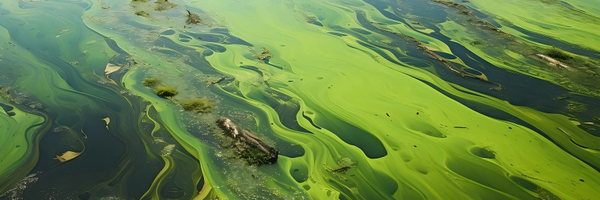
Eutrophication is when excess nutrients like nitrogen and phosphorus enter bodies of water, causing an overgrowth of algae that depletes oxygen in the water.
The root cause of eutrophication primarily comes from the excess of nitrogen and phosphorus from untreated sewage water, industrial food waste, and runoff containing high levels of nutrients. Overall, this pressing issue stems from human actions in regards to negligence in agriculture and farming.
When algae starts to bloom, it covers the water’s surface and blocks sunlight from reaching aquatic plants. Organisms drain the dissolved oxygen in the water while eating this surplus algae and eventually become unable to breathe. These organisms die and release CO₂ as they decompose and the water becomes ‘hypoxic’, meaning there is not enough oxygen to sustain the ecosystem, and it becomes a dead zone.
What forms of phosphorus exist in water, and which are most responsible for eutrophication?
Phosphorus (P) is an element that exists as phosphate molecules (PO4), however it doesn’t usually present itself in its purest form, especially in freshwater. Instead it appears in different chemical and biological forms which can be grouped into 3 main categories:
1. Dissolved inorganic phosphorus (DIP)
Inorganic phosphorus/orthophosphate ions (PO₄³⁻, HPO₄²⁻, or H₂PO₄), have their forms dependent on the pH of the environment. Aquatic plants, such as algae, directly utilize inorganic phosphates for nutrition as it is the most soluble and available for their growth. However, orthophosphates are seen in low concentrations in natural water bodies, making their existence within fertilizers, sediments, and soil waste in water a huge boost of energy for algae blooms to grow, ultimately making them the main driver of eutrophication.
2. Dissolved organic phosphorus (DOP)
Organic phosphorus originates from phytoplankton and bacteria cannot be immediately used by algae and aquatic plants as it must be broken down by bacteria or sunlight. While its role in eutrophication is not nearly as large as inorganic phosphorus, it still contributes to it over time.
3. Particulate phosphorus (PP)
Particulate phosphorus is attached to or inside particles such as soil, detritus, or plankton in water. It often sinks into sediments but can be released back into the water under low-oxygen conditions. It contains fragments of both inorganic and organic phosphorus attached to particles.
What materials/material structures could be useful in binding/absorbing/clumping phosphates?
Many phosphate compounds can contribute to eutrophication through their widespread use, but there are also ways to remove the phosphorus from them through different elements. Different materials can remove phosphates through absorption, precipitation, or flocculation (clumping). Iron, calcium and other metals specifically can bond with the phosphorus in water to form insoluble clumps that can easily be collected. There are several natural waste-derived materials as well.
Calcium-rich materials (CaCO₃, CaO, Ca(OH)₂) Examples of calcium-rich materials include crushed eggshells, limestone, and marble dust. The calcium-rich materials work in a few ways.
- Chemical Precipitation: in which positively charged calcium ions (Ca²⁺) react with negatively charged dissolved phosphate ions (PO₄³⁻) in water. This forms insoluble calcium phosphate compounds (Ca₃(PO₄)₂). Once formed, these compounds precipitate (settle out) because they’re not soluble in water, effectively removing phosphate in its dissolved state
- 3Ca²⁺ + 2PO₄³⁻ → Ca₃(PO₄)₂(solid) is the chemical equation represents the formation of calcium phosphate as a solid precipitate
- Surface Binding: many calcium-rich materials (like limestone, seashells, eggshells, bone char etc.) have surfaces that can absorb phosphate ions. Phosphate groups can stick onto calcium sites by ionic attraction (force between oppositely charged ions that hold them together in and ionic bond) and surface complexation (reactions where ions/molecules bind to a solid surface), meaning the phosphate is locked onto the material rather than floating freely in the water.
- pH Buffering: Calcium carbonate (CaCO₃) and similar minerals can increase pH in water. At higher pH (typically >8.5), phosphate tends to exist in forms (like dissolved phosphate ions/PO₄³⁻) that are more easily precipitated by calcium. This means calcium-rich environments naturally encourage phosphate removal.
Iron oxides (Fe²⁺, Fe³⁺, compounds) Iron is also commonly used to precipitate phosphorus, turning loose particles into an easily gathered and insoluble sludge-like material. It can work in several forms.
- Iron oxides (Fe2O3 or FeO (OH), where the iron and phosphorus bond, and the oxygen connects with the phosphorus, making the structure more stable. This makes iron phosphates (FePO₄) that are insoluble.
- Iron shavings or pieces (Fe²⁺/Fe³⁺), where the small iron particles are placed alongside a sediment, sand or gravel filter. When water comes into contact with the pieces, it creates iron oxides (Fe2O3) that then make iron phosphates.
What factors influence the removal of phosphates?
pH in Water: Certain compounds can turn phosphates into insoluble clumps, but some pH levels can cause clumped phosphates to dissolve. Different materials precipitate best at different pHs.
- Iron oxides are better at 5 - 7, too high can cause competition with calcium
- Calcium bonds more with phosphate at a pH slightly higher than 7
Trapped Phosphorus: Some phosphates bind to other compounds in water, or sink to the bottom of the water and become solid through sedimentation, where it may be difficult to remove.
How can we increase/maximize the absorption capabilities of materials?
- Increase available reactive surface area:
- Finer particles, porous materials, or coatings give more binding sites for phosphates
- In eutrophication control, this mean using porous calcium/iron-rich substrates (substances where chemical reactions take place) in filters, wetland substrates, or lake treatment agents
- Control water chemistry for phosphate removal
- pH adjustment:
- Slightly alkaline (pH 7–9) favors Ca²⁺ (calcium ions) precipitation as calcium phosphates (stable, sinks to sediments)
- Slightly acidic to neutral (pH 5–7) favors absorption to iron
- Optimizing pH ensures more phosphorus ends up locked into solid forms instead of staying soluble.
- pH adjustment:
- Promote precipitation into stable mineral
- calcium, iron, and compounds react with phosphate to form a low-solubility solid
- These solids settle into sediments, reducing dissolved phosphorus that algae can access
- Prevent re-release from sediments (internal loading)
- Once phosphorus binds, we want it to stay locked in sediments instead of cycling back to into the water during low oxygen conditions
- Iron is prone to releasing phosphate if sediments go anoxic, but adding calcium provides more stable binding under variable oxygen conditions
How can biochar be used to amplify the absorption of materials?
Biochar is a material derived from organic materials and biomass (natural materials like wood chips etc.) undergoing a process called pyrolysis (heating the material to remove oxygen). It is porous and mostly made of carbon. Due to its porous structure, it is often used for agriculture to hold onto nutrients, retain moisture, and increase agricultural productivity for nutrient-poor soils.
Different biochars can be created by heating different materials. Most biochar is made from agricultural and animal waste. Agricultural waste biochar, made from various scrap materials such as corn stalks, wheat straws, and wood chips. This kind of biochar is often used to enrich soil. Contrarily, animal waste biochar from manure is better for burning as a fuel, and it retains more of its original chemical composition with elements like phosphorus. Other materials used to produce biochar include food waste and sewage sludge.
Biochar can also become more calcium/iron rich in a few ways.
- Altering Biomass: Using organic matter that is originally chemical-rich before pyrolysis, such as bones and shells (calcium), sewage sludge and certain vegetables (iron)
- Adding to Biomass: Placing extra nutrients on or into the organic matter if it is not inherently chemical-rich, before or during pyrolysis.
- Adhering to Biochar: Gluing extra nutrients into or onto the surface of already-pyrolysed biochar, so that the chemicals are not affected by the pyrolysis.
How is phosphate measured?
Phosphorus is usually measured in parts per million (ppm) or milligrams per litre (mg/L). However, phosphates in water have no colour or scent, so many different ways are used to analyze the amount of phosphorus in water bodies, most frequently orthophosphate ions (PO₄³⁻), one of the most common kinds of inorganic phosphorus. These can be detected using:
- Colorimeters, devices that add reagents that react with the phosphates to create a colour and shine a light on water samples to detect the particles. The amount of phosphorus is calculated based on the intensity of a blue or yellow colour. Colorimeters are a more digital and advanced method of measuring phosphorus, but can cost anywhere from $100 to over $1000 for the best models.
- Phosphorus or PH Test Strips, small filter paper strips with chemical reagents inside that react with phosphorus and change colour based on the concentration. A white or pale colour indicates low phosphate levels while a darker colour shows high phosphate levels. They are much cheaper than colorimeters at around $15 to $30 however their results are based on comparing your result with a list of prepared outcomes, meaning it may be less precise.
Overall, colorimeters are higher quality and provide an accurate numerical result while also being more expensive, while phosphorus test strips are cheaper and more accessible, but may be harder to pinpoint the exact outcome with.
How will we use chemical precipitation and absorption?
Calcium-Biochar Beads We know that phosphorus mainly exists as orthophosphate/ dissolved inorganic phosphate ions (PO₄³⁻ or HPO₄²⁻). The exact form depends on pH, but all are negatively charged and soluble, making them easily available to algae. The calcium-rich materials embedded in the bead release Ca²⁺ ions into the surrounding water, which chemically react with the phosphate ions to form calcium phosphate minerals (Ca₃(PO₄)₂) that have very low solubility in water and precipitate out of the solution
This precipitation converts the dissolved phosphate ions into a solid form, making it inaccessible to algae and eutrophication. The biochar in the bead enhances the calcium phosphate removal by providing a highly porous structure that increases contact between phosphate ions and calcium-rich areas.
Iron-Biochar Beads: The iron particles in the iron oxide bead become positively charged (Fe²⁺/Fe³⁺), especially when in neutral or slightly acidic solutions (5-7), and these positive ions are attracted to the more negative phosphate ions that are present in dissolved inorganic phosphates (PO₄³⁻ or HPO₄²⁻). Iron and phosphorus bond into iron phosphate (FePO₄), which is insoluble in water and can be collected as small, solid chunks. These solid pieces cannot be consumed by aquatic plants and algae. Having biochar in the bead assists this process by providing a larger, more porous surface area for phosphorus to bind to.
Variables
VARIABLES:
Controlled:
- Volume of testing water per trial
- Concentration of phosphorus in initial testing water
- Size/mass of beads
- Amount of beads placed in water
- Location and placement of beads in water
- Tools used (such as droppers and syringes)
- Location of experiment
- Light exposure and temperature of beads and water
- Time/length of the experiment
- Initial pH of water (not adjusted)
- Mixing conditions (no stirring after beads are added)
Manipulated/Independent:
- The material composition of each capture bead
- Calcium-biochar beads
- Iron oxide-biochar beads
Responding/Dependent:
- Amount of phosphorus remaining in the water after 9 days (mg/L or ppb)
Procedure
PROCEDURE:
Course of Action:
We aim to develop 2 different beads using biochar and sodium alginate, one with calcium, and one with iron oxide. We will compare the efficiency and effectiveness of each bead in a controlled environment and test how much phosphorus can be absorbed from water. Some of our controlled variables include the amount of phosphorus in the starting water, the volume of water, the size and number of beads, and the location and environment of the experiment. The manipulated variable is the materials of the beads, and the responding variable is the amount of remaining phosphorus in the water. We will experiment over the course of 2-3 weeks and apply our data to our hypothesis and analysis.
Experiment Preparation
Materials & Equipment:
- Calcium carbonate/CaCO₃ material (eggshell powder etc.)
- Iron oxide powder/Fe2O3.or FeO (OH)
- Monopotassium phosphate/KH2PO4/Pure phosphorus fertilizer to prepare phosphate solutions
- Water
- Biochar (porous, either powder or chunk form)
- Sodium alginate (as an adhesive)
- Calcium Chloride (to set the alginate)
- Pipettes, syringes
- pH test meter
- Phosphate test strips
- Gloves, goggles, waste containers
Calcium-Biochar Bead:
Ingredients:
- 5 g calcium carbonate (eggshell powder)
- 10 g calcium chloride
- 2 g/1 tsp biochar
- 5 g sodium alginate
- 0.6 L water (600 mL)
Plan:
-
Prepare calcium-biochar-alginate mixture
-
Measure 100 mL of water and put in a blender
- Measure 5 g sodium alginate, 2 g of biochar, and 5 g calcium carbonate and slowly mix into the water
-
Mix until fully blended. Afterwards, you may notice some foaming/bubbles. If this occurs, refrigerate for at least 1 hour or until the bubbles are gone.
-
Prepare calcium chloride mixture
-
While the calcium-biochar-alginate mixture is in the fridge, prepare the calcium chloride bath
- NOTE: the pH of the calcium-biochar-alginate mixture MUST be between 4-10 (adding sodium citrate can increase the pH of mixture if its too low)
- Measure 10 g of calcium chloride and mix into in 500 mL of water
-
Stir until fully dissolved
-
Form beads
-
Fill a syringe or dropper with the calcium-biochar-alginate mixture (may use a teaspoon if wanting larger beads)
- Slowly release uniform droplets about 2-3 cm above the the calcium chloride, allowing the beads to form one at a time
- Let the beads harden in the solution for 15 minutes
- Strain or scoop the beads out of the mixture with a sifter and rinse twice in water
- Afterwards, store in room temperature water until testing
Iron Oxide-Biochar Bead:
Ingredients:
- 5 g iron oxide powder
- 10 g calcium chloride
- 2 g/1 tsp biochar
- 5 g sodium alginate
- 0.6 L water (600 mL)
Plan:
-
Prepare iron-biochar-alginate mixture
-
Measure 100 mL of water and put in a blender
- Measure 5 g sodium alginate, 2 g of biochar, and 5 g iron oxide and slowly mix into the water
-
Mix until fully blended. Afterwards, you may notice some foaming/bubbles. If this occurs, refrigerate for at least 1 hour or until the bubbles are gone.
-
Prepare calcium chloride mixture
-
While the iron-biochar-alginate mixture is in the fridge, prepare the calcium chloride bath
- NOTE: the pH of the iron-biochar-alginate mixture MUST be between 4-10 (adding sodium citrate can increase the pH of mixture if its too low)
- Measure 10 g of calcium chloride and mix into in 500 mL of water
-
Stir until fully dissolved
-
Form beads
-
Fill a syringe or dropper with the iron-biochar-alginate mixture (may use a teaspoon if wanting larger beads)
- Slowly release uniform droplets about 2-3 cm above the the calcium chloride, allowing the beads to form one at a time
- Let the beads harden in the solution for 15 minutes
- Strain or scoop the beads out of the mixture with a sifter and rinse twice in water
- Afterwards, store in room temperature water until testing
Phosphate Removal:
Ingredients:
- 2.425 L water
- 100 mg Phosphate material (monopotassium phosphate/phosphate fertilizer)
- 3 same sized containers
- pH test strips
- Phosphate test strips or colorimeter
Setup:
- Label 3 identical containers
- Control (no beads)
- Calcium-Biochar
- Iron Oxide-Biochar
- In a separate jar, take 100 mg (\~ 0.02 teaspoons or 0.1 mL) of phosphate and pour it into 1 L of water to make a 100mg/L phosphate stock solution
- In each of the 3 containers, pour 497.5 mL of water and 2.5 mL of the stock solution to get a final concentration of 0.5 mg/L
- Measure and record the initial phosphate concentration from each container using phosphate test strips, it should equal 500 ppb
- Measure and record initial pH
Treatment:
- Add 30 g calcium-biochar beads to the calcium treatment container
- Add 30 g iron oxide-biochar beads to the iron treatment container
- Do not add beads to the control container
- Leave all containers undisturbed at room temperature under the same light conditions and in the same general area
Observations
OBSERVATIONS:
Data Collection:
We will have Eden use the test strips to test the phosphate levels, pH and temperature from each container every day. With this data, we aim to determine the exact amount (mg/L or ppm) of phosphorus as well as the percentage of phosphates removed both daily and overall.
Trial #1
| DAY 1 (DEC 23) | Control | Calcium | Iron Oxide |
|---|---|---|---|
| pH | 8.04 | 8.13 | 8.11 |
| Phosphate | 500 ppb | 500 ppb (0.25 mg/495mL) | 500 ppb |
| Written observation | Start date, no change | ||
| DAY 2 (DEC 24) | Control | Calcium | Iron Oxide |
|---|---|---|---|
| pH | 8.26 | 8.34 | 8.27 |
| Phosphate | 500 ppb | 250 ppb (0.125 mg/490 mL | 200 ppb |
| Written observation | No change except for pH | Some beads have expanded or split open | Some beads have expanded or split open |
| DAY 3 (DEC 25) | Control | Calcium | Iron Oxide |
|---|---|---|---|
| pH | 8.41 | 8.46 | 8.52 |
| Phosphate | 500 ppb | 100 ppb (485 mL | 100 ppb |
| Written observation | No change except for pH | Most beads have expanded in size or split open, however are holding more shape than iron oxide | Most beads have split open, some are releasing their contents |
| DAY 4 (DEC 26) | Control | Calcium | Iron Oxide |
|---|---|---|---|
| pH | 8.54 | 8.62 | 8.55 |
| Phosphate | 350 ppb | 50 ppb | 100 ppb |
| Written observation | Decrease in phosphate, potentially because of water reduction? | Water sample was quite pale but not yet clear | Little to no changes, even in pH |
| DAY 5 (DEC 27) | Control | Calcium | Iron Oxide |
|---|---|---|---|
| pH | 8.69 | 8.69 | 8.56 |
| Phosphate | 300 ppb | 50 ppb | 50 ppb |
| Written observation | Slight decrease in phosphate, increase in pH | Almost the same as yesterday | Very similar to Calcium |
| DAY 6 (DEC 28) | Control | Calcium | Iron Oxide |
|---|---|---|---|
| pH | 8.59 | 8.51 | 8.43 |
| Phosphate | 250 ppb | 50 ppb | 50 ppb |
| Written observation | All pH’s have lowered slightly | Phosphate levels seem to have stabilized | |
| DAY 7 (DEC 29) | Control | Calcium | Iron Oxide |
|---|---|---|---|
| pH | 8.68 | 8.67 | 8.65 |
| Phosphate | 250 ppb | 50 ppb | 50 ppb |
| Written observation | It has become slightly more difficult to take a pH reading due to the reduced water | Slightly foggy but very little blue colour | |
| DAY 8 (DEC 30) | Control | Calcium | Iron Oxide |
|---|---|---|---|
| pH | 8.79 | 8.78 | 8.68 |
| Phosphate | 300 ppb | 0 ppb | 50 ppb |
| Written observation | More blue results than yesterday, potentially because phosphates have settled in one place? | Not completely transparent but no colour | Still more blue |
| DAY 9 (DEC 31) | Control | Calcium | Iron Oxide |
|---|---|---|---|
| pH | 8.82 | 8.74 | 8.72 |
| Phosphate | 200 ppb | 0 ppb | 0 ppb |
| Written observation | Sudden reduction in phosphates, yesterday’s reading may have been an outlier | pH has become difficult to read due to low water levels | Same reading as Calcium, no colour but cloudy |
| DAY 10 (JAN 1) | Control | Calcium | Iron Oxide |
|---|---|---|---|
| pH | 8.84 | 8.82 | 8.79 |
| Phosphate | 150 ppb | 0 ppb | 0 ppb |
| Written observation | In order to take a pH reading, the container had to be tilted to provide the right depth for the pH meter | ||
| DAY 11 (JAN 2) | Control | Calcium | Iron Oxide |
|---|---|---|---|
| pH | 9.09 | 9.03 | 8.95 |
| Phosphate | 150 ppb | 0 ppb | 0 ppb |
| Written observation | Sudden surge in pH | The test strip left some fuzz in the sample, may have been shaken too hard? | Water sample appeared slightly green, most likely from the green iron oxide beads |
| DAY 12 (JAN 3) | Control | Calcium | Iron Oxide |
|---|---|---|---|
| pH | 9.05 | 8.98 | 8.97 |
| Phosphate | 150 ppb | 0 ppb | 0 ppb |
| Written observation | The container is nearly empty, making it difficult to take a sample | The Calcium and Iron containers still have a testable amount of water | |
| DAY 13 (JAN 4) | Control | Calcium | Iron Oxide |
|---|---|---|---|
| pH | — | 8.98 | 8.98 |
| Phosphate | — | 0 ppb | 0 ppb |
| Written observation | Completely dried out, cannot be experimented on | ||
Trial #2
| DAY 1 (JAN 19) | Control | Calcium | Iron Oxide |
|---|---|---|---|
| pH | 8.46 | 8.49 | 8.39 |
| Phosphate | 500 ppb | 500 ppb | 500 ppb |
| Written observation | Starting a new round of experimenting! | Beads have expanded | Beads have expanded, though not as much as Calcium |
| DAY 2 (JAN 20) | Control | Calcium | Iron Oxide |
|---|---|---|---|
| pH | 8.58 | 8.54 | 8.42 |
| Phosphate | 500 ppb | 300 ppb | 250 ppb |
| Written observation | Some small air bubbles along the walls of the container | Bead have expanded more, the largest have released some of their contents | Some beads appear more oblong, and several are splitting open |
| DAY 3 (JAN 21) | Control | Calcium | Iron Oxide |
|---|---|---|---|
| pH | 8.45 | 8.39 | 8.34 |
| Phosphate | 500 ppb | 200 ppb | 200 ppb |
| Written observation | |||
| Some beads have expanded and are taller than the water level | Beads have more abnormal shapes |
| DAY 4 (JAN 22) | Control | Calcium | Iron Oxide |
|---|---|---|---|
| pH | 8.58 | 8.38 | 8.35 |
| Phosphate | 500 ppb | 150 ppb | 150 ppb |
| Written observation | pH seems to be fluctuating | Slight phosphate reduction, but otherwise little to no change | |
| DAY 5 (JAN 23) | Control | Calcium | Iron Oxide |
|---|---|---|---|
| pH | 8.40 | 8.52 | 8.46 |
| Phosphate | 500 ppb | 150 ppb | 100 ppb |
| Written observation | There is a dead gnat floating in the water | ||
| DAY 6 (JAN 24) | Control | Calcium | Iron Oxide |
|---|---|---|---|
| pH | 8.58 | 8.53 | 8.44 |
| Phosphate | 500 ppb | 100 ppb | 100 ppb |
| Written observation | Buying a new set of phosphate test strips | ||
| DAY 7 (JAN 25) | Control | Calcium | Iron Oxide |
|---|---|---|---|
| pH | 8.44 | 8.58 | 8.53 |
| Phosphate | 400 ppb | 50 ppb | 50 ppb |
| Written observation | Slight decrease, unsure why | Beads are much larger than Iron oxide | |
| DAY 8 (JAN 26) | Control | Calcium | Iron Oxide |
|---|---|---|---|
| pH | 8.68 | 8.70 | 8.62 |
| Phosphate | 300 ppb | 50 ppb | 50 ppb |
| Written observation | |||
| The largest beads are splitting open | Some beads have stringy appendages |
| DAY 9 (JAN 27) | Control | Calcium | Iron Oxide |
|---|---|---|---|
| pH | 8.64 | 8.75 | 8.63 |
| Phosphate | 300 ppb | 50 ppb | 0 ppb |
| Written observation | |||
| Very pale blue | Cloudy but no blue colour |
| DAY 10 (JAN 28) | Control | Calcium | Iron Oxide |
|---|---|---|---|
| pH | 8.72 | 8.80 | 8.64 |
| Phosphate | 300 ppb | 0 ppb | 0 ppb |
| Written observation | |||
| Cloudy but no blue colour | |||
Trial #3
| DAY 1 (FEB 2) | Control | Calcium | Iron Oxide |
|---|---|---|---|
| pH | 8.35 | 8.20 | 8.25 |
| Phosphate | 500 ppb | 500 ppb | 500 ppb |
| Written observation | Starting our last experiment | ||
| DAY 2 (FEB 3) | Control | Calcium | Iron Oxide |
|---|---|---|---|
| pH | 8.49 | 8.27 | 8.28 |
| Phosphate | 500 ppb | 300 ppb | 300 ppb |
| Written observation | |||
| Beads appear slightly larger | Some beads are releasing small specks of their contents |
| DAY 3 (FEB 4) | Control | Calcium | Iron Oxide |
|---|---|---|---|
| pH | 8.41 | 8.39 | 8.34 |
| Phosphate | 500 ppb | 300 ppb | 200 ppb |
| Written observation | |||
| Some beads are splitting open |
| DAY 4 (FEB 5) | Control | Calcium | Iron Oxide |
|---|---|---|---|
| pH | 8.48 | 8.37 | 8.33 |
| Phosphate | 500 ppb | 200 ppb | 200 ppb |
| Written observation | |||
| Beads are overall holding shape | |||
| DAY 5 (FEB 6) | Control | Calcium | Iron Oxide |
|---|---|---|---|
| pH | 8.49 | 8.45 | 8.40 |
| Phosphate | 500 ppb | 100 ppb | 100 ppb |
| Written observation | |||
| DAY 6 (FEB 7) | Control | Calcium | Iron Oxide |
|---|---|---|---|
| pH | 8.49 | 8.38 | 8.34 |
| Phosphate | 500 ppb | 100 ppb | 100 ppb |
| Written observation | Same pH as yesterday | ||
| DAY 7 (FEB 8) | Control | Calcium | Iron Oxide |
|---|---|---|---|
| pH | 8.52 | 8.48 | 8.43 |
| Phosphate | 500 ppb | 100 ppb | 50 ppb |
| Written observation | |||
| DAY 8 (FEB 9) | Control | Calcium | Iron Oxide |
|---|---|---|---|
| pH | 8.59 | 8.53 | 8.51 |
| Phosphate | 400 ppb | 50 ppb | 50 ppb |
| Written observation | |||
| DAY 9 (FEB 10) | Control | Calcium | Iron Oxide |
|---|---|---|---|
| pH | 8.61 | 8.62 | 8.58 |
| Phosphate | 400 ppb | 0 ppb | 0 ppb |
| Written observation | |||
Analysis
ANALYSIS:
 In our first trial, we saw a somewhat steep downward trend for the Calcium and Iron Oxide beads, and a slight decrease in the Control. The Control saw a gradual decline in phosphate after a few days, then suddenly rose again near the end of the experiment for unknown reasons. This could be because of a faulty test strip or an inaccurate reading. For the beads, the decrease in phosphate started quickly and gradually weakened after a few days, with the Calcium bead reaching 0 ppb at Day 8 and the Iron bead finishing the day after. The Calcium bead appeared to be the most efficient overall, although the Iron bead worked more quickly during the first few days.
 In our second trial, we saw similar results to our first, although we noticed that the Control stayed at a steady 500 ppb for a majority of the testing period with a rapid dip towards the Day 7 mark, eventually tapering off at 300 ppb on Day 9. As for the beads themselves, the Iron Oxide Bead seemed to be the most effective overall, reaching 0 ppb of phosphate at the end of the trial date, while the Calcium Bead was not too far behind, ending at 50 ppb, and although it did not reach zero during the designated test period, it finished shortly afterward.
  In our third trial, we saw consistent results again. The control remained at 500 ppb for the longest of the three experiments, and decreased the least by the end. The Calcium and Iron Oxide beads both reached 0 ppb on the same day, although the Iron had a steadier descent while Calcium followed a steeper path, similar to our second experiment.
Results/Performance Evaluation:
Trial/Graph Results: From what is displayed in the data we collected, the iron oxide and calcium beads seem to be tied in terms of the rate at which they absorbed/bound to the phosphates in the water. This is supported in Trial 1, where the Calcium beads removed all the phosphates in 8 days and the Iron Oxide in 9 days, Trial 2 with the Calcium not being able to remove the phosphates in 9 days, and the Iron Oxide removed them in 9 days, and Trial 3 where the Calcium and Iron Oxide tied at removing the phosphates in 9 days.
While on average the Iron Oxide and Calcium beads are equal in rate of removal, the Iron Oxide beads were more consistent with their results, maintaining a steady 9 days to reach 0 ppb of phosphate. On the other hand, the Calcium beads varied in terms of how many days it took to remove all phosphate, with 8 in Trial #1, 10 in Trial #2 (while this data was excluded to maintain the same variables for the graphs, we continued recording to ensure the bead was not faulty), and 9 in Trial #3. Specifically in scientific trials like these, we value consistent trends to ensure reliability and validity. In this case, if we look at the standard deviation (measurement of variation in data) of these two pieces of data, the Calcium has a standard deviation for phosphate removal of about 0.8, while the Iron Oxide has a standard deviation of 0. This makes the Iron Oxide Bead the least varied and the most consistent and efficient in terms of solely looking at the data.
Steepness of Decline: Based on the results in our graphs, we can see that in the first trial, both the Calcium and Iron Oxide beads started with a quick, sharp decline in phosphate levels, before steadying after Days 4 and 5. The Calcium followed a slightly less steep curve afterward, while the Iron Oxide was slower. From the steepness of the phosphate decline, we can see that the Calcium bead removed phosphate more quickly and consistently, while the Iron Oxide was slightly less efficient. In the second experiment, both beads were less steep at the start, slowing their decline around Days 3 and 4. In this second test, the Calcium bead followed a slower decline throughout, ultimately not finishing within 9 days, while the Iron bead decreased smoothly, particularly from Days 2 to 5. Overall, experiment two’s beads followed less sharp, but steadier declines, meaning the beads absorbed phosphate more slowly but more consistently per day. In our third test, we saw a similarly smooth, slow descent, with Calcium and Iron following almost identical paths and finishing on the same day. However, Iron Oxide was less efficient and more consistent, while Calcium was the opposite. Between all three experiments, both beads tended to start with a steep decline before steadying after a few days, with the Calcium bead following a steeper, faster line but with more varied daily results, and the Iron Oxide bead moving more slowly, but with a more consistent phosphate precipitation rate from day to day. Because of the variation in absorption rate with the Calcium beads, we decided that the Iron Oxide Bead performed better overall for its consistent phosphate removal, although it was less efficient daily.
Cost of Materials: For both of the beads, the $15.95 calcium chloride, $15.95 sodium alginate, $9.88 monopotassium phosphate, and $16.75 biochar were the same for both, with the same quantities for the Calcium and Iron Oxide beads. Specifically for the Calcium beads, we used around 10 eggs to crush up for eggshells/calcium carbonate, coming to \~$5.50 for a dozen. For the Iron Oxide beads, the iron oxide powder was $15.98. Overall, this points to the Calcium Bead being the most cost-effective, but not by a large margin.
Effort: While the recipes used were almost the exact same, the two kinds of beads also varied in the amount of time and effort required to prepare. To make the Calcium beads, we had to remove the membranes of eggshells, then boil and bake them to sanitize them before crushing the shells into a powder, which overall took more time. After this was complete, the eggshell powder was easy to store, and the sterilization process did not have to be repeated during later experiments. For the Iron Oxide, no such preparation was required, as the product could be bought online; more effort had to be put into maintaining safety since the fine iron powder could be dangerous to inhale. In terms of storage, the iron oxide came in a bag, which made it easy to store away; however, when reopened, a small amount of iron dustwas released into the air. We decided that, because of the tedious process of eggshell sterilization and crushing, the Iron Oxide Bead required less effort overall.
Phosphate Levels: In terms of preventing eutrophication, it is generally better to have a very small, low amount of phosphate rather than none at all. While high levels of phosphorus lead to harmful algae blooms and dead zones, phosphorus is a naturally occurring essential nutrient required for the growth of aquatic plants. 5-10 ppb of phosphate per litre of water is considered healthy for an ecosystem. Based on this, the Calcium Bead, which did not absorb all the phosphate once, may be better suited for the environment. However, since our phosphate test did not have perfect accuracy, we are not sure if our test water was within the ideal phosphate threshold.
Final Decision: Based on our experiment data, graphs, cost, effort, and other considerations, we decided that the Iron Oxide bead was the best overall.
Conclusion
CONCLUSION:
Concluding Statement:
Our beads made of biochar, sodium alginate, calcium carbonate(CaCO₃), and iron oxide(Fe2O3) successfully reduced phosphate levels in simulated eutrophic water while our control test with no beads retained its phosphate content, proving our hypothesis that the calcium and iron particles would precipitate and lower phosphate levels. Both beads succeeded in removing phosphorus, and we found that the iron oxide bead worked the best because it functioned more consistently and took less effort to manufacture, whereas the calcium bead’s results fluctuated. This may have been because the iron oxide powder was finer than the calcium, allowing for more points of contact for phosphates to bind to, or potentially because we sourced our calcium from home while the iron came from a formal manufacturing brand. While the iron beads worked better during our experiment, our test data suggests that both kinds of beads and biochar would help mitigate phosphate levels in eutrophic waters and dead zones. These beads are made of relatively cheap materials and are biodegradable, meaning that they can be manufactured effectively and ethically, and overall our project proves that the problems of eutrophication might be mitigated in the future.
Application
APPLICATION:
What’s Next? (Application/Extension):
In today’s society, eutrophication remains one of the most prevalent threats to biodiversity. To aid in this pressing issue, our beads would be able to control the eutrophication levels to some extent. However, our experiments were obviously done in a very controlled, diluted environment of about 500 mL compared to how large a real eutrophic body of water might be. This means that application wise, upscaling our project to be suitable for larger bodies of water may introduce areas of growth and extension.
While our project was a major success, there were several areas of improvement or development that could’ve been made. In the future if we are to repeat or build upon this project, we could choose to incorporate the growth of real algae to mimic or analyze how an actual eutrophic water body with living organisms would react to our beads. Moreover we might choose to contact a biologist or chemist with specialties in this field to gain a wider breadth of knowledge in terms of the chemical processes that are actually happening and what we could do to manipulate those outcomes. Obviously the materials that we used were intended to be extremely accessible to the average person so for a deeper expansion of the project we could invest in more complex or precise measuring technology or materials to maximize the potential of our project.
Sources Of Error
SOURCES OF ERROR/INFLUENCING FACTORS:
Our experiment results aligned with our hypothesis, however there may have been a few sources of error caused by limitations in our materials, human error, and unprecedented results.
Materials
- How did water quality influence results?
- For the majority of our project we used the tap water from Eden’s kitchen sink which we identified to be more basic than we expected.
- This did not however severely positively or negatively affect our project’s results as eutrophic bodies of water typically do not have an exact pH of 7 and range from 7.5–8.5
- Were incorrect pH readings an issue?
- Naturally when measuring anything, there is room for error in measurement so we wanted to account for that here.
- It's important to note that and incorrect pH reading wouldn’t have affected our results significantly as we did not rely on the pH measurements heavily for our data analysis
Experiment
- Were measurement conversions (between mL to g etc.) exact?
- When working with extremely small amounts of materials, it gets difficult to measure precisely and convert units.
- Throughout our experiment, we had to convert units to tbsp or tsp to better measure out materials, potentially causing maybe a few milligrams to be shaved off of the initial measurements
- Did human errors make an impact?
- During our phosphate measurements, human error might have occurred, however we minimized the impact of these potential errors by conducting more than one experiment.
- Why did the water levels go down?
- Water may have been removed by evaporation, absorbed into the beads via osmosis, or accidentally splashed during the test process
- The reductions in water were very small and should not have an impact on our results
Results
- Why was the phosphate gone so fast?
- The binding of ions can occur very quickly, and there were several beads so the phosphates could be absorbed from all sides
- Why was the phosphate decrease not constant?
- At the start all the phosphate was floating freely in the water which made it easy for the beads to absorb
- Reduction per day began slowing down because the phosphorus was beginning to settle on the base of the container instead of floating freely
- Why did the control also decrease?
- Potentially from a small amount of evaporation or the phosphates settling and not being picked up by the tester
- Why was the pH fluctuating?
- Carbon dioxide makes water more acidic, so over time as the carbon dioxide is released the water’s pH increases
- More carbon dioxide may be added into the air from human breathing, which could cause the pH to go back down
- Why were the results different for each bead?
- The eggshell pieces were less fine, meaning there might have been less surface area for the phosphates to bind to
- The iron powder was bought online while the calcium was from home, so the calcium might be less pure
- Why were the experiment results inconsistent? (If we applied same method)
- There are always minuscule differences in the process, (such as having a few grains less of biochar or mixing for a longer time) that cannot be avoided
Citations
CITATIONS:
- US Department of Commerce, N. O. and A. A. (2019, April 2). What is eutrophication?. NOAA’s National Ocean Service. https://oceanservice.noaa.gov/facts/eutrophication.html
- Nature Publishing Group. (n.d.). Nature news. https://www.nature.com/scitable/knowledge/library/eutrophication-causes-consequences-and-controls-in-aquatic-102364466/
- Environmental Protection Agency. (2012, March 6). 5.6 phosphorus. EPA. https://archive.epa.gov/water/archive/web/html/vms56.html#:~:text=Forms%20of%20phosphorus&text=Phosphorus%20in%20aquatic%20systems%20occurs,with%20organic%20material%20is%20inorganic.
- Phosphorus: Canadian water quality guidelines for the ... (n.d.). https://ccme.ca/en/res/phosphorus-en-canadian-water-quality-guidelines-for-the-protection-of-aquatic-life.pdf
- Phosphorus forms, environmental impact, and measurement. Bartovation. (2025, February 13). https://bartovation.com/phosphorus-and-phosphate-waterways-environment/#:~:text=Forms%20of%20Phosphorus%20in%20the,concentrations%20in%20natural%20water%20bodies.
- Augustyn, A. (1998, July 20). Principal compounds. Encyclopædia Britannica. https://www.britannica.com/science/phosphorus-chemical-element/Principal-compounds
- Frankel, T. (2015, September 9). What is phosphorus removal in wastewater. SSI Aeration. https://www.ssiaeration.com/how-to-remove-phosphorus-from-wastewater/#gref
- Zhang\, J.\, Liu\, S.\, Wang\, S.\, & Huang\, X. (2020). Dissolved organic phosphorus - an overview | sciencedirect topics. Dissolved Organic Phosphorus. https://www.sciencedirect.com/topics/earth-and-planetary-sciences/dissolved-organic-phosphorus
- Zhang, B., Wang, L., & Li, H. (2019, May). Fractionation and identification of iron-phosphorus compounds in sewage sludge - sciencedirect. https://www.sciencedirect.com/science/article/abs/pii/S0045653519302693
- Rajendran, S., Sai Bharadwaj, A. V. S. L., Barmavatu, P., Palani, G., Trilaksanna, H., Kannan, K., & Meenakshisundaram, N. (2024, February 9). A review on lanthanum-based materials for phosphate removal. MDPI. https://www.mdpi.com/2305-7084/8/1/23#:~:text=3.3.&text=The%20adsorption%20of%20phosphate%2C%20especially,additional%20binding%20sites%20%5B51%5D.
- Yin, H., Kong, M., & Fan, C. (2013, September 1). Estimating phosphorus retention capacity of flow-through wetlands - sciencedirect. https://www.sciencedirect.com/science/article/abs/pii/S0925857422003305
- Gubernat, S., Masłoń, A., Czarnota, J., & Koszelnik, P. (2020, July 30). Reactive materials in the removal of phosphorus compounds from wastewater-A Review. Materials (Basel, Switzerland). https://pmc.ncbi.nlm.nih.gov/articles/PMC7435924/#:~:text=Reactive%20materials%20are%20those%20able,phosphorus%20removal%20efficiency%20%5B3%5D
- Why do we need phosphorus. MEL Science. (n.d.). https://melscience.com/US-en/articles/what-do-we-need-phosphorus/
- Basinski, J. J., Bone, S. E., Klein, A. R., Thongsomboon, W., Mitchell, V., Shukle, J. T., Druschel, G. K., Thompson, A., & Aristilde, L. (2024, July 18). Unraveling iron oxides as abiotic catalysts of organic phosphorus recycling in soil and sediment matrices. Nature News. https://www.nature.com/articles/s41467-024-47931-z
- Ai, H., Zhang, K., Penn C. J.,& Zhun, H., (2023, November 1). Phosphate removal by low-cost industrial byproduct iron shavings: Efficacy and longevity. Water research. https://pubmed.ncbi.nlm.nih.gov/37866245/
- Wilfert, P., Meerdink, J., Degaga, B., Temmink, H., Korving, L., Witkamp, G. J., Goubitz, K., & van Loosdrecht, M. C. (2020, March 15). Sulfide induced phosphate release from iron phosphates and its potential for phosphate recovery - sciencedirect. https://www.sciencedirect.com/science/article/pii/S0043135419311637
- Phosphorus monitoring in water and phosphorus removal. Phosphorus in Water, Measurement, Monitoring and Removal. (n.d.). https://www.ysi.com/parameters/phosphorus?srsltid=AfmBOoqGCBLxcAhLdoCYSYr7wzEIn7GPH44QjiAT8S0i1-ssfzvwvLEa
- Wikimedia Foundation. (2025b, July 12). Phosphorus cycle. Wikipedia. https://en.wikipedia.org/wiki/Phosphorus_cycle#:~:text=The%20phosphorus%20cycle%20is%20the,in%20isolated%20and%20specific%20conditions.
- Phosphorus. Understanding Global Change. (2020, September 10). https://ugc.berkeley.edu/background-content/phosphorus/#:~:text=The%20phosphorus%20cycle%20refers%20to,the%20amount%20of%20available%20phosphorous.
- Khan Academy. (n.d.). Khan Academy. https://www.khanacademy.org/science/biology/ecology/biogeochemical-cycles/a/the-phosphorous-cycle
- Back to basics: How and why phosphorus cycles through a lake | IISD experimental lakes area inc. (n.d.-a). https://www.iisd.org/ela/blog/back-to-basics-how-and-why-phosphorus-cycles-through-a-lake/
- Testing for phosphorus the three ways to test for phosphorus in water are: (n.d.-a). https://cdn.hach.com/7FYZVWYB/at/php597gh7hjvbzhxm584r66r/DOC0405310108.pdf
- Efficient smartphone-based measurement of phosphorus in water - sciencedirect. (n.d.-a). https://www.sciencedirect.com/science/article/pii/S2589914724000070
- Baytek., D. (2020, July 21). What is fertilizer?. Fertilizer Canada. https://fertilizercanada.ca/about/what-is-fertilizer/
- Funes, A., Martínez, F., I. Álvarez-Manzaneda, Conde‐Porcuna, J. M., J. De Vicente, Guerrero, F., & Inmaculada de Vicente. (2018). Determining major factors controlling phosphorus removal by promising adsorbents used for lake restoration: A linear mixed model approach. Water Research, 141, 377–386. https://doi.org/10.1016/j.watres.2018.05.029
- Team, S. S. N. (2024, May 29). Phosphorus Removal From Wastewater. Seven Seas Water Corporation. https://sevenseaswater.com/phosphorus-removal-from-wastewater/
- Graziani, M., & McLean, D. (2006). Phosphorous Treatment and Removal Technologies wq-wwtp9-02 Chemical Dose. https://www.pca.state.mn.us/sites/default/files/wq-wwtp9-02.pdf
- pH and Alberta Streams and Rivers. (n.d.). Retrieved February 27, 2026, from https://alms.ca/wp-content/uploads/2014/02/pHStreams_AWQA.pdf
- Rochester Institute of Technology. (2021\, January 20). What is biochar and how is it made? | Golisano Institute for Sustainability | RIT. Www.rit.edu. https://www.rit.edu/sustainabilityinstitute/blog/what-biochar-and-how-it-made
- Salah Jellali, Besma Khiari, Maram Al-Balushi, Majida Al-Harrasi, Al-Sabahi, J., Yassine Charabi, Al-Raeesi, A., Al-Reasi, H., Nasser Al-Habsi, & Mejdi Jeguirim. (2024). Novel calcium-rich biochar synthesis and application for phosphorus and amoxicillin removal from synthetic and urban wastewater: Batch, columns, and continuous stirring tank reactors investigations. Journal of Water Process Engineering, 58, 104818–104818. https://doi.org/10.1016/j.jwpe.2024.104818
- FDCE Inc. (2023, January 4). What Feedstocks are Used to Make Biochar? - FDCE Inc. FDCE Inc. https://fdcenterprises.com/what-feedstocks-are-used-to-make-biochar/
- (2026). Youtu.be. https://youtu.be/ZK9eSLFtYws
- How to Make Popping Boba: The Science of Spherification. (n.d.). Www.youtube.com. https://youtu.be/74RnO_wHX7k
- Gerry, P. (2025). DIY Eggshell Calcium Powder, Youtube. https://youtu.be/-SM52S9MvCk
Acknowledgement
We would like to give a huge shoutout to our school Science Fair Coordinators, Mr. Lahoda, Mr. Winter, and Ms. Allen, for helping us organize and register our project, as well as the authors of the sources we used in our research. We also thank our parents for helping supply materials and our friends for supporting us throughout this project. Finally, we thank the organizers of the Calgary Youth Science Fair as this project would not exist without them.