
Spectrum
Brooklynn Dowd
H. D. Cartwright School
Grade 7
Presentation
No video provided
Problem
How does light and different colors of light affect your brain and how it functions? I want to do this project because with technology and phones becoming more and more popular people are on screens more often. This causes people to be exposed to increased levels of blue light and I want to know what that does to the brain. I also wanted to know how other colors of light affect the brain for comparison and to learn more.
Method
I will be looking for websites that answer the various questions of my topic and using those websites to find information. I will write that information in jot-notes on my log book slides and then turn those notes into paragraphs to put on my trifold. Every time I find a new website I will cite it and put that citation on the slide it's information is on.
Research
Light Spectrum:
- The light spectrum has visible, ultraviolet, and infrared light.
- Light affects our psychology, mood, and wellbeing.
- Visible light is white light and all the colours of the rainbow.
- Light affects most living beings.
- Visible light has 380 nm (nanometers) to 780 nm wavelengths.
- Visible light is the environmental cue for the circadian rhythm.
- Visible light is comprised of red, orange, yellow, green, blue, indigo, and violet light which is also white light.
- The presence of visible light dictates the circadian rhythm in animals.
The electromagnetic spectrum:
- Visible light is only a small fraction of the spectrum.
- The whole spectrum is known as the electromagnetic spectrum.
- Visible light is in the middle of the spectrum.
- Wavelengths longer than red light (in order from shortest to longest) are:
- Infrared.
- Radar waves.
- Microwaves.
- Television waves.
- Radio waves.
- Wavelengths shorter than violet light (in order from longest to shortest) are:
- Ultraviolet.
- X-rays.
- Gamma rays.
Wavelengths:
- Infrared: 700 nm - 1µm
- Red: 600 nm - 750 nm
- Orange: 585 nm - 620 nm
- Yellow: 570 nm - 600 nm
- Green: 495 nm - 570 nm
- Blue: 380 nm- 510 nm
- Indigo: 420 nm - 450 nm
- Violet: 380 nm - 450 nm
- Ultraviolet 10 nm - 400 nm
Infrared Light:
- Invisible to the human eye.
- Red and near-infrared light are the only wavelengths able to penetrate skin. This promotes cell regeneration, tissue oxygenations, and overall health and energy in the cells.
- Used in various medical treatments like pain relief, muscle recovery, and wound treating.
- Infrared A light (also known as near infrared light):
- 780-1400 nm wavelengths.
- Range of electromagnetic radiation.
- Used to stimulate cellular activity and to promote healing in the body.Pain relief:
- Increasing blood flow to pained areas.
- Promoting the release of endorphins which are hormones that get released when you body feels pain or stress. They are produced in your brain and act as messengers in your body.
- Reduced inflammation:
- NIR has anti-inflammatory effects which can help with conditions like arthritis and tendinitis.
- Improved circulation:
- Increases the formation of blood vessels.
- Improved skin health:
- Improve the appearance of skin.
- Stimulating collagen production.
- Reducing fine lines and wrinkles.
- Promoting wound healing.
- Enhanced athletic performance:
- Improve muscle recovery.
- Reduce muscle fatigue.
- Infrared B
- 1400-3000 nm wavelengths.
- Used in photobiomodulation therapy since it has better tissue penetration. This makes it more effective in treating deeper tissues like bone and muscle thanks to its longer wavelengths.
- Also known as MIR
- Infrared C
- 3000 nm to 1 mm wavelengths.
- Though not as common it is used in photobiomodulation therapy like MIR.
Red light:
- Longer wavelength and lower energy than blue light.
- Red light is more soothing and nourishing.
- No effect on the production of melatonin which makes it a good light for before bed.
- Red light in the evening can improve mental health.
- Red light increases levels of melatonin.
- Red light before bed can improve sleep.
- If you expose yourself to red light before bed and in the morning it can make you feel less tired.
- If red light is too bright it can lower melatonin productions.
- Red light does not have any affect on your circadian rhythm making it an ideal choice for nighttime.
Orange light:
- Orange light improves alertness.
- Orange light improves cognitive brain function.
- Melanopsin can either be photoinsensitive (passive) or photosensitive (active).
- Orange light triggers a change in passive melanopsin turning it into active melanopsin.
- Blue light triggers a change in active melanopsin turning it into passive melanopsin.
- A study was conducted:
- 16 participants were exposed to 10 minutes of either orange or blue light.
- Then they were blindfolded for 70 minutes and put in an MRI scanner.
- While in the MRI scanner the participants performed memory tasks.
- The MRI scanner allowed the scientists to see which parts of the brain were active.
- Orange light had a much higher impact on parts of the brain necessary for cognition than blue light.
- This shows that melanopsin may be involved in making it easier for cognitive processes to occur.
- Orange light has minimal impact on the circadian rhythm
Yellow light:
- Yellow light can reduce eye fatigue by 20%.
- Yellow light increases relaxation by 30%.
- Yellow light can reduce stress by 20%.
- Yellow light has impact on the ventromedial prefrontal cortex also known as the vmPFC, which is a region of the brain that plays a role in decision making and emotional regulation.
- Yellow light can stimulate cognitive abilities and increase alertness.
- Yellow light can also be useful for conditions that involve indecision, mental sluggishness, or lack of motivation because yellow light can cause a sense of clarity.
- Yellow light can increase energy and mood levels.
- Yellow light can bring up unresolved emotions related to stress. Anxiety, or fear.
- Yellow light can increase mental flexibility.
- The cognitive functions yellow light can improve are problem solving, attention, and memory.
- Yellow light increases creativity and the ability to think of new ideas.
- Yellow light can increase feelings of joy and optimism and decrease feelings of depression and anxiety.
- Yellow light can increase self empowerment and self awareness.
- Yellow light has minimal impact on the circadian rhythm
Green light:
- Research has shown that exposing people with migraines to a narrow band of green light can reduce photophobia and the sensitivity of the headache. The narrow band of green light reduces headache severity more than other colours of light that were tested. Many people with migraines seek darkness and can isolate themselves from others.
- Green light therapy can have positive impact on multiple conditions such as:
- Seasonal affective disorders (a type of depression linked to the change in seasons. It begins and end at roughly the same time each year).
- Dysregulations in the circadian rhythm.
- Neurodegenerative disease.
- Green light can reduce pain and be a way to reduce medical drug use.
- When you are exposed to different colours of light it can change the way different parts of the brain communicate with each other which can improve mental health and focus.
- Light therapy can treat sleep issues, seasonal disorders, amd alzheimer's disease.
- Although the exact areas light changes is unknown, but scientists are currently trying to figure it out.
- A study was done using brain scans in order to figure out how a minute of a specific colour of light affects the way brain regions work together:
- Blue light had a decrease in the connectivity between most areas of the brain but not the salience network. The salience network is what helps you notice information.
- Green light had an increase in brain connectivity, more so in the left side of the brain. Green light also appears to increase visual attention.
- Green light reduces drowsiness.
Blue light:
- Affects the production of melatonin which is a hormone that regulates sleep.
- Highest amounts of blue light in sunlight is during the middle of the day.
- You need high quality blue light in order to regulate the body's circadian rhythm.
- When blue light is exposed to eyes they send a signal to the brains suprachiasmatic nucleus. The suprachiasmatic nucleus regulates the bodies internal clock. That signal tells the body not to make melatonin which keeps you awake and more alert.
- When you are exposed to less blue light the signal it causes is lessened which increases the production of melatonin to tell your body it’s time to sleep.
- It’s important not to expose yourself to blue light directly before bed as it can disrupt your sleep.
- Blue light has 380 nm - 510 nm wavelengths.
- Keeps our bodies in good health.
- Fundamental and necessary part of the light spectrum.
- Good during the day but bad at night and during the evening.
- There are two types of blue light: high energy violet which is also known as blue-violet light, and blue-turquoise light.
- Blue-violet light:
- 380-450 nm wavelengths.
- Most of the dangers of LED lighting are because of this part of the spectrum.
- Can cause damage to the retina.
- Blue-turquoise light:
- “Healthier” blue light.
- Stronger influence on the circadian rhythm.
- 450-500 nm wavelengths.
- Prolonged exposure to artificial light is an increasing health concern.
- People are being exposed to more blue light from LEDs.
- Studies were done that showed that flies that were in a 12 hour blue light and 12 hour darkness cycle had a shorter lifespan than flies that were exposed to 24 hour darkness or white light with blue light blocked. Adult flies in 12 hours of blue light per day increased production of aging phenotypes, damage to retinal cells, death in nerve cells within the brain, and impaired motion.
- Blue light can damage retinal cells.
- Blue light is the main signal that tells our body if it’s day or night.
- Blue light can cause a variety of eye diseases like cataracts, dry eyes, and AMD.
- Blue lights can improve the mood and sleep quality of alzheimer's patients.
- Blue light blocking glasses can filter out more harmful blue light wavelengths. Those glasses specifically can improve eye strain, fatigue and dryness that can be associated with LED and excessive screen use.
- Exposure to blue light for 30 minutes may enhance working memory.
- Exposure to bright white light could have improvement on the brain’s functions, however those benefits wear off after the light exposure. Although they wear off they leave lasting improvements in the brain.
- Blue light blocking glasses have potential risks as well as some limitations.
- In the experiment exposure to blue light for 30 minutes resulted in better memory. If you perform a task without prior exposure to light it does not improve alertness.
- Blue light hurts blind migraine patients.
- At night most forms of artificial light have too much blue light which is bad for nighttime.
- Candlelight has no blue light.
- Lots of exposure to blue light increases eye strain by 18%.
- Blue light has the highest impact on your circadian rhythm compared to other colours of light. It causes difficulties in falling asleep and staying asleep.
- Blue light reduces drowsiness.
Indigo light:
- Indigo light “turns on” the hippocampus. The hippocampus is a region of your brain makes your brain better at finding and storing information.
- Using indigo light while studying can make you remember things better.
- Exposure to indigo light switches your brain waves to alpha and theta states.
- Alpha states are associated with restful and meditative states.
- Theta states play a role in processing information and making memories.
- Indigo light helps work feel more effortless.
- Indigo light may help you become more aware.
- Many people think that indigo light can connect your conscious and unconscious mind.
- The areas of the brain indigo light impacts are the hippocampus, prefrontal cortex, and pineal gland.
Violet light:
- Exposure to violet light can regulate the following:
- Your circadian rhythm.
- The way your body creates and manages heat.
- Eye growth.
- A study was done that showed that exposing old mice to violet light:
- Improved memory.
- Reduced depression-like feelings if OPN5s were present.
- Violet light is a regulator of mood and cognition.
- OPN5s keep the brain healthy as it ages.
- Violet light use could lead to treatment for neurodegeneration and psychiatric disorders.
- Violet light can prevent myopia (nearsightedness).
- It has not been thoroughly studied how violet light affects humans.
- A study was done to see how violet light impacted health.
- 25 participants aged 23-65 were exposed to 2 hours of violet light via violet light glasses each morning.
- The study was done to figure out if violet light improved sleep and if it managed glucose levels.
- Heart rate and sleep stages were monitored for ten weeks. Throughout those ten weeks glucose levels were monitored during weeks 1-2, 4-6, and 8-10.
- Four things were measured to evaluate sleep quality:
- How much time is spent sleeping when in bed.
- How long it takes to fall asleep.
- How long sleeping lasts.
- How much time the participant was awake after first falling asleep.
- There were five phases to the study:
- A: For two weeks the participants were observed in their normal routines.
- B, C: One month of violet light every morning.
- D, E: checking one month after stages B and C to see if effects lasted.
- Results:
- Over 50% of participants began the study with sleep issues.
- 67% of participants experienced improvement with difficulties falling asleep.. One they stopped the violet light in the morning the benefits disappeared and by the time four weeks had passed nobody had the benefits anymore.
- Everyone improved in the amount of times they woke up at night and 60% of that improvement was still there a month after using the violet glasses.
- 54% of participants showed improvement on waking up early and 30% still had the benefits after they stopped using the violet light glasses.
- There were a few people that had the amount of time it takes to fall asleep drop by a lot however after they stopped using the violet light glasses the amount of time it took them to fall asleep increased to be more than it originally was.
- In the study everyone reacted differently.
- Some people saw great improvement while others didn’t.
- 30% of people fell asleep faster with the violet light.
- Better sleep lasted for a whole month in some cases.
- 10% of people had more trouble falling asleep
- People who struggled with waking up earlier than they should have did not see much improvement.
- Scientist believe that violet light has impact on the hypothalamus which is in control of hunger and sleep.
- 40% of the participants felt hungrier after a month of using the violet light glasses.
- 90% of the participants had their digestion improve while they were wearing their glasses, however it stopped once they stopped using the glasses.
- People who had improved sleep also had their blood sugar levels drop after using the glasses.
- \~30% of participants didn’t have their blood sugar levels drop until they stopped using the violet light glasses.
- 12% of participants had their blood sugar levels go up post treatment.
- Violet light is helpful for some peoples health.
- Violet light helps the body regulate blood sugar levels.
- Violet light helps people with high blood sugar or those who take awhile to fall asleep.
- Researches suggest adding violet light it to your daily routine.
- Violet light boosts your mood and your memory.
- Violet light could potentially treat depression and dementia in the future.
- Violet light light send signals to the habuenala.
- Violet light speeds up electrical signals in the brain and matures brain cells.
- In a study, mice that were considered “depressed” became more social after exposure to violet light compared to mice exposed to white light.
- Violet light increases the wanting for rewards/pleasure, which is lost if you have depression, however neuropsin must be present.
- Violet light does not impact the SCN.
- Most light doesn’t have violet light in it.
Ultraviolet light:
- 200-400 nm wavelengths.
- Invisible light.
- Wavelengths are too short to be seen.
- Broken down into UVA, UVB, and UVC.
- Natural UVC light doesn’t reach the earth’s surface.
- Overexposure can damage eyes and skin.
- Balance of UV light is good for health.
- Control the synthesis of vitamin D.
- UVA light has 315-400 nm wavelengths.
- UVB light has 280-315 nm wavelengths.
- UVA light is closest to visible light and even overlaps a little bit.
- UVB has shorter wavelengths than UVA light but it also has more energy.
- Overexposure can cause skin cancer, wrinkles, and sunspots.
- UVB does more than UVA to produce vitamin D.
- Causes improved mood due to the production of serotonin which is a neurotransmitter that regulates mood and can reduce symptoms of depression and other mood disorders.
- It’s important to get UV light from the sun in the morning.
- UVC has 200-280 nm wavelengths.
- UVC light can kill bacteria.
- UV light can access the brain via skin:
- Skin is an intelligent organ
- It is a barrier that self regulates.
- It senses environmental information.
- It computes that environmental information.
- It works with your immune system and endocrine, which is a hormone, to maintain the steady state in which your body is best able to function known os homeostasis.
- UV light is bad in the sense that it can cause damage to the skin which may lead to aging, autoimmune issues, and cancer.
- UV light is good because it gets converted into neural and chemical signals which travel from your skin and eyes directly into the brain. UVB light is better at doing this.
- UV light can cause a reaction in your skin that can protect it from damage. It’s almost like a built in anti-skin-damage-from-sunlight alarm system.
- That protection system is managed by a communication network operating within the skin that uses nerves and hormones.
- That communication network reaches and communicates with the control centers of the brain as well as many hormone systems.
- The whole process keeps your body healthy and balanced.
- Skin is coordinated partly by the brain and partly by systems within the skin itself.
- UV light enters mammals via the eyes and integument (the integument is a scientific term that refer to the skin, hair, and nails.) Those are the only two ways for light to enter our bodies and have affect on our biology.
- Skin is an intelligent organ
- UV light exposure releases stress regulating hormones into your bloodstream.
- UV light effects your hypothalamus which is essentially your brains control center. The hypothalamus can help ”reset” the way your body will handle energy and stress levels.
- UV light has influence on the brain and on hormones.
- UV light has therapeutic potential to treat mood disorders, depression, autoimmune diseases (even though it can also cause them), addiction, and obesity.
- UVB light creates vitamin D.
- UV light and light on the visible spectrum regulate the central nervous system which consists of the spinal cord and brain.
- High exposure to UV light can be damaging to skin but lower amounts are good for health.
White light:
- White light increases alertness and concentration.
- White light can reduce melatonin levels by 23%.
- White light boosts productivity by 15%
Light and memory:
- Our brains are designed to learn things during the day and store it in long term memory during the night.
- Blue light promotes alertness and cognitive function.
- When exposed to dim light rather than the day/night light cycle it can impact your memory and impair your learning.
- Indoor lights are not bright enough for daytime but too bright for night time which can have impact on your brains.
- Mistimed light exposure can disrupt hormone production, lead to elevated stress levels, insomnia, and mood disorders.
Sunlight:
- Sunlight is white light with all the colours but there is more blue light in the morning and more red light in the evening. Bright white LEDs are similar with more blue light like in the morning and near mid-day. Yellowish looking LEDs have more red light like during the afternoon and evening.
- It’s good to get more blue light in the morning especially from sunlight and less light in the evening and red light near sunset.
- When our bodies receive light other than what the circadian rhythm is used to it can have negative health outcomes.
- The light that reaches the ground when the sun is directly above you is broken down into three parts:
- 53% Infrared, felt as heat.
- 44% Visible light, light that bounces off of things so we can see.
- 3% Ultraviolet, biological impacts.
- UVC rays are the sun’s most dangerous rays, but the Earth’s atmosphere filters them out.
- When the sun is angled more light gets filtered out. This is why it is darker and cooler just after the sun has rose.
- When the sun is directly above you then the sun is in zenith.
- Sunlight makes you smarter. When you get enough sunlight your body produces a chemical known as urocanic acid, in your blood. The urocanic acid then travels to your brain where it becomes glutamate. Glutamate is a very important signal in your nervous system. Having extra glutamate in your brain strengthens the circuits in your brain responsible for learning and memory. This leads to you learning new things and skills easilier and recognizing things faster and easilier. The urocanic acids in your blood are special chemicals because they are able to pass through the blood brain barrier when it would otherwise keep chemicals in the blood out. In order for urocanic acids to turn into glutamate it needs to be converted by urocanase. Glutamate is used by neurons in your brain to make new memories. Sunlight (UVB) exposure increases levels of glutamate which causes better memory and ability to learn in mice. Glutamate is a neurotransmitter.
- Tests were done on mice by exposing some to darkness and some to UV light and the mice exposed to UV light learned new skills much faster than the mice kept in the dark. Those mice were also better able to remember and recognize new objects.
- Then another test was done where urocanic acids were injected into mice. Those mice had the same results as the ones exposed to UV light.
- A test was also done where urocanase was blocked in mice and they no longer had the benefits of UV light exposure.
- Natural light is healthy.
- Sunlight changes its intensity and colour as the time of day changes.
Wavelengths:
- A wavelengths is the distance between two corresponding points in two waves.
- When you see the Greek letter lambda (λ) it usually is referring to a wavelength.
- Distance between crest and crest or trough and trough.
Why is light pollution bad for the brain?:
- Light pollution is disruptive to the natural environment and cycles of life here on earth.
- Light pollution could affect many systems in our bodies.
- There are also indirect positive associations between light pollution and things like depression, cancer, and sleep disturbances.
- Light pollution can disrupt the circadian rhythm.
- Disruption of the circadian rhythm can be linked to depression, insomnia, and cancer.
LEDs:
- LED’s can cause macular degeneration and mitochondrial dysfunction (when the mitochondria isn’t functioning).
- LED’s are light emitting diodes.
- LED’s are electronic light sources.
- LED’s are white light but have lots of blue light in them.
- Most LEDs are white LEDs (WLEDs) which have lots of blue light.
- LEDs have their benefits of increasing alertness and allowing you to stay awake longer than the daylight provides although that may not always be a benefit.
- Memory performance increases after being exposed to WLEDs.
- LEDs emit visible light.
- LEDs are becoming more popular.
- LEDs are more energy efficient than incandescent lights and they last longer.
- Artificial light does not change colour or intensity throughout the day.
- Artificial light is unhealthy.
- For LEDs you have to choose between warm and cool white which means that you are not getting the difference throughout the day.
Incandescent light:
- The biggest difference between LEDs and incandescent lights is how they emit light.
- Incandescent lights produce light and heat.
- Incandescent lights are cheaper.
- Convert electricity into light using heat.
- Emit electromagnetic radiation.
- As electrical currents flow through an incandescent light the temperature rises which is what causes the light to light up. That is known as incandescence.
- Lots of energy goes into heat.
- Incandescent light does not have very much blue light.
Does colour blindness affect how your brain reacts to light:
- Since colour blindness means you have less or more faulty cones then the message that gets sent to the brain is altered.
- Colour blindness results in the brain perceives different or less colours than the average human.
- Humans have three different types of cones. Each process a different kind of wavelength: long, medium, and short wavelengths.
- Colour blindness results in the signal sent to the brain being modified and the images your brain processes are in different colours.
- There are many types of colour blindness.
- A bit about colour blindness:
- Colour blindness is the result of some of your cones being missing or damaged.
- Depending on your type of colour blindness different colours are harder to see. Some types of colour blindness allow you to see some colours.
- Your long wavelength sensing cones detect red light.
- Your medium wavelength sensing cones detect green light.
- Your short wavelength sensing cones detect blue light.
- Some types of colour blindness could result in you not having one of your cone types entirely.
- Some rare types of colour blindness could result in you not being able to perceive colour at all. You would see in only white, black, and grey.
- A study was done to figure out if colour blind people produce melatonin differently since they may not be able to process blue light.
- The study exposed people with red-green colour blindness and people without colour blindness to white and green light at night.
- Red-green colour blindness:
- Most common.
- Makes it hard to see red, green, and colour containing red and green.
- More common among men.
- The study showed that both groups produced little to no melatonin which proves that if you are colour blind it does not impact your ability to produce melatonin.
- There were no significant differences between the two groups.
- The reason there was no difference in melatonin levels is because your body has a hidden light detector.
- The main factor in the production and suppression of melatonin is another cell in the eye. These cells are proteins called melanopsin.
- Colour blindness does not protect you from the late night light circadian rhythm disruption.
Melanopsin:
- Melanopsin are photopigments (light sensitive molecules that change shape when they are exposed to light.)
- Most sensitive to blue light.
- Present in blind and colour blind people which allows their circadian rhythms to work normally.
- They can function as brightness detectors.
- Third type of light sensor in our eyes.
- Melanopsin are also known as mRGCs (Melanopsin retinal ganglion cells.)
- Responsible for non-visual tasks.
- These cell stell the suprachiasmatic nucleus if it is day or night. The suprachiasmatic nucleus is in charge of signaling the circadian rhythm.
- They also help with reducing pupil size in bright light, influencing our alertness and mood, and maybe even seeing basic movement and brightness.
Melatonin:
- Produced mainly by your pineal gland in your brain.
- Helps regulate your circadian rhythm.
- Makes you feel sleepy.
- Melatonin gets released most when it’s dark and less when there is light present.
- When it’s winter there is more darkness each day so your body makes more melatonin.
- Melatonin affects the cells in your hypothalamus which tells it it’s time to wind down for the day.
- Your pineal gland releases melatonin around the same time each day.
- Melatonin helps your retinas become less sensitive to light which can make less alert and ready for bedtime.
- Melatonin helps you get enough sleep which is good for the following:
- Skin.
- Hair.
- Internal organs.
- Mental health.
- Emotional health.
- Melatonin helps regulate menstrual cycles.
- Melatonin protects your brain health and prevents brain cells from breaking down. If the cells in your brain break down it can lead to dementia and alzheimer's disease as well as parkinson's disease.
- There was a study done where the pineal gland was removed from a human which lead to faster aging. This supports the belief of melatonin having the ability to slow aging.
- Females usually have more melatonin than males.
- Kids and teens have the most melatonin before they begin puberty.
- Melatonin levels in people are pretty consistent from late teens until roughly the age of 40. After the age of 40 melatonin levels decrease for the rest of your life.
- Hypomelatoninemia:
- Lower than average melatonin levels at night or lower melatonin levels than is usual for your age.
- Can change when you fall asleep and wake up.
- Can worsen quality of sleep.
- Can have impact on how you function and feel during your waking hours.
- Hypermelatoninemia:
- Too much melatonin in your blood.
- Mostly occurs when you take too many melatonin supplements. It can also be caused by your pineal gland releasing too much melatonin but that is rare.
- Can increase your risk of getting eating disorders.
- Can cause irregular periods or potential infertility.
- Can cause high blood sugar.
- Can cause hypothermia or excess sweating.
Circadian rhythm:
- A rhythm that repeats once daily is circadian.
- Nearly every organism has these rhythms.
- These circadian rhythms occur even without an external cue.
- Circadian rhythms are generated within an organism and not primarily by the light/dark cycle.
- Circadian rhythms are used to anticipate the time in correspondence to the daylight cycle.
- Circadian rhythms are what determine whether you should be resting or active.
- Circadian rhythms are written into our DNA.
- Just like you get your features from your ancestors like your moms hair colour, your circadian rhythm comes from your ancestors too.
- With electric lighting and the ability to create dark spaces in the day can greatly disrupt the circadian clock because you can have bright light son in the night or be in a dark room during the day.
- Disruptions to the circadian rhythm can lead to diseases.
Suprachiasmatic nuclei/nucleus:
- You have two suprachiasmatic nuclei.
- Your suprachiasmatic nuclei are in charge of your life. They control when you feel hungry or when you can concentrate better.
- The suprachiasmatic nuclei are composed of approximately 10000 closely interconnected neurons.
- Your suprachiasmatic nuclei are part of your circadian rhythm.
- They coordinate the daily behavioral and physiological cycles to adapt to the 24 hour day cycle.
- Master clock for the body.
- Inside of the hypothalamus (part of the brain).
- Each cell of the SCN acts as a 24 hour clock.
- If one of the cells in the SCN were isolated from the SCN and brain it would still work in its 24 hour cycle.
- The SCN controls behavior.
- If an animal is in a perfect 24 hour day-night cycle the SCN stays in tune with the sun.
- If an animal is in constant darkness the SCN will keep running its 24 hour cycle based on it’s “memory” of a day/night cycle.
- The SCN coordinates the rhythms within the body.
- The SCN also tracks the seasons.
- The retinohypothalamic tract is a nerve pathway that allows travel from the eye to the SCN. It is also known as the RHT.
- The RHT is the only way for light to travel to the SCN and have impact on the clock.
- The amount of melatonin released in a mammal tells the SCN what season it based on how much melatonin is released each night. Long pulses of melatonin = winter. Short pulses of melatonin = summer.
- The SCN acts like an internal calendar.Your daily rhythm is the building up and breaking down of proteins in your body over the span of 24 hours.
- The SCN keeps it’s 24 hour rhythm going indefinitely, even if it is taken out of a mammal. This is different from other “body clocks” in a mammal that usually weaken over the span of a few days.
- Each cell in the SCN is in sync.
- The cells in the SCN communicate through rapid electrical signals (kind of like nerve impulses). If these electrical signals are blocked the SCN begins to lose it’s sync.
- The cells within the SCN are very active and communicative during the day but quiet at night. This occurs even if an animal is a nocturnal creature.
Photophobia:
- If lights seem too bright or make your headache pain worse you could have photophobia.
- Can be a symptom of migraines.
- If you have photophobia brighter lights can cause more pain.
- It can cause pain in your eyes when you’re exposed to bright light.
- Light with shorter wavelengths can have more effect on you when you have photophobia.
- Photophobia is a neurological issue.
- Headaches associated with photophobia:
- Migraine: Most people with migraines experience photophobia.
- Tension-type headache: These headaches can cause photophobia during or between headaches.
- Cluster headache: These can cause photophobia during or between headaches.
- NDPH (New Daily Persistent Headache): Some people with NDPH and photophobia have experienced pain relief in a dark room.
- Traumatic brain injuries (concussions): Photophobia is a common visual problem for people with traumatic brain injuries.
- Any type of light can cause photophobia.
- There are glasses, like migraine glasses that have a tint that can reduce migraines and photophobia.
- Wearing sunglasses indoors to try to relieve photophobia is not good because seeing darkness all the time can make light seem brighter.
Other Information:
- Light can decrease depression scores.
- When exposed to new environments our brains try to link it to an already existing memory to understand the new environment better.
- Brightness saturation and hue and the three main qualities of colour light.
- Brightness:
- The amount of light given off by something.
- It is recorded in lux.
- Brighter light can intensify emotions.
- Dim light can stabilize emotions which can make it easier to make rational decisions.
- Saturation:
- The intensity of colour.
- More saturated colours can have amplifying effects on emotions.
- Muted colours can dampen emotions.
- Hue:
- Colour or shade.
- Natural light can make you happier.
- The effect on mood caused by the colour of light vary depending on hue.
- Brain cells tend to be the most sensitive to blue light wavelengths and least sensitive to red light wavelengths.
- Better sleep at night leads to improved cognition and overall mental wellbeing.
- A disrupted circadian rhythm can affect your limbic system which regulates emotions and negatively affect your emotions.
- Colour is a property of light.
- Light is a form of electromagnetic radiation.
- Light is part of the electromagnetic spectrum.
- Light is the only part of the electromagnetic spectrum that is visible.
- Infrared waves can be felt as heat.
- Colours of the spectrum are called chromatic colours.
- Nonchromatic colours which are like brown and pink.
- Achromatic colours can refer to black, grey, and white.
- The primary colours of light are red, blue, and green.
- Electric light has been causing an increasing amount of energy consumption.
- Colour temperature:
- Colour temperature is whether or not light appears warm or cool to the human eye.
- Colour temperature is measured in kelvin (K).
- Ranges from 100K to 10000K
- Warm light colours are reds, oranges and yellows. They have a lower level of kelvin.
- Cool light colours have a more bluish tint and have a higher level of kelvin.
- All light has been emitted from something
- Sometimes you can tell the temperature of an object by observing the light it emits.
- Measuring colour temperature is another way of measuring the “whiteness” of light.
- Colour temperature can be used to figure out how LEDs can work in different situations to make a room feel a specific way.
- Depending on the colour temperature of a light it can make a room feel calm and welcoming or more intense and alert.
- Light colour temperature is not always about heat.
- Colour temperature can be referring to whether or not something reminds you of warmth or coldness.
- Screen time effect on the brain:
- Screen time can disrupt connections in the brain and brain development.
- If people are on screens it can reduce the amount of time spent on things that are good for your brain and brain development.
- Screen use can cause changes in the brain’s cognitive control center.
- Screen time can cause disconnections between parts of the brain that control decision making and critical thinking.
- Screen time in young people can cause delays in development and language development.
- Some teens spend 13-25 hours on screens.
- Screen time can have negative effects on social-emotional development.
- Being on screens disrupts sleep by suppressing the production of melatonin.
- Screens mimic midday daylight.
- Even a little bit of screen time can reduce hours of melatonin production.
- It desynchronizes your circadian rhythm.
- Gaming triggers a large release of dopamine. If your brain has lots of dopamine released your brain will make itself less sensitive to dopamine to protect it. This will make people need to play more video games to experience the same amount of pleasure. If the brain is less sensitive to dopamine then it will be harder to stay motivated and focus. Everyday tasks can start feeling boring or hard since dopamine is a chemical that helps you focus and stay motivated.
- Screen time can expose people to light at night which has been linked to increased risk of suicide and depression even if you are not directly staring at the screen.
- Removing screens at night is very protective of your body.
- Screen time can induce stress reactions. Cortisol, which is a stress hormone can be both a cause and an effect of depression.
- Screen time can overload the sensory system.
- Screen time can decrease your attention span.
- Screen time can deplete your mental reserves. Unfortunately this can lead to meltdowns becoming a coping mechanism since meltdown can temporarily boost mental reserves.
- Screen time leads to poor focus which can lead to aggressive behavior.
- Screen time can lead to people making big deals out of little things.
- Screen time reduces the amount of physical activity people are participating in.
- Lessened physical activity is bad for your overall health.
- People who are constantly on screens are also not getting outside much which is also good for your overall health and restore attention as well as lower levels of stress and decrease aggressiveness.
- Light is electromagnetic radiation.
- To a scientist light is a physical property.
- Light is important because:
- It comes from the sun to warm the earth and let plant conduct photosynthesis.
- Light is what allows our eyes to see by bouncing off of objects and entering our eyes.
- Optics is the study of how light moves and behaves.
- At a low intensity light acts as a bunch of energy known as photons.
- Light is neither a wave nor particle. It is a little bit of both.
Data
Data is all taken from websites and not created by me (except for one). Websites for images are in citations.


 Sunlight at different times ^
 noon evening and night again. ^


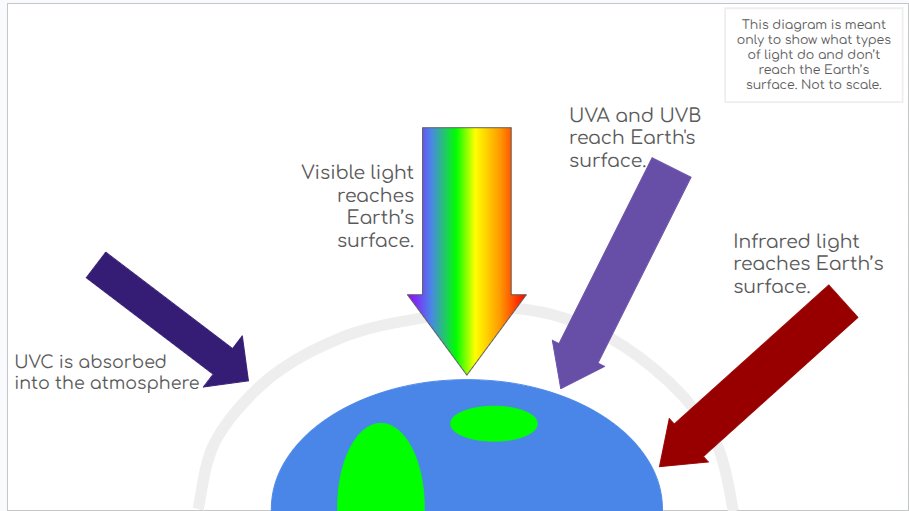 this one was made by me. ^
Conclusion
In conclusion there are a variety of different colours of light, and they’re only part of the whole electromagnetic spectrum. Infrared light, at 700 nm - 1µm is invisible to the human eye and does not have many benefits for the brain however it is good for the body. Red light, at 600 nm - 750 nm can improve mental health and sleep because it doesn’t impact the circadian rhythm. Orange light, at 585 nm - 620 nm improves alertness and cognitive brain function. Yellow light, at 570 nm - 600 nm has lots of benefits including reduced eye fatigue, relaxation, increased mood, and increased cognitive ability. Green light, at 495 nm - 570 nm is good for when you have migraines because it can reduce migraine severity. Green light also helps with SAD and increases brain connectivity. Blue light, at 380 nm - 510 nm is the primary influence for the circadian rhythm however blue light can harm you by increasing eye strain, potentially shortening lifespan, but also increase alertness and memory. Indigo light, at 420 nm - 450 nm allows you to remember and store information better as well as allow you to be a little bit more relaxed. Violet light, at 380 nm - 450 nm can help regulate your circadian rhythm, mood, and cognition. Violet light also helps with sleep and glucose levels. UV light, at 10 nm - 400 nm is also invisible to the human eye is good for mood regulation, depression reduction, healthy body function, and making you smarter. It can also harm your skin though. White light contains mostly blue light and has most of the same impacts of blue light. Same goes for LED light which is a form of white light. Incandescent light has less blue light than LED light but is also a form of white light. Sunlight has every colour of the light spectrum and is the most healthy light you can expose yourself to. Light can also impact the brain by causing pain if you have photophobia. Overall there are ways that light is good for the brain and also bad for the brain, but one thing is for sure, the good things light does for you exceed the bad and keep you healthy and happy. The best thing you can do for yourself is expose yourself to sunlight and the spectrum.
Citations
A guide to the spectrums of light. Healthlighting. (n.d.). https://healthlighting.com/blogs/lighting-guide/guide-to-the-spectrum-of-light?srsltid=AfmBOopBfQw_zOOuk3Y72fo7Q1GiIDN4JQvM1dk5H8Pkcaar99CKhi5-
Merriam-Webster. (n.d.). Synthesis definition & meaning. Merriam-Webster. https://www.merriam-webster.com/dictionary/synthesis
C. C. medical. (2025, November 14). Endorphins: What they are and how to boost them. Cleveland Clinic. https://my.clevelandclinic.org/health/body/23040-endorphins
Mills, B. (2021, March 11). How does light exposure affect memory?. Alzheimer’s Drug Discovery Foundation. https://www.alzdiscovery.org/cognitive-vitality/blog/how-does-light-exposure-affect-memory
Wavelength | definition\, formula\, & symbol | britannica. Britannica. (2025\, November 21). https://www.britannica.com/science/wavelength
CK12-Foundation. (n.d.). https://flexbooks.ck12.org/cbook/ck-12-middle-school-physical-science-flexbook-2.0/section/16.6/primary/lesson/wavelength-ms-ps/
Admin. (2018, May 19). What is wavelength? explained in plain English with an illustration. Quantum Physics Lady. https://quantumphysicslady.org/glossary/wavelength/
Nash, T. R., Chow, E. S., Law, A. D., Fu, S. D., Fuszara, E., Bilska, A., Bebas, P., Kretzschmar, D., & Giebultowicz, J. M. (2019, October 17). Daily Blue-light exposure shortens lifespan and causes brain neurodegeneration in drosophila. Nature News. https://www.nature.com/articles/s41514-019-0038-6
Romocean, M. (2025, November 26). The psychological impact of Light & Color: TCP Lighting Solutions. TCP Lighting. https://www.tcpi.com/psychological-impact-light-color/
Merced, A. D. L. (2024, April 9). Light pollution: How it affects the brain. Remedy Psychiatry, Inc. https://remedypsychiatry.com/light-pollution-how-it-affects-the-brain/
The hidden dangers of leds – and the healthiest type of home lighting. Conscious Spaces. (n.d.). https://consciousspaces.com/en-us/blogs/science/the-hidden-dangers-of-leds-and-the-healthiest-type-of-home-lighting
Colour - visible spectrum\, wavelengths\, hues | Britannica. (n.d.). https://www.britannica.com/science/color/The-visible-spectrum
Explanations. StudySmarter UK. (n.d.). https://www.studysmarter.co.uk/explanations/physics/waves-physics/spectral-colour/
Mixing colors of light - lesson. HelpTeaching.com - Free Printable K-12 Worksheets. (n.d.). https://www.helpteaching.com/lessons/1506/mixing-colors-of-light
Reproduction of Newton’s experiment for the DECOMPOSITION OF LIGHT: A detailed optical analysis | by Gabriel Borges Macedo | Medium. (n.d.-b). https://medium.com/@gabriel.macedo.brother/reproduction-of-newtons-experiment-for-the-decomposition-of-light-a-detailed-optical-analysis-9015a66883b1
Impact of domestic white LED light on cognitive functions and amelioration of blue light blocking lens (BBL) on healthy adults. Neurobiology of Sleep and Circadian Rhythms. (2025, May). https://www.sciencedirect.com/science/article/pii/S2451994425000082
Color: The world your brain creates. BrainFacts.org. (2025, November 10). https://www.brainfacts.org/thinking-sensing-and-behaving/vision/2025/color-the-world-your-brain-creates-111025#:\~:text=Colors%20aren’t%20a%20fixed,more%20limited%20range%20of%20color.
Isherwood, Z. J., Joyce, D. S., Parthasarathy, M. K., & Webster, M. A. (2020, November 13). Plasticity in perception: Insights from color vision deficiencies. Faculty reviews. https://pmc.ncbi.nlm.nih.gov/articles/PMC7886061/#:\~:text=Abstract,underlying%20how%20we%20experience%20color.
Mulligan, K. (2019, February 6). What do color blind people see?. EnChroma. https://enchroma.com/blogs/beyond-color/how-color-blind-see#:\~:text=Color%20Blindness%20Definition,than%20they%20are%20supposed%20to.
Dowd, B. (n.d.). I See, You See, We All See Differently!. CYSF. https://platform.cysf.org/project/0e41d5d7-2c6d-4aab-aef5-7d4bcf22732b/
What is color blindness? - zoomax low vision AIDS. Zoomax. (n.d.). https://zoomax.com/low-vision-information/what-is-color-blindness-.html
Ruberg, F. L., Skene, D. J., Hanifin, J. P., Rollag, M. D., English, J., Arendt, J., & Brainard, G. C. (n.d.). Melatonin regulation in humans with color vision deficiencies. The Journal of clinical endocrinology and metabolism. https://pubmed.ncbi.nlm.nih.gov/8768862/#:\~:text=In%201%20study%2C%2014%20red,for%20light%2Dmediated%20neuroendocrine%20regulation.
Melanopsin - an overview | sciencedirect topics. ScienceDirect. (n.d.). https://www.sciencedirect.com/topics/nursing-and-health-professions/melanopsin
Espejo, G. (2025, June 1). Guide to light color temperature. Casa Di Luce. https://www.casadiluce.ca/blogs/how-to/guide-to-light-color-temperature?srsltid=AfmBOooP8e0Pc9spe5vF4Epzz1OMqtr-7YnP9wRGcesWUZMxTJMphkTl
Colour temperature explained. Lights Canada. (n.d.). https://lightscanada.ca/blogs/news/colour-temperature-explained#:\~:text=Color%20temperature%20refers%20to%20the,cool%20(more%20blue%20tones).
Energy=light=radiation=temperature?. ESA. (n.d.). https://www.esa.int/Science_Exploration/Space_Science/Energy_light_radiation_temperature#:\~:text=Light%20and%20temperature&text=The%20wavelength%20of%20the%20light,of%20about%206000%C2%B0C.
What is lighting color temperature?. TCP Lighting. (2024, August 20). https://www.tcpi.com/what-is-lighting-color-temperature/
Light and headache disorders: Understanding light triggers and Photophobia. National Headache Foundation. (n.d.). https://headaches.org/blog/light-and-headache-disorders-understanding-light-triggers-and-photophobia/
What is the difference between LED and incandescent lighting?. Light Bulbs Unlimited. (2020, February 13). https://www.light-bulbs-unlimited.net/2020/02/01/what-is-the-difference-between-led-and-incandescent-lighting/
Incandescent light bulb. Incandescent light bulb - Energy Education. (n.d.). https://energyeducation.ca/encyclopedia/Incandescent_light_bulb
Screen Time and the developing brain: Research, benefits, risks, and policy. Brain Canada Foundation. (2025a, May 30). https://braincanada.ca/announcements/screen-time-and-the-developing-brain-research-benefits-risks-and-policy/#:\~:text=he%20key%20message%20from%20Dr,the%20teens%20coming%20into%20Dr.
Panda, S. (2024, January 25). What are circadian rhythms?. myCircadianClock Blog. https://blog.mycircadianclock.org/what-are-circadian-rhythms/
Patton, A. P., & Hastings, M. H. (2018, August 6). The suprachiasmatic nucleus. ScienceDirect. https://www.sciencedirect.com/science/article/pii/S0960982218308431#:\~:text=Summary,health%20of%20far%20greater%20scale.
Dunckley, V. L. (n.d.). What does screen time do to my brain?. Potsdam. https://www.potsdam.edu/studentlife/wellness/counseling-center/what-does-screen-time-do-my-brain
What does screen time do to my brain?. Potsdam. (n.d.). https://www.potsdam.edu/studentlife/wellness/counseling-center/what-does-screen-time-do-my-brain
How does melatonin work?. Cleveland Clinic. (2025, December 22). https://my.clevelandclinic.org/health/articles/23411-melatonin
Kritz, J. (2016, May 17). Green Light for Migraine Relief. Harvard Medical School. https://hms.harvard.edu/news/green-light-migraine-relief
Martin, L. F., Cheng, K., Washington, S. M., Denton, M., Goel, V., Khandekar, M., Largent-Milnes, T. M., Patwardhan, A., & Ibrahim, M. M. (2023, March). Green Light Exposure Elicits Anti-inflammation, Endogenous Opioid Release and Dampens Synaptic Potentiation to Relieve Post-surgical Pain. ScienceDirect. https://www.sciencedirect.com/science/article/pii/S1526590022004370
Mayo Foundation for Medical Education and Research. (n.d.). Seasonal affective disorder (SAD). Mayo Clinic. https://www.mayoclinic.org/diseases-conditions/seasonal-affective-disorder/symptoms-causes/syc-20364651
Argilés, M., Sunyer-Grau, B., Arteche-Fernandez, S., & Peña-Gómez, C. (2022, September 28). Functional connectivity of brain networks with three monochromatic wavelengths: A pilot study using resting-state functional magnetic resonance imaging. PubMed Central. https://pmc.ncbi.nlm.nih.gov/articles/PMC9519584/
Light | definition\, properties\, physics\, characteristics\, types\, & facts | britannica. Britannica. (n.d.). https://www.britannica.com/science/light
Slominski, A. T., Zmijewski, M. A., Plonka, P. M., Szaflarski, J. P., & Paus, R. (n.d.). How UV light touches the brain and endocrine system through skin, and why. Endocrinology. https://pmc.ncbi.nlm.nih.gov/articles/PMC5905393/
Zhu, H., Wang, N., Yao, L., Chen, Q., Zhang, R., Qian, J., Hou, Y., Guo, W., Fan, S., Liu, S., Zhao, Q., Du, F., Zuo, X., Guo, Y., Xu, Y., Li, J., Xue, T., Zhong, K., Song, X., … Xiong, W. (2018, June 14). ScienceDirect. https://www.sciencedirect.com/science/article/pii/S0092867418305075
Parvatam, S. (2018, June 26). How getting some sun can improve learning and memory. BioTechniques. https://www.biotechniques.com/drug-discovery-development/how-getting-some-sun-can-improve-learning-and-memory/#:\~:text=A%20new%20study%20published%20in,require%20four%20rounds%20of%20training.%E2%80%9D
Comparing natural light and artificial light. Sunlight Inside. (n.d.). https://www.sunlightinside.com/light-and-health/natural-light-vs-artificial-light/#
Orange light helps thinking. Science Learning Hub. (n.d.). https://www.sciencelearn.org.nz/resources/2290-orange-light-helps-thinking
Cadena, V. (2014, June 1). Shedding (orange) light on to Cognitive Brain Function. The Company of Biologists . https://journals.biologists.com/jeb/article/217/11/1836/12130/Shedding-orange-light-on-to-cognitive-brain
Yellow vs white lighting: Mood, health, productivity. BenQ. (2024, May 27). https://www.benq.com/en-us/knowledge-center/knowledge/yellow-lighting-vs-white-lighting.html
Blackstock, J. (2025, February 20). The Psychology of Yellow: Illuminating the Mind, Empowering the Self. Taproot Therapy Collective. https://gettherapybirmingham.com/the-psychology-of-yellow-illuminating-the-mind-empowering-the-self/
Centers for Disease Control and Prevention. (n.d.). The color of the light affects the circadian rhythms. Centers for Disease Control and Prevention. https://archive.cdc.gov/www_cdc_gov/niosh/emres/longhourstraining/color.html
Summer, J. V., & Adavadkar, P. (2025, July 11). What color light helps you sleep?. by Sleep Doctor. https://www.sleepfoundation.org/bedroom-environment/what-color-light-helps-you-sleep
Electromagnetic spectrum | definition\, diagram\, & uses | britannica. Britannica. (n.d.). https://www.britannica.com/science/electromagnetic-spectrum
Infrared radiation. ICNIRP. (n.d.). https://www.icnirp.org/en/frequencies/infrared/index.html
Klein, C. (2019, December 12). Infrared radiation and infrared spectroscopy. Thermo Fisher Scientific . https://www.thermofisher.com/blog/materials/all-about-infrared-radiation-and-spectroscopy/#:\~:text=The%20infrared%20range%20covers%20700%2D1000,100%20to%20400%20nm%20(wavelength).
Tsai, S.-R., & Hamblin, M. R. (2018, May 1). Biological effects and medical applications of infrared radiation. Journal of photochemistry and photobiology. B, Biology. https://pmc.ncbi.nlm.nih.gov/articles/PMC5505738/
Project E Beauty. (2025, May 9). Understanding red light therapy wavelengths. Project E Beauty. https://www.projectebeauty.com/blogs/news/understanding-red-light-therapy-wavelengths-3?srsltid=AfmBOoqCSHFru1MVvQKT_KN33uggD-KUxzWDQ8YB1wHFq_qapUzzJb_V
Red Light Wavelength explained. Joovv. (2025, October 6). https://joovv.com/blogs/joovv-blog/red-light-wavelength?srsltid=AfmBOoorG2tG3LPSp_uNlcege2-K30O0zm06jbPmctae0Dv9D1PUsRT5
Center for Science Education. Wavelength of Blue and Red Light | Center for Science Education. (n.d.). https://scied.ucar.edu/image/wavelength-blue-and-red-light-image
Kelley\, T. (n.d.). Orange | description\, etymology\, & facts | britannica. Britannica. https://www.britannica.com/science/orange-color
Lumitex, LLC. All Rights Reserved. (2018, April 19). Visible light spectrum: From a lighting manufacturer’s perspective. Lumitex. https://www.lumitex.com/blog/visible-light-spectrum
Yellow | description\, etymology\, & facts | britannica. Britannica. (n.d.-b). https://www.britannica.com/science/yellow-color
Klein, E. M. (n.d.). Effects of green light on Biological Systems. U.S. National Library of Medicine. https://pubmed.ncbi.nlm.nih.gov/1498206/
Visual spectrum, color. Jack Westin. (n.d.). https://jackwestin.com/resources/mcat-content/light-and-electromagnetic-radiation/visual-spectrum-color
Wavelength of Blue and Red Light. Center for Science Education. (n.d.). https://scied.ucar.edu/image/wavelength-blue-and-red-light-image
What is blue light?. Block Blue Light. (n.d.). https://www.blockbluelight.com/pages/what-is-blue-light?srsltid=AfmBOoq4a6DNhGgrR9KuLmLyF2nDz5t6vypjU44oanBUf-1-a8Ia9Kkv
Kelley\, T. (n.d.-b). Violet | description\, etymology\, & facts | britannica. Britannica. https://www.britannica.com/science/violet
Helmenstine, A. M. (2025, June 10). The Visible Spectrum: Wavelengths and Colors. ThoughtCo. https://www.thoughtco.com/understand-the-visible-spectrum-608329
Ultraviolet (UV) Radiation. UCAR Center for Science Education. (n.d.). https://scied.ucar.edu/learning-zone/atmosphere/ultraviolet-uv-radiation
World Health Organization. (2016, March 9). Radiation: Ultraviolet (UV) radiation. World Health Organization. https://www.who.int/news-room/questions-and-answers/item/radiation-ultraviolet-(uv)
Visible light. Physics and Radio Electronics. (n.d.). https://www.physics-and-radio-electronics.com/physics/electromagnetic-spectrum/visible-light.html#google_vignette
Blackstock, J. (2025, February 20). Indigo: The Color of Insight, Intuition and Inner Vision. Taproot Therapy. https://gettherapybirmingham.com/indigo-the-color-of-insight-intuition-and-inner-vision/
Cherry, K. (2025, October 29). What Are Alpha Brain Waves?. Verywell Mind. https://www.verywellmind.com/what-are-alpha-brain-waves-5113721
Larson, J. (2020, July 1). Theta brain waves: Frequency, sleep, binaural beats, and more. Healthline. https://www.healthline.com/health/theta-waves
Hayano, M., Gusain, P., Robertson, S., Mitsukura, Y., & Tsubota, K. (2023, June). Violet light modulates the central nervous system to regulate memory and mood. Arvo Journals. https://iovs.arvojournals.org/article.aspx?articleid=2790376
Kato, T., & Mitsukura, Y. (2025, August 1). Violet light could improve sleep quality and blood glucose levels in healthy individuals: A pilot study. PLOS ONE. https://journals.plos.org/plosone/article?id=10.1371%2Fjournal.pone.0314346
Sasaki, N., Gusain, P., Hayano, M., Sugaya, T., Tonegawa, N., Hatanaka, Y., Tamura, R., Okuyama, K., Osada, H., Ban, N., Mitsukura, Y., Lang, R. A., Mimura, M., & Tsubota, K. (2021, November 4). Violet light modulates the central nervous system to regulate memory and mood. bioRxiv. https://www.biorxiv.org/content/10.1101/2021.11.02.466604v1.full
Visible light spectrum: From a lighting manufacturer’s perspective. Lumitex. (2018b, April 19). https://www.lumitex.com/blog/visible-light-spectrum
Westland, S. (2012, February 25). What colour is Indigo?. Colourchat. https://colourware.org/2012/02/25/what-colour-is-indigo/
Acknowledgement
I would like to acknowledge my mom for helping me out and being my biggest supporter. I would like to acknowledge my dad for providing me with a few websites. I want to acknowledge Mrs. Offord for being our coordinator and providing helpful advice. I want to acknowledge my friends Ananya, Saffron, and Navkirat for being supportive of me.