
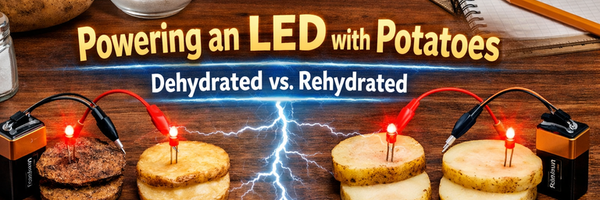
Rehydrating the Dehydrated - Can Rehydrated Potatoes Conduct Electricity?
Dilan Makwana, Rudra Patel
FFCA High School Campus
Grade 9
Presentation
No video provided
Hypothesis
If a potato is dehydrated, and then rehydrated in tap water with salt, and then connected to a simple circuit with a battery and an red LED, the LED will turn on due to the potato allowing electrons to flow just like a normal potato would because the water that goes back into the dehydrated potato restores a pathway for electrical current.
Research
ChatGPT was used to: figure out which colour LED to use, how to dehydrated a 4 mm potato slice, how to rehydrate a dehydrated potato slice in saltwater, what ratio of salt to water to use. Every site that ChatGPT sourced was checked to confirm accuracy. All other knowledge needed for this project was obtained from our own reasoning.
Variables
Controlled Variables - voltage of the battery\, conductivity of the wires Manipulated Variable - water content of the potato Responding Variable - brightness of the red LED
Procedure
-
Gather all the materials:
-
One russet potato
- One knife
- One potato peeler
- One small bowl
- ¼ cups of tap water
- One tablespoon of salt
- Four breadboard wires
- One 9V battery
- ¾ teaspoons of salt
- One red LED
- ¼ teaspoon measuring spoon
- One roll of invisible tape
- One ruler
- One pencil
- ¼ cups measuring cup
- One electric scale
- One notebook
- One plate
- 20 paper towels
- One microwave
- One timer (phone app)
-
One smartphone equipped with a camera capable of capturing long exposure photographs
-
Completely peel the russet potato with the potato peeler
- Slice the russet potato into 4 mm thick slices with the knife
- Rinse each sliced potato under lukewarm tap water
- Pat each slice of potato down with a paper towel until dry
- Leave the potato slices on a fresh paper towel
- Place one paper towel on the plate
- Put one slice of potato on the paper towel
- Place one paper towel on the slice of potato
- Place the plate, along with the things on it, into the microwave
- Run the microwave at 40% power for one minute
- Take the plate and its contents out of the microwave
- Replace both paper towels with new ones
- Put the used paper towels in the appropriate waste collection bin
- Repeat steps 10-12 six more times
- Put the used paper towels in the appropriate waste collection bin
- Measure the weight, length, width and thickness of the dehydrated potato using the scale and the ruler
- Write the measurements in the notebook under a header labeled “Dehydrated Potato”
- Put 250 mL of lukewarm tap water into the small bowl
- Dissolve ¾ teaspoons of salt into the water by stirring
- Place the dehydrated potato into the saltwater
- At the same time, start a 30 minute timer
- Take the dehydrated potato out of the bowl once the timer ends
- Measure the length, width and thickness of the dehydrated potato using the ruler
- Write the measurements in the notebook under a header labeled “Dehydrated Potato”
- Measure the length, width and thickness of a normal potato slice using the ruler
- Write the measurements in the notebook under a header labeled “Normal Potato”
- Cut the dehydrated potato and one normal potato slice in half along the short edge
- Place all four pieces on a new paper towel, making sure they don’t touch
- Tape two wires to the positive and negative terminals of the 9V battery
- Stick the other ends of the wires into the two normal potato halves, one in each.
- Put the red LED into the potatoes, the short end into the potato with the wire going into the negative terminal of the battery and long end into the potato with the wire going into the positive terminal of the battery. Use tape to hold the wires in place on the battery if necessary.
- Observe if the LED is on or not
- Using the phone camera, take a 10 second long exposure photograph of the circuit and a normal exposure picture
- Disconnect the LED and the wires from the two potato halves
- Insert one wire into one half of the dehydrated potato
- Insert one wire into the other half of the dehydrated potato
- Put the red LED into the potatoes, the short end into the potato with the wire going into the negative terminal of the battery and long end into the potato with the wire going into the positive terminal of the battery.
- Observe if the LED is on or not
- Using the phone camera, take a 10 second long exposure photograph of the circuit and a normal exposure picture
- Disconnect the LED and the wires from the two potato halves
- Dispose of the four potato halves in the appropriate waste container
- Dispose of the salt water in the bowl into the sink
- Return all remaining materials to the appropriate place
Observations
After rehydrating, the dehydrated potato got one mm thicker and 0.5 cm wider. After rehydrating, the dehydrated potato felt like human skin. The LED glowed brighter when the electricity passed through the rehydrated potato. The LED glowed when the electricity was passed through the normal potato and the rehydrated potato.
Analysis
What caused the dehydrated LED to be brighter? The LED glowed brighter when the electricity was passed through the rehydrated potato because of the added salt and water content. When rehydrating, the potato collected more water than it had before dehydrating. More water means that it conducts better. This is paired with the salt in the water. The salt is dissolved into ions which carry electrical current. These two are paired to lower the natural resisting force of the potato. Why do potatoes conduct electricity, and what does water content have to do with it? Potatoes are approximately 80% water, and the rest is minerals and starches. This causes them to conduct electricity relatively well because the water acts as a medium for electrons to flow through. Without the water, the potato would not be able to conduct. When salt was added to the water, it conducted even better because it formed an electrolyte solution within the potato. Naturally, potatoes are semiconductors. How does the flow of electrons in a potato compare to a simple metallic conductor? Both potatoes and metallic conductors can have electrons flow through them, but they do it in two different ways. In a metal, conduction occurs through a vast array of loose valence electrons that move freely. The current moves through these electrons, flowing from the negative terminal to the positive terminal. In a potato, however, electricity flows through ions. The potato acts as an electrochemical cell, with water dissolving minerals into ions which pass the flow of electrons. The ions conduct much slower, which is why potatoes have a much higher resistance than a copper wire, for example.
Conclusion
To conclude, the hypothesis was proved to be correct. When the potato was dehydrated, it lost its electrical conductivity. When it was rehydrated with saltwater, the salt ions and the water worked together to restore a pathway for the electrons. In the end, it can be confidently said that it is possible to dehydrate, and then rehydrate a potato slice to restore an electrical pathway to reach an LED.
Application
A dehydrated potato cannot conduct electricity due to its lack of water. When you reintroduce water and minerals to the potato, it is able to conduct again. The potato can be compared to human muscle tissue. If it doesn't get enough water, it will not function as well as it could. When given enough water, it can work at its full potential. This project proves the importance of hydration in the human body. The water in muscles contains sodium and potassium ions, which conduct small amounts of electricity to contract and relax your muscles. When you don't drink enough, your body has to pull water from your muscles and put it in your blood, essentially dehydrating them. There isn't a good enough pathway for electricity to contract your muscle, so it weakens. This project is a great simplification of why we should drink enough water every day for those who refuse to understand the importance of it.
Sources Of Error
The method used for dehydration most likely didn't only remove water. A microwave was used to agitate the water molecules in the potato and the water came out onto the paper towel. This method heats the potato and slightly cooks it. While doing the experiment, it is assumed that the potato has only been dehydrated, and nothing else has changed about it. This can be avoided by using a proper dehydrator, which is designed to dehydrate without changing anything else. When inserting the wires into the potato slices, the amount that the wires contact the potato is not measured. This affects the strength of the electricity getting to the LED. The normal potato's LED may have glowed brighter if more of the wire made contact with the potato. The same can be said about the distance between the wire from the battery and the LED prongs. A shorter distance means a lower resistance, resulting in a brighter glow. It is impossible to get both areas of contact and distance between wires to be the exact same, but a ruler can be used to be more accurate. The same wires were used with both the rehydrated potato and the normal potato. Residue from each potato left on the wire could affect the resulting brightness.
Citations
OpenAI. (2025, September 12). ChatGPT. Chatgpt.com; OpenAI. https://chatgpt.com No other sources were used for information. This sentence is to hit the character limit to save this section on the CYSF platform.
Acknowledgement
We would like to acknowledge Ms. Fan for letting us join this science fair late. If it weren't for her generosity, we wouldn't have been able to do this. We would also like to thank Dilan's dad for giving tips and advice on how to properly execute the experiment, and to our peers, especially Jonah Lam and Kaiden Manji, for reminding us that we had the oppourtunity to join the science fair this year.