
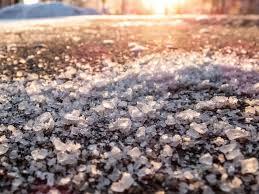
The Effects of Road Salt on Ecosystems and City Infrastructure
Julianna Hung, Tram Do
John G. Diefenbaker High School
Grade 11
Presentation
No video provided
Problem
Road salt is a ubiquitous sight during Canadian winters. When freezing temperatures and high amounts of snow contribute to dangerously slippery roads and sidewalks, road salts increase traction and improve road safety by lowering the freezing point of water, therefore decreasing the amount of ice buildup. Sodium chloride is a commonly used road salt within Canadian cities such as Calgary due to its affordability and accessibility. However, while much attention is paid to the benefits of road salt on road de-icing, there is much less awareness of the negative impacts of road salt practices on ecosystems and city infrastructure, which this investigation seeks to explore through the research questions below:
How does the use of sodium chloride to de-ice roads during winter affect the ecosystems and infrastructure of Canadian cities? What are possible road salt alternatives?
Method
Through research of the previous scientific literature, this investigation will explore how road salt practices affect local ecosystems by considering the biological impacts of excess chloride on organisms in addition to the effects on soil chemistry. Additionally, this investigation will consider the corrosive nature of road salt and its impacts on infrastructure, and discuss the relationship between road salt and the catastrophic Bearspaw water main breaks of 2024 and 2025. Furthermore, this investigation will compare the winter road salt policies of different Canadian municipalities, and consider the advantages and disadvantages of different road salt alternatives.
Research
Effects of Road Salt on Ecosystems:
Road salts, primarily sodium chloride, are widely used to melt ice on winter roads, but they can have serious environmental impacts. When snow and ice melt, the dissolved salt runs off into nearby soil, rivers, and lakes, increasing salinity levels. This can harm freshwater organisms that are not adapted to salty conditions, disrupt aquatic ecosystems, and reduce biodiversity. In soil, road salt can damage plant roots, hinder water absorption, and cause leaf burn, weakening or killing roadside vegetation. Additionally, salt can contaminate groundwater and corrode infrastructure, leading to long-term environmental and economic consequences.
Effects of Road Salt on City Infrastructure:
The most common road salts are sodium chloride (NaCl), magnesium chloride (MgCl2), and calcium chloride (CaCl2). The chlorides within these salts make them corrosive, causing extensive damage to roadways and water infrastructure. Calgary uses around 40,000-50,000 tonnes of road salt annually, causing a significant rise in soil chloride levels, corroding critical water infrastructure. According to an independent report on the Calgary Bearspaw South Feeder main break in 2024, road de-icing practices, in addition to a variety of other factors, contributed to “chemically aggressive soil conditions” which made the feeder main especially vulnerable to corrosion.
A Comparison of Road Salt Policies in Different Canadian Cities
Calgary: Calgary uses a mix of sand and salt known as pickle, which is 97% gravel and 3% salt when temperatures are below -5C and temperatures are expected to fall further. If temperatures are expected to remain constant between 0 and -14 C, salt is primarily used, while sand/pickle is used when temperatures below -15C.
Toronto: Toronto developed a Salt Management Plan in 2001 in response to concerns about the negative impacts of excessive road salt usage. As part of the plan, Toronto implemented an employee training program, which helped reduce road salt usage by 37,000 tonnes over two winter periods.
Cowansville (Quebec): Prior to snowfall, a mixture of beet juice and salt is sprayed on roads. This mixture is more effective than only using sodium chloride, as the mixture performs better in colder temperatures and lasts longer. Additionally, the beet juice mixture reduces costs, reduces infrastructure corrosion and is better for the environment.
Alternatives to Sodium Chloride:
Calcium Magnesium Acetate: Calcium magnesium acetate is another alternative that is less damaging to the environment than sodium chloride. It works by preventing ice from bonding to pavement rather than simply melting it. It is less corrosive to vehicles and infrastructure and has a lower impact on soil and freshwater ecosystems. While it is generally safer for plants and aquatic organisms, it is more expensive and can require larger quantities for effective deicing, which limits its widespread use. Additionally, it is most effective in temperatures above -5∘C and has to be used in significant amounts, which poses an additional obstacle.
Beet juice: Beet juice is an eco-friendlier alternative to traditional road salt because it lowers the freezing point of water. Often mixed with brine, beet juice reduces the total amount of salt needed and minimizes runoff into nearby soil and waterways. It is biodegradable and less harmful to plants and aquatic life compared to pure sodium chloride, though it can still contribute some organic runoff. Overall, beet juice is considered a more sustainable option for winter road maintenance.
Data
The data and statistics used within this investigation are referenced in the citations. Data on the road salt practices of Calgary comes from the city's websites on winter road management and frequently asked questions.
Conclusion
While use of sodium chloride to de-ice roads significantly improves road safety due to increased traction, there are also many negative impacts. Sodium chloride causes significant environmental harm by increasing soil and water salinity, killing many organisms that cannot tolerate the elevated levels of chloride. Furthermore, excessive chloride levels introduced by road salt practices cause corrosion, which damages critical infrastructure. While sodium chloride is the most commonly used road salt in road de-icing due to its affordability and accessibility, there are many varying approaches to winter road de-icing. Additionally, there are many alternatives to sodium chloride such as calcium magnesium acetate and beet juice.
Citations
Brendan, F. (2017, September 14). Road salt — a costly way to fight winter. Canada’s Ecofiscal Commission. https://ecofiscal.ca/2017/04/26/road-salt-costly-way-fight-winter/#:\~:text=Toronto's%20salt%20management%20plan%20outlines,expensive)%20until%20costs%20come%20down
City of Calgary. (2021). Snow and ice Control Annual Report (2020/2021). https://www.calgary.ca/content/dam/www/transportation/roads/documents/road-maintenance/snow-and-ice-control/snow-and-ice-control-annual-report-2020-2021.pdf
City of Calgary. (2022). Snow and ice control annual report. In City of Calgary. https://www.calgary.ca/content/dam/www/transportation/roads/documents/road-maintenance/snow-and-ice-control/snow-and-ice-control-annual-report-2021-2022.pdf
Cwhc. (2018, February 17). A salt on wildlife health: The environmental impacts of road salt. Healthy Wildlife - the Blog of the CWHC. https://healthywildlife.ca/salt-wildlife-health-environmental-impacts-road-salt/#:\~:text=Chloride%20Rising,become%20toxic%20to%20aquatic%20wildlife
Dindorf, C., Fortin, C., Fortin Consulting, Inc., Asleson, B., Erdmann, J., & Minnesota Pollution Control Agency. (2014). THE REAL COST OF SALT USE FOR WINTER MAINTENANCE IN THE TWIN CITIES METROPOLITAN AREA. In Fortin Consulting, Inc. Economic Analysis of Salt Use [Report].
Government of Canada. (2017, September 10). Success in road salts management: case studies. Environment and Climate Change Services. https://www.canada.ca/en/environment-climate-change/services/pollutants/road-salts/success-management-case-studies.html
Hinsdale, J. (2023, January 6). How road salt harms the environment. State of the Planet. https://news.climate.columbia.edu/2018/12/11/road-salt-harms-environment/
Houska, C. & TMR Consulting. (n.d.-b). Deicing Salt – Recognizing The Corrosion Threat. IMOA. https://www.imoa.info/download_files/stainless-steel/DeicingSalt.pdf
Kiefer, S., Crothers, M. J., Engbloom, G. M., Foster, N. F., Kerr, B. B., Stanley, S., & Bearspaw South Feedermain Independent Review Panel. (2026). Bearspaw South FeederMain Independent Review Panel: Final report. In The City of Calgary. https://www.calgary.ca/content/dam/www/emergencies/files/feedermain-review-final-report.pdf
Lawlor, M., Md. Masud Rana, & Hossain, K. (2023). An investigation on corrosivity of road salt and alternatives on steel. In Paper Prepared for Presentation at the of the MO - Innovations in Summer and Winter Maintenance Session (pp. 1–17). https://www.tac-atc.ca/wp-content/uploads/an_investigation_on_corrosivity_of_road_salt_and_alternatives_on_steel.pdf
Pieper, K. J., Tang, M., Jones, C. N., Weiss, S., Greene, A., Mohsin, H., Parks, J., & Edwards, M. A. (2018). Impact of road salt on drinking water quality and infrastructure corrosion in private wells. Environmental Science & Technology, 52(24), 14078–14087. https://doi.org/10.1021/acs.est.8b04709
Road salt management plan. (n.d.). https://www.calgary.ca. https://www.calgary.ca/roads/conditions/snow-ice-salt.html
Rollin, J. (2024, April 8). What type of salt is used on roads? Ninja De-Icer. https://ninjadeicer.com/blogs/resources/common-types-of-road-salt
Said, A. (2025, November 27). Sodium chloride use continues on Calgary roads after likely contributing to 2024 water main break. CBC. https://www.cbc.ca/news/canada/calgary/road-salt-calgary-bearspaw-south-feeder-main-9.6993387
Salt: A Substance that eats through our infrastructure and budgets. (2025, July 17). Rescue Lake Simcoe Coalition. https://rescuelakesimcoe.org/2025/07/17/salt-a-substance-that-eats-through-our-infrastructure-and-budgets/
Szklarek, S., Gorecka, A., & Wojtal-Frankiewicz, A. (2021). The effects of road salt on freshwater ecosystems and solutions for mitigating chloride pollution- a review. ScienceDirect.
Tenneti, A. (2022, December 17). Looking into Road Salt Use, Harms, and Alternatives. NiCHE.https://niche-canada.org/2022/12/19/looking-into-road-salt-use-harms-and-alternatives/
Winter is Coming! And with it\, tons of salt on our roads | US EPA. (2025\, November 25). US EPA. https://www.epa.gov/snep/winter-coming-and-it-tons-salt-our-roads
Winter Maintenance FAQ. (n.d.). https://www.calgary.ca. https://www.calgary.ca/roads/conditions/snow-ice-faqs.html#:\~:text=When%20road%20surfaces%20are%20below,in%20temperatures%20below%20%2D15%20C
Acknowledgement
We would like to acknowledge the support of our teachers, friends, and family. Additionally, we would like to acknowledge the dedication of the organizers of the Diefenbaker Science Fair Club and thank them for providing us with this opportunity.