
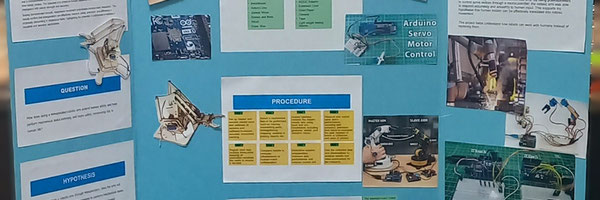
Teleoperated Cobot Arm for Human Augmentation
Eshan Siddiqui
Glamorgan School
Grade 6
Presentation
No video provided
Problem
Across many industries—including manufacturing, construction, healthcare, disaster response, and hazardous material handling—humans are required to perform mechanical tasks that expose them to significant physical and environmental risks. These tasks may involve operating heavy machinery, lifting substantial loads, working in confined or unstable spaces, or entering environments contaminated by heat, chemicals, radiation, or toxic substances. Such conditions increase the likelihood of injury, long-term health complications, fatigue-related errors, and in extreme cases, loss of life. Beyond environmental dangers, human physical limitations also restrict strength, endurance, and precision over extended periods of work. Fatigue can reduce accuracy and reaction time, increasing the probability of mistakes during delicate or high-risk operations. While fully automated robotic systems can perform repetitive tasks efficiently, they often lack the adaptability, judgment, and real-time decision-making abilities that humans provide. Many complex mechanical tasks still require human control, problem-solving, and situational awareness. Therefore, a gap exists between human capability and environmental safety. There is a need for a system that preserves human intelligence and control while removing the human body from direct exposure to danger. A teleoperated robotic arm offers a potential solution by allowing an operator to remotely control mechanical movements with precision, strength, and consistency. By combining human cognition with robotic power and durability, such a system could extend human ability, improve task performance, and significantly reduce risk to human life.
Method
-
Research Methods
-
Measure ease of control for the human operator through feedback and observation, noting how smoothly and accurately the system responds to human movements.
-
Record safety outcomes by identifying any potential risks or hazards that were avoided while using teleoperation.
-
Repeat each trial multiple times to ensure consistency and reliability of the results.
-
Analyze the collected data to determine effectiveness of human–robot collaboration in improving task performance and reducing human risk.
Analysis
In modern society, mechanical and industrial tasks remain essential for infrastructure development, manufacturing, medical procedures, disaster response, and hazardous material management. However, many of these tasks place humans in environments that present serious physical and environmental risks. Workers may be exposed to extreme heat, toxic chemicals, radiation, high-voltage systems, unstable structures, or heavy moving machinery. Even in less extreme conditions, repetitive mechanical labor can lead to muscular strain, joint damage, fatigue, and long-term occupational injuries. These risks highlight a persistent global challenge: how to maintain human control and intelligence in mechanical operations while minimizing direct exposure to danger. Human capability, although highly adaptable and intelligent, is biologically limited. Humans experience fatigue, reduced precision over time, and vulnerability to environmental hazards. When performing high-risk mechanical tasks, even a small lapse in concentration can result in equipment damage, injury, or loss of life. Additionally, in emergency scenarios such as natural disasters or industrial accidents, certain environments may be completely inaccessible or unsafe for human entry. This creates a critical operational gap: tasks must be performed, yet human presence may significantly increase risk. Automation has partially addressed this issue. Fully autonomous robotic systems are capable of executing repetitive and pre-programmed tasks with high efficiency. However, these systems often lack contextual understanding, ethical judgment, and real-time adaptability in unpredictable situations. Many mechanical operations require human decision-making, situational awareness, and fine motor control that cannot be fully replicated by pre-programmed automation alone. Thus, relying solely on either human labor or full automation presents limitations. This gap between human intelligence and environmental safety forms the core problem. A system is needed that preserves human cognitive control while transferring physical execution to a machine capable of withstanding hazardous conditions. Teleoperation presents a viable solution to this challenge. By allowing a human operator to remotely control a robotic mechanism, teleoperation combines human reasoning and adaptability with robotic strength, endurance, and environmental resistance. A teleoperated robotic arm, in particular, has the potential to significantly extend human capability. It can replicate arm movements with precision while operating at a safe distance from danger. Such a system reduces the likelihood of direct physical harm, minimizes fatigue-related errors, and allows tasks to be completed in environments that would otherwise be inaccessible. Furthermore, this approach bridges the gap between full autonomy and manual labor, creating a collaborative model where the robot acts as an extension of the human operator. Therefore, the central problem is not simply the existence of dangerous mechanical tasks, but the lack of systems that effectively integrate human intelligence with mechanical strength while maintaining safety. Addressing this issue could improve workplace safety standards, reduce occupational injuries, and expand the range of environments in which humans can safely operate. Developing and testing a teleoperated robotic arm is a step toward solving this broader engineering and human-safety challenge.
Conclusion
In conclusion, this project successfully demonstrated that a teleoperated cobot arm can accurately replicate human movement in real time. Using potentiometers to capture human joint positions and a microcontroller to control servo motors, the robotic arm responded smoothly and reliably, supporting the hypothesis that human motion can be effectively translated into robotic movement. The project shows how robots can work collaboratively with humans rather than replacing them. Acting as an extension of the human operator, the cobot arm can enhance physical capabilities, perform tasks in hazardous or physically demanding environments, and reduce risk to human life. This system highlights the potential of human-robot collaboration to improve safety, increase precision, and extend human ability in industrial, medical, or assistive applications, demonstrating a practical approach to solving real-world mechanical and safety challenges. Moreover, it provides a foundation for further research into more advanced teleoperation, such as incorporating force feedback, wireless control, and AI-assisted movement prediction, which could make robotic systems even more responsive, intuitive, and useful across a wider range of tasks. Ultimately, this project illustrates how integrating human intelligence with robotic power can create safer, more efficient, and highly adaptable solutions for the challenges of modern work and everyday life.
Citations
Universal Robots – What is a Cobot? https://www.universal-robots.com/
RoboHub – Teleoperation in Robotics https://robohub.org/
IEEE Xplore https://ieeexplore.ieee.org/document/844887
RoboTurk https://roboturk.stanford.edu/multiarm
Science News Explores https://www.snexplores.org/article/teaching-robots-right-wrong – Robots in Industry
YouTube – Introduction to Cobots
Book: Robots for Kids: Exploring New Technologies for Learning
Acknowledgement
I would like to express my sincere gratitude to all the individuals, institutions, and resources that contributed to the successful completion of this project. First, I thank my teachers and mentors for their guidance, advice, and encouragement throughout the development of this project. Their insights helped me refine my design, testing methodology, and analysis. I also acknowledge the authors and researchers whose work provided valuable background information and inspiration for this project, including studies on teleoperated robotic arms, human–robot collaboration, and collaborative robotics systems (Junge & Hughes, 2025; Wang et al., 2024; Zhang et al., 2023; Patil et al., 2023). Their research helped shape my understanding of teleoperation principles and human augmentation. Finally, I would like to thank the online platforms, technical documentation, and communities that offered guidance on Arduino programming, servo control, and robotics assembly. Their tutorials and forums were instrumental in helping me implement and troubleshoot my system. This project would not have been possible without the support, knowledge, and inspiration provided by these individuals and resources.